Showing posts with label Australian. Show all posts

Monday, May 12, 2014

12-May-14: Opting for humanity in an ocean of savagery

Syrian impact on Syrians: The Juret al-Shayah district
in Homs, Syria - April 2012 [Image Source]
As wars tend to do, the ongoing carnage in Syria provides insights into the nature of the combatants, of their friends and allies, of the news reporting industry, of the multilateral institutions that struggle to do something positive in the face of such hideously negative events.

As many (the estimates vary) as 150,000 human lives have been violently ended since the Syrian kill-frenzy began in early 2011, and many times that number have been severely impacted. More than 9 million Syrians (out of a total of 23 million) have been displaced, many of them fleeing their country for refuge elsewhere.

It's strongly arguable (though denied by the fighting parties themselves) that this is a war with a strongly religious foundation to it. It overwhelmingly involves Moslems: Shia groups side by side with mainly-Alawite government forces, backed by (Shia) Iranian technical, logistical and military support and with the involvement of (Shia) Hezbollah forces - all fighting to save the (Alawiteal-Assad dynasty's stranglehold on power. Against them, a variety of mainly Sunni rebel groups trying to destroy it and end Bashar al-Assad's rule.

Israeli impact on Syrians: Syrian girl receives life-saving
treatment in Safed's Rebecca Sieff Hospital [Image Source: Reuters]
We have no particular argument with the many Moslems who argue that their faith is "the Religion of Peace". It's a commendable aspiration. If it's true, even better.

Nor would we want to disagree with the way a prominent Moslem political figure put it in a 2002 speech:
Islam... is a religion of peace. However through the centuries, deviations from the true teachings of Islam take place. And so Muslims kill despite the injunction of their religion against killing especially of innocent people.
So if it's helpful, let's follow his lead and think of the savagery unfolding daily in the killing fields of Syria as the work of deviants. But then where does that leave the rest of us? What decent and good things can be done by decent and good people?

Michael Harari, whom we know from Australia as well as from his work as a doctor who treated one of our briefly-hospitalized children here in Jerusalem, is an intensive care paediatrician at the the Rebecca Sieff Hospital (Israelis call it Ziv) in the small northern Israeli city of Safed (Tzefat in Hebrew).

Israeli impact on Syrians: Syrian mother and daughter
receive life-saving treatment in Safed's Rebecca Sieff Hospital
[Image Source: China Radio International]
Australia's ABC broadcast an interview with Michael earlier today on its "The World Today" radio program.

Here's a transcript of what we think is a very moving look at what individuals can do in the face of colossal evil though it's clear Michael does not work alone and could not possibly do what he does without a system around him and people in positions of power saying 'yes'. The interviewer is Eleanor Hall (and the full audio recording can be heard here.)

ELEANOR HALL: The three-year civil war in Syria has killed more than 100,000 people and displaced more than 9 million. One Australian doctor treating severely injured children has witnessed the toll from an unusual perspective. Dr Michael Harari is an intensive care paediatrician who works in a hospital in northern Israel. He has treated hundreds of Syrians who've made their way to the centre over the last year and a half. Dr Harari is back in Australia this week and he joined me in the studio earlier.

MICHAEL HARARI: I've seen lots of trauma in motor vehicle accidents and even bullet wounds and stab wounds. I lived in Papua New Guinea for many years. But I've never actually seen war trauma or blast injuries. And they don't just damage one organ of your body, they're multi-system injuries and for me that's something new and shocking. And it's also the first time I've seen in such a systematic fashion the human agency behind trauma. You know, it's always accidents or illness, but this time people have done it deliberately. And for me that's also something that's a revelation in the most unpleasant way.

Israeli impact on Syrians: Syrian man
receives life-saving treatment in Safed's Rebecca Sieff Hospital
[Image Source: Deutsche Welle]
INTERVIEWER: So tell us about this medical centre in northern Israel where you work, and how do these Syrian patients actually come to be in your care?

MICHAEL HARARI: I work in a place called Ziv Hospital in the town of Tzfat in the far north of Israel, in the Upper Galilee. The Syrian border is about 30 kilometres away as the crow flies. And throughout the last year and a half a steady trickle of wounded have been coming across the border. Exactly how they get there we don't know.

INTERVIEWER: You have no idea how they get to you?

MICHAEL HARARI: Absolutely none. I mean, often the combatants bring one another to the border. There's a gate in the fence near a town called Quneitra. The Israeli army has set up a field hospital near that gate. We think about 900 have come across the border, of which 450 have reached civilian hospitals in the country. So I work in a civilian hospital and I deal with children only. So we've had about 50 children come across the border, all of them really severely wounded, many with amputations. Some are double or triple amputees.

INTERVIEWER: I imagine dealing with children must be particularly confronting?

Israeli impact on Syrians: Syrian girl (R), with Israeli girl
and Israeli medical clown in Safed's Rebecca Sieff Hospital
[Image Source: New York Times]
MICHAEL HARARI: I've almost stopped... It's confronting no matter which age group you deal with. I think the brutality of war is still something that's quite shocking to me. People doing this to one another deliberately is really hard to stomach.

INTERVIEWER: Is there any particular case that you found really difficult?

MICHAEL HARARI: There was one 8-year-old girl who to this day is both awful and uplifting because the outcome was a good one. But she for a month was mute and refused to eat and wouldn't emerge from under her blanket. I think post-traumatic stress but she was so severely traumatised. We cut our teeth on her: she taught us many things including the importance of keeping a parent alongside. So her mother came across the border as well.

INTERVIEWER: What was wrong with her?

MICHAEL HARARI: She had both legs shattered and had some abdominal wounds. The mother had both legs shattered and the father had been killed.

INTERVIEWER: How did they get there?

MICHAEL HARARI: We don't know. They're dumped on the border by somebody and the Israeli army brings them across. We realised very quickly that she needed her mother alongside her, even though the mother was severely injured herself. It was far preferable to keep a severely injured parent alongside the severely injured child. The importance of keeping the child pain-free in order to allow the psychologic healing became self-evident. And she also taught us the importance of getting them back to school early. So we've got a school inside our children's ward in this hospital. It's like a small country hospital, Ziv Hospital. We've got a school, an Arab teacher and a Jewish teacher. And she hadn't been to school in two and a half years and so we got her back to school.
She also taught us the importance of using clowns. Clowns have become central to the management of these children. So we eventually worded up the clown that took her on. Every day we told him what we were going to do with her. And very soon she began to think that the clown was the one who was running the show and that was brilliant. That really changed her whole attitude and she emerged from - and good nutrition, because nearly all of them arrive undernourished.

INTERVIEWER: So where is she now?

MICHAEL HARARI: She's gone back to Syria but she's been back twice already. Her injuries are quite complicated and she's got this scaffolding holding her bones together and it has to be tweaked and changed from time to time. So I don't know how this is done but she's gone back to Syria and she's come back across the border twice already for ongoing follow-up.

INTERVIEWER: Do you know if she is able to go to school when she's back in Syria?

MICHAEL HARARI: Oh, no. Most infrastructure has been - they're from Daraa province - and the health infrastructure, the education infrastructure's been decimated.

INTERVIEWER: So what happens to most of these patients when they leave your care?

MICHAEL HARARI: We initially thought most of them were going to refugee camps in Jordan but, at least lately, we're pretty sure that they're going back to Syria. There's a sort of cloud of secrecy, of necessity I think, so as not to torpedo the whole system. We know that one family has been targeted for having come across to Israel. So the child is...

INTERVIEWER: By whom? In what way?

Australian impact on Israel:
Dr Michael Harari [Image Source: Jwire]
MICHAEL HARARI: We don't know. All we heard was, through other people that came back, that another family that had also gone back had been targeted because they'd been across to us, treated in Israel. They come from across the border that was never porous and suddenly there's a little crack in the border. And people who have been taught to be your sworn enemies come across and they realise that we don't have horns. Within a few weeks we're sitting, having coffee together. And this is a drop in the ocean compared to the carnage on the other side, but something about the paradigm of the Middle East has changed for me just by playing a very small part of it in a small hospital.
---
For some follow-on reading, including a little background on Israeli hospitals and how they deploy medical clowns, see "23-Apr-12: Does a people really get the leadership it deserves? Ask the Palestinian ruling class as they make their way to Israeli medical centers". More about Michael's marvellous work in The Australian  (November 2013).

Saturday, September 15, 2012

15-Sep-12: The ongoing chaos in Sinai [UPDATED 16-Sep-12]

The MFO's Sinai headquarters [Image Source]  
If you were Egyptian, and got all your news about Egypt from Egyptian sources, you might end up somewhat in the dark. Not a new problem, but an ongoing one. Al-Ahram is [source] "Egypt’s largest news organisation, and the publisher of the Middle East’s oldest newspaper: the daily Al-Ahram, in publication since 1875".

Buried deep inside the English version of its online edition, virtually impossible to find unless you look hard, is this report about something that happened in Sinai on Friday:

Egypt Bedouins storm peacekeeper Sinai camp over anti-Islam film
AFP, Friday 14 Sep 2012
A group of Bedouins stormed an international peacekeepers' camp in Egypt's Sinai Friday to protest against a film mocking Islam, sparking clashes that left three people injured, a security official said. The Bedouin broke through the fence of the Multinational Force and Observers (MFO) compound and set fire to an observation tower. In the ensuing clashes two Colombians and an Egyptian were injured, the official said, adding that the extent of their injuries was not immediately clear.
Bearing in the mind the increasingly violent state of Sinai and the clear presence there of very active Islamist and jihadist terrorist groups, the rather minor coverage is odd.

[In case you have not seen our numerous reports on the terrorist attacks that have plagued Sinai in the past two years, and the growing concerns here in Israel over their implications, please read just one of our recent blog postings on this: "17-Jul-12: Sinai used to be seen as a paradise"].

Here's how a major newspaper in far-off Australia covered the same Friday events - Australian soldiers were in the line of fire and Australians care about such matters.

Attack on Sinai base of Aust peacekeepers
From: AAP September 15, 2012 6:03PM
ARMED militants have attacked an international peacekeeping base in the northern Sinai, where Australian soldiers are stationed. However, no Diggers were hurt in the incident, Defence says. In the attack on Friday, dozens of militants broke down the wall of the facility housing the Multinational Force and Observers (MFO) headquarters, setting fire to vehicles and facilities. MFO soldiers defended the base and there was an exchange of fire. Four MFO members were reportedly wounded.
"There were Australian Defence Force (ADF) peacekeepers within the base that was attacked, but all ADF personnel have been accounted for and there have been no reports of Australian personnel wounded in these attacks," a Defence spokesman said.
Twenty-five Australian personnel are serving with the MFO in what's known as Operation Mazurka. MFO is a non-United Nations mission formed in 1981 out of the Camp David accords, under which Egypt and Israel ended long-running hostilities and Israel agreed to withdraw its forces from the Sinai and hand the peninsula back to Egyptian control. Australia has been involved in MFO since 1982, initially with a much larger contingent that included eight helicopters and 100 personnel. MFO is commanded by the US and has about 1000 personnel, most of them Colombian and Fijian soldiers.
Israeli newspaper Haaretz reported the attackers were Bedouins. But it said it wasn't clear whether the attack was linked to unrest across the Middle East over a US film insulting Prophet Mohammed, or whether militants simply exploited the protests to stage the attack.
Not surprisingly, given the strategic stakes, the Jerusalem Post takes the matter more seriously still.

Armed Beduin attack peacekeeping force in Sinai 
By JPOST.COM STAFF, REUTERS09/14/2012 22:34
Militants opened fire on an international observer base near El Gorah, close to the borders of Israel and the Gaza Strip, and burned tires blocking a road to the camp, a witness and a security source reported Friday evening. Several members of the force were reportedly wounded. Officials from the Multinational Force and Observers (MFO) in Cairo were unreachable Friday night to confirm the report. Israeli media reported that some of the wounded were being evacuated to Soroka Medical Center in Beersheba for treatment. The IDF would not comment on reports that IDF helicopters were helping evacuate the wounded.
Egypt's Al-Masry Al-Youm reported that the gunmen attacked the base, setting fire to one of its guard towers and raised a black flag bearing Islamic inscriptions. Channel 2 described the attackers as Salafi Islamists, although that report was not confirmed. The wounded were Colombian nationals, according to Egyptian media.
The MFO is a force that was deployed to the Sinai Peninsula as part of the 1979 peace treaty between Jerusalem and Cairo. It includes a US contingent... North of Sinai, at least 30,000 Palestinians staged rallies against the film, which denigrates the Prophet Mohammad. Some 25,000 took to the streets of Gaza City, answering a call by Hamas and the smaller Islamic Jihad faction and waving the green and black flags of the two factions. American and Israeli flags were set alight, along with an effigy of the film's producer.
For the record, here's how Christian Science Monitor and Associated Press kicked off their reports about Friday's armed assault on the peace-keeping force.

Christian Science Monitor
In an assault that appeared to take advantage of general anti-foreign sentiment in Egypt, Islamist militants on Egypt's Sinai Peninsula attacked a foreign mission assigned to observing the Israeli-Egyptian peace treaty.
And AP
CAIRO (AP) — A senior official with the international peacekeeping force in Egypt's Sinai Peninsula says suspected Islamic militants stormed their base near the Gaza-Israel border, wounding four officers. The official says militants armed with automatic weapons broke into the base Friday, set fire to vehicles and are clashing with the force inside.
Our conclusion: There's something about the term "Islamist militants" that causes news editors to make strange editorial decisions. We'll come back to this soon.

UPDATE Sunday morning, September 16: "Egyptian troops riding dozens of armored vehicles and supported by attack helicopters assaulted armed militants in the northern Sinai village of Sheikh Zuweid Sunday, Egyptian paper Al-Youm a-Sabi’ reported." [Source] And the terrorists are not sitting back and waiting: "Three Egyptian soldiers were injured in an attack on the government’s security headquarters in Northern Sinai, by Islamist terrorists on Sunday. The gunmen attacked the base with a barrage of mortar bombs and machine guns security officials told Reuters."[Source]

Tuesday, August 30, 2011

30-Aug-11: Dark clouds over Israel's south - hard to see from most newspapers, TVs and web pages

Sinai terrorist weapon deployment is now out of control [Source]
At this hour, the following headlines dominate the news in Israel:

HaaretzHome Front Minister: Sinai-based cell may try to attack Israel in coming days / Israel has been warned that a Islamic Jihad-linked cell comprising at least 10 militants may may use Eid al-Fitr as 'right time' to carry out their attacks, says Vilnai; Cairo has deployed more than 1,500 soldiers in peninsula, according to Arab media reports.

Jerusalem PostVilnai: 10-man terror cell planning attack from Sinai / Home front defense minister says cell wants to attack Israel on border with Egypt during Id al-Fitr, and adds that the defense establishment has "concrete evidence." / Vilnai said that the IDF and the Shin Bet (Israel Security Agency) were working in close cooperation to thwart the attack and that Israel was also coordinating with Egypt.

Yediot Aharonot/YnetReport: Egyptian forces raid Jihad cells in Sinai / Minister Matan Vilnai says Israel received warning that a cell comprised of more than 10 terrorists may carry out attack on Eid al-Fitr as some 1,500 Egyptian troops reportedly mount large-scale operation in Sinai against Jihad operatives / Large Egyptian army forces are fighting Jihad operatives in the Sinai Peninsula Tuesday as Israel maintains its high alertness level on the southern border following an alert on a cell said to be comprised of more than 10 terrorists.

As for non-Israeli news channels, the story is a non-starter: check for yourself. A quick but comprehensive review of the online editions of BBC World, the New York Times and other opinion formers during the past hour shows not a word of recognition of this developing crisis.

Greg Sheridan, the foreign editor of the influential national newspaper The Australian has an insightful piece today under the heading "Freedom for extremists could make Sinai the new Somalia":
"There is still much cause for hope in the Arab Spring, but we ought not to look away from the many unpleasant facts staring us in the face. Australia's best friend and closest ally in the Middle East is Israel. In many ways, Israel is the only expression in the Middle East, apart perhaps from some segments of Lebanon, of Western civilisation and values. In the long run, Israel would benefit immeasurably from more representative, democratic and successful Arab societies around it... Although, with Israel's agreement, Egypt has sent more troops into Sinai to try to restore order, it has essentially lost control of Sinai, where non-integrated Bedouin tribes are happy to co-operate with Islamist terrorists."

Monday, June 14, 2010

14-Jun-10: Humanitarian aid, tunnels and dogs

John Lyons of The Australian, based in Jerusalem, is visiting Gaza and has some insights, most of them uncomfortable to read no matter what your political viewpoint (unless you identify with the Hamas Islamist-Jihadists for whom misery is a blessing and a tool, whether your enemy's or your daughter's).

This edited excerpt - the whole piece is certainly worth your time - offers some comments about the Gazan Palestinian Arab tunnel operators that we have not seen anywhere else.
AS Israeli Air Force jets roar overhead, our fixer suggests we do our interviews quickly, as some of the owners of Gaza's tunnels are becoming agitated. They don't like questions about profit and insist they are developing this huge network of tunnels from Egypt into Gaza because of the blockade that has hermetically sealed this small strip of land. Israel and Egypt are concerned the tunnels are used not just for goods but to smuggle into Gaza weapons that are then used against Israel. Israel periodically bombs the tunnel system -- craters are clearly visible -- and while 100 or so are estimated to have been destroyed, hundreds of others continue or have been built as a response. Egypt has also begun building a wall near the tunnels -- about 10km long and up to 30m deep -- to try to cut off the system.
When I ask one owner about profits he begins shouting: "My children need food. Dogs in other parts of the world eat better than our children!"
The tunnel operators have a vested interest in maintaining the blockade; they stand to lose tens of millions of dollars should it end. A European official who knows Gaza as well as anyone tells me what he says is one of the great unwritten stories about Gaza: that it is the tunnel operators firing the rockets... There's a strong logic to the argument of the European that the tunnel operators, many of whom have their licences only because they have paid Hamas, would be the biggest losers should the embargo be lifted. And a pattern of behaviour certainly fits with the theory; almost every time Israel begins talking about a period of calm with Gaza or every time Israel comes under pressure to lift the blockade, rockets are fired.
As news emerged last week of the nine killed on the flotilla and international reaction called on Israel to lift the blockade, suddenly there were rockets fired from Gaza into Israel. Tunnel owner Abu Ali rejects the notion it could be the tunnel owners firing the rockets: "No one can fire rockets unless Hamas and the factions of Hamas approve," he says. But that's not really a no. The 1,000 or so tunnels are estimated to amount to a $100 million economy. Hamas approves, monitors and taxes each tunnel, which costs on average about $200,000 to build.
From where we sit, it's a tough call trying to figure who, from among the rocket firers, the tunnel-making entrepreneurs, the operators of the tunnels and their financiers, and the tunnel-taxers are the biggest dogs.

We like dogs and certainly don't mean to disrespect them with the comparison.

Wednesday, December 16, 2009

16-Dec-09: Israel's bloody choice

The feature article below, written by The Australian's Middle East correspondent John Lyons, appears in today's edition of The Australian. [Minor editorial changes have been made to the text below, and hypertext links have been added that do not appear in the original.]

Israel's bloody choice
John Lyons, Middle East Correspondent, The Australian
December 16, 2009 12:00AM

AT lunchtime on August 9, 2001, the lives of two women intersected at a pizza restaurant in Jerusalem. Malki Roth, 15, from Melbourne, walked inside to have pizza with a friend. 

Outside, Ahlam Tamimi, a Palestinian television news presenter, dropped off Izzadin Al-Masri at the restaurant, which she had chosen as a target for an act of terrorism. Al-Masri walked into the restaurant with a guitar case on his back. What nobody at the scene would have realised, apart from Tamimi, was that the guitar case was loaded with explosives that would tear apart the restaurant in one of the worst attacks of the second intifada. Malki and 14 others were killed and scores were injured or maimed. One woman remains in a coma.

But while the restaurant was being blown apart, Tamimi was on her way back to her TV studio. In one of the most chilling stories from the entire period of bombings, Tamimi walked into her studio and broke the news of the bombing to her viewers. Tamimi was convicted for murder and is serving 16 consecutive life sentences in an Israeli jail.

But she's again making news, this time as one of the 1,000 prisoners who militant group Hamas wants released in return for captured Israeli soldier Gilad Shalit, who has been held in a secret location in Gaza since 2006. Tamimi's possible release in the coming weeks has prompted Malki's parents, Arnold and Frimet Roth, to write to the Israeli cabinet to urge Tamimi not be freed.

Referring to the "indescribable pain" with which they read of an imminent prisoner release, the Roths write:
"While she is a woman, and for this reason accorded relatively compassionate coverage by the media, Tamimi is a far more prolific murderer than most of the men she will accompany. She slaughtered seven men and women and eight babies and children in cold blood. Tamimi personally led the suicide bomber, Al-Masri, right up to entrance of the target she had selected, Jerusalem's Sbarro restaurant, made a hasty getaway to save her own skin and then, in effect, fired her weapon."
For Israel's Prime Minister Benjamin Netanyahu, the Shalit issue could be his most difficult decision. The emotions it is evoking both ways are deep-seated. On the one side is Shalit, the 23-year-old staff sergeant who in Israel is a household name. His supporters have a permanent marquee next to the PM's residence where a number is changed each day to show the length of his captivity. The desire to bring him home is powerful because of the country's military culture. Israel has been at war in one way or another from the day it was formed in 1948, and the military culture imbues society. Most young people join the army at 18.

Most parents know the experience of having a child out of contact if they are fighting a war. An understanding the army has with its soldiers is that if they are captured or killed, the government will do everything to bring them home. But as the public has begun focusing on the price that will be paid for Shalit -- the release of up to 1000 Palestinian prisoners -- the debate has become more complicated.

Tamimi's name is in the media as being on Hamas's wish list.

"Take a look at what were about to hand over to them," Arnold Roth tells The Australian. "We're going to release from prison people who not only have done the most hideous, barbaric things but are deeply committed to doing them again. "I can't find a better example of that than the woman who engineered the massacre at the Sbarro restaurant. It's hard for me to say her name.

"She has never made any secret -- and to her great good fortune she's been given plenty of opportunity to say these things -- that she is proud of what she did. She certainly doesn't seek to be forgiven and she will do it again and help other people to do it again just as soon as she has the opportunity. This is not hyperbole. It is literally the case. What are we doing putting people like that back out on the street?"

For Arnold and Frimet Roth the pain of that day in 2001 clearly has not subsided.

"For all practical purposes my daughter's murder took place this morning," Arnold Roth says. "I don't mean that in a hyperbolic way.

"I'm not a morose individual. Nor is my wife, and certainly none of our children are. But the act of losing a child to an act of murder, you can never get your mind around it. You deal with it in a functional way, but you can never fully grasp it. What, Malki's not coming back? I can't believe that. It's not possible."

Arnold Roth's description of that day as "an incredible nightmare" surely is no understatement. For 12 hours the family did not know where she was. They searched local hospitals, given that the scores of dead and injured were taken to different places. The hospitals, says Roth, were like Dante's Inferno. At 11 o'clock that night their neighbour, a senior doctor, ran into their house: "There's a girl on the operating table at Hadassa, let's go." They drove to the hospital, where their neighbour rushed into emergency but returned with the news: "It's not Malki."
Another doctor told them: "There's a dead girl over there, go and have a look, and there's another girl over there who's about to be operated on."

Roth recalls: "I have to say I caught myself at that moment. It was like somehow, right then, it all became real. He's telling me to go have a look at that dead girl over there. And if it's not her, maybe it's the other one over here they're about to operate on. I cannot tell you how difficult that was."

The Roths' lives were changed forever. They grew apart from some friends who were unable to deal with their loss but gained new ones. Arnold Roth estimates the family has "a couple of hundred friends" who have lost relatives to terrorism. "We have a common language with people who have been through this experience," he says.

In the first intifada of 1987, many of the clashes were stone fights between Palestinian youths and Israeli soldiers. But in the second intifada, which began in 2000 under Palestinian leader Yasser Arafat, a decision was made to target Israeli civilians. It is an insight into how deeply that intifada has worked itself into the Israeli psyche -- and why trust has broken down between Israelis and Palestinians -- that five children in Roth's street in Jerusalem have been killed.
"People call it intifada but I really resist that," Roth says. "I call it the Arafat War. I think that Arafat single-handedly brought on this war and I want people to relate the war to him.

Roth has developed an avoidance mechanism. "You identify situations and people where you're just not going to talk to those people, you just don't want to hear what they have to say because they don't understand what the effect of the loss of this beautiful child and the hundreds of others like her is," he says.

"On the other hand, you are forced to listen to some of the arguments that are put forward, like: `Why were you here?' or `She's an enemy agent just as much as the soldier in the tank', or `This is what you get for messing with other people's lives and territory' and many other assertions [that] to me are superficial or wrong, or both. So you've got to figure out where you stand on these issues. You've got to figure out avoidance; to figure out how to deal with some of these things. You've got to be careful before you say things and you've got to also remember that no matter what you say many people will simply never understand what you are talking about."

Roth says Israel should look at alternatives to a prisoner swap for Shalit. One option for instance could be that the large amount of money channelled to the Hamas regime through foreign governments could be stopped.

The terrorism that claimed his daughter, he says, has not made him anti-Palestinian. He and his wife have set up the Malki Foundation, which provides therapies to disabled children whose parents choose to keep them at home. So far the foundation has provided about 30,000 therapy sessions, one-third to Palestinian children. [Correction: Overall, about one-third of the families helped by Keren Malki are drawn from Israel's Arab population.] The cause of disabled children was chosen because of the affection Malki had for her disabled younger sister.

"She's very disabled, she's blind, she has no communication with the world. She suffered profound brain damage when she was a year old as a result of uncontrolled epilepsy, so she's a big burden in our lives. Malki loved her and was very involved with her and spent many nights with her," Roth says. "She goes to school, but we were told very early in the piece: `You should institutionalize this child and get on with your lives.' " [Comment: The Roth family refused the suggestion and their disabled youngest child continues to live with her family at home.]

Roth says the release of Malki's killer would be "a deep embitterment".

"We have moved on," he says. "We have rich lives. We're doing a lot of good work in our daughter's name. I have a professional life that gives me a great deal of satisfaction. We made a wedding in August, and another wedding in March, all being well. We have a rich, contributing, loving life as a family. We're not stuck at all. However the release of this woman would be a deep embitterment in our lives. Not just because of the woman but because of the confusion in the minds of other people who say: `Oh well.' That's very upsetting to me, but it's no more than that. Our lives won't stop and if we stop them [the release of the terrorists in a deal] it won't bring Malki back, it won't make us whole. But it's upsetting. It's very upsetting. It's more than upsetting, it's enraging."

Wherever Roth travels he seeks to talk about terrorism. Last year he addressed the UN. "I look for opportunities to come and present in a non-political way, non-ideological way, some things that I think people aren't intuiting or learning from the media or from any other means," he says.

What is his basic message? "That terrorism is a major issue in our lives that's not going away. No matter what direction it's coming from, we've got to put it higher up on the list. It's a major issue and it's going to get a lot worse for all of us before it gets better. Terrorism is a function of education, not of politics, not of territorial arguments. It's a function of education and we've got to deal with the education that produces terrorism. Education towards hatred; I see it everywhere.

"Some of the things that people say about terrorism are plainly wrong. Like: they're underprivileged people at their wits end; they don't have any other direction to go in, therefore you've left them with no alternative. This is rubbish. Everyone that I've ever looked at among terrorists turns out to be someone who's highly motivated. The suicide agents among them are the highest motivated. They're not depressed people, and so on."

The bomber who killed his daughter was from a wealthy family, a fanatic who became religious only in the last year of his life.

"Terrorism is a really serious issue. It's everywhere and it's spreading and we're not doing enough to stop it," Roth says. "And if things aren't worse today, it's only because of our good luck and not because of our good management." 

Monday, January 01, 2007

1-Jan-07: The "Whole Earth Guide" to Blowing People Up in their Homes

You no longer need to wear a kaffiyeh to be a jihadist. Sometimes it's enough just to have access to a word-processor and an assignment from a major newspaper or electronic media publisher.

For years, major brands like BBC, NYTimes and Agence France Press have leavened their reportage from such terror-afflicted Israeli cities as Sderot and Ashkelon with the expression "home-made" in reference to Palestinian Arab weaponry, and especially their rockets.

A fine piece of writing in The Australian newspaper this weekend provides a valuable perspective on that sort of soft-headed, nonsensical journalism.

Here's an extract:
Qassam rockets are the brainchild of Adnan al-Ghoul - literally Adnan the evil demon who feeds on corpses - the chief Hamas bomb manufacturer until he was killed in an Israeli airstrike in 2004. He devised the weapon after Yasser Arafat rejected the Camp David peace accords in 2000 and declared war on Israel, launching the second intifada.

Qassams are fuelled by a solid propellant made of potassium nitrate (fertiliser) and sugar, which is melted down to a combustible toffee in domestic kitchens. This fuel is packed into casings, made out of the steel poles used to mount traffic lights. The advantage of the Qassam is that it can be fired at Israel over the security wall, largely without endangering the lives of the terrorists. The disadvantage is that they are unguided but the terrorists have learned by trial and error that if they fire enough of them they will eventually murder Israelis.

Al-Ghoul's first rockets were constructed in Gaza and fired at Israel in 2001. They became increasingly deadly as their range and payload was extended. Al-Ghoul's earliest prototypes had a maximum range of 3km, weighed 5.5 kilos and had a 500-gram explosives payload. The Qassam 3 has a range of 10km, weighs 90kg and has a payload of 10kg. In July 2006, Hamas fired a Qassam that it claims has a range of 15km and hit a high school in central Ashkelon.

Qassam rockets are frequently referred to in the media as home-made, as if they were as wholesome as a tray of home-baked biscuits or simply a bit of fun for the kiddies on cracker night. Arafat before his death claimed Qassams hadn't killed anyone, saying: "They only make noise."

In fact, Qassams are deadly and Adir Bassad is only the latest to be left fighting for his life. Fatima Slutzker, 57, and Yaakov Yaakobov, 43, were killed by Qassams in November. The first fatalities were two Israeli toddlers, Dorit Benisian, 2, and Yuval Abebeh, 4, killed as they were playing outside their grandmother's house in Sderot near the border with Gaza in September 2004. Afik Zahavi, also 4, was killed as his mother was taking him to nursery school. Ella Abukasis, 17, was killed as she shielded her younger brother from a rocket. Dana Galkowicz, 22, was killed as she sat on the verandah of her boyfriend's house. Mordechai Yosepov, 49, was killed as he sat near the nursery his two grandchildren attended. In total, Qassams have killed eight people in Israel and five in Gaza - a Chinese worker, a Thai worker, two Palestinian workers and a Palestinian girl, killed by a rocket that fell short of theborder.
Please read the whole article. In fact, consider putting it aside to re-read the next time you come across such gems as the BBC's definitive backgrounder on the Gaza Strip, a classic analysis piece which manages to tell you everything you need to know without a single mention of the word Qassam (or Kassam).

Why bother? They're really just for children.

Monday, August 07, 2006

7-Aug-06: The truth, the whole truth, and a whole lot more than the truth

It's 11.30 at night on Monday here in Jerusalem and we're sitting here thinking about the ethics of the news industry. 

Depending on where you look at this hour, you are going to get radically different versions of what seems like a very straightforward black-and-white report today about the tragedy of war.
The Melbourne Age | More Die as US and France Fail to Strike a Deal | Jonathan Pearlman and Sam Ghattas - August 8, 2006: AN ISRAELI air raid killed at least 40 people in a Lebanese village yesterday, Lebanon's Prime Minister said, and other air strikes killed 19 after efforts to end the 28-day-old war stalled. "An hour ago, a horrific massacre took place in Houla village as a result of the intentional Israeli bombardment that resulted in more than 40 martyrs," Prime Minister Fouad Siniora told an emergency meeting of Arab foreign ministers in Beirut. Residents of Houla said they feared up to 60 people, including many children, had been killed. They said most of the people were shepherds who had refused to flee the fighting.
Pretty much the same story can be found right now at other Australian media where it's the high-news-consumption morning rush hour right now. This includes the Sydney Morning Herald (Bombing kills 40 in village) and The Australian ('Forty dead' in Israeli raid).

Over at Reuters, they say:

Lebanon demands ceasefire | Lin Noueihed Mon Aug 7, 10:14 AM ET: BEIRUT (Reuters) - Lebanon's prime minister, choking back tears, demanded a "quick and decisive ceasefire" on Monday after an Israeli air raid that he said killed more than 40 civilians sheltering from fighting in a southern village... His eyes brimming with tears as he spoke about the suffering of civilians, Siniora demanded a quick ceasefire and Israeli withdrawal from south Lebanon.
Meanwhile at Associated Press, they have a post-oops version that appears to have been available for some hours already:
AP News Alert | Aug 07 11:17 AM US/Eastern BEIRUT, Lebanon: The Lebanese prime minister says only one person died in an Israeli air raid on the southern village of Houla, lowering the death toll from 40.
With Reuters now freely admitting to having published fake images of damage and destruction, and the Lebanese now admitting to claiming a huge death toll that was really nothing more than a bogus emotional grab at the facts with near-zero actual basis, we onlookers are left to ask: 
So where do the professionals of the news media find the arrogance that lets them sit down at their word processors or stand up in front of the cameras and state with utter confidence the things that, frequently, they are really just guessing or simply hoping to be true?

Thursday, June 29, 2006

29-Jun-06: The face of the enemy

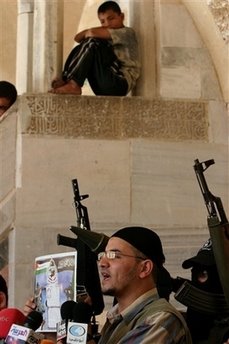
Reporters from the mainstream media assembled yesterday in Gaza City for a press conference given by a self-admitted terrorist-kidnapper. The gathering's purpose was to advance the terrorists' war by asserting that an eighteen year-old Israeli student, Eliyahu Asheri, snatched by terrorists on Sunday, would be murdered by them if Israel did not immediately cease to do this or start doing that etc.
Mohammed Abdel Al, a spokesman for the Popular Resistance Committees, a violent group with ties to the Hamas-led Palestinian government, holds up a poster he said shows the Israeli identity card of abducted Jewish settler Eliahu Pinchas Asheri during a news conference in Gaza City, Wednesday, June 28, 2006. The PRC on Wednesday threatened to kill Asheri if Israel doesn't stop its raid on the Gaza Strip.(AP Photo/Hatem Moussa)
It's now evident (on Thursday morning) that Eliyahu Asheri, son of Miriam and Yitro (Yitro moved to Israel from Australia at about the same time we did) had been dead for several days by the time the man in the picture above made his cynical speech and contemptuously waved his photographs.

We wonder whether this still qualifies him to be called 'militant' (as most media channels did yesterday) or whether 'terrorist', 'kidnapper', 'murderer' or 'savage' are ever pressed into service as descriptors. We'll know the next time his PRC terrorist group calls another press conference.

The moral agnosticism (some would call it blindness) of reporters and editors who persist in referring to lying, murdering thugs like the man in the picture as 'militants' is at the very heart of the rampant confusion and ignorance that surrounds this ongoing conflict.