Showing posts with label Assad. Show all posts

Thursday, August 20, 2015

20-Aug-15: Rockets from Syria slam into Israel's north

Incoming Syrian fire caught on camera by an Israeli driver somewhere in
Northern Israel early this evening [Image Source]
We learned this afternoon of a heightened state of tension in southern Israel today. The authorities
deployed an Iron Dome missile defense battery to Ashdod in southern Israel. Gaza security coordinators received warnings Wednesday of possible rocket fire from the Gaza Strip... [Ynet]
The rocket fire eventuated, but not in the south. Early this evening (Thursday), four rockets fired from Syrian-controlled territory, landed in northern Israel, causing an outbreak of brush-fire but causing no injuries. According to AP, today was the first time since the 1973 Yom Kippur war (when Egypt and Syria invaded Israel on its holiest day of the year) that Syrian rockets have crashed into Israel.

Keep in mind that Israeli hospitals and medical teams have treated streams of wounded and injured Syrians ["12-May-14: Opting for humanity in an ocean of savagery"] caught up in the Arab-on-Arab bloodbath during the past two years. That humanitarian policy remains in effect as of today, with no sign of it changing.

Times of Israel, quoting the IDF, says all four of this evening's rockets landed in Israel's northern Galilee region and in Israel's Golan Heights. No injuries are reported. And no Arab party has sought to claim credit so far, though it's early. Associated Press attributes the rocket fire to "militants" on behalf of "the Iran-backed Islamic Jihad group". Ynet says the rocket-fire originated in the Quneitra area
which is under Syrian President Bashar Assad's control and in which according to reports, Hezbollah operatives Samir Kuntar and Mustafa Mughniyeh have free rein [Ynet, tonight]
Previous in-coming rockets from Syria have been described as accidental by-products of the savagery devastating that country, but that's not the case this time. Commentary on Israel's Channel 2 news this evening said today's rockets were fired at Israeli territory with deliberate intent; they are not a "mere' spillover from Syria's civil war bloodbath.

Nor were they "merely" mortars (which are of course lethal). According to Israel Radio (here) these rockets were artillery shells. Later this evening, there have been reports of Israel responding with artillery fire on the Syrian settlements of Baath and Khan Arnabeh.

Israelis living in communities organized under the Upper Galilee Regional Council have been told to remain near safe places.

Friday, July 24, 2015

24-Jul-15: If the Iranians read the Wall Street Journal, we're all in deep trouble

Iran nuclear deal acclaimed: last week's
newspaper covers in Teheran [Image Source]
Barely a year after the successful elimination of Syria's chemical weapons arsenal, it's now being revealed to the shock-horror-astonishment of Western media and observers that... the Syrians failed to surrender the chemical weapons they said they were surrendering. And that they told teensie-weensie lies to get the United States and the other interested Western parties off their backs.

As a spine-chilling, lengthy analytical report published yesterday ["Mission to Purge Syria of Chemical Weapons Comes Up Short", Wall Street Journal | Adam Entous and Naftali Bendavid | July 23, 2015] shows, the wily Syrian regime is now, today, right at this moment, holding onto caches of deadly nerve agents which they
"may be prepared to use... if government strongholds are threatened by Islamist fighters. If the regime collapses outright, such chemical weapons could fall into the hands of Islamic State or another terror group." [Wall Street Journal]
Bashar al-Assad of Syria, alleged liar [Image Source]
The details, and there is a long list of them, make for terribly depressing reading. Here are just some (all are direct quotes from the WSJ piece):
  • “Nobody should be surprised that the regime is cheating,” says Robert Ford, former U.S. ambassador to Syria under President Barack Obama. He says more intrusive inspections are needed...
  • Inspectors from The Hague-based Organization for the Prohibition of Chemical Weapons, or OPCW, together with U.N. personnel, arrived in Damascus in October 2013 to an especially difficult work environment... Because the regime was responsible for providing security, it had an effective veto over inspectors’ movements. The team decided it couldn’t afford to antagonize its hosts, explains one of the inspectors, or it “would lose all access to all sites.”
  • [The right to inspect sites that the Syrians were not offering] was never exercised, in part, inspectors and Western officials say, because their governments didn’t want a standoff with the regime.
  • Syrian scientists showed them [the inspectors] rooms with test tubes, Bunsen burners and desktop computers, according to inspectors. The Syrians gave a PowerPoint presentation detailing the medical and agricultural research they said went on there. A Syrian general insisted that the Assad regime had nothing to hide. As the international inspectors suspected back then, it was a ruse, part of a chain of misrepresentations by President Bashar al-Assad’s regime to hide the extent of its chemical-weapons work. 
  • [T]he Syrian regime controlled where inspectors went, what they saw and, in turn, what they accomplished. That happened in large part because of the ground rules under which the inspectors were allowed into the country...
  • Among the biggest surprises for the inspectors was Syria’s fleet of mobile chemical-weapons production facilities, housed on 18-wheeler trucks. They looked so much like regular trucks that they even carried advertisements, including one for a Hungarian moving company. [One of the expert inspectors] says it was “unlike any other program that I’ve seen or read about.”
  • The Syrians laid out the ground rules. Inspectors could visit only sites Syria had declared, and only with 48-hour notice. Anything else was off-limits, unless the regime extended an invitation. “We had no choice but to cooperate with them... The huge specter of security would have hampered us had we gone in there very aggressively or tried to do things unilaterally.
  • According to the WSJ, the Syrians used disguised trucks to 
    conceal their chemical weaponry. Who would have imagined it? 
    [Image Source]
  • [Following] recent battlefield gains by Islamic State militants and rival al Qaeda-linked fighters [it's] even more urgent to determine what Syria held back from last year’s mass disposal, and where it might be hidden... The team that visited the SSRC facility in Damascus recently asked the regime for information about unaccounted for munitions. Officials say there has been no response from Damascus. “Accountability?” asks Mr. Cairns, the inspector. “At this point in time, it hasn’t happened.”
In these fraught days, we're watching a major effort by the Obama government to get the US Congress - and the world - to buy into the idea that an agreement, unsigned and devoid of almost all leverage and sanctions, is going to produce a peace-embracing effect in Iran.

It's hard not to see direct parallels between Syria and the Iran Nuclear Enablement Deal™ when you read paragraphs like this one:
The White House and State Department say last year’s mission was a success even if the regime hid some deadly chemicals. Western nations removed 1,300 metric tons of weapons-grade chemicals, including ingredients for nerve agents sarin and VX, and destroyed production and mixing equipment and munitions. U.S. officials say the security situation would be far more dangerous today if those chemicals hadn’t been removed, especially given recent battlefield gains by Islamists. Demanding greater access and fuller disclosures by the regime, they say, might have meant getting no cooperation at all, jeopardizing the entire removal effort... [Wall Street Journal]
We're hoping that no-one over there in Teheran has a subscription to the Wall Street Journal. Because, if they do, and if they get it into their heads to follow the Iranian-client-state-Syria's template, they might eventually end up telling lies about their nuclear weaponization and understate their deployment plans. 

And then where would the world be?

Tuesday, March 31, 2015

31-Mar-15: The other Iran, the one with less need of Swiss hotel rooms and press conferences

One of a collection of snapshots published in December 2014 on an
Iranian military website under the headline "We come..." depicts
uniformed Iranian soldiers touring southern Lebanon, close to the
border with Israel [Iranian source]
Israel, and especially our country's border zone, is often described as tense.

This might seem odd so long as no actual shooting or rocket firing is taking place. Some might seet it as paranoia, maybe even war-mongering.

But it's less so to Israelis. Many of us understand that the general level of a population's anxiety is a function of the extent to which real and physical threats are reported. If you don't know they are there, or choose to look in the other direction, you may feel more relaxed.

But that does not mean there are no enemies, or that they are not deployed out there.

Here's part of a chilling news report about our northern border ("Iranian troops advance towards Israeli border") from yesterday's Times of London:
Iran is close to putting its forces on Israel’s northeast border for the first time, as its allies crush rebel groups in the Golan Heights area of Syria. The prospect of Iranian troops being posted on a frontier that has been calm for decades is causing alarm in Israel, and comes as international negotiations over Iran’s nuclear ambitions near a climax.
“Iran will be so close to the Israelis that it will no longer need long-range missiles to hit them,” said Abu Ali, a fighter with Lebanon’s Iranian-backed Hezbollah organisation who has served multiple combat tours in Syria...
Mortar fire and heavy machineguns are audible daily from the area as Hezbollah fights Syrian rebel forces, some of them aligned with al-Qaeda.
Israel assesses that the Syrian government army, apart from some artillery units, is largely exhausted. With its best divisions stationed around Damascus, the Assad regime is now leaving the fight in the south to Iran and its proxies. A spokesman for the Syrian rebel forces in southern Syria, Major Issam el-Rayyes, said that 80 per cent of a 5,000-strong force attacking rebels around the Golan Heights were Iranian-backed militias, including Hezbollah, but also Shia fighters from Yemen, Iraq, Iran and Afghanistan.
The offensive into the southern region of Daraa and Quneitra, bordering the Golan Heights, began in February. It is the first time that Iranian forces have operated openly in southern Syria.
Same Iranian, same Lebanon/Israel border
“Iran is on the march, its proxies are taking territory,” an Israeli official said.
Abu Ali confirmed that Iranian troops were on the ground. “We are taking the area square by square until we reach the border with Israel.” ...From August to October last year, rebel groups gained territory along the southern half of the Golan Heights adjacent to the Israeli line, leaving only one village in the northern border area under Syrian government control.
Israel has offered medical assistance to more than a thousand wounded Syrian rebels and civilians, in a medical centre in the town of Zefat — but the Assad regime has accused Israel of going beyond humanitarian aid, and providing rebels with weapons, ammunition, communications equipment and tactical intelligence. This pragmatic decision to be a “good neighbour” to Syrian rebels — even though some elements are affiliated to al-Qaeda — appears to be aimed at countering the more pressing threat from Iran.
Abu Ali said that, over the past year, a military infrastructure of bunkers and tunnels had been constructed in parts of the Golan Heights under the Assad regime control — echoing the facilities Hezbollah built in south Lebanon before a month-long war with Israel in 2006. “We are almost ready,” he said.On January 18, Israeli drones targeted a convoy of vehicles near Quneitra, on the Syrian side of the Golan Heights, killing an Iranian general and six Hezbollah fighters. The highly unusual attack was interpreted as a forceful message to Iran to stay away from the Golan Heights. It appears to have fallen on deaf ears...
Is it paranoia if they say at every opportunity they really are out to attack your home and community? And they have colossal means of doing so?

Monday, September 15, 2014

15-Sep-14: Like a horse and carriage: Qatari money and terror

Back in 2008, Basher and Asma al-Assad hosted
Hamad bin Khalifa Al Thani of Qatar and his wife (centre) in Syria
[Image Source]
This past Thursday, the IDF Spokesperson's Office announced that 45 members of a UN border monitoring unit, all of them from the Fijian military forces, abducted by terrorists of the al-Nusra Front on the Syrian side of Israel's Golan Heights frontier, had been released and had crossed the border and arrived safely in Israel.

According to a New Zealand source, "the Fijian soldiers were seized on August 28 after their UN commander told them to surrender rather than fight. 40 Filipino soldiers ignored the order and fought their way to freedom... A UN spokesman said in New York on Thursday no ransom had been requested for the Fijian peacekeepers and none was paid. He said the UN mission in the region remained viable and would continue to fulfil its mandate."

But it now appears, on the basis of a report carried by the Asharq Al-Awsat newspaper (published daily in Arabic from London) that the freedom of the Fijians was in fact purchased with a $20 million ransom paid by Qatar.
Syrian opposition forces said on Saturday that Qatar had paid militants from the Nusra front $20 million ransom for their return. This comes a day after Qatar's Foreign Affairs Ministry announced that it had brokered the release of 45 Fijian U.N. peacekeepers "at the request of the government of Fiji." "The efforts of the State of Qatar led to the successful release of the Fijian soldiers... who had been held for two weeks," the Qatari foreign ministry said in a statement. The reports of a ransom fly in the face of earlier statements from the UN that no concessions had been made to secure the peacekeepers' release. [Source]
A Financial Times analysis in May 2013 ["How Qatar seized control of the Syrian revolution"] observed that:
few appear to be aware of the vast sums that Qatar has contributed – estimated by rebel and diplomatic sources to be about $1bn, but put by people close to the Qatar government at as much as $3bn. However, a perception is taking root among growing numbers of Syrians that Qatar is using its financial muscle to develop networks of loyalty among rebels and set the stage for influence in a post-Assad era. “Qatar has a lot of money and buys everything with money, and it can put its fingerprints on it,” says a rebel officer from the northern province of Idlib interviewed by the FT... Qatar’s ruling family, the al-Thanis, have no ideological or religious affinity with the Islamists – they are simply not choosy about the beliefs held by useful friends... Allegations that the Qataris have – directly or indirectly – helped Jabhat al-Nusrah have not gone away. 
In Fiji, they are reporting that
Apart from the UN talks were held with the governments of Qatar, Jordan and the United Arab Emirates to secure their release. [Fiji Times, September 13, 2014]
The al-Nusra Front or Jabhat al-Nusra and sometimes called Tanzim Qa'edat Al-Jihad fi Bilad Al-Sham, is a branch of al-Qaeda operating in Syria and Lebanon that announced its creation on January 23, 2012, during the Syrian Civil War.

Since then, it has been described as "the most aggressive and successful" of the "rebel forces" in Syria. Others give it different names: Al-Nusra is designated as a terrorist organization by the United Nations, the United States, Saudi Arabia, Australia, Canada, France, Russia, the United Arab Emirates, the United Kingdom and Turkey.

It's now probably one of the wealthier of the terrorist groups operating in the Middle East. So now they will probably stop doing abductions and focus on gentler deeds. Right?

Monday, June 02, 2014

2-Jun-14: A moment's thought about Syria

Aleppo, Syria's largest city. April 10, 2013 [Image Source]
Known as the crown of Jewish splendor in the Sefardic
world, Jews lived in Aleppo from ancient times. But no more.
Syria, with its immense troubles and unrelenting bloodbath, is in the news this morning. And the news, as usual, is disturbing to Syria's neighbours, notably to us here in Israel.

Lazar Berman in Times of Israel reports on an Israel strike in the early hours of this morning, Monday, by the Israel Air Force on unspecified Syrian targets triggered by something explosive and air-borne, originating in Syria, having struck Israeli territory on Mt. Hermon in northern Israel yesterday. There have been several similar instances of Syrian fire on Israel in recent weeks. Ynet's reported offered a few more facts:
Several mortars were fired at Israeli targets early this morning, with a mortar landing near an IDF outpost in Mt. Hermon region. The IDF responded with artillery fire aimed at the source of the mortar fire. No injuries or damage were registered on the Israeli side. An initial investigation revealed that at roughly 5 am a mortar landed only a few hundred meters from the outpost. Heavy fog was felt in the area, hindering visibility, and once it cleared, the IDF began searching the area to find the shell.
Israel's wariness of the Syrians has deep roots over decades. One of the reasons is the Assad family's proven willingness to avail themselves of chemical weapons even in the face of intense scrutiny from outside. So while Syria came perilously close last August to a United States military attack ["Obama says U.S. will take military action against Syria, pending Congress’s approval", Washington Post, August 31, 2013], there continue to be indications that chemical-based attacks on his own population - and perhaps on other populations as well - remain on Assad's mind and, it appears, table.

Elhanan Miller, also writing in Times of Israel today, quotes reports from anti-Assad Syrian sources that chemical weapons are continuing to be hidden away and stockpiled in remote regions of northwestern Syria where the Assad clan's own Alawite tribe have a strong presence. Eight weeks ago, vehicles loaded with chemical substances arrived by night in a town under the control of Assad's Mountain Brigade. Electric power was cut to the entire region as the vehicles and their load "were then buried underground within the brigade’s encampment. In addition, the sources reported, the regime has been transferring chemical substances and missiles carrying chemical warheads from a research center" to a location in the mountains where they were stored in caves and trenches...“We believe the regime has hidden a large amount of VX (nerve agent)”, one of the sources is quoted saying.

The US president said at the height of last summer's standoff with the chemical-minded Syrian regime that someone needed to step up and confront the Syrians and under certain circumstances that might be the United States. Here's how he was quoted by the BBC on September 10, 2013:
"US President Barack Obama has said he will put plans for a US military strike against Syria on hold if the country agrees to place its chemical weapons stockpile under international control. But he said he was sceptical the Syrian government would follow through... The US accuses Damascus of war crimes including use of chemical weapons, allegations denied by the regime... The US president on Monday gave a series of television interviews aimed at building support among a US Congress and public wary of new military action in the Middle East." [BBC]
As we know now, the US did not step up and move on Syria, and in fact no one has. With a death toll that has already exceeded 160,000 and shows no sign of abating, the carnage goes on.

Belgian media coverage of Mehdi Nemmouche,
charged with being the Brussels Jewish Museum shooter
[Image Source]
And one additional Syria-based story of death and destruction in today's news: AFP says today the murderer of four people at Brussels' Jewish Musuem last week is a French male of 29 who spent a year fighting for Islam in Syria. Mehdi Nemmouche was arrested on Friday in Marseilles. A 40-second 'confession' video was in his possession, along with a Kalashnikov rifle and a handgun, and a piece of white fabric on which were inscribed in Arabic the words Islamic State of Iraq and the Levant, a notorious terrorist organization, and the words “Allah is great”. The video includes some footage of the killer saying he brought a GoPro camera with him to capture the killings for posterity. But the technology let him down.  He returned from the killing fields of Syria in March 2014, ready - it appears - for more domestic action, and found it firing a high-powered automatic weapon at unarmed visitors to a cultural venue. A Jewish cultural venue. Nemmouche, we now know too late, was "known" to the French domestic intelligence agency DGSI. His family say he was taciturn but harmless: “Nice, intelligent, educated and has done a year at university,” Nemmouche's aunt told reporters... “He never went to the mosque or spoke of religion.”

One of the lawyers, Soulifa Badaoui, who represented him in his numerous legal entanglements is quoted in the New York Times today saying "he had been moved “from foster home to foster home” as a child, and became homeless at age 17. “He was not a young man anchored in crime... He was a young man with difficulties of a personal sort... but also “endearing,” “respectful” and “sharp-minded.

40,000 Jews continue to live in Belgium. Meanwhile
As many as 3,000 Europeans, including more than 700 French, are thought to have fought or to be fighting in Syria, most of them with the jihadist groups opposed to the government of Bashar al-Assad. France, with Europe’s largest Muslim population and a deep pool of anger and resentment among the country’s poor black and Arab youth, has already arrested dozens of men upon their return from Syria, charging some under the country’s antiterror laws and warning people thinking of traveling to Syria to join the conflict that their activities will be closely followed by the intelligence services. [New York Times today].
Aleppo in Syria was once home to one of the world's most ancient Jewish communities. In 1947, 10,000 Jews lived there, with about 30,000 Jews living in other parts of Syria. In 1967, Aleppo had only 1,500. Today there are none.

Monday, May 12, 2014

12-May-14: Opting for humanity in an ocean of savagery

Syrian impact on Syrians: The Juret al-Shayah district
in Homs, Syria - April 2012 [Image Source]
As wars tend to do, the ongoing carnage in Syria provides insights into the nature of the combatants, of their friends and allies, of the news reporting industry, of the multilateral institutions that struggle to do something positive in the face of such hideously negative events.

As many (the estimates vary) as 150,000 human lives have been violently ended since the Syrian kill-frenzy began in early 2011, and many times that number have been severely impacted. More than 9 million Syrians (out of a total of 23 million) have been displaced, many of them fleeing their country for refuge elsewhere.

It's strongly arguable (though denied by the fighting parties themselves) that this is a war with a strongly religious foundation to it. It overwhelmingly involves Moslems: Shia groups side by side with mainly-Alawite government forces, backed by (Shia) Iranian technical, logistical and military support and with the involvement of (Shia) Hezbollah forces - all fighting to save the (Alawiteal-Assad dynasty's stranglehold on power. Against them, a variety of mainly Sunni rebel groups trying to destroy it and end Bashar al-Assad's rule.

Israeli impact on Syrians: Syrian girl receives life-saving
treatment in Safed's Rebecca Sieff Hospital [Image Source: Reuters]
We have no particular argument with the many Moslems who argue that their faith is "the Religion of Peace". It's a commendable aspiration. If it's true, even better.

Nor would we want to disagree with the way a prominent Moslem political figure put it in a 2002 speech:
Islam... is a religion of peace. However through the centuries, deviations from the true teachings of Islam take place. And so Muslims kill despite the injunction of their religion against killing especially of innocent people.
So if it's helpful, let's follow his lead and think of the savagery unfolding daily in the killing fields of Syria as the work of deviants. But then where does that leave the rest of us? What decent and good things can be done by decent and good people?

Michael Harari, whom we know from Australia as well as from his work as a doctor who treated one of our briefly-hospitalized children here in Jerusalem, is an intensive care paediatrician at the the Rebecca Sieff Hospital (Israelis call it Ziv) in the small northern Israeli city of Safed (Tzefat in Hebrew).

Israeli impact on Syrians: Syrian mother and daughter
receive life-saving treatment in Safed's Rebecca Sieff Hospital
[Image Source: China Radio International]
Australia's ABC broadcast an interview with Michael earlier today on its "The World Today" radio program.

Here's a transcript of what we think is a very moving look at what individuals can do in the face of colossal evil though it's clear Michael does not work alone and could not possibly do what he does without a system around him and people in positions of power saying 'yes'. The interviewer is Eleanor Hall (and the full audio recording can be heard here.)

ELEANOR HALL: The three-year civil war in Syria has killed more than 100,000 people and displaced more than 9 million. One Australian doctor treating severely injured children has witnessed the toll from an unusual perspective. Dr Michael Harari is an intensive care paediatrician who works in a hospital in northern Israel. He has treated hundreds of Syrians who've made their way to the centre over the last year and a half. Dr Harari is back in Australia this week and he joined me in the studio earlier.

MICHAEL HARARI: I've seen lots of trauma in motor vehicle accidents and even bullet wounds and stab wounds. I lived in Papua New Guinea for many years. But I've never actually seen war trauma or blast injuries. And they don't just damage one organ of your body, they're multi-system injuries and for me that's something new and shocking. And it's also the first time I've seen in such a systematic fashion the human agency behind trauma. You know, it's always accidents or illness, but this time people have done it deliberately. And for me that's also something that's a revelation in the most unpleasant way.

Israeli impact on Syrians: Syrian man
receives life-saving treatment in Safed's Rebecca Sieff Hospital
[Image Source: Deutsche Welle]
INTERVIEWER: So tell us about this medical centre in northern Israel where you work, and how do these Syrian patients actually come to be in your care?

MICHAEL HARARI: I work in a place called Ziv Hospital in the town of Tzfat in the far north of Israel, in the Upper Galilee. The Syrian border is about 30 kilometres away as the crow flies. And throughout the last year and a half a steady trickle of wounded have been coming across the border. Exactly how they get there we don't know.

INTERVIEWER: You have no idea how they get to you?

MICHAEL HARARI: Absolutely none. I mean, often the combatants bring one another to the border. There's a gate in the fence near a town called Quneitra. The Israeli army has set up a field hospital near that gate. We think about 900 have come across the border, of which 450 have reached civilian hospitals in the country. So I work in a civilian hospital and I deal with children only. So we've had about 50 children come across the border, all of them really severely wounded, many with amputations. Some are double or triple amputees.

INTERVIEWER: I imagine dealing with children must be particularly confronting?

Israeli impact on Syrians: Syrian girl (R), with Israeli girl
and Israeli medical clown in Safed's Rebecca Sieff Hospital
[Image Source: New York Times]
MICHAEL HARARI: I've almost stopped... It's confronting no matter which age group you deal with. I think the brutality of war is still something that's quite shocking to me. People doing this to one another deliberately is really hard to stomach.

INTERVIEWER: Is there any particular case that you found really difficult?

MICHAEL HARARI: There was one 8-year-old girl who to this day is both awful and uplifting because the outcome was a good one. But she for a month was mute and refused to eat and wouldn't emerge from under her blanket. I think post-traumatic stress but she was so severely traumatised. We cut our teeth on her: she taught us many things including the importance of keeping a parent alongside. So her mother came across the border as well.

INTERVIEWER: What was wrong with her?

MICHAEL HARARI: She had both legs shattered and had some abdominal wounds. The mother had both legs shattered and the father had been killed.

INTERVIEWER: How did they get there?

MICHAEL HARARI: We don't know. They're dumped on the border by somebody and the Israeli army brings them across. We realised very quickly that she needed her mother alongside her, even though the mother was severely injured herself. It was far preferable to keep a severely injured parent alongside the severely injured child. The importance of keeping the child pain-free in order to allow the psychologic healing became self-evident. And she also taught us the importance of getting them back to school early. So we've got a school inside our children's ward in this hospital. It's like a small country hospital, Ziv Hospital. We've got a school, an Arab teacher and a Jewish teacher. And she hadn't been to school in two and a half years and so we got her back to school.
She also taught us the importance of using clowns. Clowns have become central to the management of these children. So we eventually worded up the clown that took her on. Every day we told him what we were going to do with her. And very soon she began to think that the clown was the one who was running the show and that was brilliant. That really changed her whole attitude and she emerged from - and good nutrition, because nearly all of them arrive undernourished.

INTERVIEWER: So where is she now?

MICHAEL HARARI: She's gone back to Syria but she's been back twice already. Her injuries are quite complicated and she's got this scaffolding holding her bones together and it has to be tweaked and changed from time to time. So I don't know how this is done but she's gone back to Syria and she's come back across the border twice already for ongoing follow-up.

INTERVIEWER: Do you know if she is able to go to school when she's back in Syria?

MICHAEL HARARI: Oh, no. Most infrastructure has been - they're from Daraa province - and the health infrastructure, the education infrastructure's been decimated.

INTERVIEWER: So what happens to most of these patients when they leave your care?

MICHAEL HARARI: We initially thought most of them were going to refugee camps in Jordan but, at least lately, we're pretty sure that they're going back to Syria. There's a sort of cloud of secrecy, of necessity I think, so as not to torpedo the whole system. We know that one family has been targeted for having come across to Israel. So the child is...

INTERVIEWER: By whom? In what way?

Australian impact on Israel:
Dr Michael Harari [Image Source: Jwire]
MICHAEL HARARI: We don't know. All we heard was, through other people that came back, that another family that had also gone back had been targeted because they'd been across to us, treated in Israel. They come from across the border that was never porous and suddenly there's a little crack in the border. And people who have been taught to be your sworn enemies come across and they realise that we don't have horns. Within a few weeks we're sitting, having coffee together. And this is a drop in the ocean compared to the carnage on the other side, but something about the paradigm of the Middle East has changed for me just by playing a very small part of it in a small hospital.
---
For some follow-on reading, including a little background on Israeli hospitals and how they deploy medical clowns, see "23-Apr-12: Does a people really get the leadership it deserves? Ask the Palestinian ruling class as they make their way to Israeli medical centers". More about Michael's marvellous work in The Australian  (November 2013).

Monday, November 18, 2013

18-Nov-13: "When you touch someone you’ve touched a whole world, and he will pass it on"

It's beyond the capability of most of us to visualize what
the ongoing death toll in Syria's Arab-on-Arab orgy of violence looks like.
The crowd in this photo is substantially smaller than the
115,000 we mention below [Image Source]
We have been thinking about the carnage in Syria that continues relentlessly, and about how the world's great institutions have been dealing with it.

We're not so naive as to expect global gatherings of besuited diplomats to achieve an end to savagery via speeches and resolutions. But the reality of what has happened - and what has not - is a stunning reminder of the gap between what people tend to say, especially in hotel meeting rooms and airport press conferences, versus what they actually do.

That's a chasm that is at the heart of a great deal of human misery.

Start with the cold numbers. Horrifying is an appropriate word. The Syrian Observatory for Human Rights website, which tracks these closely, reported this past Thursday (the most recent update we could find) that the killings that day alone were about two hundred:
"including: 60 civilians, 34 rebel fighters, 43 regular soldiers, 10 unidentified rebel fighters, 4 defected officers and soldiers, 29 combatants from the NDF and popular committees and at least 20 non-Syrian fighters from the ISIS, al-Nusra and rebel factions... In Aleppo 33 civilians (12 children) and 17 rebel fighters were killed. 12 civilians, including 7 children and 2 women were killed by regime bombardment on the A'btin village in Reef Aleppo. 1 woman and 2 children were killed by regime bombardment on the Rasm al-Basas village in Reef Aleppo. 6 men were killed by aerial bombardment on the al-Bab city. In Reef Dimashq, 15 civilians and 6 rebel fighters were killed. 5 civilians (1 man and his son from the al-Zabadani city and 1 man and 2 women from Qarra) were killed by regime bombardment on areas in the al-Zabadani and Qarra cities. 6 rebel fighters were killed by clashes in al-Ghouta al-Sharqiya, al-Qalamoun and Mahin in south eastern Reef Homs and in the neighbourhoods of Jobar and Barza of Damascus. In Homs 5 civilians and 5 rebel fighters were killed. In Damascus 4 civilians and 1 rebel fighter were killed. 3 civilians were killed by shell that fell on the al-Amin neighbourhood in central Damascus. In Hama 3 civilians and 1 rebel fighter were killed. In al-Qneitra 2 rebel fighters were killed. In Idlib 1 rebel fighter was killed. In Dera'a 1 rebel fighter was killed. 1 man from the Tibet al-Imam town of Hama was documented as tortured to death 10 days earlier in detention centres. Reports that 1 man was killed by regime bombardment on Harasta city of Reef Dimashq and that 1 woman was killed by a shell that fell on her house in the Tarnaha town in al-Qneitra. At least 20 non-Syrian fighters from the ISIS, al-Nusra and rebel factions were killed by bombardment and clashes in several provinces. 3 defected officers were killed. 1 defected colonel and rebel commander was killed by clashes with regular forces in M'aret al-Artiq of Aleppo. 1 defected lieutenant and rebel commander was killed by clashes with regular forces in the Mahin area in south eastern Reef Homs. 1 defected lieutenant was killed by clashes with regular forces in Mahin. 1 defected soldier was shot by regular forces after he killed 1 colonel and 1 sergeant inside the air defence division in the perimeter of the Asqabla village in Banyas city of Tartous province. 10 unidentified rebel fighters were killed by clashes and bombardment in several areas. 29 combatants from the NDF and pro-regime popular committees were killed by clashes, attacks on checkpoints and explosions. Confirmed reports that several fighters from the Abu Fadel al-A'bass battalion were killed by clashes with rebel fighters in Reef Aleppo. At least 43 regular soldiers, including 6 officers, were killed by a suicide explosion, clashes, rocket attacks on centres, checkpoints and machineries and IED attacks in several provinces: 18 Aleppo, 9 Damascus and Reef Dimashq, 2 Tartous, 8 Homs, 3 Idlib, 2 al-Raqqa [and on and on]"
That's a single day's harvest in the slaughter fields of Syria.

The overall tally is said to be about 115,000 dead humans... so far. It's a number that includes (roughly speaking, since data like these are approximate) 41,000 civilians, among them 6,000 children and 4,000 women. Plus 3,000 more who are, and likely always will be, "unidentified people".

Is it a wonder that, in the face of such intensely barbaric destruction, even the most dedicated killers can sometimes end up beheading the wrong people? This is from the BBC, this past Friday:
Syrian rebel 'beheaded in case of mistaken identity' | An al-Qaeda affiliated rebel group in Syria is reported to have asked for forgiveness after beheading a fellow rebel in a case of mistaken identity. A video recently posted online showed members of the Islamic State of Iraq and the Levant (ISIS) brandishing the severed, bearded head of a man. They said was an Iraqi Shia caught fighting on the government side. But other rebel fighters watching the video recognised the man and said he was one of their commanders. [BBC]
What sort of measurable impact does barbarism on this scale have on the people paid to sort out and end the very bad things people do to each other at the national and global level? Here's an authentic indication of how it goes. It was exactly two years ago this week that the government of Syria - the dictatorial regime of the blood-soaked Basher al-Assad - received the honour of becoming
the Arab representative on the UNESCO committee the deals with issues relating to the implementation of human rights.
It's a mind-numbing reality: in the eyes of an international forum that is, without a doubt, up there with the most distinguished and influential of global multi-lateral organizations, the regime chosen to represent the Arab world on matters pertaining to "the implementation of human rights" is the one headed by the Butcher of Damascus. Since the other Arab states who sit in the halls and lobbies of UNESCO evidently accepted this, we're left to wonder what dimension of the Arab world's "implementation of human rights" is embodied by Syria.

We're encouraged to see recent reports of a different kind that reflect the embodiment of Israel's ethos and core values. A widely syndicated news report on the McClatchy Newspapers network, published this past Friday, is one of many that have recently taken a modest peek at the simple practical actions that Israelis are doing for some ordinary Syrians in compelling need. A brief extract:
Syria and Israel are formally at war, and the idea of Syrians being treated in an Israeli hospital once would have been unthinkable. But the brutality of the Syrian civil war has driven some 200 wounded Syrians in the past six months to seek help at the Israeli frontier on the Golan Heights, according to the Israeli army. Soldiers take them to a field hospital for treatment and triage, with more serious cases sent to hospitals in northern Israel. About 100 have been treated at the Nahariya hospital, with more arriving as news of the Israeli medical aid spreads by word of mouth. For the man in the bed, who declined to be named for fear of retribution against his family back home, treatment in Israel has been a profoundly transforming experience.
“I thank the Israeli army,” he said. “Two and a half years of revolution have changed my opinion of Israel. Look what Bashar Assad” – Syria’s president – “has done to his people. Everything he says is a lie. He spreads hatred of Israel, but Israel is a friend, not an enemy. The Israelis showed us their humanity.”
...Many of the wounded who end up in Israel arrive unconscious and are jarred when they awake in an Israeli hospital, surrounded by Israeli nurses and doctors, including Arab staff who speak their language. “At first they’re quite scared and closed, but after a few days of treatment they start to absorb that they’re being cared for by Israelis, and they become more receptive,” said Dr. Eyal Sela, who directs head and neck surgery at the Nahariya hospital. Sela said his staff had performed complicated reconstructive surgery on seriously wounded patients. “As soon as you show them sympathy and start talking to them with the help of a translator, you establish human contact and they begin to open up,” he said...
A 17-year-old who entered the room in a wheelchair said that at the border he’d been frightened by Israeli soldiers pointing their rifles at him and ordering him to raise his hands. After an examination and transfer for medical treatment, he said he was surprised by the “compassion, sympathy and humanity” shown him at the hospital...
[One of the doctors] said he felt “privileged to help people who arrive with such serious wounds, when we know that in Syria there’s no chance they’ll get this level of treatment. At the human level, when you touch someone you’ve touched a whole world, and he will pass it on.” [Tampa Bay Times, November 18, 2013]
How irritating is it that such reports get relatively limited exposure? Quite, in our opinion, though note that some quarters in the Arab world - like this one - are paying attention. And while we're at it, the Financial Times has an excellent article here from a week ago.

Still, the reality is that certain prominent parts of the global mainstream news media manage to turn their noses away when faced with evidence of the great good being done at this moment in certain typhoon-ravaged island communities. [See "Which country is absent from the BBC’s list of international aid efforts in the Philippines?" on the estimable BBCwatch website.] This says far more about what motivates some forms of mainstream reporting than it does about the givers and the receivers of the aid effort they purport to describe.

Since we ourselves are involved in a successful undertaking that reaches out to people in need - in our case, families grappling with the challenge of raising a child with serious disabilities - we know the profound difference between making speeches and making a difference.

In the case of the foundation we created as a memorial to the beautiful life of our murdered fifteen year-old daughter Malki, about 30% of the families who have been helped by the ongoing work of Keren Malki happen to be Arab. As the doctor we quoted above who is helping to heal broken Syrian bodies put it so well, it's a privilege to help, as well as serving as an eloquent reaffirmation of the supreme value of life.

Experience teaches us that it's an outlook not that widely shared in the region where we live.

Friday, September 20, 2013

20-Sep-13: In Syria, who was right, who was wrong?

[Image Source]
Syria, the foreign policy catastrophe, has not gone away. It's with us, and from an Israeli perspective it's no less an existential problem than it was before the Russia/US Syria understanding was reached less than a week ago.

Foreign Policy magazine has an analysis of the way intelligence was obtained and used, or not used, in an article ["The Spies Inside Damascus"] by Ronen Bergman. The summary below, entitled "Israel Has Best Intelligence on Syria in Western Hands", comes from today's edition of dailyalert.org, prepared by the Jerusalem Center for Public Affairs.
Israel Has Best Intelligence on Syria in Western Hands
Ronen Bergman (Foreign Policy)
  • On March 10, 2013, Israeli intelligence sources began reporting that the Syrian regime had made use of chemical weapons, based on sources that eavesdropped on the Syrian army's tactical frequencies and surveillance satellites that monitored movement out of a bunker known to contain chemical weapons. 
  • Israel shared its findings with the U.S., but Washington would not acknowledge those findings' veracity. In the end, the U.S. admitted that the information was correct. 
  • Israel continues to share vast amounts of information about Syria with the U.S. The Wall Street Journal credits Israel with giving the CIA "intelligence from inside an elite special Syrian unit that oversees Mr. Assad's chemical weapons" after the massive Aug. 21 sarin attack outside Damascus. 
  • "We have a very extensive knowledge of what is happening in Syria. Our ability to collect information there is profound. Israel is the eyes and ears, sometimes exclusively, sometimes as complementary aid, to what U.S. intelligence is able or unable to collect itself," Maj. Gen. Uri Sagi, Israel's former chief of military intelligence, told me on Sept. 19. 
  • Today, Israel enjoys the best intelligence on Syria in Western hands, and it is sharing that intelligence with the U.S. The Americans are also getting information from Jordan and Turkey, both of which gather information themselves and allow the U.S. National Security Agency (NSA) to set up listening posts on their territory.
 The fighting on the ground in Syria, meanwhile, has evolved into a three-front war as an analysis in the Wall Street Journal yesterday ["Rebel-on-Rebel Violence Seizes Syria"] argues. Extract:
An al Qaeda spinoff operating near Aleppo, Syria's largest city, last week began a new battle campaign it dubbed "Expunging Filth." The target wasn't their avowed enemy, the Syrian government. Instead, it was their nominal ally, the U.S.-backed Free Syrian Army. A band of fanatical al Qaeda rebels are turning their guns on more secular rebels in an attempt to turn the struggle in Syria into a holy war. Across northern and eastern Syria, units of the jihadist group known as ISIS are seizing territory—on the battlefield and behind the front lines—from Western-backed rebels. Some FSA fighters now consider the extremists to be as big a threat to their survival as the forces of President Bashar al-Assad. [WSJ]

Monday, September 09, 2013

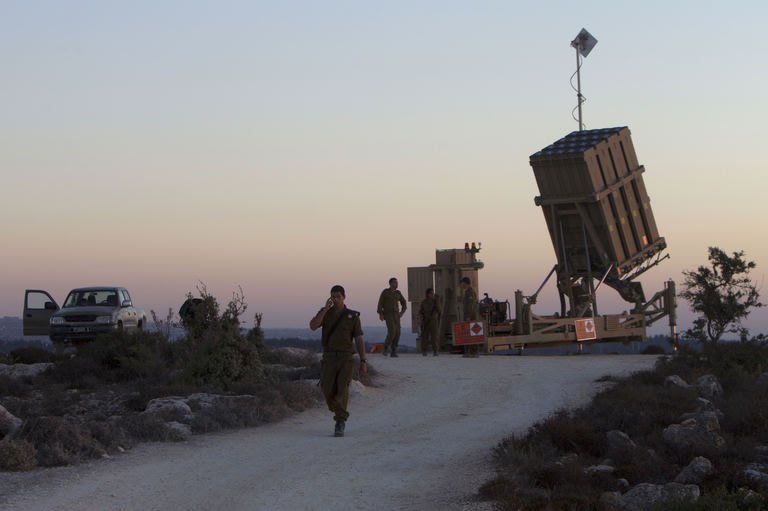
9-Sep-13: Iron Dome battery positioned near Jerusalem

Iron Dome battery deployed somewhere
west of Jerusalem on Sunday [Image Source: AFP
Times of Israel reports tonight that an Iron Dome air defence system battery was deployed near Jerusalem for the first time ever on Sunday. This is seen as part of the military's preparation for the possibility that rockets or missiles will be fired at Israel if and/or when a military operation is undertaken against Syria's Bashar al-Assad regime. It's a reminder of how short the distances are in today's Middle East (as the rocket flies).

We Jerusalemites last heard incoming-missile sirens this past November ["17-Nov-12: Saturday night update"] when the Hamas regime in Gaza fired them at the capital during Operation Pillar of Defense. Two rockets are thought to have exploded somewhere outside, but close to, Jerusalem's city limits.

Haaretz says three other Iron Dome batteries were deployed in recent days at other key locations: near Tel Aviv, and near Haifa and in the Galilee of northern Israel. It says the IDF is considering whether to deploy another battery in northern Israel. Bamahane, the IDF magazine, has said six are currently in service around the country and more are on the way.

Officially at least, the assessment here is of a low probability that the Assad regime or its allies (presumably Hezbollah and Hamas) would attempt to hit Israel in response to a US-led attack on Syria. Times of Israel's article reminds us that "Syrian and Iranian leaders have repeatedly threatened to strike Israel if Obama goes ahead with military intervention."

Saturday, June 29, 2013

29-Jun-13: Syria then and now

IDF field hospital on border with Syria,
March 2013 [Image Source: AFP via Yediot Aharonot]
The situation in Syria, with whose government Israel has repeatedly been urged to come to terms and to make painful compromises etc. etc, goes from catastrophic to even worse.

An NPR report today, "As Doctors Leave Syria, Public Health Crisis Looms", by Deborah Amos, says that while the number of people killed in the vicious civil war there
may now be as high as 100,000... another emergency is looming: a public health crisis across the region.
She quotes a study just published by the British medical journal The Lancet. It says
Syria's health care system is near collapse. Outbreaks of disease are on the rise in the country, and refugees sheltered beyond the border are also at great risk... Seventy percent of Syria's medical professionals have fled the country... There has been a dramatic rise in communicable disease... [Quoting local doctors in the field] 7,000 cases of measles in northern Syria in the past few months after a vaccination program was disrupted by war, and the list is growing to include TB, leishmaniasis, typhoid and cholera, which will come up during the summer months... When you consider chronic diseases like diabetes, Type 1 and 2, and cancer... you start to see that more people are dying of disease rather than war... This could lead to a public health crisis for the entire region. By the end of this year, the Syrian refugee population is expected to reach more than 3 million. [NPR]
Naturally none of this means the thugocracy running the country, and certainly not the jihadist rebels seeking to overthrow the Assad regime, have forgotten their deep hatred for Israelis. A Jerusalem Post report yesterday reminds Israelis of the ramifications:
IDF deploys Iron Dome battery near Haifa | The IDF deployed an Iron Dome anti-rocket battery in the Haifa area early Friday morning, amid heightened tensions in the North stemming from the ongoing Syrian civil war. The IDF Spokesman's Office stated that Iron Dome batteries are redeployed periodically in accordance with appraisals of the security situation. IDF Chief of Staff Lt-Gen. Benny Gantz [said] Thursday, “The region is shaking, from south to north. Syria is hemorrhaging blood, and in Lebanon, the fire has begun to catch the edge of Nasrallah’s robe. In the face of this changing reality, we must be prepared, coordinated and alert, more than ever...” [Jerusalem Post]
Military defenses aside, Israel, has been making a small contribution to addressing the humanitarian disaster unfolding north of the border. The Times of Israel reports tonight that
Over 100 Syrian citizens have been treated in Israel since the outbreak of the Syrian civil war two years ago, Yedioth Ahronoth reported Thursday. According to the report, the Israeli government had downplayed the number of admitted patients, fearing that it would lead to an increase in refugees. Five Syrians remain hospitalized at Ziv besides the injured trio admitted Saturday. Earlier this month, Defense Minister Moshe Ya’alon confirmed for the first time that Israel is operating a field hospital on the Syrian border. He said the IDF was transferring severely wounded Syrian nationals to Israeli hospitals for treatment. Initial reports of an IDF field hospital in the Golan Heights surfaced in February. “Our policy is to help in humanitarian cases, and to that end we are operating a field hospital along the Syrian border,” Ya’alon told the Knesset’s Foreign Affairs and Defense Committee. “In cases where there are badly wounded, we transfer them to Israeli hospitals. We have no intention of opening refugee camps.” The IDF has kept secret the identities of Syrian nationals treated in Israel. [Times of Israel]
To give the monumental Syria implosion some small degree of perspective, a BBC report from three years ago (selected absolutely at random) reflects the memes and themes that seemed so precisely spot on at the time but, with hindsight, were nonsense.
Syria's Bashar al-Assad warns of Middle East conflict | BBC News | 17 June 2010
Syrian President Bashar al-Assad has said Israel's raid on the Gaza aid flotilla has increased the chances of war in the Middle East. In an interview with the BBC's Middle East editor Jeremy Bowen, he said Syria was working to prevent a regional war. But he added that there was no chance of a peace deal with the current Israeli administration, which he called a "pyromaniac government". Mr Assad also rejected claims he was arming Hezbollah militants in Lebanon.
His calling Israel a "pyromaniac government" is part of a response to reports earlier that year saying "Israel desires peace and to engage in unconditional talks with Syria" [Haaretz, February 4, 2010].

As for those Hezbollah "militants" mentioned by the BBC, the general sense in the news media today, three years on, is that Hezbollah's now-admitted intervention on his side appears to be crucial to Assad's energetic manouevres to stay alive while his nation burns.

Wednesday, January 30, 2013

30-Jan-13: Drawing the line between regional warfare and mass-destruction-by-terrorism in Syria

Better to show some kind of red line here [Image Source] than to reach for illustrations of what nerve gas does to people. Such pictures do exist online; many of them are from Syria.
The picture is not clear yet about what happened, and has been happening, up north today, but there's plenty of speculation around. 

We posted earlier about the reports of Israel having carried out some attacks on something on the ground near Syria's Lebanese border. When one of the parties makes an official statement, we may have a basis for being better informed. So far there is mainly silence from everyone except the news reporting media.

There's a background: Israeli officials have been warning for months, using language that has been growing clearer and more explicit, that any transfer of Syria’s advanced weapons, chemical and biological weapons in particular, to terrorist organizations will just not be tolerated. Syria's government is falling apart in front of the world's cameras, but still possesses the largest arsenal of 'non-conventional' weapons on the globe. The air strike this morning may indicate (according to this source) that the Assad regime is testing Israel's resolve on its red line.

Much earlier in the day today (Wednesday) in Jerusalem, a well-informed Israeli official, Brig. Gen. (Ret.) Amnon Sofrin addressed journalists about where Israel's red line is drawn. Sofrin established - and between 2000 and 2003 led - the IDF's combat intelligence corps. Few media experts will have his authority in interpreting what's on the mind of Israeli security officials. Some of his points:
  • For Israel, the red line is crossed with the transfer of any of Syrian non-conventional weapons to Hezbollah.
  • Non-conventional weapons? There's Sarin, an extremely potent nerve gas; that's the one that worries him less. The other is VX. Wikipedia calls it "an extremely toxic substance that has no known uses except in chemical warfare as a nerve agent. As a chemical weapon, it is classified as a weapon of mass destruction by the United Nations in UN Resolution 687. The production and stockpiling of VX was outlawed by the Chemical Weapons Convention of 1993". For a sense of their devastating effects, take a look a recent piece in, of all places, New Yorker: "The Case of Agent 15: Did Syria Use a Nerve Agent?"
  • Assad, who controls "hundreds of warheads", might decide that his regime's days are running out and think, as Sofrin put it: "If I go down and I leave my chair, at least one of the heritage I will leave will be that Hezbollah will have capability to hit Israel very bad. Is it something that you can rule out? I can't."
According to Sofrin, an Israeli failure to prevent such a Syrian transfer to Hezbollah would leave Israel in the very difficult position of having to
"build up a new equation of deterrence against Hezbollah and to make it clear to Hezbollah that if you are going to make any attempt to even think about using it, the price will be very, very high and very painful."
Israel remains conscious of the burdens it carries. The Australian newspaper quotes Sofrin saying this morning that
Israel was unlikely to carry out air strikes on chemical weapons stocks because of the environmental risks. "When you go and attack a... chemical weapons depot, you're going to do unwarranted damage, because every part will leak out and can cause damage to many residents... But if you know of a convoy leading these kind of (chemical) weapon systems from Syria to Lebanon, you can send a unit to the proper place and try to halt it" on the ground.
Those comments were made, as we noted above, before today's reports of an air attack by the IDF emerged. But they came after a series of reports like one from the New York Times ["Hints of Syrian Chemical Push Set Off Global Effort to Stop It"] three weeks ago which spoke of Syrian troops appearing to be mixing chemicals - probably Sarin - at two storage sites and filling dozens of 500-pounds bombs that could be loaded on airplanes and be "airborne in less than two hours".

30-Jan-13: In fighting terrorism, fear cannot be a substitute for moral clarity: Two political figures speak from personal experiences of terror

Trimble and Aznar [Image Source]
We posted here yesterday ["29-Jan-13: What their view on Hezbollah tells us about Europe's counter-terrorism strategy"] about the European Union's pusillanimous stance on banning one of the world's most dangerous and active terror organizations, Hezbollah.

The Times of London has a leading op ed column today written by two former political figures who have deep first-hand experience of terrorism. In their essay, entitled "Don’t mince words. Hezbollah are terrorists", José María Aznar who was was prime minister of Spain from 1996 until a few days after the Madrid railway massacre of 2004, and Lord Trimble, First Minister of Northern Ireland between 1998 and 2002 and a Nobel Peace Prize laureate in 1998, begin with the antithesis to yesterday's Guardian op ed about which we blogged last night: "29-Jan-13: Is the threat of terrorism greater now, or less?". They open with these words:
Jihadi terrorism is still alive and, as events in Mali and Algeria show us, poses a direct threat to us. The turmoil in North Africa reminds us that jihadism has no boundaries and that when confronting terrorism it is always better to prevent it rather than deal with its consequences. 
As we noted yesterday, the EU prefers not to face the reality of terrorism. Trimble and Aznar point to what is and is not being done about Hezbollah to make their case. About last summer's terrorist bombing in Bulgaria of a bus-load of Israelis, they point out that
despite this atrocity some European governments are not willing to declare Hezbollah a security threat and put it on the EU terrorist list. This refusal is based on a misunderstanding of the nature of the group. Hezbollah is not just a Lebanese militia group and political party. It is the long arm of Iran. From its conception by Tehran in 1982, it has been committed to the revolutionary goals of the international expansion of Shia Islam, as dreamt of by the Ayatollah Khomeini. The fact that it holds seats in the Lebanese Parliament and posts in the Cabinet does not mean that its leaders see themselves as just another Lebanese faction — albeit one that murders its political opponents (a UN tribunal found that the assassination of Rafic Hariri, the Lebanese Prime Minister was a Hezbollah plot). On the contrary Hezbollah has a global vision and reach. It has perpetrated attacks in places as distant as Argentina, Georgia, Israel, Thailand, Turkey and Saudi Arabia, as well as Lebanon. It has been involved in illegal but very lucrative activities in Latin America and West Africa. 
They then address a dimension of this issue that often drives us crazy - the willingness of many to make an artificial distinction between the so-called "military wing" of terrorist groups like Hamas and Hezbollah, and their political, charitable and who-knows-what-other front activities. People who think like that, say the authors, are wrong. Hezbollah is a single body and needs to be condemned and blacklisted in all its manifestations:
...Every part plays a role in the overall strategy. The leaders in charge of its hospitals and schools, the military leader and the political representatives all sit together under the secretary-general, Hassan Nasrallah. His deputy, Naim Qassem, was quoted as recently as October, saying: “We don’t have a military wing and a political wing. We don’t have the Party of Allah and the Party of Resistance. These differences do not exist and are rejected.” Hezbollah is committed to violent revolution. It sees itself as being in total confrontation with our way of life. The idea that engaging Hezbollah through the Lebanese political process and institutions would moderate it has proved to be a dangerous illusion. And today it is actively intervening in Syria on behalf of Bashar Assad; we will know soon about the atrocities conducted by its militants there... We know from our own experience in Spain and Northern Ireland that terrorism cannot be defeated unless you tackle all the tentacles that serve the purposes of the terrorists, and that includes the political and financial front organisations. Make no mistake — terrorist groups use all the means at their disposal to survive, flourish and achieve their plans.
About the claim by certain European governments that this is somehow not the right time to put Hezbollah on the EU terrorist list, they correctly ask:
But what more is needed to let us take such a decision? Official bodies, private research, parliamentary inquiries, one after another, have revealed the terrorist connections.
Addressing one of the reasons European states have held back from condemning Hezbollah, they write
We understand the caution of nations that have citizens living in Lebanon or peacekeeping troops deployed there. But fear cannot be a substitute for moral clarity. We need to remember that Unifil II (United Nations Interim Force in Lebanon) was deployed in 2006 to disarm Hezbollah, not to become its hostage... Hezbollah is already present and active on European soil; its illegal activities and networks cover the continent. It has shown that it is willing to strike in Europe. That is why European governments must move now to stigmatise Hezbollah and its activities, vision and goals.
What more must happen before that view is heard and comprehended?