Monday, January 29, 2007

29-Jan-07: Bread of Affliction

A bakery in a holiday resort town in this country came under armed attack today. Three ordinary people, makers of fresh bread, were blown to pieces by a bomber. He is an Arab. He died in his own explosion.

Today's act of hate-driven terrorism happened in Eilat, the southern-most town in Israel. Eilat is filled with hotels and a fairly un-Israeli relaxed ambiance. The fact that it has not previously been hit by self-mutiliating Arab murderers may explain why security in the town has been relatively relaxed. Until now.

We know from bitter experience that until a tragedy like today's hits you personally, you tend to think that it happens only to other people.

We've also learned that those with an inclination towards pontificating and placing things in neat moral boxes tend to sink to the occasion when faced with the opportunity to express an opinion about a tragedy of this kind. Unfortunately most editors and many consumers of news seem unable to distinguish between the pontificators and those with something valuable, insightful and instructive to offer.

So let's review a few published reactions from this day's reporting, and see how much light, as opposed to cheap heat, they manage to generate.

Report: "Israeli leaders said the bombing jeopardized a two-month truce in Gaza."
We say: Really? A two-month truce? We must have come awfully close to peaceful relations with our nation-building neighbours in those two months, right? Hardly. Consider this: "In 2006, the IDF and Shin Bet (Israel Security Agency) caught over 100 Palestinian terrorists who originated in the Gaza Strip and tried crossing into Israel from the Sinai Desert in Egypt. Among the terrorists were suicide bombers, weapons experts on their way to establish terror infrastructure in the West Bank and masterminds of soldier-kidnapping plots. In addition to the terrorists, security forces also succeeded in dismantling 11 terror rings that had established infrastructure which was used for infiltrations along the border. "

Report: "Prime Minister Olmert vowed to continue the "ongoing and never-ending struggle against terrorists.""
We say: Really? Yediot Aharonot sees it differently.
"No obstacle along border, IDF officer says
"There is a substantial need for a physical obstacle along the border with Egypt, sources in the Israel Defense Forces said several hours after the Eilat terror attack , which claimed the lives of three people. A senior IDF officer said Monday evening that building such an obstacle, such as a fence along the Israel-Egypt border, was necessary in order to meet the challenges posed by terror organizations in the area. "What worries me is that what happened today will only tempt other terror groups to continue their attempts to carry out attack in the same pattern," the officer said. "We must remember that what happened today was not a record incident and that graver incident could take place. There is no physical, artificial or mental obstacle along the border," he added."

Report: Our defense minister, Amir Peretz, convening an emergency meeting of top security officials said: "This is a grave incident, it's an escalation and we shall treat it as such."
We say: Yes, it's grave. Every time the forces of terror manage to break through the defences which civilized societies put up against the barbarians, it's grave. But it's not an escalation of any sort. It's precisely the same old same old -- Arab terror is a constant -- that leaves us so exasperated by the empty words and incoherent actions of the political figures who bring so much noise and so little wisdom to public life here and in most other places.

Report: "A spokesman for Hamas, the radical Islamic group that controls the Palestinian parliament and Cabinet, praised the bombing as a "natural response"."
We say: Praising terror is what separates barbarian society from civilized society. So then why do the hate-filled statements of the barbarians receive so much air time? They're not only a threat to our society here in Israel. They're a threat to all societies.

Report: "Palestinian terror organizations Al Aqsa Martyr's Brigade, an arm of Palestinian President Mahmoud Abbas' Fatah organization, and Islamic Jihad have claimed joint responsibility for the attack. "
We say: A Jerusalem Post analysis puts this in perspective: "It also does not make much of a difference which terror group was behind the attack. Nowadays, most of the groups - Islamic Jihad, Hamas, Tanzim, Al Aksa Brigades, PFLP - work together with one supplying the bomb, the other the bomber, and a third the infiltration route. The attack is also a way of trying to divert the attention from the Palestinian internal factional fighting and unite the groups to fight against their common enemy Israel instead of against one another."

Report: "A senior aide to Palestinian Authority President Mahmoud Abbas condemned the attack. "We reject these acts and we do not believe that they are in the interest of the Palestinian cause and that they blacken the image of the Palestinian people," Yasser Abed Rabbo told AFP news agency. "
We say: It isn't really a condemnation when you say something shouldn't have been done because it spoils your image. Can you imagine the impact of a Palestinian Arab leader getting up and saying "We have to stop these acts of murder and hatred because they're sending our society back to the stone age and creating a moral burden for our children's children's children that no society can ever bear. We have to stop this because it's immoral and appallingly wrong."
Well, we can dream.

Report: "The last suicide attack was at a Tel Aviv restaurant, killing 10 people. Hundreds of Palestinians have been killed by Israeli forces in that time, mainly in the Gaza Strip."
We say: The BBC has an interesting way of framing the story. There was a previous terror attack, they say. Then afterwards the Israelis killed hundreds
of Arabs (a toll that presumably includes deaths like that of the cowardly thug who attacked the bread loaves and ovens this morning). Tit for tat. Classic BBC-talk. Cycle of violence. Want to understand why today's killings happened? asks the BBC's editor. Because hundreds of Palestinians have been killed. Except that this killing by Arabs of Jews in the Jewish homeland has been happening for more than a hundred years. Long before there were occupied territories. Long before there were any Israeli forces. Long before the BBC and the other purveyors of morally-confused news reporting began sending their ill-informed and agenda-driven reporters and photographers to this area.

Thursday, January 25, 2007

25-Jan-07: An observation about religion and differences among people

As people who just want to be left in peace to raise our family, to make an honest living, to protect our health and to contribute something useful to society, we sometimes feel like an endangered species. Israel is filled with people like us, of course. But looking around at our neighbours here in the Middle East and wondering about their values, actions and aspirations can sometimes be an extremely dis-spiriting thing.

Just two examples to make a point.

First, the absolutely indispensable but relatively little-known Palestinian Arab journalist, Khaled Abu Toameh, writes in one of today's dailies about some Arab voices you almost never hear.
"The situation is very dangerous... I believe that 15 years from now there will be no Christians left in Bethlehem. Then you will need a torch to find a Christian here. This is a very sad situation."
Abu Toameh writes of how a monk was recently roughed up for trying to prevent a group of Muslim men from seizing lands owned by Christians in Beit Sahur:
Thieves have targeted the homes of many Christian families and a "land mafia" has succeeded in laying its hands on vast areas of land belonging to Christians... "President Mahmoud Abbas is taking our case very seriously," said Georgette Lama. "But until now he hasn't done anything to help us get our land back. We are very concerned because we're not the only ones suffering from this phenomenon. Most Christians are afraid to speak, but I don't care because we have nothing more to lose..."
A Christian businessman who asked not to be identified said the conditions of Christians in Bethlehem and its surroundings had deteriorated ever since the area was handed over to the PA in 1995. "Every day we hear of another Christian family that has immigrated to the US, Canada or Latin America... The Christians today make up less than 15 percent of the population. People are running away because the Palestinian government isn't doing anything to protect them and their property against Muslim thugs. "
As Jews, we have never understood how little concern there seems to be among Christians outside the region about the suffering of their Christian brothers. And if you'd like to know why this bothers us so much, click on Human Rights of Christians in Palestinian Society.

Meanwhile here's a second illustration of how depressing it is to see what the people in the states that border on ours do and think.

This one is a Moslem viewpoint. Published a few weeks ago by a freelance writer from Islamabad, Pakistan, it expresses opinions that are rarely heard anywhere, and probably least of all in Islamic society. The voice belongs to Farrukh Saleem, a man brave enough - or maybe crazy enough - to publish his email address.

Saleem says the League of Arab States has 22 members. 7 of them are monarchies and 6 are classed by the UN Commission on Human Rights as "authoritarian" and among the "world's most repressive regimes" (Libya, Syria, Sudan, Tunisia, Algeria and Somalia).

Against this promising background, our Pakistani observer shares with us these insights:
  • Of the 330 million Moslems living in Arab countries, fewer than half a million live in a democracy. That's 0.15 per cent of all the Moslem Arabs in the world.
  • You need to travel no more than 250 miles from the Arab League's headquarters in Cairo to encounter the sole parliamentary democracy in the entire Middle East. It's a place that has universal suffrage. It's a country with multi-party, multi-candidate, competitive elections. It's called Israel.
  • "Israel [says Saleem] spends $110 on scientific research per year per person while the same figure for the Arab world is $2."
  • Knowledge [he writes] makes Israel grow by 5.2 per cent a year. Meanwhile the average production per worker in the Arab League countries was negative throughout the 1980's and 90's according to the World Bank's Arab Development Report.
  • The average per capita income in Israel is $25,000. In the oil-rich Arab League countries, it's $5,000.
  • "The state of Israel [he writes] now has six universities ranked as among the best on the face of the planet. "
  • He gets more specific, quoting an authoritative source on tertiary education: "The Hebrew University in Jerusalem is in the top 100. Technion Israel Institute of Technology, Tel Aviv University and Weizmann Institute of Science are in the top 200. Bar Ilan University and Ben Gurion University are in the top 300. The Arab League does not have a single university in the top 400.
  • Every second Arab women is unable to read and to write. Noting this, he quotes Imam Ali Ibn Abi Taleb: "If God were to humiliate a human being, He would deny him knowledge".
  • Between 1998 and 2000, more than 15,000 Arab physicians migrated out of the Arab world. According to World Bank figures, "roughly 25 per cent of 300,000 first degree graduates from Arab universities emigrated. Roughly 23 per cent of Arab engineers, 50 per cent of Arab doctors and 15 per cent of Arab BSc holders had emigrated."
  • Israel, on the other hand, has more engineers and scientists per capita than any other country in the world. For every 10,000 Israelis, there are 145 engineers or scientists.
  • Israel ranks among the top 7 countries worldwide for patents per capita.
  • He mentions Teva Pharmaceutical Industries - whose plant we can see from our living room window here in Jerusalem - because it's the world's largest producer of antibiotics. Teva also developed Copaxone, a unique immunomodulator therapy for the treatment of multiple sclerosis, the only non-interferon agent available.
  • Most members of the Arab League grant Moslem women few rights in relation to marriage, divorce, dress code, civil rights, legal status and education. Israel is entirely different - its women enjoy the broadest possible rights by any standards.
  • Spain (alone) translates more books in a single year than the entire Arab world has in the past thousand years.
  • The world's six million Israelis buy 12 million books every year. This makes them one of the highest consumers of books in the world.
  • Israel has the highest number of university degrees per capita in the world. The Arab world has the lowest.
  • Israel produces more scientific papers per capita than any other country (109 per 10,000 Israelis). The Arab world? Next to none.
Does any of this matter? No, not if you're a Christian living in a Moslem country. Or a women, or a liberal.

But yes, it does matter to people like us. We have a lot to protect: a society that's growing, achieving, making an impact. If the Arabs in general, and the Palestinian Arabs in particular, had the same kind of stake in their own future, the chances that we might find ways to live in peace with each other would be immeasurably greater.

Even from Pakistan, it's clear how far we are from that happening.

Monday, January 01, 2007

1-Jan-07: The "Whole Earth Guide" to Blowing People Up in their Homes

You no longer need to wear a kaffiyeh to be a jihadist. Sometimes it's enough just to have access to a word-processor and an assignment from a major newspaper or electronic media publisher.

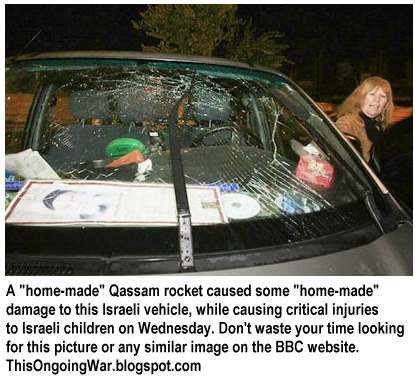
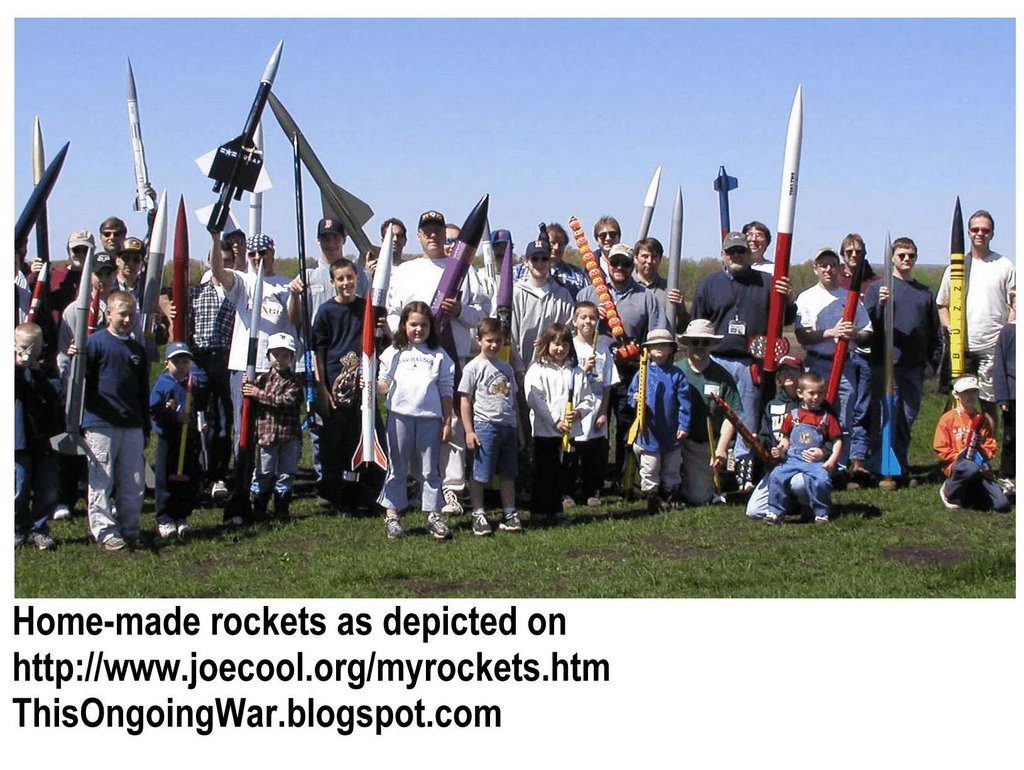
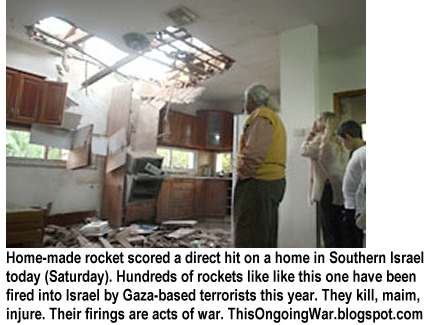
For years, major brands like BBC, NYTimes and Agence France Press have leavened their reportage from such terror-afflicted Israeli cities as Sderot and Ashkelon with the expression "home-made" in reference to Palestinian Arab weaponry, and especially their rockets.

A fine piece of writing in The Australian newspaper this weekend provides a valuable perspective on that sort of soft-headed, nonsensical journalism.

Here's an extract:
Qassam rockets are the brainchild of Adnan al-Ghoul - literally Adnan the evil demon who feeds on corpses - the chief Hamas bomb manufacturer until he was killed in an Israeli airstrike in 2004. He devised the weapon after Yasser Arafat rejected the Camp David peace accords in 2000 and declared war on Israel, launching the second intifada.

Qassams are fuelled by a solid propellant made of potassium nitrate (fertiliser) and sugar, which is melted down to a combustible toffee in domestic kitchens. This fuel is packed into casings, made out of the steel poles used to mount traffic lights. The advantage of the Qassam is that it can be fired at Israel over the security wall, largely without endangering the lives of the terrorists. The disadvantage is that they are unguided but the terrorists have learned by trial and error that if they fire enough of them they will eventually murder Israelis.

Al-Ghoul's first rockets were constructed in Gaza and fired at Israel in 2001. They became increasingly deadly as their range and payload was extended. Al-Ghoul's earliest prototypes had a maximum range of 3km, weighed 5.5 kilos and had a 500-gram explosives payload. The Qassam 3 has a range of 10km, weighs 90kg and has a payload of 10kg. In July 2006, Hamas fired a Qassam that it claims has a range of 15km and hit a high school in central Ashkelon.

Qassam rockets are frequently referred to in the media as home-made, as if they were as wholesome as a tray of home-baked biscuits or simply a bit of fun for the kiddies on cracker night. Arafat before his death claimed Qassams hadn't killed anyone, saying: "They only make noise."

In fact, Qassams are deadly and Adir Bassad is only the latest to be left fighting for his life. Fatima Slutzker, 57, and Yaakov Yaakobov, 43, were killed by Qassams in November. The first fatalities were two Israeli toddlers, Dorit Benisian, 2, and Yuval Abebeh, 4, killed as they were playing outside their grandmother's house in Sderot near the border with Gaza in September 2004. Afik Zahavi, also 4, was killed as his mother was taking him to nursery school. Ella Abukasis, 17, was killed as she shielded her younger brother from a rocket. Dana Galkowicz, 22, was killed as she sat on the verandah of her boyfriend's house. Mordechai Yosepov, 49, was killed as he sat near the nursery his two grandchildren attended. In total, Qassams have killed eight people in Israel and five in Gaza - a Chinese worker, a Thai worker, two Palestinian workers and a Palestinian girl, killed by a rocket that fell short of theborder.
Please read the whole article. In fact, consider putting it aside to re-read the next time you come across such gems as the BBC's definitive backgrounder on the Gaza Strip, a classic analysis piece which manages to tell you everything you need to know without a single mention of the word Qassam (or Kassam).

Why bother? They're really just for children.

Sunday, December 31, 2006

31-Dec-06: Terror Sinks Roots in Even the Best of Neighbourhoods

Five months ago, in an article called "BBC Exposes Hamas' UK Terror Financiers", we wrote about a BBC Panorama expose of Interpal. That's a British charity certified by the US authorities as a terrorist front organization but happily in business in the UK all these years, riding above the storm. The BBC calls Panorama its most important documentary programme.

We pointed our readers to a transcript of the Panorama programme here, and to a streaming video edition of the entire one-hour film.

Today, the BBC reports that
...the Charity Commission has launched a formal investigation into the London-based Palestinian charity Interpal. The commission says there are "concerns about the potential for indirect and inappropriate links" between Interpal "and organisations or individuals who appear to support the militant or terrorist activities of Hamas".
This about-face comes after years of the British authorities refuting claims from Israeli and American sources about those "inappropriate links", while downplaying strong documentary evidence that Interpal plays a central role in the global jihadist enterprise. An earlier Charities Commission investigation stubbornly provided Interpal with a clean bill of health.

That investigation, it now turns out, was "not in depth." Who'd ever have thought it?

But to their credit, the Panorama team kept plugging away, undaunted by the status and prestige of Interpal as one of Europe's largest Moslem charities, according to Wikipedia. If you catch the show, you'll be left in little doubt about what Interpal really stands for. As today's BBC item says:
The programme showed how Interpal's Managing Trustee Dr Essam Yusuf doubled as the key trustee for a coalition of Islamic charities chaired by Dr Yusuf Qaradawi, who has championed suicide bombings in the Israel-Palestine conflict.
We've not the only ones to have a hard time understanding the British authorities and their hands-off attitude to the purveyors of terror. Their capital city has turned into Londonistan right under their prim and proper noses.

In the interests of full disclosure, our interest in this story is personal. On 9th August 2001, Hamas murdered our fifteen year-old daughter with the financial backing of overt and hidden supporters in Europe and throughout the Arab world.

Friday, December 29, 2006

29-Dec-06: Seven Arab Terror Attacks So Far Today

Don't look for this story in the New York Times, BBC World, the Guardian or AFP. Because it's not there. Check now - you'll see from Google News that almost all the reporting that's been published is Israeli.

Palestinian Arabs have fired seven more Qassam rockets into Israel so far today (Friday) and it's still only mid-afternoon. We can tell you what happened with six of the seven. One landed in the Sha'ar Hanegev area; two landed in the Eshkol area; one near the Karni Crossing (a goods crossing for trucks moving between Israel and Gaza); in the strip between Kibbutz Nahal Oz and Kibbutz Alumim; and one on Zikim beach (it's freezing cold, so presumably very few people there).

Nearly seventy - that's 70 - rockets have been fired so far by Pal-Arab thugs operating in Gaza since the "ceasefire" declared on 27th November 2006.

(The comprehensive BBC Israelis-and_Palestinians web-page is almost entirely devoid of mentions of Qassams or Israeli victims. The sole reference to what's being done to Sderot is from June.)

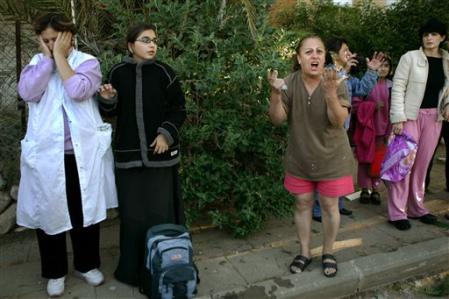
Thankfully the casualties and damage were relatively light this time. But there have been deaths. And families unlucky enough to be making their homes in undisputed, uncontested, unoccupied, 100%-lawful Israeli towns within firing range of the Gazans are in constant, very real danger, their lives terrorised and bordering on the unbearable.

On a far more positive note, we're very glad to report that there has been a significant improvement in the condition of 14-year old Adir Basad who was injured by a Qassam rocket in Sderot on Tuesday. He recovered consciousness in Barzilai Hospital yesterday, breathing independently after being taken off the respirator on Thursday morning. One report says he managed to speak a little with his family.

Discerning consumers of news products will be asking themselves why the constant barrage of rockets is almost entirely unmentioned in news reports; why the so-called "ceasefire", now in its second bogus month, continues to be reported as if it were holding; why the absence of even a semblance of counter-terrorist activity by the terrorist regime in Gaza is undisclosed. The disgraceful, deliberate, politically-motivated silence of the major media channels in the face of this ongoing war is a story that has to be told.

Just don't hold your breath waiting for Reuters, AP and the other majors to do it.

Wednesday, December 27, 2006

27-Dec-06: So This is What's Meant by Ceasefire

It's hard not become affected by cynicism when you live in this neighbourhood.

We're now into the second month of a "ceasefire" between Israel and the Palestinian Arab leadership. A ceasefire designed to bring an end to Israeli defence actions inside the Gaza Strip on one hand, and to stop the murderous firing of explosive rockets into Israeli cities, towns, settlements, farms, homes and people.

So how effective has it been? Very effective... if you're a Gazan. Israeli military actions inside the Gaza Strip have come to a complete stop, as Israel agreed.

But if you're an Israeli, especially one who lives near Israel's border with the Gaza Strip, the picture could not be more different. Eight Qassam rockets were fired into Israel yesterday (Tuesday). That's the largest one-day total since the ceasefire was declared. Sixty rocket attacks so far since the "ceasefire" started. 60.

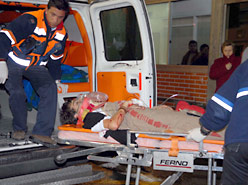
And at 9 o'clock last night, two Sderot boys, both 14, were injured when a Pal-Arab rocket crashed into the street where they were walking. This morning's reports say Adir Basad is in surgery and in critical condition. And Matan Cohen is in moderate to serious condition having lost one foot and in danger of losing his leg. Matan's home had been hit in a previous Pal-Arab terror attack.

For the record, reports about the two boys and their injuries are almost completely absent from the news coverage coming from this extremely over-covered part of the world. If you do a Google News search now (click here), you'll see that, by and large, the only news reports about Israeli children being injured by Palestinian Arab terrorists and in danger of dying are Israeli sources. The rare foreign reports use such laconic language as "Two Israelis were wounded..."

This is more than just appalling. It's part of a pattern which Israelis can see and almost no one else wants to. To understand what's happening in this ongoing war, you need to be an Israeli or be willing to avail yourself of Israeli news sources. Otherwise you're left wondering why Israel is constantly beating the daylights out of those poor defenceless Pal-Arabs, making their lives miserable with "unprovoked", massive military over-response. 'Activist' news sources such as the French AFP make the task of finding the truth even more challenging when they come up with classics like "The truce has generally held amid hopes that it can help restart the dormant peace process."

Whose
hopes? The Pal-Arabs'? For heaven's sake, they openly claim credit for these acts of terror, including last night's. But evidently they don't issue their press releases in the French language.

The news and the way it's reported is a critical part of the advances which terrorists are making against civilized society. What are you doing about it?

Tuesday, December 26, 2006

26-Dec-06: Excavators for Freedom, Dig It?

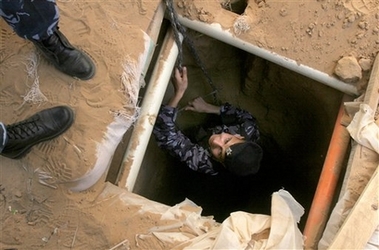
An Associated Press report says the digging of tunnels used for smuggling arms into the Palestinian Authority is Gaza's "fastest growing" business. Not only that, but it's "one of the biggest obstacles to any lasting Israeli-Palestinian truce".

The number of tunnels has doubled since Israel unilaterally withdrew from the Gaza Strip almost a year and a half ago. According to both Israeli and Palestinian sources, the weapons reaching Palestinian hands include longer-range Katyusha rockets, cordite, the explosive propellant used in anti-aircraft weapons, anti-tank missiles and "thousands of rifles and tons of explosives."

When Israel withdrew, says AP:

some 90 tunnels were operating. Now, there are at least 150, but the number is probably closer to 250, said one tunnel digger. The digger, a tunnel operator and a former operator - all insisting on anonymity because they said they fear repercussions despite relatively lax law enforcement - described the tunneling.

But to be fair, when you're as busy blowing one another's people's brains out, as Abbas of Fatah and Haniyeh of Hamas are, you can hardly be expected to trouble yourself with sideshows like tunnels. Or with stopping Qassam rockets. Four were fired into Israel this morning, bringing to thirty the number of Palestinian Arab missiles fired from Gaza into Israeli towns, cities, farms and homes in the past week of this "ceasefire".

Is anyone, but literally anyone, bothered by the bald-faced hypocrisy of the Pal-Arab terrorists and their fancy Italian suits and ties?

Friday, December 22, 2006

22-Dec-06: An End-of-Year Call to Action

For many people, we're approaching the end of the financial year. A good time to remind you of the voluntary work we (the bloggers behind this site) do and have done since September 2001.

We lost our child to an act of barbaric murder and incomprehensible hatred. Our response has been to create the Malki Foundation in our daughter's name and to raise money and distribute it very efficiently in a way that allows us to do a lot good. You can get the whole picture at the website of the Malki Foundation. But if you're click-resistant, here's the brief version.

For Israeli families (Jews, Christians, Moslems, Druze, others) who have a special-needs child like the little boy above being helped by his brother, we provide substantial subsidies to enable five kinds of therapy: physical, occupational, speech, water and horse-riding. This subsidy is given without limit, provided the child is being cared for at home and not institutionalized. The parents decide how much therapy, which therapies and which therapist. We aim to empower them, and certainly not to patronize or direct them. They get enough of that from the establishment.

We also provide long-term free loans of home-care equipment like beds, wheelchairs, walkers and standers. The goal, again, is to make home-care a real option for such families.

In a country which has some fine institutional solutions, we believe that home care is and always will be the best option for a child with serious disabilities. For those who agree (not everyone), we want to help in our murdered daughter's name. We are doing this today for many hundreds of families with a special-needs child.

We have a blind, severely-disabled eleven year old child at home (she attends a special school but sleeps at home) and came by our opinions the authentic way - by living the experience, by fighting the establishment and by learning how to work around the schlerosis in the system in order to do substantial good. And for those to whom this sort of statistic is important, nearly a third of the families we support month-in, month-out are Arab.

If you're in a position to help us by making a 2006 fiscal-year donation, we can promise it will be honestly and effectively applied. And if you're living in the United States or Israel, we can provide you with a tax-deduction for your contribution. Details here.

22-Dec-06: In confusing times, it sometimes pays to stop, look and listen

Image Source
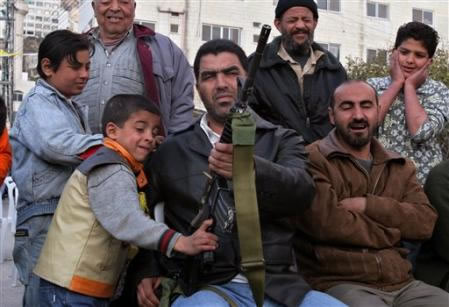
There's steady bloodshed going on down south of us. The revolutionary heros of the Palestinian Arab nation-to-be are busy firing into one another, into one another's children and into Israeli homes, towns and cities that have the misfortune of a location close to the Gaza Strip.

There's been a ceasefire between Israeli forces and the Hamas/Fatah/Jihadist gangs since November... but as of yesterday more than forty Qassam rockets had been fired in the direction of Israel since it was announced, presumably to provide added emphasis to that ceasefire.

There have been numerous injuries and plenty of damage from the random firings of these 'heros', mostly among their own children, siblings and cousins.

Yesterday, though several rockets crashed into the southern Israeli city of Sderot, most of the injuries were among small Arab children in Gazan Bet Hanoun where a rocket fell short. Your local media won't report it (Pal Arabs injuring other Pal Arabs? Who cares?) so click on this Israeli media link about the rockets, or this other Israeli link about forocious gun-fights and mutual kidnappings and killings (read about Pal-Arab parents placing their children into empty baths to protect them from revolutionary bullets flying in through the window) among over-supplied, over-testosteroned Pal-Arab terror gangs.

Image Source
And not only in Gaza.

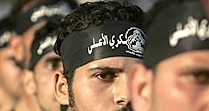
The pictures over on the right are from yesterday in the entirely-Pal-Arab-controlled town of Nablus. The manly heros prancing, preening and wielding their weaponry belong to the Al-Aqsa Martyrs Brigade, a thuggish, brutish armed gang that answers directly to the head of Fatah, Mahmoud Abbas (a.k.a. the president of the Palestinian Authority).

You don't really need to know much about the attitude of Pal-Arab society to the welfare of its own children beyond what these images convey so articulately.

But if perchance you do care to hear a reasonable, rational, extraordinarily well-informed Arab voice speaking articulately and fearlessly about the moral dimensions of the endless war of terror against the Jewish communities of Israel and about the almost inconceivable harm which Palestinian Arab society has done to itself and in particular its children, this video speech would be a good place to start.

Monday, November 27, 2006

27-Nov-06: Today would have been our daughter's 21st birthday

Malki in 2000, standing in one of the galleries of
the Jerusalem Theatre. Her mother's art was on
display there that day and Malki came to watch
as visitors admired the pictures.
Our daughter Malki was born twenty-one years ago today on 27th November 1985 in Melbourne, Australia. 

Her life ended in a roaring explosion the center of Jerusalem on 9th August 2001. A Hamas barbarian exploded his guitar case inside one of the city's most popular and crowded restaurants, the Sbarro pizzeria. 

The human bomb had been brought there by the attack's mastermind, a Jordanian woman who was herself just 21 and possessed of evil beyond description.

We hope you will take a moment to remember Malki's beautiful life by paying a visit to the website of the foundation that bears her name. It does a good deal of practical work for families from all parts of Israeli society who care at home for a disabled child. The website address is www.kerenmalki.org

Malki's mother wrote the short essay below soon after the murder:
How can I compress my Malki's fifteen years into a mere few words? How can I sing her praises without sounding hyperbolic? And, the greatest challenge, how can I endure the pain that this will undoubtedly bring? While the task seems daunting, I will attempt it nonetheless.

Since a Palestinian Arab suicide bomber snuffed out her life on August 9th, talking about my Malki is all there is left for me to do for her. And helping her was something I so enjoyed.

The opportunities were usually limited; she was a very independent girl. I used to tell friends that she was "fifteen going on eighteen."
Malki handled all her school and teacher problems on her own. Shopped for her clothes without me. Conducted a very active social life at Horev Girls school and in her youth movement, Ezra. During her last two years, she was rarely at home. So I had to look hard for ways to lend her a hand. A lift by car to her flute lesson now and again to save her the short walk. A quick dash in my car to hand her the lunch she made but forgotten on the kitchen counter. A pretty new blouse I thought might grab her. A few packets of her favorite gum. Small gestures.

But the help she gave me was always on a grand scale, in ways that truly mattered. I could count on Malki to calm down her eight year-old sister who has a tendency to become irate or rebellious. Taking her into her bedroom, they'd chat a while; this would somehow win her over. Malki would then proudly present me with a cooperative little girl eager to brush her teeth, finish her homework or do whatever it was I'd been insisting upon in vain. When I would collapse on the couch after an exhausting day, Malki appeared at my side with my pillow and blanket, and gently settled me down.

She never missed a chance to compliment me when I dressed up for a simcha or wore a new outfit. When my husband would phone home from one of his overseas business trips, Malki would first ask him how he was feeling and how his meetings were panning out. Only then would she enquire about the items she'd asked him to buy her. (I, on the other hand, would launch pell-mell into my long shopping list, along with a litany of the woes I was enduring on the home front by myself.) If she were spending some time downtown, she would call home and offer to do errands for me, aware that I rarely get out of the house.


Then there was her unique relationship with Haya-Elisheva, our youngest child, now six-and-a-half, who suffers from global and profound retardation as well as an extreme epilepsy condition called Lennox-Gastaut. Early on, when Haya was hospitalized, Malki spent many hours at her side, relieving me or simply keeping me company. She was only eleven at the time but once alerted me to the fact that a nurse had hooked Haya up to the wrong IV drip. On another occasion she was the first to notice a croupy cough that turned out to need antibiotics.

As a result of her competence, I grew to lean on her - perhaps more than I should have. In one of several diaries she left behind, she confessed that she would be happy if we had put Haya away in an institution-though to me she insisted that she preferred to keep her at home.


Despite the challenges, Malki was well-balanced enough to develop into a wholesome, active teen-ager. Her ability to see the bright side of things, to concentrate on the "half-fullness of the cup" became her trademark.

Many of her close friends have written to tell us how Malki constantly inspired them to fight despondence, be happy, utilize every moment for fun but worthwhile activities. She achieved this in a variety of ways. One was the cards she sent to her friends: birthdays, holidays, returns from vacations, a disappointment, whatever. On the cover, an artistic decoration alongside an apt poem or quotation she had read somewhere that had touched her. On the back - a personal, original note.

Another was the intense, empathetic heart-to-heart talks she had with her friends. In her diaries, these are often mentioned as the highlights of her day.


Yet a third medium of uplifting was music, an area in which she was multi-talented. She studied recorder and flute for some ten years and acquired impressive skill in both. When her school or youth movement organized some event she never failed to contribute with either solo or group performances. At mid and end-of-year concerts of the neighborhood conservatory where she took lessons, Malki's playing always reduced me to tears of nachat. She also taught herself to play guitar and, I've been told, would lug it around practically everywhere, and strike up group sing-a-longs at every opportunity - even on the school bus. Needless to say, the songs she and her friends sang were what are dubbed here "shirei neshama" - songs of the soul.

Once Haya's condition stabilized somewhat and I leaned on Malki's help in that area a lot less, I made a great effort to "normalize" our family life as much as possible. Malki's contacts with Haya were more pleasurable, and her love unadulterated. On those rare occasions when she was home relaxing, Malki would sit Haya in her lap on an armchair. At night, she often took her into her bed and slept beside her. She became the only other family member capable of feeding Haya and relieved me thus from time to time.

Her relationship with Haya did not satisfy her urge to help those less fortunate than herself. She exhibited an amazing sensitivity to all kinds of disabled people. One summer she helped a local single mother with her profoundly disabled child suffering from the degenerative Canavan's Disease. His limited responses were hardly noticed by others but elicited enthusiasm from my Mali (the name we used inside the family).

At school, she gravitated towards the group of learning-disabled girls who study in a separate but parallel class. She developed genuine friendships with them and urged her teachers to include those girls more frequently in joint activities with the other students.

Two weeks before her death, Malki volunteered with a girlfriend at a sports camp located in the Galilee (arranged by the Etgarim organization) for disabled children. During the five days they were there assisting the counselors, Malki's gentle, caring way touched everyone. Many of the people associated with Etgarim travelled long distances to comfort us during the Shiva - one trekked all the way from Kiryat Shmona at Israel's northernmost edge and back in one day, a four hour drive each way-and related incredible stories to us about Malki.

One of the counsellors who had supervised her remembered the farewell chat he had conducted with the volunteers the night before their return home. When he asked each of the volunteers to stand up and tell the group what they viewed as the most important feature of their stint, they all emphasized the importance of and satisfaction gained from giving to others. Malki was the last one to speak. We were told that she was the only one who spoke of what she had gained - of the happiness she had experienced in working with the children.


Nearly a year before she was murdered, Malki and her friends, at the behest of their youth movement leader, wrote personal letters addressed to G-d, in which they expressed their prayers and requests for the upcoming Jewish New Year. They submitted them to her in sealed envelopes, the intention being to open and read them aloud the following year. The madricha (leader) brought us Malki's sealed letter during the Shiva. Arnold, my husband has not yet managed to bring himself to read it but, despite a torrent of tears, I did. In it, Malki prayed for success in school and in her youth movement as a counselor (which she was to become several months later). She added the hope that our family would remain close and supportive of one another. Her request for Haya was particularly striking: not for a miracle, a cure or even a dramatic improvement. Ever modest, she asked that Haya learn to somehow convey to us which of our actions please and which disturb her. In the final line of Malki's letter, in small script because the page had already been filled, I read: "…and that I'll be alive and that the Messiah should come".

People have told us that our precious memories will eventually bring comfort. But at this point that seems impossible. I cannot conjure up even one of those I have mentioned without crying over the tragic loss that has befallen us, her friends, and the many others she surely would have helped had she been allowed to live out her life to its full course.


Frimet Roth

Jerusalem (October 2001)
In her memory, we would be glad if you would listen to a song Malki wrote in the last year of her life. The words and the music are hers; the spirit is the indomitable spirit of the Jewish people. Malki's Song in MP3 form is downloadable (in multiple versions) from here.

Saturday, November 25, 2006

25-Nov-06: Memo to "Refugee" Camp Manager: Words Kill

Earlier this week, UN Relief and Works Agency for Palestine Refugees (UNRWA) Commissioner-General Karen Koning AbuZayd said this:
“I fully recognize the right and responsibility of Israel to protect its citizens, and its legitimate concern about the home-made rockets fired from Gaza. But for humanitarian agencies such as UNRWA it is becoming increasingly difficult to deal with the aftermath of such military operations without questioning their justification, their proportionality and their effects.”
We have a suggestion for Mrs. Koning AbuZayd: If you're going to question the justification, proportionality and effects of the Israeli "aftermath", perhaps it's time to question whether your use of the expression "home-made rockets" makes sense.
Could this be simple naivete on Mrs Konig AbuZayd's part? Not likely since she's perfectly aware of the number of rockets fired from within and near the camps she manages.

Far more likely, it's a conscious attempt at diminishing the dangers of this particular aspect of Palestinian terror. After all, insisting as long and as consistently as UNRWA does, that terror attacks on Israelis are trivial is part of a strategy to delegitimize Israel's acts of self-defence. The intended result: more Israeli deaths.

While we're at it, here's some background about UNRWA for those wondering how many other refugee agencies are operated by the United Nations.
  • The United Nations deals with the world's refugees with a single agency ­, the U.N. High Commission for Refugees­. But the Palestinian refugees have their very own agency ­ - UNRWA ­ - with a particular mission.
  • UNRWA was founded in 1949. Since that time, it has consistently abused its mandate and become a tool of terror. UNRWA has an annual $400 million budget (which includes $90 million from the U.S.) This compares with the $881 million budget for the United Nations High Commission for Refugees (UNHCR).
  • Some 23,000 UNRWA employees care for an estimated 3.9 million Arab “refugees,” compared with an UNHCR staff of 5,000 to manage relief for nearly 20 million other refugees in the world today.
  • UNRWA's primary mission has never been to help the Palestinians deal with the reality of the post-1948 world. Resettling the Palestinians was never, and is not, the point. No UNRWA camp has ever shut down.
  • UNRWA exists to keep the Palestinians alive exactly where they are. This serves, for those interested in such convoluted and sick logic, as the justification for continued conflict with Israel.
  • Does UNRWA employ terrorists? Maybe. "I am sure that there are Hamas members on the UNRWA payroll and I don't see that as a crime... we do not do political vetting and exclude people from one persuasion as against another." That's a statement by Peter Hansen, UNRWA's head speaking in 2004. (Hamas is the terror organization that claimed responsibility for a massacre in the Sbarro restaurant in the centre of Jerusalem where our fifteen year-old daughter was murdered in 2001.)
  • UNRWA employees have been filmed using UN ambulances and other equipment to transport armed terrorists, bombs and other weapons.
  • UNRWA retirement benefits include a fund whose assets now total some $10 billion. No other UN agency has such a fund.

Thursday, November 23, 2006

23-Nov-06: Israel Under Fire - Only You'd Never Figure That Out From The Reports

For far, far too long, the media have reported the daily bombardments of southern Israel - if they have reported on them at all - as being attacks on Sderot.

Since most Israelis have never visited Sderot, and most non-Israelis don't have a clue where Sderot is or what it looks like, this has serious implications.

It amounts to a total delegitimization of the suffering of ordinary Israelis in the face of the extraordinary ongoing war waged by the Palestinian government against Israel and Israelis.

Even within Israel, there's a reluctance to face up to the true implications. After all, it's only Sderot under attack. We can tolerate that, but just don't let those Arabs dare to attack our centre, our cities, our whatever.

The fact is - it's Israel under attack, not (only) Sderot. It's Israelis under attack, and the intention is to cause civilian deaths and injury. There is no strategic plan beyond this, because civilian deaths and injury are enough when you're a terrorist. In fact, they are the whole purpose.

An analogy that comes to mind is an American administration saying to its people: "Never mind, the enemy have only attacked far-off Pearl Harbour. We don't really need to let this ruin our parade."

The Palestinian Arabs don't hide what they're doing. They don't deny it. They do however rely on the in-built apathy of people living far from where the rockets fall to allow them to get on with their barbarism. That apathy costs lives.

The headline-writers, and the policy makers as well, are playing into the hands of the terrorists.

The unusually sensitive article below comes from today's Haaretz.

As officials stay away from funeral of eighth Qassam victim, relatives ask: 'Why doesn't anyone visit us?'
By Mijal Grinberg

The only public figure from City Hall, the Knesset or the government who attended the funeral of Sderot Qassam victim Yaakov Yaakobov yesterday was Yisrael Beiteinu MK Robert Ilatov. Municipal officials say they didn't attend because intermediaries asked them not to. Yaakobov's sister-in-law, Zilpa, denies such a request was made, saying the pain is too great for anyone to have asked.

All day Tuesday, the family, immigrants from the Caucasus, maintained a vigil by Yaakobov's bedside in Soroka's intensive care unit. Throughout the day, relatives repeated the question "Why doesn't anyone come to us? From City Hall? The government?"

"If he were Moroccan, they would be here," Yaakobov's son said through his tears, summarizing the sense that no one cares.

8:20 A.M.. School buses pick kids up all over town, a rocket lands in the parking lot of Sderot's Gil elementary school, slightly damaging the building. A few shock victims are evacuated a little later. Teachers union chair David Manzur was on a previously scheduled visit to the site. "I don't think the state knows what's going on here," he says.

10:30 A.M.. Two people are standing at the entrance to the Off Kor meat-packing plant, looking at the site of yesterday's rocket strike. "Poor things," one mumbles. "Lost friend," another sighs. Few of Yaakobov's friends speak Hebrew. They sweep the floor quietly, everything around them is burnt. They try to wash down the area with a hose. Shift boss Meir Kakoun mumbles, "Everything is from God, from the heavens."

11:00 A.M.. On the quad at Sapir College, the students organize a protest. It is difficult for them to explain what they are protesting. Many are wearing red shirts, a reference to the "Color Red" alert sounded when a Qassam is fired. The shirts say, "The South is Israel too." They want someone to recognize their distress, as well as reinforce buildings at the college and provide counseling.

Sapir has students from a variety of ethnic and religious backgrounds. Among the organizers of the demonstration are Ethiopians and Russians, united under the color red. Bedouin student Hanni takes the stage to speak. "We hear the cries and pain of women and children on both sides every day. We want a solution of peace and hope." His words are greeted by applause. Every once in a while, people look toward the sky. This many people together is a little scary. The demonstration ends with a reading from Psalms and singing of the national anthem, as well as a promise to continue to organize and take action.

1 P.M. The Sderot cemetery is crowded already, mostly with immigrants from the Caucasus. Almost no one speaks Hebrew and the only words that are understandable are "Olmert" and "Peretz," which are accompanied by angry faces and sharp hand gestures. The women congregate on one side and the men on the other. The women's cries shatter the air; someone pours water on them to calm them.

The unassuming Ilatov is the only official in attendance. The rabbi addresses the crowd in Hebrew. "We are the fourth-largest arms dealer in the world," he tells them. "And what good does that do us?" The body is taken away and the heart-wrenching cries grow louder. Yaakobov's wife Purim falls on the ground and is taken away in an ambulance. She's not the first.

Downtown, between the big candy store and Itzik's falafel stand, there are huge black puddles on the sidewalk, the remnants of yesterday's burning tires. Yesterday, local business owners were furious. "[Arcadi] Gaydamak ruined our livelihoods," they yelled, about all the people who left town and lowered their turnover. When the police arrested two of them for the tire burning, the demonstration came to a quick end. The evening bar mitzvah, which had received a great deal of media coverage, calmed matters down. "Arcadi called," celebrant Itzik recounted. "He said he would take all the kids to Eilat, the saint."

The Yaakobov family had already begun the mourning preparations specific to their ethnicity. Long white tables are spread out and set up. Everyone comes to provide support to the mourners.

"It is important to hold those who suffer and not let go," they explain. "This is why the community is strong." They don't hide the pain of their feeling of abandonment, however. "Why could all the Knesset members come here yesterday for the bar mitzvah, but they can't come for us?" they ask.

Friday, November 17, 2006

17-Nov-06: Indonesia Shows the Way in Fearlessly Combatting Religion-Based Terror

The world's largest Islamic nation is demonstrating, by its uncompromising actions, precisely where it stands on the global scourge of religion-based lethal hatred, otherwise known as terror.

For some reason, the report below has gotten very little media coverage even though it's already twenty-four hours old at this point. Why is this?

Islamic terrorists set free
Mark Dunn and Shannon McRae (The Herald-Sun, Melbourne, Australia) - November 17, 2006 12:00am
ALMOST 60 jailed Islamic extremists linked to such atrocities as the Bali bombings have been set free. They include 14 terrorists who have been quietly released in the past two months. Many of those who walked free in October and this month had at least two months cut from their sentences under Indonesia's justice system. They were convicted on charges linked to the two Bali bombings, attacks on the Australian Embassy and Marriott Hotel in Jakarta, and other atrocities.
The latest releases, and that in June of Jemaah Islamiah's spiritual leader Abu Bakar Bashir, have outraged families who lost loved ones in the 2002 and 2005 Bali terrorist strikes. Dozens more had been arrested by Indonesian police, often with the help of Australian authorities, and held for just days or weeks before being freed for lack of evidence. Those questioned but freed include Jemaah Islamiah member Bambang Tutuko, who was believed to have been trained in bomb making under the notorious Dr Azahari Husin. He was held for just one day in September 2003.
Australian survivors of the attacks were shocked last night to learn those responsible had escaped justice. "They've probably been in jail for maybe a couple of years. That's not enough. They're accessories to murder, they played a part in killing 202 people," said Melbourne man Dale Atkin, who suffered severe burns in the Sari Club bombing in 2002. Other survivors feared those set free could be plotting more terrorist attacks.
"While they're alive they've still got the opportunity to plan these attacks," said Leanne Woodgate, who escaped death when she fled Paddy's bar.
More than 200 prisoners are in Indonesian jails as a result of terrorism-related offences. But the dozens already released had been arrested for connections to the Bali, Australian Embassy and Marriott bombings, terror-linked weapons offences and a string of Christmas Eve church bombings in 2000. Others had harboured known terrorists who were being hunted for the 2002 Kuta attacks that killed 202 people, including 88 Australians.
Among those freed in the past two months are:
SIROJUL Munir bin Achmad Asumi, convicted of providing money and harbouring terrorists after the Bali bombings, given a two-month remission on a five-year sentence.
GUN GUN Rusman Gunawan, jailed for involvement in JI's al-Ghuraba cell and document fraud. Also linked to financing the 2003 Marriott blast, which killed 12. Released at the end of Ramadan.
MUHAJIR bin Amin, Sukastopo bin Kartomiarjo and Eko Hadi Prasetyo bin Sukastopo, arrested in 2003 for helping hide Bali bomber Ali Imron in Kalimantan – each received a two-month sentence reduction.
MUHAMMAD Rusi bin Salim, KOMPAK member, also concealed the whereabouts of Imron while he was on the run.
PURYANTO, alias Pak De, helped hide Imron and fellow bomber Mubarok – later received a two-month remission.
ABDUL Haer, Mujahidin KOMPAK member arrested in 2003 in connection with attacks in Poso, sentenced to four years but released early.
ARMAN, Andang, Hamdan, Syafri and Hendra Yadi, also Mujahidin KOMPAK members arrested for the Poso attack, released this month.
Freed earlier were JI member Dedi Mulyadi, who was involved in the Christmas 2000 bombings in Java and released in 2004. Firmansyah, alias Edi Harun, was also freed after about two years' jail for helping hide Imron. And like JI leader Bashir who was controversially freed after 2 1/2 years, Abu Jibril, a close associate of Bashir and a primary recruiter for the group, was held for less than 3 1/2 years. Originally detained in Malaysia, Jibril was sentenced to 5 1/2 months for immigration and forgery but authorities could not lay terrorism charges. Dozens of other suspected militants were also picked up but were unable to be prosecuted because of lack of evidence. They include Dahlan, aka Leo, a JI member and trained bomb-maker who was held for a week.
When the Kuta Beach massacre happened on 12th October 2002, this same newspaper - the Melbourne Herald-Sun - contacted us and asked that we write a first-person response, an open letter to the families of the victims. Like most of the victims of Bali massacre, our daughter Malki was also an Australian-born victim of vicious terrorists acting in the name of Islam. She had been murdered a year earlier.

Our article was duly submitted, but was never published in the pages of that Melbourne newspaper. It was, however, subsequently printed in several other places. The paper's editor at the time never responded to our several emails asking for an explanation.

As the Indonesian government shows, people can be a bit strange when terror is on the agenda.

Amrozi bin Nurhasyim (pictured above), one of the Moslem terrorists convicted of the Bali (Kuta beach) massacre, showed zero remorse in his trial. "I am very happy," he said "because they attack Muslims and are inhumane." His only regret was that he wished "there were more American casualties". Seven Americans died in the tragedy, along with 88 Australians, 38 Indonesians, 23 Britons, nine Swedes, six Germans, four Dutch nationals, and others. In all, people from 21 countries were killed.

17-Nov-06: How Effective is the "Apartheid" Security Fence? This Palestinian Knows

For the past three years, we have personally taken active roles as private individuals in speaking out against the foolish inaccuracies peddled in the brand-name media about the security barrier between Israel and the areas occupied by the Palestinian Authority.

We spoke in The Hague when the International Court of Justice presumed to rule on the legitimacy of Israel's fence building. We addressed political leaders who came to Israel to see for themselves and we spoke to visiting United Nations officials who did not really want to see for themselves (since they already knew everything they needed to know) but were somehow snookered (with notable lack of enthusiasm) into meeting Israeli victims of terror. We spoke - by invitation - to visiting journalists on their various 48 hour "in depth" flying visits to the scenes of Israel's "crimes". We write, speak, demonstrate and keep peppering away as best we can to make a simple point. Simple, that is, to people who have an open mind on the absolute right of Israelis to protect their children, homes and society.

The point: the security fence is a defensive measure which brings no happiness to anyone, least of all to Israelis, and the inconvenience and disruption which the extraordinarily expensive construction delivers to the lives of Palestinian Arabs is trivial, trivial, compared with the price paid by families like ours - the injury and death of loved ones at the hands of Palestinian Arab barbarians. The fence is the least of several evils. It saves innocent lives on both sides, every hour, every day. The way we see things, anyone in doubt on this suffers from a profound case of self-imposed moral blindness.

Have we had an impact? Not really. Perhaps because we were speaking English and Hebrew. Now let's pay attention to someone who takes a different tack.

Ramadan Shalah is not exactly a household name in this part of the world, but his occasional utterances are noted by the media. When we speak of Palestinian Arab barbarians, the dapper Ramadan Shallah, one of the numerous terror suits residing in the democratic paradise of Syria, is the sort of barbarian we have in mind. The man stands at the head of a gang of thugs called PIJ - Palestinian Islamic Jihad. Variously called Sallah, Salah and Shalah, he has been on the FBI's Most Wanted Terrorists list since February 24, 2006. During the Jewish festival of Passover earlier this year, his colleagues carried out a deadly "strategic" attack on an occupied Zionist felafel stand in Tel-Aviv. Nine people including the teenage nephew of friends in our neighbourhood died.

Shallah's cowardly gutter-dwellers also tried claiming credit for the 2001 massacre of restaurant patrons in Jerusalem in August 2001. Unfortunately for them, their blood-lust had to take a back seat to Hamas that day because it turned out their purported involvement in the Sbarro bombing was pure public relations , an exercise in jihadist fantasy without a factual basis. PIJ have actually carried more terror murders than Hamas over the years. In 2005, during a period the media called quiet and "relatively free of acts of terrorism", Shallah's PIJ carried out five lethal bombing attacks within Israel, and two more in 2006.

We know these things because the August 9, 2001 massacre took the life of our fifteen year old daughter.

If slick, sick, well-funded global terrorism has a face, it's Ramadan Shallah's face. That face appeared on the television station operated by Lebanon's curse, Hizbullah, less than a week ago. On 11th November 2006, Ramadan Salah scored a long televised interview on Al-Manar, an especially vile media outlet based in Lebanon and funded since 1991 by the revolution-minded Iranian mullahs. We don't watch Al-Manar. Nor do we recommend that anyone else tunes in to it. But the analysts at one of Israel's ever-vigilant anti-terror groups do and did. Their report, online here, includes streaming video of Ramadan Shallah's contribution to a greater, more-in-depth understanding of what the Israeli security barrier is about. According to Shallah, a man who knows from terror:
  • Israel's security fence was and is important obstacle to the terror organizations. (He calls them resistance groups so we'll paraphrase.)
  • The bombing of Israeli civilians is the Palestinian people's “strategic choice”.
  • Palestine terrorism is meant to “create a balance of force and deterrence” in the campaign against a superior enemy.
  • The jihadist terror organizations have every intention of continuing these bombing attacks on ordinary Israeli civilians.
  • The timing and the possibility of implementing these terror attacks from Judea and Samaria (which is not the name he gives to the region) depend on certain external factors. “For example,” he said, “there is the separation fence, which is an obstacle to the resistance. If it were not there the situation would be entirely different.”
  • The last few years have witnessed a reduction in the number of terror bombings. Among other factors, this is due to the still-incomplete construction of Israel's security fence. [Our note: try to find a journalist from a brand-name media outlet who will admit this.]
  • Though people from PIJ and other similar "resistance" groups continue to search for the security fence's weak spots, the security fence hampers their attempts to slip their bombers into Israel.
To view the hatred-filled interview, click here. And to hear PIJ's front man speak about his organization's vision of a better future for his brothers and sisters, about his plans for a Palestinian state with democratic institutions and healthy, well-educated children, click here...

Sorry, don't bother clicking on that last link. There's no link there because it's a sort of joke. There is no such vision. There is no such plan. There is no such hope. Palestinian Islamic Jihad is entirely dedicated to hatred, to racist crimes, to killing and maiming for terror's sake.

Don't you just wish you had people like Ramadan Salah on your television screen?

Saturday, November 11, 2006

11-Nov-06: So... Just How Broke Are The Palestinian Arabs, Really?

An excellent analysis by the Jerusalem Post's Evelyn Gordon does what mainstream papers and other media channels avoid doing like the plague: look closely at where Palestinian Arab resources are coming from and going to.

In asking how broke the Palestinians really are, she's taken open-source information in much the same way as the outstanding Funding for Peace Coalition have done for several years. No special insights are needed. No subscription-only information sources. No highly-placed leaks and no forensic investigations. It's all there, ladies and gentlemen, for those who care to look. For the tiny, unintimidated handful who are to look, that is.

She acknowledges the almost daily reports of a growing humanitarian crisis in the Palestinian Authority. This seems logical, she concedes. European and other donors shut down the foreign aid tap to the Palestinians after a Hamas government took over earlier this year. And since aid from the west - not, Heaven forbid, from Arab sources - has long provided most of the PA's budget, this was bad news.

As a result, the PA is broke, unable to deal with its people's needs.

Not.

The PA, as the JPost article points out, has simply chosen to use its funds for purposes other than the welfare of the Palestinians. For instance, more than twenty tons of explosives have been detected by the Israelis being smuggled into Gaza so far this year. Plus militarily significant and highly sophisticated antitank and antiaircraft missiles. While much of this has gone straight into Hamas warehouses, the terror groups connected to Fatah, PA Chairman Mahmoud Abbas's party, have not missed out.
"The purchase price for this materiel, including the cost of smuggling it into the Gaza, could have been used to cover the unpaid salaries of thousands of PA employees - but Hamas and Fatah would both rather buy arms than feed their people. And as long as this is true, giving either group more money would be futile."

As we pointed out back in June, the Hamas government and its fellow-traveler media friends, were shedding tears all over about their inability to pay salaries to the vastly bloated ranks of PA employees. Then they announced an increase in the PA's payroll - 5,400 new employees added to the ranks of Hamas "security personnel". For 5,400 Hamas gunmen, there was a budget, and salaries. Teachers, doctors, social workers, nurses - these were shown an empty Palestinian treasury though its doubtful they bought these lies as readily as Western reporters did.

Then there's the matter of western aid. Unlike almost every other report on this subject until now, the JPost points out that funding to the Palestinians by the European Union - for years, the PA's principal source of handouts - has increased this year. John Vinocur of the International Herald Tribune says the EU's own records show $814 million being given to the Palestinians between January and October 2006, "more than it would in a normal year."

Some went to Abbas, some to NGOs, some directly to PA employees through a so-called "Hamas bypass". Bottom line: while claiming to observe a boycott of the Palestinian pro-terror regime, the EU has increased rather than decreased its contributions. We're not suggesting this increased funding went to humanitarian purposes - because we don't know. We do know that claims of a humanitarian crisis are a propaganda lie.

Then there's the matter of how effective the government of the Palestinian Arabs has been in stopping terror. the JPost puts it this way:
For years, the West has maintained that Abbas, unlike Hamas, wants to fight terror, but is incapable of doing so. Yet in fact, Abbas's forces have demonstrated exceptional proficiency in handling certain types of attacks - namely, those directed at Western journalists and aid workers. Over the past year, there have been numerous kidnappings of foreigners. Just last week, for instance, a Spanish aid worker was kidnapped in Gaza; the week before, an AP photographer was kidnapped there; two weeks before that, an American aid worker was kidnapped in Nablus. In every such kidnapping, however, the victims have been released unharmed, usually within 24 hours. And in every single case, this has been due to PA intervention - usually by Abbas's office. This begs an obvious question: How is it that Abbas's security forces are so quickly able to locate and free kidnapped Westerners, but are completely incapable of dealing with any other type of terrorist activity? Even during Abbas's 14 months in sole control of the PA, from January 2005 to March 2006, his forces failed to arrest so much as a single one of the terrorists who have launched Qassam rockets into Israel from Gaza every day since disengagement. Nor were anti-Israel terrorists of any other stripe - bomb-makers, gunmen, kidnappers - ever arrested, even when Israeli intelligence gave him information on which to act. The conclusion is obvious: Abbas's forces are quite capable of taking action when he wishes them to do so, and in the case of Western journalists and aid workers, he does. He knows that these journalists and aid workers are largely responsible for generating Western sympathy for the Palestinian cause, and it is therefore important to him that they keep coming. And since this would be less likely if they risked torture or death at the hands of kidnappers, he makes sure that kidnapped Westerners are rescued quickly and unharmed. But Abbas has no interest whatsoever in fighting anti-Israel terror, because that would be unpopular with his own public: As one September poll found, 63 percent of Palestinians support bombarding Israeli cities with rockets, 57 percent support suicide bombings against Israeli civilians and 75 percent favor kidnapping Israeli soldiers. Yet neither can he openly advocate such attacks, since that could lead to the West boycotting him like it does Hamas. The obvious solution is to plead helplessness and rely on a gullible West to swallow this plea.
Western gullibility is one of the safest bets there is, and entire careers, not to mention political and propaganda campaigns, have been built around it. This is not a victimless crime, unfortunately. For as Evelyn Gordon points out:
"If the PA can enjoy Western diplomatic and material support even without amending its behavior, it will have no incentive to change. And without change, neither the conflict nor Palestinian misery will end."
Palestinian misery - amazing how much it troubles us Israelis, and how little it bothers the Palestinian kleptocracy.

Friday, November 10, 2006

10-Nov-06: Behold - The British Ostrich

We don't wish the British any harm. But anyone with even a partial sense of the scale of war preparations taking place in every corner of the world where Islamic ist radicals are based must read today's BBC report (below) with a deep sigh. The British are facing mortal terrorist threats to every part of their kingdom, having already tasted blood on their streets, buses and subway carriages. Yet they speak, even now, of "threats", of "dangers", of "plots".

Why are they not speaking of war? Plainly, their terrorist enemies understand matters far better.

MI5 tracking '30 UK terror plots'
MI5 knows of 30 terror plots threatening the UK and is keeping 1,600 individuals under surveillance, the security service's head has said. Dame Eliza Manningham-Buller warned the threat was "serious" and "growing". She said future attacks could be chemical or nuclear and that many of the plots were linked to al-Qaeda.

Prime Minister Tony Blair said the terrorist threat was "very real" and spoke of "poisonous propaganda" warping the minds of young people.

Hard choices

MI5 has increased in size by nearly 50% since 9/11 and now stands at roughly 2,800 staff. But according to Dame Eliza the current terror threat will "last a generation" and her concern is that even with MI5's rapid growth, the security service will not be able to investigate nearly enough of activities it deems to be suspicious. She said hard choices would have to be made about resources. "Tomorrow's threat may - I suggest will - include the use of chemicals, bacteriological agents, radioactive materials and even nuclear technology."

Dame Eliza's warning comes days after a UK man was sentenced to at least 40 years in jail for planning a series of attacks. Attacks planned by Dhiren Barot, 34, from London, included using a so-called "dirty bomb" using radioactive material.

Mr Blair also said he agreed with Dame Eliza's comments that the terrorist threat would last for a generation. "I've been saying, as you know, for several years that this terrorist threat is very real, it's been building up over a long period of time. It's not just in this country, as we've seen recently from incidents in India, France, other parts of the world. This is a threat that has grown up over a generation."

In response to Dame Eliza's warning, Massoud Shadjareh, of the Islamic Human Rights Commission, said he accepted there was a terrorist threat but it had to be put into perspective.

"Over 1,000 arrests have been made under anti-terrorism since 9/11 and out of those, 27 have been found guilty. Out of those 27, only nine have been Muslims," he said.

Dame Eliza, who rarely speaks in public, gave a speech to a small audience on Thursday, detailing what she believes her organisation and the UK is facing. She said that, since the 7 July bombings, five further major conspiracies in the UK had been thwarted. "Today, my officers and the police are working to contend with some 200 groupings or networks, totalling over 1,600 identified individuals - and there will be many we don't know - who are actively engaged in plotting, or facilitating, terrorist acts here and overseas," she said. "Today we see the use of home-made improvised explosive devices. Tomorrow's threat may - I suggest will - include the use of chemicals, bacteriological agents, radioactive materials and even nuclear technology."

Out of the 200 or so groups being watched by MI5, a smaller subset are of the highest priority because it is feared that they are plotting actual attacks.

"We are aware of numerous plots to kill people and to damage our economy. What do I mean by numerous? Five? 10? "No, nearer 30 that we currently know of. These plots often have linked back to al-Qaeda in Pakistan and through those links al-Qaeda gives guidance and training to its largely British foot soldiers here on an extensive and growing scale."

She added that of the 30 plots some may turn out to be less credible or advanced but it would be hard to be sure until they are fully investigated.
What is it going to take to shake them from their stupor?

10-Nov-06: European of the Year?

Over at the website of European Voice, produced by the same corporate publisher responsible for The Economist, they're in the last hours before closing the ballots later today (Friday) on the 2006 European of the Year titles.

This is not the typical sort of issue on which we focus. But if you check out this year's candidates, they reflect some disturbingly odd choices.

Among this year's batch of European of the Year candidates are such distinguished achievers as Mahmoud Abbas, president of the Palestinian Authority and Tariq Ramadan, Swiss author and a notorious promoter of a radical Islamic message of hatred against Israel.

We'd like to suggest, for those of you as appalled as we are with these candidacies, to consider casting a vote right now for Cecilia Malmstrom, a European parliamentarian (pictured at right). She has played, and continues to play, a major role in supporting pro-democracy forces in the world with a special interest in Syria where democracy has - how shall we say this - some considerable way to go. In the European Parliament, hers has been one of the strongest voices consistently speaking out for democratic reforms. There's more about Cecilia Malmström here.

The deadline to vote is Friday (today) at 11.59pm, Brussels time. You may want to pass this message along to your more thoughtful friends. Be sure to register with a legitimate email address, and click here now to vote.

Wednesday, November 08, 2006

8-Nov-06: More Death in Gaza, and More Longing for Even More Death

Today's media reports of the deaths of women, children and other innocents in Bet Hanoun in the Gaza Strip are sadly focused, as is so often the case, on one-half of the disaster.

We're sitting here in Jerusalem this evening, listening to radio reports and watching television news, hearing Israeli political leaders, senior military figures from the IDF and prominent media personalities expressing their pain, upset, sadness. It doesn't matter whether (which we believe because it's so plainly true) the deaths were the result of mistake, an awful accident typical of the accidents that happen in war. Children died, lives were smashed, and the pain is palpable and crushing.

Israelis make no secret of the almost universally-held opinion that all of us in this region would benefit immeasurably if the lives of the Palestinian Arabs were better, more prosperous, healthier, more peaceful. To the extent it's up to us, we do what we can to make that happen. But it isn't really up to us.

It's a reflection of the asynchronous nature of this generations-long conflict that the feelings on the other side, on the Palestinian street, are the very opposite. We're strong, we're prosperous, we're healthy - and so they hate us, our lives, our strength, our prosperity, our health and well-being. We've mentioned in previous blog entries that this war is not about the Palestinian Arabs lacking a homeland. It's about the Jews having one. The core hatred stems not from what they lack, but from what we have.

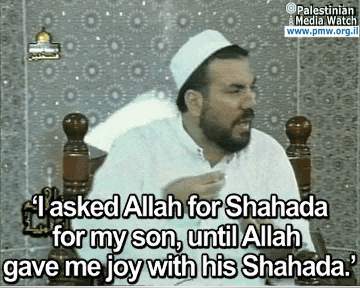
A sense of just how far this goes can be guaged by a report put out today by the indispensible Palestine Media Watch. In a PMW report by Itamar Marcus and Barbara Crook entitled "PA Grants Religious Status to Suicide Terror", the authors/researchers point out that even before today's Israeli action that accidentally struck civilians, the government of Palestine continues, and has continued throughout its history, to promote Jihad, Shahada (Death for Allah) and suicide terror as religious imperatives. It grants the highest status and rewards to the shahids (martyrs for Allah) and terrorists.

The Palestinian Authority promotes suicide bombings constantly. A religious leader, Sheik Imad Hamato appearing on official PA television five days ago (November 3, 2006), compares suicide terror to a story found in the Hadith, Islam's holy writings, of a friend of Muhammad who died accidentally on his own sword. The point of the scriptural quotation is that Muhammad grants the man the status of martyr.

The lesson? Hamato says: "It’s like the conflict today! One who exploded with a bomb." With proper intent, the government-authorized preacher says, self-inflicted death is not suicide but shahada - the death of a martyr.

Hamato gives a graphic description of the corpse of a Shahid, with “no head, no legs, his body completely burned... intestines outside, fingers... gone”. While ordinary mortals fear such a death, this is “what the Shahids wish for most of all”, according to this man of the cloth. A video of his "religion" lesson as televised on state-run Palestinian television is here.

And here, courtesy of PMW, are some excerpts:
  • "Hadith: There is one thing that causes Allah…to elevate his worshipper 100 levels in Paradise, and each level is like the space between heaven and earth. And what is this thing, Allah’s prophet [Muhammad]? It’s the Jihad for Allah. Jihad for Allah…
  • “A man, when he sees one of his brothers being killed for Allah, those we consider Shahids for Allah, he sees [for example] a person with no head, no legs, his body completely burned. Yes? Intestines outside, fingers are gone, it’s a difficult image. The most difficult thing which we fear is what the Shahids wish for most of all.
  • "They ask Allah: ‘Oh God, bring us back [to earth] to be killed by the Apache [Israeli helicopter]. Bring us back so that the planes will blow us up, that our heads will be cut off from the body.’ What is that? We have criteria, and Allah, praise him, also has criteria. Study the Hadiths that discuss this issue to understand the essence of Shahada for Allah…
  • "Hadith: One of the Prophet Muhammad’s good friends was preparing a bow and arrow when his own sword struck him and killed him… Is he considered a Shahid or not? Did he commit suicide? It’s like the conflict today! One who exploded with a bomb. People talk about whether or not he’s a Shahid…"
  • [Hamato continues with the Hadith, that people did not want to pray in memory of a man who was killed by his sword, because they didn’t know if he was a Shahid or committed suicide.] “They said: ‘The man died from his own weapon, and not from the weapon of the enemy.’ Answered Prophet Muhammad: ‘He died in an attempt to be a holy warrior… And his reward for that was doubled…'
  • "Khamtu says: 'When we talk about Shahid and Shahids, we shouldn’t forget that Allah, praise him, in blessing the blood of the Shahid, he forgives him, from the first gush of blood. Yes, yes. And sees his place in Paradise. He is shielded from the Great Shock and marries 72 Dark-Eyed Maidens (virgins)...'
  • “I once heard a father of one of the Shahids say: ‘I would pray with my son at night, and ask Allah for Shahada for my son.’ Allah Akbar, God is Great. ‘I asked Allah for Shahada for my son, until Allah gave me joy with his Shahada…”
Some may consider this an inconsequential theology lesson. They'd be very wrong. The hatred and incitement spewing forth from the state-sponsored mouth of this charlatan typifies the pervasive hate-based, death-adoring culture of the Palestinian Arabs. Any analysis of the six years of daily rockets fired into Israel from Gaza towns like Bet Hanoun that ignores this "theology" completely misses the mark, leaving half the story unreported.