Showing posts with label Pew. Show all posts

Wednesday, September 09, 2015

09-Sep-15: Figuring out what people have figured out about Iran and its nuclear plans

Tehran: Where is this all going? [Image Source]
It's been eight weeks since the Joint Comprehensive Plan of Action became a reality. Many news outlets would have written that as "been signed". Wikipedia's entry on the JCPOA, for instance, starts out with this definition:
an international agreement on the nuclear program of Iran signed in Vienna on 14 July 2015 between Iran, the P5+1 (the five permanent members of the United Nations Security Council—China, France, Russia, United Kingdom, United States—plus Germany), and the European Union. [Wikipedia]
But as we pointed out ["29-Jul-15: Built not on trust but on... verification"], the JCPOA was not signed in Vienna and will not be signed there or anywhere else. (We explain in that post.) This has been carefully and repeatedly explained to the Iranian people by the people who run the Iranian regime. In fact, ordinary Iranians appear overall to have a better grasp of what the JCPO does and does not mean for them and their interests when compared with citizens of other places.

In the West, where optimism frequently trumps reality, the JCPOA and what it stands for continues to be seriously misunderstood.

How much support does it have in the US? Depends whom you ask.

The issue is with the people's representatives in Washington right now. There, the threshold which the Obama administration had to cross to overcome Congressional rejection seems to have been passed a few days ago ["In Win for Obama, Iran Deal Assured of Passage", Vice of America, September 2, 2015]. Seems to, because so far it's all pledges by politicians which, forgive the cynicism, are not always worth the paper they're not written on. But everyone seems to agree that whatever had to be done in the Senate and the House from an Obama standpoint has been done, and the rest is predictable, more or less.

Scene at a rally in Washington DC happening right
now [click to view] [Image Source: Twitter]
But if you ask the American people, the picture looks entirely different: black-and-white different. The latest numbers from Pew Research Center ["Support for Iran Nuclear Agreement Falls", Pew, yesterday] tell a clear, unambiguous and - if you're a politician with principles - depressing story: US public support for JCPOA, very low on the day it was signed - sorry, agreed, no we mean finalized - has dropped precipitously and steadily since then. The more people know about it, the more they want it stopped.

As of yesterday, it stands at 21% - one American in five is on board the train. A shade under half of all Americans define themselves as opposed: 49% according to Pew. Some 30% say they have no opinion. The poll was conducted between September 3 and 7, and among some 1,004 adults.
In mid-July, a week after President Obama announced the deal, 33% of the public approved of the agreement, while 45% disapproved and 22% had no opinion. Over the past six weeks, the share approving of the agreement has fallen 12 percentage points (from 33% to 21%), while disapproval has held fairly steady (45% then, 49% now). Somewhat more express no opinion than did so in July (22% then, 30% now)...  While the partisan divide over the nuclear agreement remains substantial, support for the deal has slipped across the board since July. Currently, 42% of Democrats approve of the agreement, while 29% disapprove and an identical percentage has no opinion. In July, 50% of Democrats approved, 27% disapproved and 22% had no opinion. Republican support for the agreement, already low, has dropped even further (from 13% to 6%).... When opinion about the Iran nuclear agreement is based only on those who have heard a lot or a little about the agreement, opposition to the agreement exceeds support by more than a two-to-one margin (57% to 27%)... [Pew Research, September 8, 2015]
Here's a comparison. When Britain's prime minister during Hitler's rise to power, Neville Chamberlain, returned home in September 1938, 77 years ago, with the infamous Munich Agreement ("peace in our time") in his hand and appeasement on his mind, he had pretty good public opinion support.
Opinion polls appear to show that the majority of the nation was in support of the stance taken by Chamberlain... [Source]
And in the end, peace was of course not what they got.

President Obama cannot even claim as much backing as the failed British leader Chamberlain did. As a German analysis of the appeasement chapter puts it
Britain and France underestimated just how determined Adolf Hitler was in his lust for conquest. The failure of Neville Chamberlain's policy of appeasement meant war was inevitable... ["The Road to World War II: How Appeasement Failed to Stop Hitler" | Klaus Wiegrefe - Spiegel Online] 
Back to 2015, and is the world closer to war or further away?

The main story on the Iraninan FARS news site at this
moment. In Iran, they take this man very seriously. Good sense
and caution suggest we should too [Image Source]
Sitting where we are, in Jerusalem, the prospect of getting to peace with Iran seems remoter than ever. To show why, here's one of the main news stories in Iran at this moment, Wednesday afternoon, in Tehran:
Supreme Leader of the Islamic Revolution Ayatollah Seyed Ali Khamenei described Israel as a "fake" regime, and said there won't be any Israel in 25 years from now. "Some of the Zionists have said that given the results of the nuclear negotiations (between Tehran and the world powers), they have been relieved of concerns about Iran for 25 years, but we tell them that basically, you will not see the next 25 years and with Gd's grace, nothing under the name of the Zionist regime will exist in the region by then," Ayatollah Khamenei said, addressing a large number of Iranians in Tehran on Wednesday. He added that the heroic spirit and morale of Muslim fighters will not let the Zionists feel comfort and tranquility in the next 25 years. ["Supreme Leader: Israel Not Alive in 25 Years" | Iranian FARS News | September 9, 2015]
There we go again, narrowly obsessing over Israel. Or as President Obama put it a month ago ["Obama says Israeli interference in US affairs over Iran deal unprecedented" | Times of Israel | August 8, 2015], the JCPOA is “very good for Israel” and (not in precisely these words, but this is how he was widely understood) "Israeli interference in internal US affairs ahead of a Congressional vote on the Iranian nuclear deal was unprecedented."

But that Khamanei blast yesterday was not directed at the Jews alone:
Elsewhere, Ayatollah Khamenei warned of the US endless enmity towards the Iranian nation, and said even after the nuclear agreement, whose fate is not yet clear in Iran and the US, the Americans have been hatching plots and approving a bill in the congress against Iran. He described national might as the only way to end the US plots, and said a strong economy, growing scientific progress and maintaining and reinvigorating the revolutionary spirit and morale of the people, specially the youth, are among ways to boost national might and power. Ayatollah Khamenei reiterated the need for vigilance against the US plots to influence Iran, and said Tehran had only entered negotiations with Washington just on the nuclear issue "and we will not negotiate with the US in other fields". In relevant remarks in August, Ayatollah Khamenei stressed that regardless of the nuclear agreement with the world powers, Tehran would not allow the US to find a way to influence Iranian economy, politics and culture...  "Washington imagined that it could use this agreement whose fate is not clear yet - as its final approval is not yet a definite fact neither in Iran nor in the US -  to find a way to influence in Iran; and this was their intention." But "we closed this path; and we will definitely keep it closed", he underlined. "We will not allow the US to influence (our) economy, or politics or culture. We will stand against such penetration with all our power - that, thanks God, is at a high level today," Ayatollah Khamenei said. [FARS News | September 9, 2015]
And over at TIME Magazine they have more, also from today, quoting the Supreme Leader's own website and Twitter account, as he reminds the faithful that:
...the U.S. remains the ‘Great Satan’. “Satan only deceives and tempts, but the Americans not only do that but they also murder and place sanctions and act hypocritically. They claim to be the banner holders of human rights in the world, yet every few days an innocent unarmed person in America itself is murdered by their police, and this is only one example of their crimes. They are worse than Satan,” he said. [TIME, today]
In case any of the Supreme Leader's statements lack clarity, we can ask one of his most recent honored guests for help in interpreting them:
Austrian President Heinz Fischer was travelling to Iran on Monday, becoming the first European head of state to visit since 2004, his office said, two months after an international deal was struck over Tehran's contested nuclear programme. During his three-day stay, Fischer is due to meet supreme leader Ayatollah Ali Khamenei, President Hassan Rouhani and Foreign Minister Mohammad Jawad Zarif, one of the main negotiators of the historic agreement signed (sic) in Vienna on July 14 with six major world powers. [AFP, September 7, 2015]
And in the background, there's plenty of Tehran action involving anxious business-minded visitors:
Germany got in on the action first, with a government jet touching down at Tehran’s Imam Khomeini Airport just five days after the deal was signed. Since then, a representative from every major European power has visited or announced plans to do so, and smaller countries like Poland are scrambling to get a cut. ["These European leaders and businesses are rushing to do deals with Iran" | Washington Post, August 21, 2015]
Just yesterday, three Spanish government ministers (Industry, Energy and Tourism; Development; Foreign Affairs) arrived there for much the same reason.

What can the JCPOA actually deliver, besides rich commercial agreements? Some disturbing things, according to an influential and very well-placed Israeli voice, who argues that the effect of the transaction is going to be very different from the way its marketers have portrayed it (our words, not the writer's). This is also from yesterday:
The claim that Iran’s enrichment routes to a nuclear bomb have been blocked has no basis. In fact, Iran will have four routes to enriching uranium to a military level... The nuclear agreement with the main world powers is set to enable Iran safely, legally, and without economic hardships or changes in its rogue policies, to overcome the main obstacles on its way to possessing a nuclear weapons arsenal and becoming a regional hegemonic power... By endorsing the deal, its supporters actually surrender the most effective tools to convince the Iranians to make concessions and give up their nuclear program, namely the biting sanctions and the credible military threat.  A containment policy by definition makes a military option irrelevant. The claim that after 10-15 years the US will have all options in case Iran resumes its nuclear program is false because the Iranian defense, industrial and nuclear infrastructures in place will make any military reaction futile.
["The Mistaken Rationale behind the Iran Nuclear Deal" | September 9, 2015, authored by Brig.-Gen. (Res.) Yossi Kuperwasser, former head of the IDF Military Intelligence's research division, and until recently, director general of Israel's Ministry of Strategic Affairs]
The way we see it, American public opinion seems to have intuited what one of Israel's sharpest and best-informed strategic minds is saying, chilling as it undoubtedly is. (His view is part of the reason we call the JCPOA the "Iran Nuclear Enablement Deal". And we think we're being factual, not irreverent or cynical.)

As for the way America's politicians are steadfastly articulating why and how they are taking the courageous stands they are taking - against the bulk of their electors' opinions, we think you can't beat the Democratic Senator for Michigan (nothing personal), one of the handful who boldly stepped forward once the Obama threshold had been safely passed, and stated his position this way:
"Despite my serious reservations, I will reluctantly vote against a motion of disapproval because I believe that doing so will protect the credibility of the United States to hold Iran accountable to adhere to every single obligation in the [Joint Comprehensive Plan of Action]..." ["Senate Democrats deliver Obama's Iran nuclear deal support" | CNN, September 8, 2015] 
Hard to argue with a man who, despite serious reservations, evinces such deep faith in the power of "credibility" to stop a renegade state propelled by messianic fervour and with a nuclear arsenal in the making.

Tuesday, July 15, 2014

15-Jul-14: Tuesday and the battle against the jihadists of Hamas goes on

  • 05:40 pm: The ceasefire of this morning, rejected immediately by Hamas while accepted - and observed - by Israel until the middle of this afternoon, is over. Hamas rockets kept on appearing throughout those hours in the skies above many Israeli cities. Now the IDF is again attacking Gaza, and the rockets are continuing as before.
    The IDF announced this around 3:00 pm this afternoon. That's about when one of its spokespersons tweeted this:
Here's how the Guardian conveyed the failure of the ceasefire to its fans:

So for a large part of the ,educated, classes, the conviction that "Israel army resumes attack" is the whole story. That the terrorist forces of Hamas didn't even bother to stop shooting at any stage is somehow of marginal interest to The Guardian's editors. That's how things work in parts of the ideology-driven news media.
  • 06:15 pm: As distorted as UNRWA's representations of fact frequently are, you can't help but get a sense of the devastation that has somehow fallen out of the sky and struck the Palestinian Arabs of the Gaza Strip. A syndicated AFP report ["UNRWA: Gaza destruction 'immense'"] published in the past hour dwells on much of the human suffering while being strangely short of the sort of context that might help explain how this mess came about. Some highlights:
  • "The level of human losses and destruction in Gaza is really immense," said UNWRA spokesman Sami Mshasha. "According to our latest figure, we are talking about 174 killed and well over 1,100 injured. This number will increase. The numbers are increasing by hours," he told reporters. 
  • "A good number of those killed and injured are women and children. That is a cause of concern for UNRWA," he added. The death toll Tuesday had risen to 192, according to local officials in Gaza. 
  • Mshasha said that 560 homes had been totally destroyed, while thousands of buildings had suffered damage. Mshasha said that 47 UNRWA facilities had also been damaged by bombing... He called on the warring sides to respect U.N. buildings. 
  • A total of 17,000 people had found refuge in 20 schools run by the U.N. agency, which has sent their GPS coordinates to Israeli authorities. 
  • In a separate statement, the International Committee of the Red Cross said the bombing had devastated Gaza's water supply. "Hundreds of thousands of people in Gaza are now without water. Within days, the entire population of the Strip may be desperately short of water," said Jacques de Maio, who heads ICRC operations in Israel and the Palestinian territories. "Water and electrical services are also affected as a result of the current hostilities. If they do not stop, the question is not if but when an already beleaguered population will face an acute water crisis," he said in a statement.
  • 06:25 pm: US Secretary of State John Kerry, of whom we have written repeatedly in this blog, spent today in Vienna. This morning, he spoke to the media there, making a statement [via jpost.com] worth reprinting: "I cannot condemn strongly enough the actions of Hamas in so brazenly firing rockets in multiple numbers in the face of a goodwill effort to offer a ceasefire, in which Egypt and Israel worked together, that the international community strongly supports..." Hamas is "purposely playing politics" by continuing the rocket fire, using innocents as "human shields... against the laws of war." "And that is why they are a terrorist organization," Kerry added. Unquote. 
  • 06:30 pm: As the fighting between the Hamas regime and Israel continues, here's an indication of where US public opinion stands. Herb Keinon, the Jerusalem Post's diplomatic correspondent, has just tweeted [@HerbKeinon] this:
  • 06:50 pm: Some more about that Pew survey: "As violence between Israel and Hamas shows no signs of abating, the sympathies of the American public continue to lie with Israel rather than the Palestinians. And dating back to the late 1970s, the partisan gap in Mideast sympathies has never been wider. Currently, 51% of Americans say that in the dispute between Israel and the Palestinians, they sympathize more with Israel. Just 14% sympathize more with the Palestinians, while 15% volunteer that they sympathize with neither side and 3% sympathize with both. These views are little changed from April, before the recent outbreak of Mideast violence. However, the share of Republicans who sympathize more with Israel has risen from 68% to 73%; 44% of Democrats express more sympathy for Israel than the Palestinians, which is largely unchanged from April (46%). The share of independents siding more with Israel than the Palestinians has slipped from 51% to 45%.
    Just 17% of Democrats, 17% of independents and 6% of Republicans sympathize more with the Palestinians than Israel. These numbers have changed little since April... White evangelical Protestants remain more likely than members of other religious groups to sympathize more with Israel than the Palestinians (70%). White evangelical Protestants make up nearly a third of Republicans (31% of all Republicans and Republican leaners), so this accounts for at least some of the partisan gap in sympathies. However, even among Republicans who are not white evangelicals, two-thirds (66%) sympathize more with Israel than the Palestinians. This compares with 78% of white evangelical Republicans." [source]
  • 06:55 pm: Since 6:00 pm, there have been rocket warnings in these communities:  Hof Ashkelon region; Netivot - where Iron Dome intercepted two rockets over the city, and two more fell in open land; Beersheba (several times) - two rockets crashed without causing serious harm; Nevatim; Sderot; Sdot Negev region; Sha'ar Hanegev region.
  • 6:58 pm: And in many communities around the country right now, including the Greater Tel Aviv area.
  • 07:00 pm: Australia's ambassador to Israel, Dave Sharma drove down to Beersheba today to visit two Bedouin Arab girls injured on Monday in a Hamas rocket attack on their village. He brought with him a toy koala. Mar’am Alwakili, 10, remains unconscious at Soroka Medical Center. Her sister Atil is in moderate condition. “The destroyed home and the fate of the Bedouin children encapsulate the indiscriminate nature of rocket fire, which continues to emanate from Gaza,” Ambassador Sharma wrote in a statement quoted by Times of Israel. Good on ya, mate.
  • 07:15 pm: A mortar attack on the Erez Checkpoint has resulted in an Israeli civilian, age 37, being injured critically [Jerusalem Post]. Quoting Channel 2 TV News, they say the man was a volunteer visiting soldiers near Gaza to deliver food to soldiers. UPDATE 07:30 pm: Ynet says he has died from his injuries.
  • 07:45 pm: There are multiple Gazan rocket attacks going on right across the land at this moment. Times of Israel says they number 36, and that warning sirens are being heard in Ashkelon, Sderot, and the Shaar Hanegev region. Two buildings in Ashkelon have taken direct hits in the past few minutes.  
  • 07:50 pm: The BBC's Jeremy Bowen observed what we call here a Fell Short and tweeted about it in the past hour: "@BowenBBC: Just saw one rocket that seemed to fail in flight, dropping back into Gaza”. Do you imagine he has any idea how very common these Gazan-rockets-fall-on-Gazan-heads are? Has he reported on it?

Wednesday, July 02, 2014

2-Jul-14: Opinion poll: Arabs increasingly view their terrorists unfavorably

Hamas inner circle of child abusers: Suffering from
decline in their poll numbers [Image Source]
A major opinion survey published yesterday by Pew Research Center in Washington ["Concerns about Islamic Extremism on the Rise in Middle East"] has some bad news for the terrorists, and maybe for us too. Here's an abstract:
Hezbollah, the militant organization headquartered in Lebanon with strong ties to the Shia-led Iranian government, is seen unfavorably in every Middle Eastern country surveyed... Overall, most people surveyed have an unfavorable impression of Hamas, a militant Palestinian organization that is in control of the Gaza Strip and designated a terrorist organization by the U.S. This includes people who live under its rule. More than half in the Palestinian territories (53%) have an unfavorable view of Hamas, with only about a third (35%) expressing positive views. Negative views are higher in the Hamas-led Gaza Strip (63%), up from 54% in 2013.
Why is this bad news for us? Because when the terrorists, who have a huge investment in continuing the control they wield, sense a weakening in their support base, they do what usually works well in the Arab world: they whip up the masses via more acts of terrorism.

We may be at another of those moments.

Saturday, September 14, 2013

14-Sep-13: Memo to Secretary of State Kerry: Your staff need some urgent guidance

Secretary Kerry speaks to the media about a deal
with Russia on Syria, this past Thursday
[Image Source: Reuters/Larry Downing]
Dear Secretary Kerry:

Reuters informed us yesterday ["Kerry to travel to Israel and meet Israeli PM Netanyahu"] that you will be visiting our home town in the coming 24 hours.

This is good for three reasons, at least.

First, it gives you an opportunity to finally respond to an open letter which was sent to you on August 13, 2013, by a group called Bereaved Families for Peace and Justice. It respectfully asks you for an urgent meeting for reasons that are stated in the letter. (We are two of the signatories to that letter.) In case this does not ring any bells, we suggest one of your staff people might review its contents [here] and remind you of what we and a dozen other families wrote there.

Unfortunately your office has not yet responded, though your spokesperson, Marie Harf, did say acknowledge in a media briefing the day we sent it that it had been received [we refer here to what else she said].

Your diligent and thoughtful ambassador in Tel Aviv met with four of us some weeks ago in the US embassy, and explained that for now that was as much as we could expect from the State Department. Now that you are back in Israel, it seems to us that this would be a good time to schedule a short face-to-face conversation.

Why the urgency? That has to do with the second good reason.

Second: Several uncontradicted news reports in the past week, emanating from the Arab side, say that a second tranche (out of a total of four) of convicted Palestinian Arabs, all of them found guilty of murder and assorted other acts of terrorism, are going to be set free by our government six weeks from now. We reported on the background to this in two recent blog posts. First: "1-Sep-13: Is a second round (of four) of convicted Palestinian Arab terrorists, most of them murderers, about to be set free?" And then "8-Sep-13: More convicted Palestinian Arab murderers are headed for freedom and role-model careers". 

These prisoner releases are a mistake on multiple levels. 
Americans have been among the victims of these terrorists. The State Department would surely want to understand this better so that it can stop the process, right? We want to help. 

Third: Most of the Israelis and Americans whom we have asked about this in the past month have been surprised - even astonished - to know that your office has an unexpected view of how to characterize the slayers of elderly Holocaust survivors and murderers of American citizens who were released in the first of those tranches on August 13, 2013. That was the day an American journalist asked Marie Harf, the deputy spokesperson in the State Department, this straight-forward question:
Do you have any thoughts or position on whether these people who are going to be released [today] are political prisoners or are they terrorists?
Speaking as the designated State Department official spokesperson that day, in a formal press briefing, she said: 
I do not have a position on that.
We hope you find this hard to believe. We certainly did. Would it make sense for someone in your entourage to check out this video of the exchange between them? Despite our repeated and polite enquiries during this past month, it appears to us that no one in the US administration is willing to admit that they have taken a position on this serious matter - at any rate, no one who was willing to speak to us, or for the record. 

Meanwhile, those first 26 unrepentant terrorists walked free. Exactly as we and others feared, they walked straight into a series of official Mahmoud Abbas-hosted PA receptions where they were despicably feted as heroes.

We would very much like to discuss this with you as well, if you have some time tomorrow. Please have someone email us, and we will do our best to fit in with your tight agenda.

For what it's worth, the Bereaved Families for Peace and Justice group asked our own government here in Jerusalem for a meeting on this same vexing matter of letting loose the unrepentant convicted killers. So far, we have the same success rate in getting a response from them as we have from Washington. 

Wednesday, September 11, 2013

11-Sep-13: No need to speculate: Palestinian Arabs genuinely, overwhelmingly believe in barbarism as a strategy

Yasser Abed Rabo, co-author of 2003 peace
plan, with Israeli partner Yossi Beilin [Image Source]
A Pew Research Global Attitudes report issued today demonstrates statistically that
Overall support for violence in the name of Islam has declined among Muslim publics during the past decade... In many of the countries surveyed, clear majorities of Muslims oppose violence in the name of Islam. Indeed, about three-quarters or more in Pakistan (89%), Indonesia (81%), Nigeria (78%) and Tunisia (77%), say suicide bombings or other acts of violence that target civilians are never justified. 
But there is one demographic where a clear majority of respondents - 62% - told Pew's pollsters that "suicide bombing is often or sometimes justified". That demographic is Palestinian Arab Muslims.


Knowing the murderous intentions of the Palestinian Arab "street" concerning us ordinary Israelis (and keep in mind that Palestinian Arab terror is rarely directed at the Israeli military), it casts a deadly light on the current strategies of the Mahmoud Abbas regime's inner circle. 

A report published just yesterday by WAFA, the official mouthpiece of the PA, quotes Yasser Abed Rabbo summing up the 'peace' process currently underway. Abed Rabbo is said to be one of the authors of the 2003 Geneva Accord. 
“Israel is trying to benefit from the negotiations to pressure Europe to cancel the boycott (of settlement products),” he said on Voice of Palestine... The negotiations have not made any progress on the ground and that all Israel wants is that no one says anything about its settlements and other activities that violate the rights of the Palestinian people.
“There are no signs of progress... There is progress only in the settlements and in the violations, but not in the negotiations that can cause us to say that US efforts have achieved any real results on the ground or in the peace process..." [Abed Rabbo quoted yesterday by WAFA]
His voice is part of a choir. The Palestinian/Israeli journalist Khaled Abu Toameh writes today on the Gatestone Institute website that -  
PLO, Fatah and Palestinian Authority officials have described the talks as "futile", "unproductive", "a waste of time" and "a cover for Israel to pursue its policy of creating new facts on the ground..." By sounding the alarm bell already, the Palestinians are hoping that when the talks fail they will be able to tell the world, "You see, we told you from the beginning that these Israelis do not want peace." But these statements and threats have also proven to be counter-productive. The more Palestinian officials and leaders talk about the "futility" and "ineffectiveness" of the peace talks, the bigger the opposition grows to the negotiations with Israel. [Khaled Abu Toameh on Gatestone Institute website, September 10, 2013]
Nearly two-thirds of the people ruled by the clique of which Abed Rabbo is a leading member are committed to the most extreme forms of lethal terrorist attacks on Israelis. In that light, do we need to speculate about the intended effect when PA insiders like him dismiss so comprehensively the current round of talks between their side and Israel?

Friday, May 10, 2013

10-May-13: Peaceful co-existence: Israelis and Palestinian Arabs believe in it to about the same degree. Not.

Pew Research Center announced yesterday (Thursday) the findings of a poll that shows Israelis generally believe an independent Palestinian state can coexist peacefully with their country. Palestinian Arabs, by contrast, overwhelmingly say this is not possible. When asked about the best way to achieve statehood, a plurality of Palestinian Arabs prefer armed struggle over negotiations or nonviolent resistance.

Americans who favour the Israeli side outnumber those preferring the Palestinian side by 53% to 14%. In the United Kingdom, the proportions are almost the reverse: 19% for Israel, 35% for the Palestinian Arabs. (In the UK, the proportion who say they are undecided is a whopping 22%.) In France it's 40% for Israel and 44% for the Palestinian Arabs; in Germany it's 28% Israel versus 26% Palestinian Arabs. 

When it comes to groups who don't sympathize with either the Palestinian Arabs or the Israelis, the standouts are Germany (31% prefer neither) and Russia (42% prefer neither)


83% of Israelis have a favorable view of the U.S. Among Palestinian Arabs, a mere 16% think the same.

Tuesday, May 15, 2012

14-May-12: Our Egyptian neighbours: Optimistic, pro-democracy, strongly Islamic, and (of course) increasingly negative to peaceful relations with you-know-which-neighbour

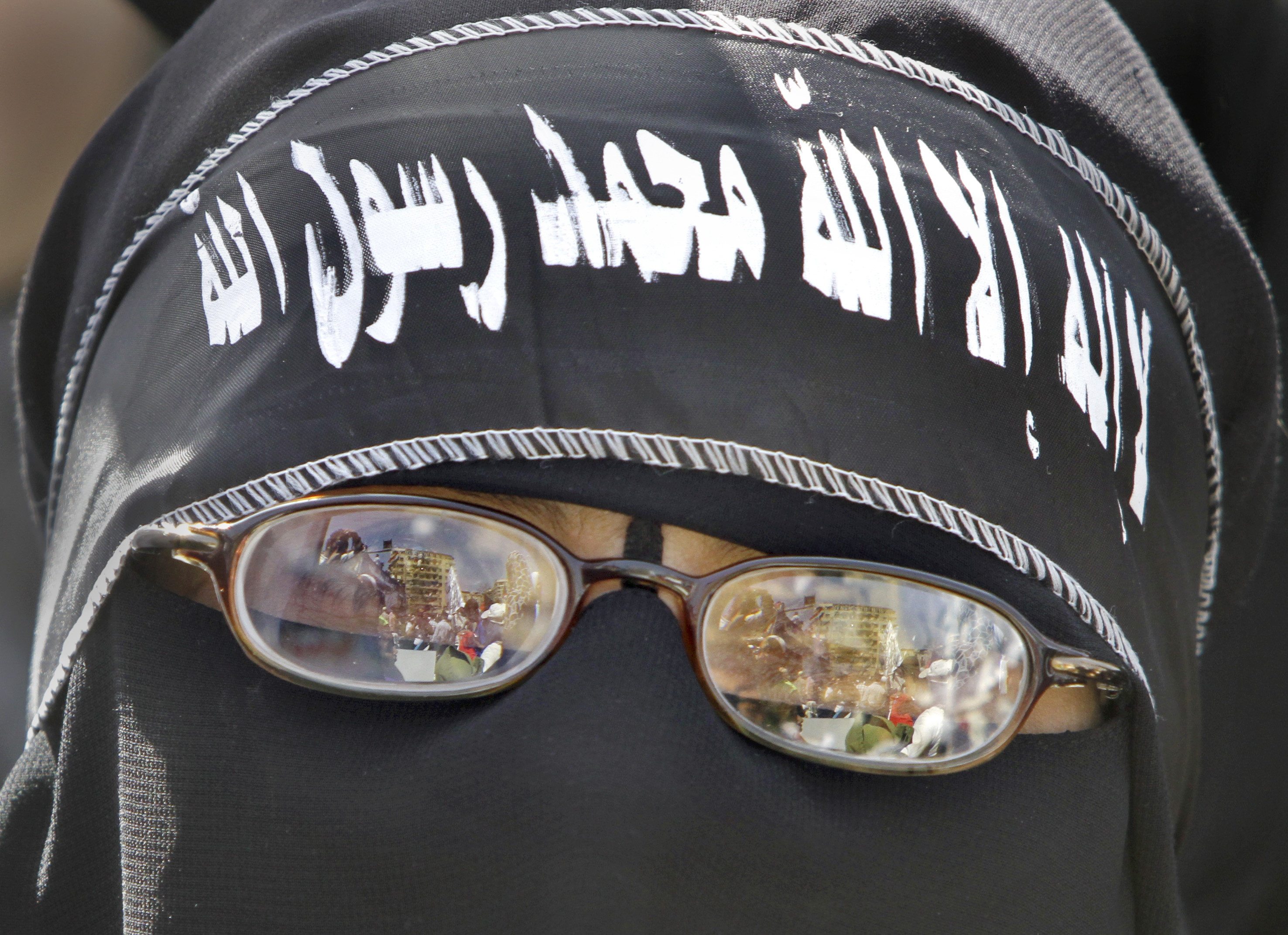
Tahrir Square, April 27, 2012: Veiled Egyptian woman
protestor. The original caption reads: "Radical Islamists
in Egypt dream of turning the most populous
Arab country into a religious state." [Image Source]


The Pew Global Attitudes Project released its 2012 poll results on Egypt some days ago.

Trying to find something encouraging in what it tells us about the Egyptians is a challenge. We're not statisticians, and still less experts on what makes Egypt tick. But the results, based on about 1,000 face-to-face interviews, point to some major internal contradictions. These seem to reflect a desire to have more democracy and Western-style economic achievements in their lives on the one hand, while at the same time yearning for a more Islam-dominated society on the other.

First, they know their economy is in dangerously bad shape. A mere 29% of Egyptians think their country's economic situation is good (it stood at 34% in 2011). But they're super optimistic; half of all Egyptians expect it to improve in the next 12 months.

How realistic is that? A survey in the Economist three months ago suggests not very:
In Egypt the public sector accounts for 40% of value-added outside agriculture—an unusually large share for a middle-income country. Such private firms as do exist tend to be large and closely connected to the state... Arab companies are globally uncompetitive. The Middle East accounts for less than 1% of world non-fuel exports, compared with 4% from Latin America (a region with a comparable population). Turkey exports five times as much as Egypt, which has a population of similar size.
EconomyWatch forecasts reduced tourism receipts, supply chain disruptions and other knock-on effects this year following the recent 'Arab Spring' uprising. Oxford Economics, interpreting the outcome in practical terms, says the negative direction of Egypt's economy means the country faces credit rating downgrades during 2012. Significant under-performance on Egypt's scale tends not to fix it itself quickly... and that's true even when the nation's frame of mind is so strikingly optimistic.

An astounding 83% say Egypt's religious leaders have a very good or somewhat good influence on the country. And about the military, who in effect run the country today via the Supreme Council of Armed Forces (SCAF) fronted by Mohamed Tantawi, 75% feel it has a good influence. That's mainly the men. Among Egypt's women, 58% said the military’s influence was very good a year ago, but today it's down to 38%. That's half of the men-plus-women number.

The media - television, radio, newspapers, magazines - get amazingly high marks from all sectors of Egyptian society. Overall, 70% have a positive assessment. Compare this with the United States where a different Pew survey on US public attitudes to the media published in September 2011 found that 66% say news stories often are inaccurate; 77% think that news organizations tend to favor one side; and 80% say news organizations are often influenced by powerful people and organizations.

But not in Egypt, according to what the Egyptian public believes.

The Egyptian public also likes democracy - a lot. At least so they say. Two-thirds of all Egyptians believe democracy is preferable to any other form of government. But (and here we start to run into some puzzling bits) 60% want their laws to strictly follow the Koran. Note however that support for Koran-based law dropped by 12 percentage points among educated Egyptians (secondary school or college education) in the past year, while it's up by 10 percentage points in the same period among their uneducated fellow citizens.

This ambivalence about democracy-versus-Islam is reflected in one of the survey's key findings. Asked whether Saudi Arabia or Turkey serves as the better model for the role of religion in government, 61% of Egyptians say Saudi Arabia. A mere 17% choose Turkey. And among Egyptians who see a positive role for Islam in their country's politics, 71% choose the Saudi Arabia model.

So much for the 'good' news.

The Pew people left the parts about Egyptian opinion on the US and Israel to the final chapter of their report, perhaps because it makes for such challenging reading. Here's a summary:
  • Overall Egyptian feelings about the U.S. and about President Barack H. Obama are overwhelmingly unfavorable. 
  • His standing in Egyptian eyes has dropped steadily since 2009. Back then, 42% expressed confidence; 47% said not much or none at all. Now, in the highly influential 18-29 year-old cohort, only 24% have confidence in the US president, a full twenty points lower than a year ago.   
  • Financial aid from the US, courtesy of American taxpayers, is viewed with utter disdain. 60% today see it as having a detrimental impact. For the record, US military aid to Egypt as of March 2012 [New York Times: "Once Imperiled, U.S. Aid to Egypt Is Restored"] stood at $1.2 Billion per year. Non-military aid to Egypt added a further quarter-billion dollars to that in 2010.
  • Yet a majority would like Egypt's relations with the U.S. to stay about as close as they are today. 38% would like to see Egypt/US relations get "less close".
  • Overall, 79% hold unfavorable attitudes toward the U.S. How many hold a favourable view? Just 19%.
  • On the Israel question, which is the last item in the lengthy report, the language of the Pew report is precise and devastating: "Most Egyptians favor overturning the 1979 peace treaty in which Egypt became the first Arab country to formally recognize Israel. Roughly six-in-ten (61%) want to annul the treaty, up slightly from last year (54%). Just under a third (32%) want to maintain it. Opposition to the treaty has grown significantly over the last year among young people and the highly educated. Support for annulling the treaty has increased by 14 points among 18-29 year-olds and by 18 points among the college-educated."
Headed for presidential elections
Egypt is about to elect a president. A Reuters report today ["Egypt vote won't push the generals aside"] describes the political haggling among Egypt's Islamists, liberals, military generals, and assorted other politicians:
At stake in the Defense Ministry meeting... was who would write a new constitution and what powers would Mubarak's successor have. No clarity has emerged. When voting starts on May 23 and 24 in a presidential race that broadly pits Islamists against men who at one time or another served under Mubarak, Egyptians still won't know the next head of state's permanent job description.
Whatever his job entails, it's going to impact Israel, and it's not hard to detect the edginess on the Israeli side of the border, including recently announced troop reinforcements. Pre-election speeches by the leading Egyptian presidential candidates have struck a notably hostile tone regarding Israel, and the Pew results suggest the reason why. Whatever they may feel, the candidates know it makes electoral sense to beat up on Israel.

So we see (via this Egyptian media report) Abdul Moniem Abul Fotouh, the leading Islamist candidate, calling Israel a “racist state” and asserting that the 1979 peace treaty is “a national security threat” that should be revised. Amr Moussa, his opponent and former Arab League chief who served as foreign minister in the Mubarak regime, also wants the treaty with Israel changed but expresses it a touch more diplomatically: "Most of our people consider it an enemy, but the responsibility of the president is to deal with such things responsibly and not run after hot-headed slogans."

Ah, yes: responsible leadership. We can hardly wait.

Saturday, December 03, 2011

3-Dec-11: The Islamists are marching...

The centrality of the religious factor in Arab public life is increasingly a talking point in media coverage as major changes wash across the entire area.

Under the headline "Jordan apology to Hamas baffles many", a mainstream Arab news publication is reporting today on Jordanian overtures to the most dangerous of this region's terrorist organizations.
The mea culpa was offered by Jordan's prime minister, Awn Khasawneh, for the 1999 decision to close the Islamist group's offices and expel its members - action widely believed to have been taken under pressure from the US. Calling it a "constitutional and political mistake", his regret was extended soon after Jordan's King Abdullah II appointed him to the premiership in October. Further, the Hamas leader, Khaled Meshaal, reportedly is arriving in Jordan today for talks. Mending relations with Hamas has raised eyebrows among the king's loyalists and his detractors, and not only because Washington considers the Palestinian group a terrorist organisation. Increasingly, it is perceived as an attempt to outflank the king's domestic critics and bolster his standing in the Arab world... Beginning this year with calls to end official corruption, [widespread Jordanian] protests have escalated into angry demonstrations - increasingly by members of the monarchy's tribal support base. By reaching out to Hamas, however, suspicion has mounted that the king is trying to put off reforms by cutting a deal with the group's influential brethren in Jordan, the Muslim Brotherhood. Their support could prove useful for restraining dissent..."
In Egypt, where the outcome of this past week's elections have been held back by the military who are the actual post-"Arab spring" rulers, first numbers are emerging and they bode ill for those who understand the close ties between the Muslim Brotherhood in its various forms, and jihadist terror. From AFP ("Islamists sweep Egypt elections") in the past hour (late Saturday night):
Early results from Egypt's first post-revolution election showed Islamist parties sweeping to victory, including hardline Salafists, with secular parties trounced in many areas.
Earlier today, there were reports that "the Muslim Brotherhood claimed the first round in the Egyptian parliamentary elections Saturday, after polls said it has won 40% of the votes. The official results of the elections are still pending."

In last week's elections in Morocco, the Islamist Justice and Development Party dominated, taking 107 seats out of the 395 seats, almost twice as many as the second place party. AP says this means "King Mohammed VI must pick the next prime minister from its ranks and to form the next government."

In elections in Tunisia in late October, the Islamist Ennahda party, banned for decades until January 2011, won 41% of the vote, securing 90 seats in the 217-member parliament. Today in the Tunisian capital, thousands of Islamists and secularists staged competing protests outside the parliament. Reuters says tensions are high:
"The latest round of protests was sparked when a group of hardline Islamists occupied a university campus near the capital to demand segregation of sexes in class and the right for women students to wear a full-face veil."
For the terrorist leadership of Hamas in Gaza, this is all great news. One of its more outspoken insiders, Musa Abu Marzouk, said this week the Egyptian win "serves the interests of Hamas", while his colleague Fawzi Barhoum, one of the Hamas designated spokespeople, said the election results we mentioned will "strengthen Hamas in the face of Israeli, American and European efforts" to isolate the terrorists.

Meanwhile an Arab voice of a different kind sees things via a different, more practical lens. Jeannette Bougrab, minister for youth in the government of France, and a self-described "French woman of Arab origin", said to the Le Parisien newspaper that that the electoral outcomes are 
"very worrying... I don’t know of any moderate Islam... There are no half measures with sharia. I am a lawyer and you can make all the theological, literal or fundamental interpretations of it that you like but law based on sharia is inevitably a restriction on freedom, especially freedom of conscience.”
Muslim Brotherhood activists "clash" with plainclothes
Egyptian police at an anti-Israel rally [Source]
The Moslem Brotherhood's official motto is: "Allah is our objective. The Prophet is our leader. Qur'an is our law. Jihad is our way. Dying in the way of Allah is our highest hope." Establishing an Islamic state based on sharia is at the center of its ideology. Egyptians - according to an April 2010 Pew Research Center poll  - very much like what it has to say about such core values as stoning adulterers (82% support), whipping and/or chopping off the hands of thieves (77%), and imposing the death penalty on apostates (84%)

They held a rally a week ago in Cairo's most prominent mosque, Al-Azhar. This report says 5,000 people took part. The main preacher was its Grand Imam, Ahmed al-Tayeb who said: "The al-Aqsa Mosque is currently under an offensive by the Jews…we shall not allow the Zionists to Judaize al-Quds (Jerusalem.) We are telling Israel and Europe that we shall not allow even one stone to be moved there." The report says Muslim Brotherhood spokesmen, as well as Palestinian guest speakers, made explicit calls for Jihad and for liberating the whole of Palestine. Time and again, a Koran quote vowing that "one day we shall kill all the Jews" was uttered at the site... Throughout the event, Muslim Brotherhood activists chanted: "Tel Aviv, Tel Aviv, judgment day has come."

With the Egyptian election behind us, it's worth recalling what a leading expert on the Muslim Brotherhood ("Egypt's Muslim Brotherhood: In Their Own Words") wrote nearly a year ago:
The Muslim Brotherhood does not hide its global aspirations and the violent path it intends to follow to achieve them. The Brotherhood is meticulous in its step-by-step plan, first to take over the soul of the individual and then the family, people, nation and union of Islamic nations, until the global Islamic state has been realized. The principle of stages dictates the Muslim Brotherhood's supposed "moderation." However, that "moderation" will gradually vanish as Muslim Brotherhood achievements increase and its acceptance of the existing situation is replaced by a strict, orthodox Muslim rule whose foreign policy is based on jihad. 
And now it appears they're taking power in our largest neighbour.

Thursday, May 19, 2011

19-May-11: Support for terrorism is going away? Not so fast

Well-meaning friends and people we meet frequently (and more so lately) tell us they see signs that support for terrorism is drying up and going away. Given our family's tragic familiarity with e subject, it's a theme to which we pay close attention.

The unpalatable and essential truth is that while terrorism in general is losing its appeal in certain parts of the world, it remains a desired option for many, and among Palestinian Arabs, it attracts support in the astronomical range.
"In recent years, Pew Global Attitudes surveys have documented a decline in support for suicide bombing in a number of countries, and today the percentage of Muslims who say this type of violence is often or sometimes justifiable stands at 10% or less in Indonesia, Turkey and Pakistan. Support for these acts is somewhat more common in Arab nations, although there have been steep declines over the last decade in Lebanon and Jordan. Palestinian Muslims, however, remain an outlier on this question: 68% say suicide attacks in defense of Islam can often or sometimes be justified, a level of support essentially unchanged from 2007. And in Egypt, support for suicide bombing is actually on the rise -- currently, 28% believe it can be justified, up from 8% in 2007."
Several additional key datapoints from the Pew Global Attitudes Project report of 17th May 2011, based on surveys of Moslems between March 21 and April 26:
  • The Hamas terrorists who control the Gaza Strip are viewed more favorably in Egypt (45%) and (47%) than they are in the areas controlled by the Palestinian Authority (42%).
  • The Hezbollah terrorist organization gets a "favorable" rating of only 5% in Turkey and 14% in Pakistan (the data were collected before Bin Laden was tracked down and killed there). Among Palestinian Arabs, they score 61%.
  • In Pakistan, Jordan and Egypt, solid majorities believe laws should be based strictly on the teachings of the Quran. But (and this seems surprising), that view is held only by a minority in Turkey, Lebanon, Indonesia and among Palestinian Arabs. 
The Pew report, "Arab Spring Fails to Improve U.S. Image: Obama's Challenge in the Muslim World" (online summary here), was published just days before President Obama's speech on the events in the Middle East and North Africa, due to be delivered at the State Department later today. Pews data suggest he is doing far less well in Moslem and Arab countries than two years ago.
"With the exception of Indonesia, Obama remains unpopular in the Muslim nations polled, and most disapprove of the way he has handled calls for political change roiling the Middle East. Moreover, many of the concerns that have driven animosity toward the U.S. in recent years are still present -- a perception that the U.S. acts unilaterally, opposition to the war on terror, and fears of America as a military threat. And in countries such as Jordan, Lebanon and Pakistan, most say their own governments cooperate too much with the U.S." 
Might this affect what the president says today?  Only if you think he wants them to like him better.