Showing posts with label JCPOA. Show all posts

Tuesday, September 19, 2017

19-Sep-17: An Iranian drone dispatched in Israel's direction from Syria is intercepted en route

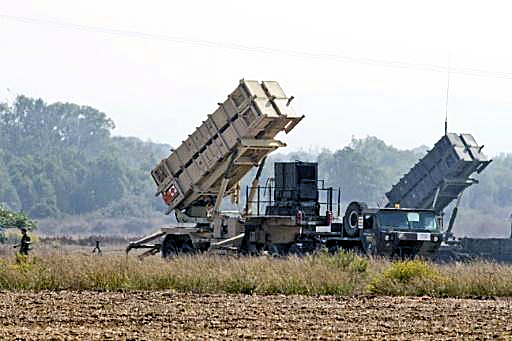
An IDF Patriot battery ready for action [Image Source]
All the ominous recent talk about Iran's massively increased financial capacity - thanks to its JCPOA deal with the Obama administration
- to feed its voracious appetite for military adventurism in our part of the world just became significantly more worrisome this afternoon.
The Israeli Air Force intercepted what it believes to be an Iranian-built drone, sent by the Hezbollah terrorist organization, with a Patriot missile after it attempted to cross into Israeli airspace on Tuesday, the army said. The military also scrambled fighter jets to the area, but ultimately did not need to use them as the interceptor missile was able to destroy the target. [According to an IDF spokesperson] the air force monitored the unmanned aerial vehicle from its take-off from Damascus airport to the demilitarized zone that separates the Israeli and Syrian Golan Heights. [When it crossed] the Syrian border and entered the demilitarized zone — but not Israeli airspace — the IDF “decided to intercept it,” [the spokesperson] said. ["IDF Patriot intercepts apparent Hezbollah drone from Syria", Times of Israel, September 19, 2017]
The report says the Patriot interceptor missile was fired from a military site near the city of Safed.

Seyyed Abdolrahim Mousavi under watchful gaze of his
ideological masters [Image Source]
Iran has not been shy for decades about its genocidal (understand the word literally) intentions when it comes to the Jewish state:
Iran’s newly appointed army chief warned Monday that the Islamic Republic would raze the Israeli cities of Tel Aviv and Haifa if the “Zionist regime” makes “any wrong move.” In remarks delivered at an event in the city of Qom, General Abdolrahim Mousavi also echoed previous warnings that Israel will not exist in 25 years. Mousavi, who issued a nearly identical threat last month, was appointed in August as the commander of the Iranian army, an entity separate from the country’s Revolutionary Guards Corps... [Source]
The sabre-rattling of Iran's entire power structure is generally taken seriously around here. An Associated Press report reminds us that Israeli leaders across the military and political spectrum are
worried that as the Syrian civil war appears to be winding down, Iranian and Hezbollah forces will maintain a permanent presence in the neighboring country. Netanyahu was to address the U.N. General Assembly later on Tuesday, with Iran at the top of his agenda... [Netanyahu] has repeatedly warned that Israel will not accept a military presence by Iran or any of its Shiite allies in the Syrian border area near Israel. Israel has largely stayed out of the fighting in Syria. But it has carried out dozens of airstrikes on alleged arms shipments bound for Hezbollah. It fears the group will gain sophisticated weapons and smuggle them from Syria into Lebanon.
From a 2014 report on the IDF's blog:
The Patriot surface-to-air missile system, officially known as the MIM-104, is an important part of Israel’s aerial defense. Designed by the American company Raytheon, this ground-to-air, long-range missile is able to intercept and shoot down all types of aircraft. Drones, helicopters and fighter jets can all be targeted from a distance of 160 km.

Wednesday, February 15, 2017

15-Feb-17: Things Iran is good at

Genuflecting: The caption to this revealing Iranian news photo is: "Minister
of Communications and Information Technology Mahmoud Vaezi 
and the Swedish Minister of European Union Affairs and Trade Ann Linde
seen in this Feb 11 photo meeting in Tehran" [Image Source]
[This post, like a number of others before it, has been translated to Polish ("W czym Iran jest dobry") by courtesy of Malgorzata Koraszewska over on the Listy z naszego sadu website. Our sincere thanks to her, and great appreciation to readers of this blog in Poland.]
There are some striking photos in the news today and yesterday, showing Swedish political leaders - among them, self-avowed feminists - bowing their heads to men, the females donning hijabs and head scarves and generally conveying a sense of deep deference to the Islamist regime ruling Iran with an iron fist - a posture rarely seen in international affairs or among people espousing the views that the Swedes claim to hold dear.

Sweden's prime minister Stefan Löfven led the visiting delegation, and has come under angry criticism from opposition politicians and female rights among others.
“This is disastrous for what is being called a feminist foreign policy,” says Jan Bjorklund of the Liberal Party. According to him, the Swedish government should have demanded not to make the hijab compulsory for the female members of the delegation. And if Iran did not agree to that, then the trade agreements should have been signed in Sweden or a third country. The Swedish government calls itself the “first feminist government”, but Linde has defended her decision to wear the hijab in Iran, saying that the only other option would be to send an all-male delegation. Swedish companies have been lining up to gain access to Iran’s lucrative market after the lifting of international sanctions... ["Sweden defends officials wearing headscarves in Iran", Tehran Times, February 14, 2017]
The Swedish delegation to Iran has had a significant impact outside
Iran. The caption reads: "Sweden's "first feminist government" has been
called hypocritical for wearing the hijab in Tehran"
[Image Source: Screen grab from a Sydney Morning Herald video]
But Löfven would have been heartened by the local reception his team got. They were
greeted with praise from Iran's supreme leader, Ayatollah Ali Khamenei, who hailed the positive relationship between the two countries during a meeting with the Swedish premier in Tehran. "America and many European powers have played a role in causing traumatic events in Syria and Iraq, and the people of the region are aware of this interference and are rightly skeptical," Khamenei was quoted as saying by Iranian television... [Löfven] also met with Iranian President Hassan Rouhani... who hailed the "moderation" in Sweden's foreign policy, ["Iran hails relations with Sweden during prime minister's visit to Tehran", DW (German State Radio), February 11, 2017]
The Swedes must have had the case of Dr. Ahmadreza Djalali on their minds while in Tehran. He's an academic physician born in Iran who has taught at universities in Belgium, Italy and Sweden. His field is disaster medicine and he traveled to Iran in April 2016 to take part in a professional conference. With no warning and without any warrant, Iranian Ministry of Intelligence officials arrested him there and charged him with “collaboration with enemy states”. The New York Times reported earlier this week [click] that he is being held in Tehran’s notorious Evin Prison and faces the death penalty. 

An image from last Saturday in Tehran that has already gone massively
viral: Swedish "feminist" government officials' walk of shame
Djalali's wife and two children live in Stockholm so the case has a higher profile there than in the countries where most of this blog's readers live. His wife is surely wondering what, if anything, those Swedish feminists did that was helpful to his cause during their well-publicized visit with the Mullahs. We were unable to find any reference to it in the media reports of the "feminist: visit to Iran, but we may have missed it.

For the past year, there's been a serious rush of vendor delegations from Europe, Asia and North America visiting, and showing extreme deference to, the Iranian regime along with an impressive flow of cross-border business deals with the Iranians [click here for a Google search results listing]. No doubt that this is a happy time for the people in charge of Iran.

But beyond the embarrassed faces and unmistakable humiliation of the visitors on show, there are significantly more disturbing next-moves emanating from the Iranian regime as flagged, for instance, yesterday by the Washington Times:
Iran’s hard-line Islamic regime has escalated its overseas terrorist operations, establishing a network of over a dozen internal training camps for foreign fighters, the regime’s largest resistance group said at a press conference on Tuesday in Washington. The National Council of Resistance of Iran issued its intelligence report specifying the camps’ locations and the countries represented... The council’s largest member is the People’s Mujahedeen of Iran (MEK). It boasts an extensive spy network inside the mullah-run government, including the all-powerful Islamic Revolutionary Guard Corps and its special forces wing, the Quds force, and has a track record of exposing clandestine parts of the Iranian national security apparatus.
The Quds force played a significant role in the Iraq War by training Iraqi Shiites on how to make bombs that killed scores of American troops. The Quds force is now directing thousands of Iraqi Shiite militia members in Iraq, some of whom have gone to Syria to fight for the regime of Syrian President Bashar Assad.
The U.S. calls Iran the world’s No. 1 state sponsor of terrorism. However, neither the Islamic Revolutionary Guard Corps nor the Quds force is on the State Department’s list of designated terrorist organizations. The Treasury Department in 2007 designated the Quds force as a material supporter of terrorism, but National Council of Resistance of Iran officials say the U.S. government should go much further.
“The Iranian resistance has emphasized on countless occasions that the source and the epicenter of terrorism, fundamentalism and regional meddling is the fundamentalist regime ruling Iran,” said Alireza Jafarzadeh, deputy director of the council’s Washington office. [“Iran growing network to train foreign terrorists, dissident group says”, Rowan Scarborough in Washington Times, February 14, 2017]
The Washington Times report goes on:
Ayatollah Ali Khamenei has approved a directorate inside the Quds force “in order to expand its training of foreign mercenaries as part of the regime’s strategy to step up its meddling abroad, including in Syria, Iraq, Yemen, Bahrain, Afghanistan and elsewhere.” “The camps have been divided based on the nationality of the trainees and the type of training,” the council said. “Both terrorist training and also military training for militias are provided, enabling them to better infiltrate and advance the regime’s regional objectives.”
What skills can aspiring jihadists acquire under the Iranian auspices?
The training is divided into two types of courses; a crash-course of 45 days for troops that will be used to fight in paramilitary forces like the IRGC’s Basij force or a full training course which lasts from between 9 and 12 months... The full training course has many different sections: Heavy weaponry; Missile Launches; Marine Training; Theoretical Training (how to spend terror rhetoric); Survival Training; Commando Training; Paratrooper Training; Security Training... The report makes clear that the IRGC is in control of these terror training camps, in an attempt to export terrorism, destabilise other countries and take control in those countries. ["IRAN’S  IRGC’S TERROR TRAINING CAMPS REVEALED", Iran News Update,., February 15, 2017]
Here's something else the Iranians know to do well: fomenting yet more mischief in Gaza. It stems from the choice of a seasoned murdering terrorist to become the new head of Hamas in Gaza [we analyzed this here: "13-Feb-17: Another Shalit Deal milestone: Four terms of life imprisonment but this murdering jihadist now heads Hamas in Gaza"]
The implication of the selection means that Iran has retaken the reins in Gaza after a long hiatus during which Egypt, on one hand, and Turkey and Qatar, on the other, tried to fill the vacuum. Iran chose to take back the reins in Gaza because of the election of Donald Trump as president of the United States.  Iran fears that in the upcoming talks in Washington, President Trump and Prime Minister Netanyahu will discuss an aggressive option vis-à-vis Iran. It is doubtful if any “elections” were held in Gaza to choose Sinwar. The result is due to pressure by Hamas’ military wing on the political wing, and the announcement’s timing is Iran’s way of conveying a message before the Trump-Netanyahu talks. If that’s the case, don’t expect that Sinwar’s “election” foretells a new escalation from Gaza against Israel. Just the opposite, Iran will restrain Hamas in order to keep the Gaza front available for Iran’s own needs, and Iran’s alone. ["Iran Grabs the Reins in Gaza", Pinhas Inbari, JCPA, February 14, 2017]
Velayati on Aljazeera this past week [Image Source]
In the interests of fairness, we will point out that Iran does have its fans, and the Iranians don't necessarily see themselves as being the bad guys or in any great trouble. You can get a sense of that deep Persian self-appreciation from published pieces like "World owes Iran debt of gratitude for sacrifices in fight against terror" [PressTV, February 13, 2017] and "Lavrov: Exclusion of Iran from anti-terror coalition is a mistake" [Tehran Times, February 12, 2017].

Also this: Iran doesn't see any reason to discontinue its rapid development of long-range offensive missiles [reviewed here two weeks ago]. As Ali Akbar Velayati (a former Iranian foreign minister and today Supreme Leader Khamenei's Advisor on International Affairs) said three days ago in an Al-Jazeera television interview [translated into English by MEMRI here]:
"If America imagines that threats and sanctions will lead Iran to stop its missile program, this is a misconception, a mere fantasy... America is not strong enough to bring us to our knees... Mr. Trump is fickle and changes his policies every other day... Running a country like America is not an easy thing. All of Trump's predecessors faced similar problems. The most important things is that he has failed, especially with us in Iran. Mr. Trump does not possess special qualifications that would enable him to claim that he wants to take over the world. His policies are immature and have led him to a confrontation with the whole world"
This sounds like bluster - something the Iranians are also good at - but it's more serious than customary bluster given the threats that have emanated from Iranian leaders at various points since the JCPOA, the infamous unsigned "agreement" that has brought such unearned benefits to Iran, came into effect. For instance, this comment which we quoted in an earlier post ["28-Jun-16: Is Iran now threatening more nuclear plotting?"]
Discussing what president Obama has called snapback and "real consequences"] "Iran’s Deputy Foreign Minister Abbas Araqchi said the country will be able to “immediately” reverse its commitments under a final nuclear deal with world powers if it finds out that the other side has breached commitments under the [JCPOA]... Whenever Iran feels the other side has not honored its commitments, the “reversibility” of Tehran’s nuclear program will happen immediately, he said." [Tasnim News Agency, Iran, July 28, 2015]
We think they're good at that sort of thing too.

Thursday, February 02, 2017

02-Feb-17: What's the US view of Iran's friendly-ties initiative and the nuclear-capable rockets it doesn't plan to use?

Iran's foreign minister, Mohammad Javad Zarif [Image Source] There's
probably a simple reason for why he's laughing in so many
published news photos
There's some elaborate dancing going on as the US, Iran and Hamas make efforts to explain their relations with each another.

From a disturbing Reuters report published this afternoon:
Iran has tested a cruise missile called "Sumar" that is capable of carrying nuclear weapons in addition to test-firing a medium-range ballistic missile on Sunday, German newspaper Die Welt reported Thursday, citing unspecified intelligence sources... The newspaper said the Sumar cruise missile was built in Iran and traveled around 600 km in its first known successful test. The missile is believed to be capable of carrying nuclear weapons and may have a range of 2,000 to 3,000 km, the paper said, citing intelligence sources... [T]he biggest advantage from Iran's point of view, a security expert told Die Welt, was that cruise missiles are not mentioned in any United Nations resolutions that ban work on ballistic missiles capable of carrying nuclear weapons... Iran confirmed on Wednesday that it had test-fired a new ballistic missile, but said the test did not breach the Islamic Republic's nuclear agreement with world powers or a U.N. Security Council resolution endorsing the pact.
A nuclear agreement? As we (and others) keep saying there is no nuclear agreement. That's because the astoundingly ineffective JCPOA was never signed by the Iranians - deliberately. See "09-Sep-15: Figuring out what people have figured out about Iran and its nuclear plans" where we explain ourselves. But that's the undoubted bottom line: despite all the reportorial and editorial claims to the contrary, there is no signed agreement with Iran on its nuclear weapons program. And there almost certainly never will be.

What did happen, as the Reuters piece recounts, is that massive sanctions on the Iranians were lifted in January 2016 under the JCPOA in exchange for their agreeing to curb - such an ambiguous term - the Iranian nuclear program.

But according to the terms of a 2015 U.N. resolution endorsing the JCPOA, Iran
is still called upon to refrain from work on ballistic missiles designed to deliver nuclear weapons for up to eight years. [Reuters]
Aren't they the same as cruise missiles? No.
Cruise missiles are harder to counter than ballistic missiles since they fly at lower altitudes and can evade enemy radar, confounding missile defense missiles and hitting targets deep inside an opponent's territory... [Reuters]
Also yesterday, President Trump’s national security adviser announced in Washington that the US is putting Iran "on notice" for its ballistic missile test and warning of new sanctions:
Calling Iran a “destabilizing influence” in the Middle East, National Security Adviser Mike Flynn declared Wednesday: “As of today, we are officially putting Iran on notice.” The pronouncement marked a pivot away from the Obama administration’s policy of diplomatic engagement, which led to a 2015 multinational nuclear deal that has been denounced repeatedly by President Donald Trump and his aides. Iran has warned that new U.S. sanctions could constitute a violation of the nuclear deal, setting up a scenario in which the agreement could unravel—something that hardliners in both countries would welcome. Administration officials, while providing few specifics, said Mr. Trump has begun a process of reviewing current U.S. policy and is “considering a whole range of options,” including tougher sanctions. Asked if military force also was one of the options, the officials didn’t rule it out... “The important thing is here is that we’re communicating that Iranian behavior needs to be rethought by Tehran,” one senior official said. “That is something Tehran needs to think through, because we are considering these things in a different perspective.” Mr. Flynn said the latest missile launch was a violation of United Nations Security Council Resolution 2231, which endorsed the nuclear deal and “called upon” Iran to avoid any activity related to missiles designed to be capable of carrying nuclear warheads. ["Trump White House Puts Iran ‘On Notice’ After Missile Launch", Wall Street Journal, February 1, 2017
Iran's propaganda machine didn't see things that way and had already pushed back by Wednesday evening via FARS (often called a "semi-official" news agency of the Iranian regime), asserting that Iran's
missile program is legal as per International Law, has nothing to do with the nuclear deal, and is non-negotiable...  [and that] Washington's latest cat-and-mouse games with Tehran... seeks pretexts to decrease international pressures and condemnations following their thoughtless decision to ban Muslims and Syrian refugees from travelling to the United States... Missile tests are Iran’s inalienable right to defend its security and interests. No country or international body can have any say in this regard... Over the past decade, Iran has made steady and gradual advances in its missile development, pursuing advancement of its strategic missile capabilities with incremental increases in range and payload technology. Iran is developing all these defense capabilities through international cooperation, legal purchases, and indigenous development. As per International Law, nothing is wrong with that. Nothing at all. ["A Risky Proposition: Is Iran Ready to Drop Missile Defense?", FARS News Agency, February 1, 2017] 
So to what extent do the Iranians now see themselves as having to comply with American wishes? The answer suggested by the FARS article is: not so much:
Whatever one thinks of Iran, it has no ballistic missiles capable of carrying nuclear weapons – unlike the United States, Israel, and their NATO allies. But it is always under constant military threat... [E]very now and then, the bloodthirsty warmongers reveal the real reason for viewing an Iranian missile defense capacity as unacceptable: The war against Iran is a risky proposition. Iranian ballistic missiles and military capabilities would prevent the US from attacking Iran at will. What scares the US is Iranian armed forces that have combat experience and a fighting doctrine of their own, able to take advantage of local and geographic factors, and design their combat style outside the traditional American box. That is what’s intolerable. [FARS]
We might be hearing more in the coming days about how intolerable US policy seems to the Iranians. Iran was
among seven Muslim-majority countries whose citizens he barred from the U.S. in an executive order Friday the White House said is aimed at keeping terrorists from entering the country. [National Security Adviser] Flynn said agreements Iran has made with the Obama administration and the U.N. are “weak and ineffective.” “Instead of being thankful to the United States for these agreements, Iran is now feeling emboldened,” he said... The senior U.S. officials briefing reporters on Mr. Flynn’s comments said the president at the moment doesn’t want “to take any action that would foreclose options or unnecessarily contribute to a negative response.” They also sought to separate the nuclear deal from U.S. concerns about Iran’s other actions such as ballistic missile tests. Tehran has maintained its nuclear program is for peaceful power generation and research, and that its missiles are conventional and for defensive purposes. [Wall Street Journal again]
A few hours ago, Bahram Qassemi who speaks for Iran's Foreign Ministry told interested parties that Flynn’s claims are “baseless, repetitive and provocative”. His statements appear in a report on the oddly-named Iranian PressTV website [here]:
Qassemi further expressed regret that instead of expressing gratitude for the Iranian nation’s continued anti-terror struggles, the US administration keeps leveling groundless accusations and adopting unwise policies, which practically promote terrorist groups... [He] further slammed as “inappropriate and discriminatory” Washington’s recent ban on the entry of travelers from seven Muslim-majority nations as well as refugees into the US [and] stressed that the Islamic Republic's regional policies are transparent, expressing Tehran’s keenness to have friendly ties with all regional states based on mutual respect and non-interference in their domestic affairs. ["US claims on Iran missile tests baseless, provocative: Foreign Ministry", PressTV, February 2, 2017]
If you're wondering how "Friendly ties with all regional states" translates into action, the jihadists of Hamas might have an answer.

Sami Abu Zuhri who, in addition to being an advocate for the usefulness of human shields, a groper of women, a sexual molestor of visiting reporters, a fan of slashing praying Jews to death in their synagogues and a one-time smuggling "mule" [all explained here], is one of Hamas' official spokes-thugs. He visited Algeria last weekend and while there was quoted [here] saying Hamas is keen to build "strong relations with all Arab and Islamic states, including Iran". Without giving any details, he said “Efforts and contacts are underway to boost relations with Iran and we hope we will achieve something positive”.

From here in Jerusalem, something positive is not the most likely of the outcomes we're expecting to see.

Tuesday, June 28, 2016

28-Jun-16: Is Iran now threatening more nuclear plotting?

Boroujerdi [Wikipedia]
Over at the Washington Free Beacon ["Iran Threatens to Restart Nuke Program", Adam Kredo, June 28, 2016] they are dissecting some Iranian moves that may produce an outbreak of red faces in numerous locations:
Iran on Tuesday threatened to restart its contested nuclear program in violation of last summer’s international agreement if the United States and other countries fail to move forward with a massive sanctions relief program aimed at bolstering the Iranian economy, according to comments by a top Iranian leader.
Alaeddin Boroujerdi, chair of the Iranian parliament’s national security and foreign policy commission, warned that the Islamic Republic would “resume large-scale uranium enrichment” if leaders feel the international community is not doing enough for Iran under the nuclear deal.
“The Islamic Republic of Iran’s response to the other side’s non-compliance with the implementation of the nuclear deal will be uranium enrichment,” Boroujerdi was quoted as saying in Iran’s state-controlled press.
The comments come on the heels of a similar warning issued by Iranian Supreme Leader Ali Khamenei earlier this month. Khamenei expressed outrage over comments by Republican leaders criticizing the Islamic Republic’s commitment to the deal. “We do not violate the [nuclear deal], but if the opposite party violates it and tears it apart as the U.S. presidential candidates state and threaten at present, then we will burn it,” Khamanei was quoted as saying. [Washington Free Beacon, today]
Boroujerdi has been chairman of the Committee for Foreign Policy and National Security of Iran's Islamic Consultative Assembly, the national parliament of Iran, according to Wikipedia, for the past eleven years. He's no side-show performer.

Almost a year ago, we posted here ["29-Jul-15: Built not on trust but on... verification"] about the odd and strikingly inaccurate ways in which the mainstream media was reporting on the exquisitely named Joint Comprehensive Plan of Action, or JCPOA, described by President Obama as a deal not built on trust, but on verification [watch]. 
Iran's foreign minister Zarif strikes a classic pose while
taking a break from talks with the Obama
administration in Vienna last July [Image Source]

We, but not the State Department, not the White House, not AFP, not Washington Post, not Times of India, not Deutsche Welle/German Radio, not Los Angeles Times, not The National (UAE), not USA Today, and not a host of other media channels, said (a) it's not an agreement, (b) it's not signed, and (c) Iran sees it as not binding on Iran. 

We, and none of the above, quoted a senior Iranian regime figure who said in blunt language back then what almost everyone in the West was trying hard, via omissions and mis-statements, to obscure:
[Discussing what president Obama has called snapback and "real consequences"] "Iran’s Deputy Foreign Minister Abbas Araqchi said the country will be able to “immediately” reverse its commitments under a final nuclear deal with world powers if it finds out that the other side has breached commitments under the [JCPOA]... Whenever Iran feels the other side has not honored its commitments, the “reversibility” of Tehran’s nuclear program will happen immediately, he said." [Tasnim News Agency, Iran, July 28, 2015]
Has that happened? Washington Free Beacon thinks so. For now, they and the rest of us can do little more right than watch closely and stay abreast of sources (like this one).

And remind ourselves that the Iranians have said from the outset that this was part of their plan.

Sunday, June 26, 2016

26-Jun-16: Confirmed: How US actions emboldened and empower the terrorists of Hezbollah

The foreign ministers of the Islamic Republic of Iran
and the United States of America, together at a gathering
in Oslo eleven days ago [Image Source]
In a public speech broadcast on Friday and reported the following day, ["In first, Hezbollah confirms all financial support comes from Iran", Al Arabiya, June 25, 2016], the supreme head of the Lebanon-based terror organization Hezbollah made several revelations that ought to have an impact on how the world views the Iranian menace.

Figuring out who the terrorists are and what to do about them is, as we keep saying here, not such a straightforward thing. 

Hezbollah illustrates the point: it is formally classified as a terrorist organization by the Arab League, all the monarchic Gulf states (Bahrain, Kuwait, Oman, Qatar, Saudi Arabia and the United Arab Emirates), United States, France, Australia, Canada, Netherlands, and Israel. 

On the other hand, the European Union, New Zealand and the United Kingdom have decided they view only its so-called military wing as terrorist; the rest of they are presumably OK with. Russia says Hezbollah is legitimate and China "remains neutral" [source; Wikipedia]. 

It's hard not to be deeply cynical about how diplomats and politicians, aware and informed of what the terrorists are doing with their improbably vast arsenal - currently estimated at  an astounding 150,000 rockets and ramping up - play games with people's lives.

Key points made in Hassan Nasrallah's Friday speech:
  • All its funding and all its arms come from the Islamic Republic of Iran...
  • And therefore US and other Hezbollah-directed sanctions will have no impact. 
  • "We are open about the fact that Hezbollah’s budget, its income, its expenses, everything it eats and drinks, its weapons and rockets, come from the Islamic Republic of Iran..."
  • "As long as Iran has money, we have money..." 
  • "Just as we receive the rockets that we use to threaten Israel, we are receiving our money. No law will prevent us from receiving it."
This is startling in its bluntness. (As far as we know, no one from the White House or the State Department has responded to it yet.) 

The Al Arabiya report reminds us that Iran was instrumental in creating Hezbollah - oriented, like Iran, to the Shi'ite strand of Islam - 1982. Iran’s financial, military, intelligence, logistical and advisory help to Hezbollah has "well known" in the years since. Iran's Revolutionary Guard along with its Quds "elite" force transformed Hezbollah to become one of Iran’s most important and powerful regional and international proxies. 

So now we have public confirmation from an unimpeachable source that Hezbollah terror is fully funded, fully enabled and fully equipped by the money and the arsenal of Iran. As the principal beneficiary of Iran's tender attentions, there's no room for doubt on the matter. For perfectly understandable Arab/Iran reasons, Al Arabiya makes some effort to clarify how the actions of the current United States administration play into this Iran/Hezbollah reality. 

An American law, the Hezbollah International Financing Prevention Act, went into effect on December 18, 2015. It ambitiously targets banks and financial institutions that facilitate money transactions for Hezbollah. Its existence is probably one of the factors that brought the Hezbollah fuehrer to make his speech.

But the reality is that a very different US foreign policy initiative, the JCPOA is achieving pretty much the exact opposite effect. In the words of the Al Arabiya article
the US is now seemingly playing a critical role in assisting and facilitating the ways through which Hezbollah receives this significant aid from the Iranian government. The Obama administration and Hassan Rouhani ’s government were two key players in getting the nuclear agreement signed. When the nuclear terms started being implemented, the Obama administration began immediately transferring billions of dollars to Iran's Central Bank. One of the payments included 1.7 billion dollars transferred, in January 2015. Two of the major primary beneficiaries of these sanctions reliefs and flow of money are Hezbollah and the IRGC. Iran also immediately increased its military budget by $1.5 billion... Nasrallah’s speech also indicates that the US money transfer to Iran’s bank and the sanctions reliefs appear to have empowered and emboldened both the Iranian government and the Hezbollah leader… Thanks to Washington, the money that Iran is receiving from the US or the market is again going on its way to Hezbollah, the major benefactor.
If you're not deeply concerned about what this means and how it happened, you might not understand what terrorism does to civilized societies. And if you think it's a problem that impacts only Israel, you might not understand the Iranian game-plan. Here's a little suggested homework:

Saturday, May 21, 2016

21-May-16: Darker sides of the JCPOA, the agreement that never was, emerge

Aspirational J Street: Changing the world is an
expensive undertaking [Image Source]
In the US world of liberal public radio, there's considerable agitation in reports emerging yesterday (like "Did $100K grant to NPR help sell Iran nukes deal?" from the website of an NPR affiliate) that large swags of cash were instrumental in the process of making that pro-JCPOA echo chamber of which Ben Rhodes recently boasted. 

It turns out NPR got $100,000 of that, which is making some people in NPR's world uncomfortable and for good reason. How do you do an honest job when someone is sending you cash to do it in a specific way?

But compared with some others, NPR got chickenfeed.

Ploughshares Fund, one of the "outsourcing" agencies (that's our word, not his) Rhodes explicitly mentioned in that famous NYT Magazine interview, is described in a Friday report ["Group that helped sell Iran nuke deal also funded media", Associated Press] as being really proud of the role it played:

Ploughshares boasts of helping to secure the deal. While success was "driven by the fearless leadership of the Obama administration and supporters in Congress," board chairwoman Mary Lloyd Estrin wrote in the annual report, "less known is the absolutely critical role that civil society played in tipping the scales towards this extraordinary policy victory." The 33-page document lists the groups that Ploughshares funded last year to advance its nonproliferation agenda.

If the name is not already familiar, there's some background in a Wall Street Journal piece from last year that explains how Ploughshares Fund was part of a behind-the-scenes White House strategy designed to "help overcome opposition to an Iran nuclear agreement". Ploughshares is
a San Francisco group started in the 1980s to resist nuclear war between the U.S. and Soviet Union. The nonprofit group has invested more than $7 million in the past four years in think tanks, media organizations and activist groups focused on championing diplomacy with Iran. The Ploughshares coalition includes a former Iranian government spokesman, the liberal Jewish organization J Street and a group of former American diplomats who have held private talks with Iranian government officials.,, ["Barack Obama Ramps Up Lobbying on Iran as Deadline Looms", Wall Street Journal, March 29, 2015]
Its website states its goals in admirably succinct terms:
How do we do it? By funding organizations and people who promote the elimination of nuclear weapons, prevent the emergence of new nuclear states, and build regional peace.
Who else got some of those Ploughshares payments? According to AP
  • National Iranian American Council: $281,000
  • The Arms Control Association: $282,500
  • Brookings Institution, $225,000
  • Atlantic Council, $182,500 
among others.

But, as far as we can tell from the reports, one group scored more than twice the amount any other did: 
"J-Street, the liberal Jewish political action group, received $576,500 to advocate for the deal." [AP]

If J Street (of whom we asked some JCPOA-related questions a few months back here) has explained this yet, we're not aware of it. It's not one of those achievements that people proud of their work ought to hide, you might think. Especially if regional peace is part of what it achieved. (We're not clear on which region.)

By the way, all the talk - yet again - of a deal or an agreement or a treaty or something signed with the Iranians is seriously misleading, as we explained in "29-Jul-15: Built not on trust but on... verification". Nothing was signed with them, and that's a deliberate part of Iran's strategy.

Monday, May 09, 2016

09-May-16: How we got into this incredible mess with the Iranians and who engineered it

Leaders of the US negotiating team: Secretary of
State John Kerry, Energy Secretary  
Ernest Moniz
[
Image Source]
Plenty of Israelis and friends of Israel are still furious about the way an agreement-that-is-no-agreement was pushed through the US legislature last summer, delivering a stunning victory to the malevolent Iranian regime. (Click on JCPOA for our earlier commentary.)

Two things have happened in the past couple of days that reinforce the very deep misgivings that the Iran Nuclear Enablement Deal™ has caused us to feel.

The deputy commander of Iran's Islamic Revolutionary Guard Corps (IRGC), Hossein Salami, gave an explicit and none-too-polite warning to the U.S. and its allies in the region via an interview aired by Iran's Channel 1 TV last Tuesday, May 3, 2016. The translation from Parsi is from MEMRI whose indispensable coverage of Iran and the Arabic-speaking world fills a hole that no news-reporting organization fills.

Here's what Iran's senior warrior said in Parsi:
If the US or its allies threatened Iran, Iran would prevent their vessels from passing through the Strait of Hormuz. Iran will take whatever steps are necessary. "The [Americans] believe that our navy is dangerous. Indeed, that is true. In my view, this is the first time that the Americans have assessed the might of our navy correctly. If the Americans want to level threats against us, we can be very dangerous to them, as we have declared. They are aware of our tremendous might. We have increased and expanded our naval might, in order to overcome the military might of superpowers like America... After all, we have no other enemy in the region except for America. The other countries and governments are not our enemies, and we are not theirs. Of course, they do not even have the potential to be our enemy.
Watching the Iranian deliver the message is a blood-chilling experience.

Iran's foreign minister Zarif, Vienna [Image Source] 
In our estimation, this week's disclosure of how the Obama administration pulled off the astonishing feat of an unsigned understanding with an avowed enemy bent on creating an active nuclear arsenal is at least as chilling, and in some ways more dangerous. It's also based on an interview, this time of a civil servant in the Obama administration with the unlikely job title "Assistant to the President and Deputy National Security Advisor for Strategic Communications and Speechwriting".

No, this is not a joke.

His name is in the title of a long essay published today by The Federalist, called "Ben Rhodes Reveals How Obama Duped America Into The Dangerous Iran Deal". The author is David Reaboi, Here's an extract:
Obama—with the help of an equally arrogant 38-year-old national security fabulist, Ben Rhodes (with whom he’s said to “mind-meld”)—succeeded in remaking the Middle East to empower America’s most hated enemy, the only United Nations member state committed to the annihilation of another state: the theocratic Islamic Republic of Iran. Rhodes and Obama knew that, for anyone but the hard-left to accept a deal with America’s bitter enemy in Tehran, a new narrative needed to emerge, even if it was relatively transparent nonsense. As Rhodes explained to his bemused interviewer, David Samuels, in a New York Times Magazine profile this weekend, it was first necessary to lie to a corrupted and inexperienced American media about all sorts of things, beginning with the nature and intentions of the enemy Iranian regime. Subsequent lies were caked on, as the White House took advantage of a dangerous mix of journalists’ ignorance, their ideological and partisan commitment to the administration, and, finally, their career aspirations. Rhodes said, “The average reporter we talk to is 27 years old, and their only reporting experience consists of being around political campaigns… They literally know nothing.” Thus they will believe what he tells them. He also tells friendly non-governmental organizations and think tanks what he is telling the journalists. Those outlets produce “experts” whose expert opinion is just what Rhodes wants it to be. These ignorant young journalists thus have quotes that look like independent confirmation of the White House’s lies. 
If the account is right, all of us need to be walking around with the idea in our heads that, when it serves the political interests of powerful people, even the powerful people in the White House, recruiting useful idiot reporters is an actual strategy.

When we all get past the Iran fiasco safe and well, we need to think through what it means for democratic societies that turning reporters at the most influential media outlets into ignorant but motivated agents in the service of manufactured lies was done, has been done and is being done in the Western world's most powerful places.

Then think about this Iranian regime insider called Salami and how much fun he and his colleagues in Tehran must have had as they pulled off last year's deal. And ponder this earlier public statement of his that we quoted in July 2015: "The Americans have always resorted to bullying because they lack diplomatic skills..."

Wednesday, April 20, 2016

20-Apr-16: Actions, words and honor in the dangerously complicated Middle East

The Getty Images photo from this morning in Riyadh shows the US president
shaking hands with Prince Faisal bin Bandar bin Abdelaziz al-Saud,
Governor of Riyadh, as he arrives at King Khalid International Airport
in the Saudi capital
The president of the United States flew into Saudi Arabia today (Wednesday) for a brief visit. Mostly, it's about a one-on-one meeting with Saudi's absolute ruler, King Salman. But there's something else at work here for those sufficiently astute to notice it.

The background, rather well known in this part of the world, is the matter of stresses, strains and surprising changes in the relations that prevail between the US and the Saudis.

The triggers for the tensions are (a) Obama's stunning redesign on how Washington sees Iran, with massively negative reverberations for Israel and (b) the zig-zagging US policy in relation to the country formerly known as Syria -but today who knows?

Here's the description of today's Salman/Obama encounter as reported by an American network, ABC News:
Under crystal chandeliers, the Saudi monarch greeted Obama in a grand foyer at Erga Palace, where the two walked slowly to a reception room as the small of incense wafted. The two offered polite smiles as they sat down side by side for pictures at the start of their two-hour private meeting. "The American people send their greetings and we are very grateful for your hospitality, not just for this meeting but for hosting the GCC-U.S. summit that's taking place tomorrow," Obama said, referring to the six-nation Gulf Cooperation Council summit. King Salman offered similarly gracious words for the president, who is paying his fourth trip here for face-to-face meetings and photos with royal rulers since becoming president. "The feeling is mutual between us and the American people," the king said through a translator.
The president was slated to spend little more than 24 hours in the Saudi capital before heading on to visits to London and Hannover, Germany.
Notice anything unusual there? No, neither did we until we saw a memo from Dr Harold Rhode a few hours ago.

We first quoted Dr Rhode in this blog two years ago ["06-Oct-14: Oh Jerusalem"] when he noticed what most others didn't about the backsides of Muslim worshipers praying outdoors on Jerusalem's Temple Mount. We won't quote his observation here but please click to see what he wrote. His insightful comments may add to your day. They did to ours.

Dr Rhode is an astute and uncommonly well-informed observer of life in the Islamic world, Serving as a professor of Islamic history at the University of Delaware in the early eighties, his career evolved into being an expert on the Islamic world for the US government. Between 1994 and 2010, he advised on Islamic Affairs in the Office of Net Assessment, the Pentagon's think-tank.

Dr Rhode evidently saw reports of the Obama visit to the Saudis earlier today, including these unobtrusive lines:
Dressed in a grey suit, Obama emerged at 1:14 pm (10:14 GMT) and descended the steps of Air Force One onto a red carpet at the Saudi capital’s King Khalid International Airport. Prince Faisal bin Abdulaziz, the governor of Riyadh, greeted him. Unusually, Saudi state news channel Al-Ekhbaria did not broadcast Obama’s arrival, as it had done during his last visit – more than a year ago – to pay respects after the death of King Salman’s predecessor King Abdullah... [Agence-France Press, today]
Dr Rhode's observations (unpublished, as far as we know) are:
In the Middle East, actions speak louder than words. Direct verbal confrontation is frowned upon, so we must look to actions to understand what message people wish to convey. It is in this context that we must understand how deeply the Saudis humiliated Obama today by sending a lower-ranking official. Protocol would demand that the King to greet Obama, because Obama is a fellow Head of State. Thus, the Saudis signaled that they are humiliating Obama, both to the Middle East and the Muslim world in general. No words are necessary. Everyone there got the message.
Everyone got the message? Dr Rhode again:
I wonder whether the American officials responsible for Saudi Affairs understood this as a insult.  After all so much seems to go over their heads.
Later today, the Obama/Salman
get-together [Image Source]
AFP's reporting today focuses on the fence-mending character of today's tete-a-tete. They remind readers that the White House is emphasising "the strength of an alliance that has endured more than 70 years... [and] seeking to minimise the frictions."

But there's another side to this as Dr Rhode noted. AFP chooses to explain that via Mustafa Alani, a senior adviser to the Gulf Research Center. whom they quote today saying the Obama presidency has been “100 percent negative” for the region, a legacy of “keeping his distance.”

Obama met with Salman in Saudi Arabia  ["Obama Seeks to Bolster Ties With Saudi Arabia", Voice of America, January 27, 2015] at the state funeral of the previous ruler, the present king's half-brother, 15 months ago. At that distant time, King Salman
led an honor guard of senior Saudi princes and officials to greet the Obamas as they disembarked, including the crown prince and deputy crown prince and the kingdom's veteran oil minister Ali al-Naimi... 
Today's meeting of the two is likely to be the last formal meeting of the two heads of state during the Obama presidency. Given the difficulties the American side seem to be having with reading the map, this might not be so bad.

Saturday, March 05, 2016

05-Mar-16: For Iran's terror-centric rulers, the plan seems to be working really well

Towards a kinder, gentler Iran [Image Source]
To the people running Iran, this must be such an enjoyable time. One of them, a parliamentarian, was quoted six weeks ago, noting that Iran
needs to expand its operational fleet from 150 to about 500 commercial aircraft over the next five years. The buying spree will end decades of aviation-related sanctions enforcement by Washington, which deliberately shackled the sector over fears that Tehran uses its civilian fleet for military purposes... Iran’s President, Hassan Rouhani, is expected to agree an order for between 114 and 127 Airbus jets during this week’s state visit to France, where the European manufacturer is based... [and] with aircraft already flying off the shelves in Toulouse, Boeing executives are working tirelessly behind the scenes to schmooze Iranian officials and secure their slice of the pie. [An Iranian official] that Iran will “purchase planes from Boeing and Airbus in equal numbers” — a clear invitation for both companies to sweeten their discounts if they want to tilt the order-book in their favor... ["Quietly Does It: Boeing Keeps A Low Profile In Iranian Aircraft Bonanza", Forbes, January 27, 2016]
Yesterday things moved into higher gear:
Iran has invited U.S. plane maker Boeing to Tehran to discuss purchasing jetliners aimed at revamping its aging fleet hit by decades of sanctions imposed on the Islamic Republic, state TV reported on Friday. In February, Iran’s deputy transport minister Asghar Fakhrieh Kashan told Reuters the country was ready to buy at least 100 jets from Boeing... ["Boeing Has Gotten an Invite From Iran to Talk Planes", Reuters, March 4, 2016]
Iranian forces: Considerably less kind and gentle [Image Source]
How can that possibly be bad? Jonathan Tobin, writing in Commentary Magazine today, seems to see what others don't and we fear he's right:
Once Boeing is established as a major partner with the Islamists, it will be that much more difficult for the West or any American government to rip up the deal even if Iran engages in blatant violations. Instead of just apologists for Iran working to oppose the re-imposition of sanctions or retribution for Iran atrocities and terrorism, the Boeing deal will create a new constituency for Iran appeasement that will be difficult to overcome.
Rather than cheering for Boeing, those who see Iran for what it is — a vicious, anti-Semitic tyranny bent on war against Israel and all its foes as well as ultimately the West — we should understand that this new Iran deal is the death knell to accountability and an assurance that Tehran is safe from retribution no matter what it does. ["Why Boeing’s Iran Deal Matters", Commentary Magazine, March 4, 2016]
If it goes through, this will be the first major business deal done by Iran with a US company since the Islamic "Revolution" of 1979. It's the sort of transaction that, as Tobin puts it, "was always the real purpose" of the JCPOA. We said our piece about that ["29-Jul-15: Built not on trust but on... verification"], at a time long before it became more widely noticed that the JCPOA is not and never was intended to be a signed and binding agreement.

(If that sounds surprising, please take a look at what we mean.)

So if it fit the Iranian purpose, who else had that interest? Here's Tobin again:
Iranian forces [Image Source]
Though little noticed at the time, the Iran deal contained a specific provision that the United States would permit “the sale of commercial passenger aircraft and related parts and services to Iran.” ...Congress has not lifted U.S. sanctions on Iran. Thus, while European governments and industries have been conducting a gold rush in Tehran doing their best to get a cut of the massive windfall that the end of international sanctions is creating, Americans are still standing on the sidelines. But by granting Boeing permission to do business with the world’s leading state sponsor of terrorism, the Obama administration is seeking to create a large exception that will work to unravel resistance to warm relations with Iran... [T]he real point of the effort wasn’t merely to postpone for a decade Iran’s acquisition of a nuclear weapon. That paltry achievement that, even if the Iranians observe the terms of the deal, leaves their nuclear program intact and makes it possible for it to weaponize fairly easily once the deal expires. But the president has all along hoped that engagement intended to allow Iran to “get right with the world” would mean the regime would moderate during this period... ["Why Boeing’s Iran Deal Matters", Commentary Magazine, March 4, 2016]
That fantasy of a self-moderating Iran has surprising appeal in certain quarters. But to believe in it, a person would have to either ignore the following randomly-selected recent developments - or not care about their impact and where they are leading:
  • "100 Iranian prisoners told to prepare for mass execution", March 5, 2016
  • "Iranian Dissident: Idea That Moderates Won Election “Could Not Be Further From the Truth”", March 4, 2016
  • "UNICEF concerned about its former official held in Iran prison", March 4, 2016
  • "Iran denounces labeling Hezbollah as terrorist group", March 4, 2016
  • "This Openly Gay Iranian Author Is Seeking Asylum in Israel", March 4, 2016
  • "Clinton condemns Iran’s cash offer for Palestinian terrorists", February 26, 2016
  • "Iran pledges thousands of dollars for Palestinian terrorists", February 24, 2016
  • "Repressive plans for hijab and virtue implemented for young girls in Iran", February 21, 2016
  • "Iran: We still fund Hamas, because fighting Israel is our policy", February 8, 2016
  • "No, Iran is not ‘opening up’", January 22, 2016
  • "Iran Executed 1,084 People In 2015", January 12, 2016
  • "Nuclear Deal Fuels Iran’s Hard-Liners", January 8, 2016
  • "'A new wave of repression is imminent in Iran'", November 2, 2015
  • "Iran Wins World Record for Most Executions Per Capita", October 27, 2015
  • "Boosted by nuke deal, Iran ups funding to Hezbollah, Hamas", September 21, 2015
  • "Iran's reformists hope regime will temper its harshness", August 3, 2015