Showing posts with label FBI. Show all posts

Sunday, July 02, 2023

02-Jul-23: A festival, a funeral and failed leaders

Tamimi is a featured interviewee on Al-Aqsa TV (and Facebook) June 30, 2023

America's most wanted female fugitive made a featured appearance on global TV again this past Friday. 

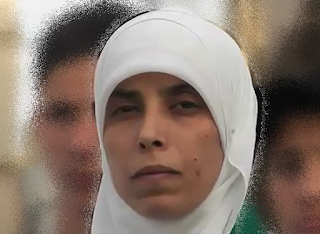
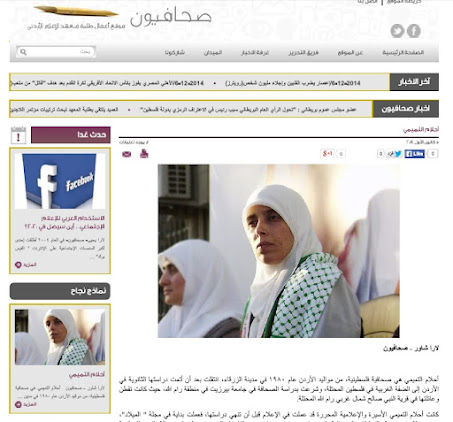
Ahlam Tamimi, a designated FBI Most Wanted terrorist since March 2017, looked jubilant as the centerpiece of a 25 minute interview on the Al-Aqsa TV network. It's been beaming programs daily from Gaza to Arabic-speaking audiences in every part of the world since 2006. 

The background is worth knowing. In 2010, the US Department of the Treasury, calling it "a television station financed and controlled by Hamas", designated Al-Aqsa TV as 

a primary Hamas media outlet [that] airs programs and music videos designed to recruit children to become Hamas armed fighters and suicide bombers upon reaching adulthood. Treasury will not distinguish between a business financed and controlled by a terrorist group, such as Al-Aqsa Television, and the terrorist group itself... [link]

Treasury designations like this one are intended to freeze assets held by the station and to

prohibit U.S. persons from engaging in any transactions with these parties. Executive Order 13224 targets terrorists, terrorist organizations, persons owned or controlled by or acting for or on behalf of designated terrorists or terrorist organizations, and those providing financial, material, or technological support to designated terrorists or terrorist organizations, or for acts of terrorism [Source]

Sounds fearsome. 

But for years, video programming that originates with Al-Aqsa TV has gotten a considerable part of its global distribution and exposure from Facebook. Could this amount to giving "financial, material, or technological support to designated terrorists"? It's a question that was posed in the past.

Ahlam Tamimi, who has long called her central role in the massacre of Jewish children in Jerusalem's Sbarro pizzeria in 2001 "a crown on my head", was interviewed live on Friday June 30, 2023 in a program marking the festival of Eid al Adha

The adulatory interview, entirely devoid of criticism and long on compliments and adulation, ran for 25 minutes on Al-Aqsa TV that day. It remains viewable now on Facebook [here].

Rambling and unfocused, with lengthy elements of theology, it calls for understanding of the greatness of what jihadists like Tamimi see themselves personifying. When Tamimi has the media's attention, it's generally about her dedication, her determination, her victimhood. And sometimes about her skillful cooking:

...I mean, I am a professional in making Jordanian mansaf [lamb cooked in fermented dried yogurt, served with rice or bulgur - considered the national dish of Jordan]... I mean, I make mansaf and feed everyone, God willing. I want to talk. Mansaf is also one of the dishes that Nizar and I love. Most Palestinian prisoners and editors also love this dish. On the other hand, I mean, if I want to compare to you, we used to make Mansaf in prison. No one asked me this question honestly. The method of making it in prison is completely different from the way it is made in. In freedom, God willing, in future episodes. If you want to talk about this talk, it is necessary, we would love it very much.

This, remember, is an interview with a confessed mass murderer.

* * *

Until a month ago, the death toll that resulted from Tamimi's August 9, 2001 execution of an act of violent savagery on behalf of Hamas was 15. 

Two of those killed were Americans. Our daughter Malka Chana Roth, 15, was one. And a young American Jewish tourist (and her parents' only child) visiting Jerusalem briefly while pregnant for the first time, was the other. Sveeral American nationals were injured.  

The number of murdered rose to 16 on May 30, 2023. Chana Tova Nachenberg had been profoundly injured in the Sbarro bombing when a splinter of shrapnel penetrated her skull, rendering her comatose - but sparing her toddler daughter. A month ago, she died in a Tel Aviv hospice, having never recovered consciousness throughout the nearly twenty-two years that ensued. 

Chana Finer Nachenberg's grave

Her closest family - parents, husband, only child - visited her for years, praying, hoping, weaping, wishing for a miracle that never came. 

Then the vigil came to an end.

We hope none of them ever hears Tamimi wail, as she did on Al-Aqsa this past Friday, about how

I am trying to be happy and get joy. But I mean, the family entity has been shaken because of this forced distance, because of constant demands, constant pursuit. However there is no listening ear to our cause as if [it were we who] committed the massacres of the whole world. They want to put the blame on my back and Nizar's back. [Source]

Her family entity has been shaken, says Tamimi, the proud murderer? It's a reference to how Nizar Tamimi, her husband and cousin, an unrepentant convicted murderer imprisoned for life and freed, like Ahlam Tamimi, in the notorious Shalit Deal in 2011, now lives free in Qatar after Jordan declared him persona non grata in 2020 ["Jordan deports Sbarro bomber’s husband, also a convicted terrorist, to Qatar", Times of Israel, October 13, 2020]

But the presenter, like every presenter of every interview Tamimi has done in all her years of obscene celebrity, doesn't once mention the children this barbarian blew to pieces. 

In the Arabic-language media, there is zero interest in addressing the humanity of Tamimi's murdered victims. Tamimi herself has said repeatedly she has no regrets. She would do it again if she could. 

In a startlingly large number of Arab media outlets, our beautiful fifteen year old daughter is repeatedly called "zionist rapist". So are all the other Sbarro pizzeria victims, some of whom never reached their teens. 

The horror is not limited to Tamimi.

* * *

The dedication ceremony at the fresh graveside of Chana Tova Nachenberg this past Friday included no references to more violence. No calls for revenge. No bitterness or anger. But much heartbreaking wistfulness, deep longing, love.

The FBI issued a Most Wanted Terrorist poster for Ahlam Tamimi in March 2017. It says she's dangerous and likely armed. You can see the English and Arabic versions here.

In the past week, evidently triggered by the increase after so many years of the number of dead, and of the Americans among them, the FBI with no fanfare has just issued an updated version which shows Tamimi looking 43 years old. It also updates the death toll.

King Hussein and President Clinton

What it doesn't say, at least not in the way we think should be said, is that Ahlam Tamimi remains free, a celebrity, safe under the illicit protection of the Hashemite Kingdom of Jordan. 

Why illicit? 

Because a 1995 extradition treaty made between the William J. Clinton administration and the late King Hussein of Jordan, the father of today's Jordanian ruler, gives Jordan no discretion in the matter. 

If pursuant to the treaty America asks for the handover of a fugitive wanted by the US justice system which Tamimi certainly is, Jordan can really only ask "Which flight?

Jordan has issued a host of alibis and made-up rationales to conceal the truth of why it refuses to extradite Tamim to Washington where she began facing terror charges under seal in July 2013. (The charges were made public only on March 14, 2017 after years of unproiductive efforts by the United States to induce Jordanian compliance with its undoubted treaty obligation.)

From speaking with a wide selection of authorities, it's clear to us that Jordan's self-excusing acrobatics aren't taken seriously by anyone. 

It's also worth noting that in the formal ratification document signed back in 1995 (we obtained the documents by personally suing the State Department), King Hussein expressing himself in formalized language (and understandably using the Royal "We") says that Jordan pledges

to carry out its provisions and abide by its articles and... shall not allow its violation. Accordingly We have ordered that Our Seal be affixed to it and We have signed it properly 

Jordan did in fact observe the provisions and articles of the treaty appropriately and conscientiously every time the US requested an extradition, as a treaty partner of course must. That however came to an end with the Tamimi case, years after King Hussein's death.

* * *

It's hard to ignore how Tamimi's continued freedom, her encouragement of more terror, her glorification of the murders she carried out, her inciting of others to do the same, all get buried again and again by those who ought to have taken action years ago. 

Since this is about justice, there's plenty of disgrace to go around.

* * *


This post, like many others before it, has been translated into the Polish language ("Święto, pogrzeb i nieudane przywództwo") by Malgorzata Koraszewska over on the Listy z naszego sadu website. Our sincere thanks to her, and great appreciation to readers of this blog in Poland.

Monday, September 12, 2022

12-Sep-22: What, officially, does Jordan hear from the US embassy about the Tamimi extradition?

Source: Yesterday's Jordan Times
There are reports in the Jordanian media today about a Congressional Delegation ("a CoDel") visit to the royal palace in Amman yesterday.

The only Congressional name that appears in any of the numerous news items we saw is that of Senator Michael Rounds, a Republican and the junior senator from South Dakota. He sits on the Senate Foreign Relations Committee.

He was accompanied by the American ambassador, Henry Wooster. Other American-looking visitors (possibly staffers) are seen in the accompanying news video but the Jordanian reports don't name any of them. 

The visit was clearly appreciated by the hosts. That's evident from seeing which Jordanians participated. King Abdullah II; his son Crown Prince Hussein; Jordan's Foreign Minister and Deputy Prime Minister, Ayman Safadi; and the director of the king's office, Jafar Hassan. There may have been others.

As we have said in previous posts, official American delegations to Jordan's sumptuous Al Husseiniya Palace raise thorny, even disturbing, questions about how the United States views the Hashemite Kingdom's years-long breach of the 1995 Extradition Treaty between the two countries


The 1995 treaty we mentioned is the one invoked by the US Department of Justice when it filed a criminal complaint on July 15, 2013 against the Jordanian woman charged with bringing a powerful and very deadly bomb - an exploding human being, a human bomb - to a central Jerusalem Sbarro pizzeria thronged with a lunch-hour crowd of families and children. The children. as we learned later from the mouth of the monster who made the decision, were the target.

Our daughter Malki, 15, was one of the children murdered there that day. 

No official account reports what happened after the charges were signed off by Magistrate Judge Deborah Robinson in the United States District Court for the District of Columbia. 

But from several sources, our understanding is that the DOJ promptly (we think in mid-2013) notified its Jordanian counterparts of the court order. And then delivered a request that the fugitive bomber be extradited under the treaty as other Jordanian fugitives had been extradited by the Jordanians before her each time Jordan was formally requested to do so by the Americans.

In the specific case of the Sbarro bomber - and on more than one occasion - Jordan rejected the request. 

* * *

Let's now fast-forward almost four years. The criminal complaint against the Jordanian woman, a Hamas agent named Ahlam Aref Ahmad Al-Tamimi, was eventually made public on March 14, 2017. It had been kept secret under seal until then. 

Did the US make energetic efforts to get Tamimi extradited under the treaty through all those years? There's no way to know for sure. But the answer is almost certainly yes.

Then, just six days after the unsealing and the formal announcement [see Individual Charged in Connection With 2001 Terrorist Attack in Jerusalem That Resulted in Death of Americans] of the terrorism charges against Tamimi, Jordan's highest court sprang into action. In a stunning and brief ruling, it said Jordan had no obligation to hand her to the Americans because the then-22-year-old bilateral agreement suffered from flaws. 

On closer examination, it was clear they meant flaws created by Jordanflaws that only Jordan could fix if -- and it's a large if -- they were indeed real
The Al-Husseiniya Palace in Amman 

But no one was giving their ruling closer examination. And no news report at the time cast any doubt at all on the soundness of the Jordanian judges' argument. That's a shame because to us it's clearly built on deception and inaccuracies. (We choose not to use blunter words.)

Tamimi herself, by then an icon in her homeland, was triumphantly hugged to Jordan's breast. 

Some excerpts from an Associated Press article under the by-lines of Karin Laub (AP's then Jordan bureau chief) and Mohammed Daraghmeh:
A Hamas activist on the FBI’s list of “most wanted terrorists” said she is relieved Jordan’s highest court has blocked her extradition to the U.S., where she faces charges in a suicide bombing that killed 15 people, including two Americans, at a crowded Jerusalem pizzeria.
Ahlam al-Tamimi, 37, who chose the target of the 2001 attack and guided the bomber there, told The Associated Press that she “lived in fear” for her life until this week’s high court ruling, in part because she had received threats, including from U.S. citizens, on social media. She said she can’t leave her native Jordan for fear of arrest if she travels abroad.
Al-Tamimi has been unapologetic about her role in one of the deadliest of scores of Hamas suicide bombings during the second Palestinian uprising against Israeli rule. She said Palestinians have a right to resist by any means, including with such attacks, against what she portrayed as a brutal military occupation.
“We are an oppressed people defending ourselves,” al-Tamimi said in an interview this week in her home in the Jordanian capital, Amman. “We want Israel to leave our land so we can live in quiet.”
Asked about her role in the killing of civilians, including children, she said: “I don’t target children, but when the bomb goes off, it goes everywhere.”
The blast at the Sbarro restaurant in downtown Jerusalem went off on the afternoon of Aug. 9, 2001. The assailant detonated explosives hidden in a guitar case packed with nails. Fifteen people were killed, including seven between the ages of two and 16, and scores of people were wounded.
Al-Tamimi was arrested by Israel several weeks after the bombing and sentenced to 16 life terms. She was released in a 2011 Israel-Hamas prisoner swap.
Since then, she has been a familiar media presence, including at one point hosting a talk show on a Beirut-based Hamas-run TV station about Palestinians imprisoned by Israel.
She has also spoken repeatedly about the attack, saying she was pleased with the high death toll.
On Monday, Jordan’s high court ruled that al-Tamimi cannot be extradited from Jordan to the United States because the two countries don’t have an extradition treaty.
[Source: "Jordan planner of 2001 blast relieved US extradition blocked", AP, March 23, 2017 - originally posted here and now archived]
There's much more to be said about whether the Jordan/US treaty is valid including very significant information we (Frimet and Arnold Roth) obtained when we sued the US government under the Freedom of Information Act. Note: sued. Simply applying under the FOIA law got us nowhere.

The US, at least for the record, has consistently said the 1995 treaty is as valid today as it was when new, and remains binding on the parties and in full effect. The treaty is listed in the State Department official online Treaties in Force compendium

In the course of many consultations and discussions we have had with officials of the US government and legal experts, not one of them has contradicted that or brought it into question.

On the other hand, getting US officials to state the obvious has proven incredibly frustrating. To say it plainly, if the treaty is valid, then the failure by Jordan to comply with its treaty obligation in the Tamimi case is a breach. And if it's a breach, why is no one saying so? The simple answer, friends and neighbors, and there is one, is that it's all about politics. 

Meanwhile, Tamimi lives free as a bird in Jordan as the Department of Justice prosecutors in Washington and the FBI agents charged with delivering her to US law enforcement cool their heels. 


* * *

Henry T. Wooster, a career diplomat, was nominated in November 2019 to become the US ambassador to Jordan, a position that had remained unfilled since Alice Wells departed in March 2017. (A Foreign Policy article at the time said that soon after taking office, "President Donald Trump pushed out the US ambassador to Jordan after complaints from the country’s king, even though there was no evidence the diplomat had misrepresented Washington’s policies.")

The nomination was made by the Trump White House.

US ambassadors need to be confirmed before their appointments are official. The confirmation process involves public hearings in the US Senate. 

Our focus now shifts to what Mr Wooster said when going through that process in a video conference session of the Senate Committee on Foreign Relations on May 13, 2020 presided over by Hon. John Barrasso, (Republican, Wyoming). The candidate, according to the chairperson's introduction in the official protocol, is:
a career member of the Senior Foreign Service, Class of Minister-Counselor. Mr. Wooster is currently the Deputy Assistant Secretary of State for the Maghreb and—or Egypt in the Bureau of Northeastern Affairs. He has previously worked as the Deputy Chief of Mission and then Charge´s d’Affaires at the U.S. Embassy in Jordan. Mr. Wooster has also served as Deputy Chief of Mission in the U.S. Embassy in France.

The years Mr Wooster previously served in America's Jordan embassy evidently warmed him to the charms of the kingdom. He underscored this in answering a question about the possible impact on Jordanian feelings if the US were to cut back its financial support refugees:

Well, Senator, no one knows this better than the Jordanians—no one is a better friend to Jordan than the United States is. And we can say that with integrity. And I can look you in the virtual eye and say it. And that is true by orders of magnitude. It is not simply a debating distinction. It is true if you look at the record. And the record shows, again and again and again, and with orders of magnitude, there is no friend that is better to the Hashemite Kingdom than the United States. So, we do not want these people to be beleaguered, and we do not want them left out in the dark. I mean, these are allies and strategic partners, and we are going to stand by them. We are going to make sure that they are not left with a deal that is bad for Jordan, too. [Source: The official protocol]

Diplomats as effusive as Mr Wooster aren't all that common.

But let's compare that now with what happened in the non-face-to-face part of the confirmation hearing when questions for the record are submitted ahead of time by the Senators and the candidate responds after taking some time to prepare a written answer. This doesn't always happen - but it happened in the Wooster confirmation.

In the protocol, the exchange that follows is headed "RESPONSES TO ADDITIONAL QUESTIONS FOR THE RECORD SUBMITTED TO HENRY T. WOOSTER BY SENATOR TED CRUZ". 

Question. Please describe the extent to which Jordan’s refusal to extradite Tamimi has affected U.S.-Jordanian relations?

Answer. We continue to ask that the Government of Jordan arrest Ahlam Aref Ahmad Al-Tamimi and agree to extradite her to the United States. The Government of Jordan has been unwilling to accede to our request due to the Court of Cassation’s ruling that our bilateral extradition treaty is not valid. We continue to dispute the court’s claim, as we exchanged instruments of ratification that brought the treaty into force on July 29, 1995 and the treaty has not been terminated. We continue to raise this issue at the highest levels in order to reach a satisfactory solution.

Question. What options and leverage does the United States have to secure Tamimi, including potentially withholding assistance to the Government of Jordan?

Answer. The United States has multiple options and different types of leverage to secure Ahlam Aref Ahmad Al-Tamimi’s extradition. We will continue to engage Jordanian officials at all levels not only on this issue, but also on the extradition treaty more broadly. U.S. generosity to Jordan in Foreign Military Financing as well as economic support and other assistance is carefully calibrated to protect and advance the range of U.S. interests in Jordan and in the region.

Question. Can you commit to using those options and leverage to secure Tamimi’s extradition?

Answer. If confirmed, I would explore all options to bring Ahlam Aref Ahmad Al-Tamimi to justice, secure her extradition, and address the broader issues associated with the extradition treaty.

It's the kind of forthright response a well-prepared ambassador ought to give. But we're left wondering how closely His Excellency Henry T. Wooster, Ambassador Extraordinary and Plenipotentiary to the Hashemite Kingdom of Jordan (as he has been since August 27, 2020), hews to the approach he outlined to the Senate.

* * *

As of today, Tamimi is still free and still making public appearances replete with messages encouraging terror. 

As for Jordan, its senior officials (with the notable exception of Foreign Minister Safadi) have maintained a policy by which they carefully avoid making public statements about the treaty even as they hold tight to the kingdom's celebrity terrorist. The principal principle seems to be: just don't get into spats with the Americans

The United States through three administrations (Obama, Trump, Biden) takes a reciprocal approach and is sticking to it. And justice be damned. 

The exception to the game-plan is Safadi. We have published two blog posts reporting how, on two occasions a year apart, he has asserted publicly in Arabic to domestic audiences that refusing to hand over the mass-murderer as required by the treaty is actually evidence Jordan respects the law: see "13-Nov-19: Thank you, Mr Foreign Minister" and "16-Nov-20: Justice, the Tamimi extradition and what Jordan tells Arabic media but not the world".

(We haven't yet written about the numerous occasions on which Jordan's king, speaking off the record in what are often closed-door meetings in the US, offers a range of near-plausible explanations for his Tamimi strategy.)

2001 The site of the Sbarro massacre (Peter Dejong, AP)
If Mr Wooster were the kind of person who answers letters, we would want to pose some questions to him based on what he placed on the record. 

For instance,

  1. Has he or his staff in the Amman embassy explored all options to bring Tamimi to justice? Is there a plan to start exploring this at some point in the foreseeable future? 
  2. Can he outline for us what "all options" might look like?
  3. Those "broader issues associated with the extradition treaty" - can we get a preview of what they are? 
  4. Can we count on them getting public exposure even as the FBI Most Wanted fugitive terrorist is hosted by Jordan? 
  5. In continuing to dispute the Jordanian court’s claim about the validity and applicability of the treaty, and raising the issue "at the highest levels in order to reach a satisfactory solution", is there progress? It's been years, Your Excellency. Can we get some teeny tiny indication of how the process is going? 
  6. And where the sticking points are?
  7. Would the Ambassador like to know a little about our murdered daughter Malki? About her beautiful life and about the really fine non-sectarian, apolitical and tremendously constructive work done in her memory via the Malki Foundation?
From experience, we fear each of our questions would get the same answer.

Tuesday, March 29, 2022

29-Mar-22: Malki and the Jordanian savage were never two sides of the same coin

Sbarro Jerusalem, August 9, 2001
The fine article that follows is authored by Varda Meyers Epstein who writes under the nom-de-blog Judean Rose. She published this interview with Arnold Roth on the esteemed Elder of Ziyon blog where it appeared on June 5, 2019 under the title "A Father Speaks Out: The Murder of Malki Roth and the Refusal of Jordan to Extradite the Beast Ahlam Tamimi". Since we are currently in dialogue with members of the US Congress about the troubling way Tamimi remains free and active, we reproduce it here in the hope that it will remind Americans of what's being swept under the rug by highly-placed officials. We have made some changes to the selection of accompanying pictures and republish this with the permission of both Mrs Epstein and Elder of Ziyon. Thank you, both!

* * *

The faces of some terror victims stay in your mind and in your heart, for instance the face of Malki Roth. In part it’s the outrage of the act: that someone could steal away a beautiful young girl with so much promise and talent. But it’s also her smile in the photos, with that soft sweetness, radiating what you’re positive was an inner beauty to match the exterior.

What happened on August 9, 2001, at the Sbarro restaurant in Jerusalem, was and remains unspeakable.

But what is truly unbearable is this: Ahlam Tamimi, the woman behind the murder of Malki Roth and so many others, lives free and clear in Jordan. Tamimi was released from an Israeli prison in the Gilad Shalit prisoner exchange in 2011. Since that time she has married and built a career on her status as a hero for masterminding the murder of Jewish children. Of this she is proud. Of this she brags.

Here is an interview with Malki’s father, Arnold Roth:

* * *

Varda Epstein
: Tell us about that day. How did you find out? How long until you knew?

Arnold Roth: Most people know that the truly life-changing things that happen to us come when we least expect them. This was a hot August Thursday at a busy time for me. I was chief executive of a drug technology company based in one of Jerusalem’s science and technology campuses and we had a lot on our plates, most of it very good. I went to lunch with the same friends as usual and got back just in time to receive a frantic call from Frimet, my wife. “There’s been a pigua [Hebrew for terror attack] and I can’t reach the children.” I went directly into calm-husband-and-father mode, trying to say what I really believed: “Don’t reach for the worst. Give the kids time to call in and reassure us.” 

But the call ended while I was in mid-sentence.

Jerusalem had been free of major terrorist attacks for years at that point. The grim reality of armed guards emplaced outside supermarkets and restaurants had not yet been instituted. But the massacre at Tel Aviv’s Dolphinarium had happened some weeks earlier in June 2001 and the raging terrorism that the more ideological parts of the media repulsively called the Second Intifada had gotten started almost a year before. In the capital, we were living on borrowed time but we didn’t realize it.

Frimet and I phoned back and forth several times over the next two hours. Malki was the fourth of our children, the oldest of our daughters, and - at 15 - busy, energetic and independent. Her older brothers all checked in by phone during the early afternoon.

As a rising sense of something awful started settling in, I phoned Malki’s cell a couple of times, begging her to call back as soon as she could. I imagine Frimet did the same.

Around 4:00 pm, and although I had a string of meetings and conference calls to deal with, I left my desk to go home. Frimet called me just before that to say she couldn’t bear waiting at home, was going mad from the worry and stress and needed to do something, go somewhere. We have a very disabled youngest child who needs constant care so Frimet leaving the house meant I needed to be there in her place.

I think of myself as religiously observant and believe hashgacha pratit—divine providence at the personal, individual level—is a real thing. I was trying to negotiate private deals with the Almighty as I walked to the bus.

-- Let her phone be broken. 

-- Please let her be in an area where there is no reception. 

-- Let her be mildly concussed. 

I no longer remember the scenarios. But I was hoping desperately that I could offer something that, if it were only accepted above, would let us off the hook that started to feel more and more real.

There was no relief at home. At first, I was alone with our daughter whose disabilities are extreme and profound. We didn’t know how to communicate with her at that stage in her life. So she was not part of the anxieties; rather she was part of the normalcy.

One by one, the children arrived home and then so did Frimet, accompanied by one of our sons who had started his compulsory military service the previous day and was sent home to help with the emerging crisis. 

He and Frimet, it turned out, had been at one of Jerusalem’s hospitals looking for whatever there was to look for. But before Frimet left our street to get there, she encountered Avivah, our neighbor. Avivah’s daughter Michal, it turned out, was with our Malki from early that morning. 

The mothers went to the hospital together and then split up to search. Frimet and our son found no sign or word of Malki and came home.

We all, in our separate private nightmares, did our praying and hoping and deal-making in the ensuing hours. As night fell, a neighbor struggled up the stairs, ashen-faced, to tell me at the open door that Michal’s name had just been reported on the news as one of those killed at Sbarro five hours earlier. 

The world, already deeply grim, now looked a lot blacker.

Another neighbor, at the time a department head at Hadassah Ein Karem who had been working the phones to tap into his network of doctor contacts, walked in and told me to get ready to go with him. “I was told there’s a teenage girl on the operating table. I’ll drive you there.”

It turned out not to be Malki. 

But as we stood there in the miyun (emergency room) area, surrounded by people who looked like I felt, a medical colleague of his took in the situation and as he rushed to deal with yet another emergency case, he may have said to my friend: “I don’t know what to tell you” or something else guarded and careful. But in the memory of the man I now am, nearly eighteen years later, what I remember him saying is: “Check over there in that cubicle. There’s a girl we’re about to operate on and another one who’s dead. One might be yours.”

That’s how one of life’s hardest moments is engraved in my memory. We didn’t find Malki anywhere. 

A hospital social worker having what was surely one of her own most challenging days, walked over to me and, under huge stress herself, said without much ceremony: “If you’re looking for a child here and can’t find her, and it’s now nine hours after the bombing, you need to go to Abu Kabir. Now.”

I understood what she meant but demurred. “I will ask one of my sons to go. At this point, it will be better if I go back and stay with my wife at home.” As I left, the social worker calmly did exactly what was needed: arranged for a taxi and a social worker to collect two of my sons and bring them to Israel’s only center for performing autopsies and identifying terror victims. It’s known as Abu Kabir after the Jaffa neighborhood where it is located.

My two older sons phoned from there at two on Friday morning, exactly twelve hours after the Battle of Sbarro Pizzeria started and ended. They had found their sister. 

I recited the brief and awful prayer that’s said on learning of a death and was aware of my wife starting to scream as she ran out the front door and into the night.

The DOJ/FBI Wanted posters appear online - you can see them here - but are not posted anywhere in Jordan where
Ahlam Tamimi, the fugitive bomber, still lives, still free, still famous, still inspiring additional terrorist acts

Varda Epstein
: For many years now, you and your wife Frimet have been raising awareness of what happened to your daughter, and the injustice of subsequent events regarding her murderer. But what was it like in the early days, after the shiva was over? What was it like waking up in the morning and just getting through the days? How long was it before you found a way forward?

Arnold Roth: The first seven days are a blur. Many people—a thousand, maybe more—passed through our hot and bustling apartment to observe the shiva with us, to bring us comfort and distraction. Many were people who didn’t know us at all—just reaching out because of the enormity of the tragedy and a sense of what else is there I can do?

Almost all the interactions that were important to me during the first year were within the family and are intimate to the point where I believe there’s nothing I can or want to share. 

Except to observe something quite uncomfortable: that we lost friends during this period—people whose social circle we felt ourselves to be part of and who now, in some cases, crossed the street as we got closer or whose small talk steered carefully away from any mention of Malki and the murder that took her from us. I can’t say I don’t judge people. But I believe we’re all to blame for how ill-prepared most of us are for comforting others in the wake of a violent, terror-driven death of a loved one and especially, especially, especially (no other way to make the point) of a child.

One aspect of this sticks out in particular and because something constructive eventually emerged, I want to touch on it here. Schools, even in Israel, even in Jerusalem which was Ground Zero for murderous terror attacks during the ensuing few years, were absolutely unprepared for dealing with the impact on school mates and especially on siblings. This caused very considerable personal suffering for thousands of individuals and families—almost all of it unnecessary and avoidable. Too many people were asleep at the wheel. Things are better now (and I credit my wife’s activism for some of why it’s better). But my impression remains that at least some of those who were ill-equipped to deal with it remain just as ill-equipped today. Let’s hope they’re never put to the test again.

Varda Epstein: What do you think Malki would be doing today, had she lived to fulfill her potential?

Arnold Roth: Because she was taken from us with such sudden finality and trauma, it’s always been hard to think of Malki grown up. She packed an amazing amount of goodness into her life, much of it unobserved or barely known to us. 

Since we modeled the Malki Foundation on those parts of her life that we wanted very much to be remembered, I will mention that she was always ready to help people who are struggling with challenges; that she approached practically every situation in life with a smile; that she felt especially close to her own catastrophically-disabled little sister and did things for her when it was clear she would get nothing back, other than satisfaction and contentment.

Malki was modest and friendly. The positive impact of her life is reinforced by the messages we got then and over the years since from age-mates, from friends in the community, from little girls who are grown up now and who were in her charge when she was a youth leader (madricha) in Israel’s Ezra youth movement.

So what would she be doing if she had been spared? She would be making herself helpful and well-loved wherever she would be and in whatever she would be doing.

Varda Epstein: What does it feel like to have Jordan refuse to extradite the murderer? What does it say about Jordanian values, about Jordanian society?

Arnold Roth: The appalling woman, a barbarian in every sense of the word, who masterminded the Sbarro massacre is living a fabulous life. The government of the Hashemite Kingdom of Jordan has put its strategic ties with the United States at risk by pretending, via its highest court, that it doesn’t have to extradite her to Washington.

Malki had American citizenship and we have made serious, little-publicized efforts to bring Ahlam Tamimi before a US Federal court to face terrorism charges. This is not going well for us but it’s far from over.

Varda Epstein: Do you have reason to hope that if you keep up the fight, Tamimi will be brought to justice?

Arnold Roth: At this point, as well as the challenges, we have some concrete achievements: Tamimi has been charged under US law; there is a $5 million reward for information leading to her arrest and conviction; the US has invoked its 1995 extradition treaty with Jordan and says it expects her to be handed over. There is a wealth of detail and complexity behind each of these ‘achievements’ and far more to tell than an interview like this can bear.

I will only add that I think there will be wide surprise and disappointment among those reading this once they know who is with us in this pursuit of justice and who is blocking the process. Since it’s very much a work in progress, I will say no more—other than to observe that Ahlam Tamimi does not live in hiding today, has never been in hiding for a single hour since she was freed—over our vociferous objections—from her Israeli prison cell and from her 16 life terms, and sent back to her homeland, Jordan. She lives free as a bird in Amman today.

Tamimi may be the first mass murderer in history to be given her own television program, to have operated freely for years under her own name on Facebook and Twitter, and to be interviewed regularly in the Arabic media—special mention here of the Aljazeera Network—without her crimes, the people she killed, ever being mentioned.

Varda Epstein: Tamimi is someone who takes joy in murdering children. How can this be, that she roams the streets of Jordan, free?

Arnold Roth: The question is a cornerstone for understanding the vast gulf between the two sides of the global debate over terrorism. One of the many professional consultants who has traveled to Jordan on behalf of the US government (there are far more of them than most people would guess) helped me understand this. Though we were strangers when I reached out to her, she was kind enough to provide me with real-time feedback during her time in Amman.

She told me the Jordanians with whom she was conferring and working—high-achievers, intelligent and well-educated people, movers, shakers, up-and-comers in Jordanian society—see Tamimi as a national hero. You won’t find this is in any English-language publication or in anything directly controlled by the Jordanian government. But black-and-white evidence of the sentiment is only too easy to find even if you don’t go there.

They utterly reject the notion, she told me, that just because Tamimi blew up a pizzeria and all the children and families inside that they ought to think of her as a terrorist. She’s doing resistance. She’s a figure of wide admiration.

If Tamimi, as I believe, is a litmus test of Arab society’s willingness to come to terms with the reality of Israel and with the challenge of living at peace with Israelis at some future point… well, you don’t need me to finish the sentence.

Varda Epstein: You showed me a blog you wrote about your Aunt Feiga. Can you tell the readers about her, the photo you received, and Malki’s reaction to that photo?

Arnold Roth: I was born in Melbourne. It’s an unusual and very special place to be from for several reasons. The one I want to emphasize is that almost all my friends, growing up, were just like me: children of “refos”—European Jews, by far most of them from Poland, who were issued papers in and after 1947 (a change of government led to a major turn-around in Australia’s notoriously closed approach to immigration) to come as refugees and rebuild their lives as far away from the European killing fields as you could go.

Almost none of us had any grandparents. Few of us had more than one sibling. All of us had parents who shared some major dimensions: working hard, getting ahead, making a good life, giving their children the best, and having frequent and noisy nightmares of the Holocaust years that stole their youth, their schooling, their families, their health.

My father’s life, the details of which are still in some ways a mystery to me, included some special drama. Dad was one of seventeen children, a Hassidic family from a small town in Galicia, of whom only two, maybe three, survived the Nazi genocide of the Jews. That sentence contains practically everything I knew up to when Dad passed away in 1982.

Among the many stunning discoveries that came after Dad was no longer available for me to consult him was a cluster of four photocopies of Nazi census forms. They are from the Krakow Ghetto, all dated August 1940, all filled in by handwriting (my father’s was familiar to me), all with passport-style photos. Up until these papers came into my hands, which was in 2000, I had never seen a portrait of my father as he looked before ending up as a survivor.

The other three were of women, one of them a sister of my father, the sum total of whose existence until that moment was a name on a family tree that I made after holding Dad down long enough to disclose things he was never comfortable disclosing.

The sister’s name was Feiga; she did not survive. The census picture shows a woman of 26, a striking beauty with distinctive eyes and eyebrows.

Malki’s eyes and eyebrows.
Malki HY"D

Malki noticed the resemblance immediately. It triggered some discussion, and perhaps some deeper thoughts, about Jewish history, about irreparable loss, about family. Malki was taken from us a little more than a year later.

Varda Epstein: What should we learn as Jews from the story of Malka Chana Roth, HY”D?

Arnold Roth: It was always clear to us that if we didn’t take steps to preserve a memory of Malki’s beautiful life, that in the nature of things her murder would be reduced to a statistic. Sounds cruel but from the perspective of Israeli society, it’s far truer than not.

As a family, we took a few minutes during the shiva, after the last of the visitors had departed on one of the evenings, to consider our options. We decided to create a charity that would give practical expression to Malki’s passion for helping children with extreme special needs. This of course was something that fit well with the wonderful devotion she showed for the very challenging needs of her own little sister. But it went beyond that.

The anecdotes are many but two stand out.

One - In the summer of 2000, a year before she was taken from us—Malki decided to apply what she had learned in helping her mother look after Haya, our youngest, by knocking on nearby doors to see if there was someone else’s mother who needed a volunteer helper with her skills. She found Ro’ei and his mother Devorah just a few streets away. Ro’ei, confined to a wheelchair, non-verbal, fed by tube, a gorgeous little boy with a smiley face—had the version of Canavan Disease whose outcome is depressingly known well in advance. Malki loved being with him daily, cleaning him up, cheering him up, sharing some of the overwhelmed young single mother’s load, making herself helpful. She embraced the self-imposed mission like others of her age embrace going to the beach. (Ro’ei outlived Malki by a few months.)

Two - In August 2001, partnered by Rachel, a school-friend, she insisted her way into the annual summer camp held by Etgarim, a wonderful nonprofit that provides summer sports, camping and the best of outdoors activity for youngsters with special needs, both cognitive and physical. Malki told us that Etgarim wasn’t geared up to take volunteers but that somehow the girls broke through the resistance and became part of the team. The photos we later saw show Malki smiling from ear to ear as she poses with campers.

Most of what we know about those few days we learned after the Sbarro bombing which happened just a couple of days after Malki came home from the north. The stories they shared with us are unbearably touching.

We named the new entity the Malki Foundation: in Hebrew, Keren Malki [www.malkifoundation.org]. Almost eighteen years on, it has a terrific record of quiet, modest achievement, empowering thousands of parents of children with extreme special needs—children from every part of Israeli society without regard for religion, political outlook, national identification or economic capability—who have made the decision to embrace the challenge of raising their child with special needs at home and withstanding the pressure to institutionalize the child.

We avoid intruding into the family’s life or second-guessing them on decisions about which non-medical therapies they feel will most benefit their child. We support physical therapy, speech therapy, hydrotherapy, therapeutic horse riding and occupational therapy. They choose the therapist and the times and the frequency; we pay. We want them to feel empowered. It’s a successful model.

We also provide home-care and mobility equipment, and for families living in the periphery—Israel’s far north and far south—we send our own therapists right into the home. For many of them, we could provide an open check for therapy services and they would be unable to spend the money. Israel seriously lets such families down.

Associating tragedy, personal loss, grief and pain with good, constructive deeds is a respected and time-honored Jewish response. We call those deeds hesed. I don’t intend to wax poetical in explaining why the family created the Malki Foundation but want simply to say: it gives me the opportunity, often and before audiences I would not otherwise reach, of saying: There was a very special young woman called Malki and we are all poorer for her having been taken from us.

Malki will never be a statistic but an inspiration. And in remembering her, we also realize that she and the savage who engineered her death are not—as several dull journalists said to me at various points in the weeks after the massacre—two sides of the same coin. Quite the opposite: their ways will never be and never were our ways.

Sounds simple but surprisingly few public figures—diplomats, politicians, editors, religious leaders—seem to actually understand it.

POSTSCRIPT: About a year after it first appeared, Judean Rose followed up this interview with another which was also published by Elder of Ziyon: "Ahlam Tamimi is Not in Hiding. Why is She Free?"

Sunday, February 27, 2022

27-Feb-22: The Jordanian woman who bombed Sbarro has earned another title

Ahlam Tamimi
We pay a lot of attention in this blog to an Arab woman called Tamimi. Starting a decade ago, we devote ourselves to seeing her removed against her will from the Arab country where she lives and brought in chains to the United States where a federal prosecution has awaited her since 2012. It's an ongoing effort. 

* * *

Ahlam Aref Ahmad Al-Tamimi, born in Jordan in 1980 and living today in its capital, was named five years ago to the FBI's Most Wanted Terrorists list. That elite collection currently features the names and mug-shots of 25 fugitives. Only two are females.

She is also the killer of our daughter Malki, one of the many innocents, most of them children, murdered and maimed in the Hamas bombing of a Sbarro pizzeria in Jerusalem. Our child was 15. 

(A side note about the other woman on that FBI list. A member of the ultra-violent Black Liberation ArmyJoanne Chesimard became the first female to be put on the list. That was in 2013, evidently to recognize the fortieth anniversary of the cold-blooded 1973 murder of a New Jersey state trooper, a terrorist act for which Chesimard was convicted and then imprisoned in 1977. Two years later, she escaped and was never recaptured. Though there is a $1 Million reward for information about Chesimard, there's no expectation she will ever be back behind US bars since, according to the FBI, she was given political asylum in Cuba.)

The State Department's Rewards for Justice unit posted a multi-million dollar reward on Tamimi's head in early 2018. It's not obvious why; the law enforcement officials assigned to the Tamimi prosecution have at no stage needed anyone's help in finding her. She resides in a modern apartment in Amman, Jordan's capital, where via online videos we have watched her interviewed by the likes of Associated Press and Aljazeera. We have clips and photographs of her front door, her living room, the view from her balcony and even her coffee mugs; all can be easily found on the web. (Links on request.)

The Jordanian fugitive calls the massacre of Jewish children in a Jerusalem pizzeria "my operation", a claim that makes sense when you know the details. She has never expressed the smallest degree of regret for the lives she destroyed. Quite the opposite: she is triumphant.

In 2017, she formally became subject to US federal charges announced on March 14, 2017. But unlike most fugitives, she hasn't been in hiding for even a day. Her life is public, her influence pervasive and toxic.

As Fox News reported two years ago [link], Tamimi

is the most wanted woman in the world, with a $5 million bounty for information that leads to her arrest or conviction... Despite being on the run from American authorities, Tamimi has been hiding in plain sight for years - under the eye of one of the United States' longest and closest allies in the Middle East: Jordan.

* * *

Even before the FBI put her face on its posters, she was honored closer to home by a different kind of tribute.

This happened a year after the criminal complaint was signed off by a federal judge in a Washington court, but before anyone knew about it. That's because those charges were sealed in 2013 at the US government's request. They stayed secret until unsealed nearly four years later in March 2017. 

Quickly removed from the JMI website, this tribute
on every page of the students' portal calls the Sbarro
bomber their "success model"
In a stunning decision, the students of a prestigious Jordanian center for journalism studies, Jordan Media Institute, declared Tamimi to be their success model. Literally.  That's the exact term they used (in Arabic). Given that she's principally known for the murdered children, that should have been a show-stopper. 

They plastered it all over their website (see image on the right). It was a position statement they wanted people to know about.

What the JMI students did was never reported by any mainstream news source - not  then and not since. But we certainly publicized it

We also publicized how about a third of the JMI's foreign funders and partners (we listed them here) reacted almost immediately by terminating their funding and discontinuing their partnering. 

JMI's management flatly ignored our comments, polite requests and questions. We understand how embarrassed their actions must have made them feel. They notably include Princess Rym Ali, JMI's principal founder. As Rym Brahimi, she was for years an on-camera reporter for CNN before marrying into King Abdullah's family.

What we don't understand is those funders and commercial sponsors who chose not to disengage or cut funding to Princess Rym's school. They include the governments Australia, Germany, the United Kingdom, the United States and the European Union - all of whom rejected our pressure and in some cases argued back. (We have never published those letters.) 

Lest you think public support for a fugitive bomber who confesses to mass murder could damage the standing of a university-level school like Jordan Media Institute, under royal patronage and funded by foreign governments - well, perhaps you don't get how Jordan works. 

Here's an example. Last month, according to the kingdom's government-controlled news platform Jordan Times, Jordan Media Institute proudly hosted White House Spokesperson Jen Psaki 

as part of the special guest speaker component of the ongoing Jordanian Government Spokesperson training implemented by JMI in partnership with the Office of State Minister for Media Affairs at the Prime Ministry and support from UNDP. 

This is the same Jen Psaki who this past July deflected the questions of an Associated Press reporter when Jordan's King Abdullah II got the red carpet treatment at the White House ["21-Jul-21: In welcoming Jordan's king to Washington, we wanted him to be reminded of the ongoing Tamimi extradition scandal"]. At a media briefing, the reporter asked her whether the Tamimi case came up in the Biden/Abdullah meeting. A reasonable enquiry given how seriously the State Department says it takes the whole Tamimi extradition matter as the slide below clarifies:

Source: "21-Jul-21: After Jordan's king visited the State Department yesterday"

But all the AP reporter got from Psaki was an unhelpful ear-full of we'll-get-back-to-you vagueness. Our understanding is she never did get back. 

Hard not to suspect that Psaki felt right at home visiting a school that views Tamimi as an inspiration and an icon. 

* * *

The latest Tamimi 'honor' came at the end of 2021 and has gotten surprisingly little media attention. Or perhaps not so surprising.

That's when Tamimi was included in the annual edition of The Top 20 Most Dangerous Extremists Around the World. The Counter Extremism Project which produces the list is 

"a not-for-profit, non-partisan, international policy organization formed to combat the growing threat from extremist ideologies... [It] builds a more moderate and secure society by educating the public, policymakers, the private sector, and civil society actors about the threat of extremism. CEP also formulates programs to sever the financial, recruitment, and material support networks of extremist groups and their leaders."

Positions 1, 2 and 3 are occupied by the heads of Hezbollah, Iran's Islamic Revolutionary Guard Corps, and Hamas. In giving her position 18, CEP accurately calls Tamimi "unrepentant for her actions" and notes she has 

exploited media platforms to promote violence against Jewish people, Israel, and its allies. In an interview, al-Tamimi even went so far as to say, “I would do it again today and in the same manner.”

CEP says 2022 will bring new and highly dangerous threats. And that political leaders need to recognize this and ensure that intelligence services are prepared, resourced, and funded to match the danger. 

* * *

If the decision makers in the countries capable of sending Tamimi to trial are paying attention to the clear and present danger she poses via her ongoing influence in Arab society, they work hard at conveying the opposite - how little interest they actually have in the case. 

How else to explain the years of toxic influence and freedom this monster has been privileged to enjoy? Why is she still free?

Then there's the matter of justice and how it's thwarted. 

If any of those officials, political figures and media professionals are reading this, we want them to know how much pain they have brought into the lives of the families of Tamimi's victims. That's actually our whole message.

To stand with us, and we hope you do, in our years-long fight to see the US respect its own legal system and press a recalcitrant ally into living up to a strategic treaty, we invite you to sign our petition. It calls on the US Secretary of State to explain to the authorities in Amman, Jordan, what neither he nor a string of previous incumbents in his office have said since those terror charges were finally made public in 2017: Tamimi needs to be extradited to Washington without further delay

The petition is here

Thursday, November 19, 2020

19-Nov-20: Putting justice back on the agenda

Today's Jerusalem Post
We did something yesterday that we have never done before.

We ordered a display advertisement in a mainstream newspaper: today's (Thursday’s) Jerusalem Post. Our message appears on its front page.

The timing of our ad is intended to coincide with U.S. Secretary of State Mike Pompeo’s visit to Israel that began yesterday afternoon (Wednesday November 18). 

Our hope is that he will see it at breakfast. And that perhaps he will think about the images we included, as well as the scriptural quote at the top of the text: “Justice, justice thou shalt pursue”.

The words from Deuteronomy (the Biblical book called Devarim in Hebrew) will be recited in the Jewish world's annual cycle of Torah reading when we get to Parshat Shoftim, the weekly portion called “Judges”. 

That happens next in August 2021. By coincidence, the same week will include the twentieth anniversary of the Sbarro pizzeria massacre.

There are two images in our Pompeo advertisement. One shows Malki. The other is of the devastated Sbarro pizzeria in the center of Jerusalem, minutes after a bomb placed by Ahlam Tamimi exploded inside. 

Tamimi, a Jordanian woman who arrived from her homeland alone, soon joined Fatah. And then, in June 2001 and aged 21, she switched to Hamas. She was evidently in search of something and found it that summer: the opportunity to kill Jews on a satisfyingly large scale. It was an opportunity she grabbed.

On the morning of July 27, 2001, a Friday, Tamimi carried a smallish made-by-Hamas bomb embedded inside a beer can and surreptitiously placed it on a shelf in what was then a Co-op Supermarket. This was located in the basement of a building on Jerusalem’s King George Street that locals knew as Hamashbir. It's an office building today with some shops at street level. She quickly left the scene.

The bomb fizzed with no serious damage except to the ambitious bomber’s pride. 

By her own account, she raged in fury at her Hamas handlers right afterwards and demanded something much larger. She got it ten days later: a diabolical exploding guitar case and a young religious fanatic eager to carry it on his back into whatever target Tamimi chose.

Tamimi scoured Jerusalem and chose Sbarro. The busy pizzeria with the good hashgacha (certificate of being kosher) was popular among religiously observant youngsters like Malki. Tamimi has for years wanted it to be known that her choice was based on the large number of Jewish children reliably inside at that hour. We don't know why this single fact does not lead every report ever published about this exceptionally cold-blooded murdering Islamist. It should.

Mostly behind the scenes, we have pressed the United States to insist Jordan extradites Tamimi since 2012. She has faced serious federal terror charges since they were unsealed by a team of senior department of Justice officials in a public event in March 2017. They had been issued secretly by a judge four years earlier.

This evidently was known to the senior members of Jordan’s political and royal power structure. That’s because secret – and entirely unsuccessful - efforts were made by high-level American officials for several years to persuade Jordan to hand Tamimi over to the FBI. They knew Tamimi was charged even before we (or even the US Congress) did. And to be clear about this central element: there's been an active and totally valid treaty between Jordan and the US since 1995 for the extradition of fugitives like Tamimi. The State Department said nothing for years about the way Jordan breaches that treaty in the Tamimi case (though not in other cases). It started being open and explicit about it late last year ["03-Nov-19: In Washington, a step towards bringing the Sbarro bomber to justice"]

Why should US charges and American justice even enter the Tamimi story? 

The simple answer: Because Malki had American citizenship via her New York-born mother. And there’s an American law that gives it the right and the obligation to go after terrorists who kill American nationals outside the territorial United States. Once taken into custody, the fugitive terrorist can be flown to the US and tried in a US court under US law. It’s what ought to have happened to Tamimi.

But first the FBI has to get its hands on the fugitive terrorist. 

The good news is the US and Jordan signed a treaty to facilitate extradition in both directions. That was in 1995, and in the years that followed extraditions were carried out on request just as the treaty stipulated. But something about the Tamimi case made it different for the Jordanians. They started refusing as soon as the requests arrived and have continued refusing right up until today [see "16-Nov-20: Justice, the Tamimi extradition and what Jordan tells Arabic media but not the world"]. The US has made clear its view that Jordan is wrong,

Tamimi not only lives in complete freedom under the patronage of the Jordanian government but has become a media celebrity there and in large parts of the Arab world. The details are chilling - almost beyond comprehension.

Our Jerusalem Post ad is a call to action to the Trump administration and specifically to its Secretary of State. There’s no political dimension to it - just a call to compel Jordan to abide by a bilateral treaty to which it is a party. And for pure and simple justice to be done.

We have made repeated efforts to recruit politicians to give our campaign some clout but they have borne no fruit. And it’s not that we’re on the wrong side of politics because we’re not on any side.

It’s also not that people actually refuse our request or argue with us or give us cogent reasons why Tamimi ought to be left alone. That’s of course not true about Jordan. There its media, some of its public officials and citizens enthusiastically stand with her.

What mostly happens is we’re ignored. Many of those we approach don’t return our calls or emails or look right through us if we happen to be speaking face to face.

How likely is it that this time will be different? Hard to know but it doesn’t matter to us. Tzedek tzedek tirdof, as the scripture says. Justice, justice though shalt pursue.

That’s our role.

We’re not alone. As our ad says, we have a petition (here - and it's not too late to sign if you haven't already). Thousands of people from everywhere – a not insignificant number of them from Arab countries and even from Jordan – have signed. Their support encourages and empowers us.

Secretary Pompeo, it’s not too late to act” reads our banner headline. “We ask that you do what needs to be done so that Tamimi is at last brought to justice in Washington.”

Next week, after the American visitor leaves, we will go, just the two of us, to Malki’s grave. We do that every year on her birthday. This next time, we are going to have to deal with the reality that she would have become 35 years old that day - but instead she was ripped from our grasp and will not come back. 

We remember her precious life when we get together with our children and grandchildren. And we feel gratified and proud when we look at the exceptional work done daily by the Malki Foundation, the charitable organization that for the past nineteen years has served as a non-sectarian memorial to Malki's short but remarkably impactful life.

And at night when we dream that she is alive and hug her lovingly.

Secretaries of State come and go as do ambassadors and presidents, prime ministers and kings. What never goes away is the absolute need to keep justice at the center of our lives as families and as a society. Our advertisement comes to deliver that message to the breakfast table of movers and shakers as well as to the hearts of ordinary people everywhere.

- O -

Here below is the advertisement as published this morning on the front page of the Jerusalem Post's paper edition:

Click to enlarge.

UPDATE December 5, 2020: Not a word of media comment from any of the many reporters traveling with the Secretary of State. And no response from Secretary of State Pompeo or any of his spokespeople, advisers, assistants or relatives.

UPDATE January 19, 2021: Just silence. Nothing but silence.

UPDATE June 16, 2024: As the US election cycle bears down on the first Tuesday in November, and a handful of well-meaning observers publicly tell us to put our faith in the Trump party (one example among many), be aware that Pompeo's contemptible silence - and not only his personally but the silence of those around him in the State Department and in the White House of those years - has continued until today.