Showing posts with label Elder of Ziyon. Show all posts

Friday, May 20, 2022

20-May-22: Jordan's king takes Washington again as we try to get our pursuit of justice noticed

Jordan's Washington embassy published
this proud tweet [Image Source]
Jordan's King Abdullah II spent all of last week in the United States. 

It was a visit filled with events including a solemn ceremony in which America's Catholic hierarchy paid homage to His Majesty and his wife for Jordan's "religious tolerance, harmonious interfaith, overall peace, and humanitarian efforts". 

Also: top-level meetings in the Congress involving various committees of both the House of Representatives and the Senate. And a lot of media ["Biden reaffirms Jordan's role overseeing Temple Mount", Associated Press, July 13, 2022]

Our own sources inform us that the Tamimi issue came up. But only tangentially and never once reported in the news.

From Jordan's standpoint, the peak achievement was a well-publicized face-time session in the Oval Office with America's chief executive. Here's the White House's official summing-up of the discussions between the two leaders: 

Readout of President Biden’s meeting with His Majesty King Abdullah II of Jordan

MAY 13, 2022 | President Joseph R. Biden, Jr. met today with His Majesty King Abdullah II of Jordan and reaffirmed the close and enduring nature of the friendship between the United States and Jordan.  Jordan is a critical ally and force for stability in the Middle East, and the President confirmed unwavering U.S. support for Jordan and His Majesty’s leadership.  The leaders consulted on recent events in the region and discussed urgent mechanisms to stem violence, calm rhetoric and reduce tensions in Israel and the West Bank. The President affirmed his strong support for a two-state solution to the Israeli-Palestinian conflict and cited the need to preserve the historic status quo at the Haram al-Sharif/Temple Mount. The President also recognized the Hashemite Kingdom of Jordan’s crucial role as the custodian of Muslim holy places in Jerusalem. The leaders discussed the political and economic benefits of further regional integration in infrastructure, energy, water, and climate projects, with Jordan a critical hub for such cooperation and investment.  They agreed to remain in regular touch and further enhance the historic ties between our countries.

Not surprisingly in view of how things have gone so far with the Biden administration, Jordan's harboring of America's most wanted female fugitive was left off the agenda. 

So too Jordan's ongoing breach of the Clinton-era Extradition Treaty that since 1995 has enabled the US to request and get the arrest and handing over of Jordanian terrorists for trial and imprisonment in the US.

How well did all of this go for the Hashemite Kingdom? Spectacularly well. The post-visit video published by its embassy in Washington has the highlights along with a stirring musical sound track:

The images in the video clip of happy Congressional figures including Senators and Representatives, their advisers, senior officials, as well as key figures in the State Department and the White House make for hard viewing if, like us, you're pressing many of those same people to stand up for American principles, values and laws in order to persuade an extremely well-funded minor state in the Middle East to comply with a binding treaty that no one outside Jordan regards as invalid in any sense.

July 13, 2022: Jordan's king, the heir apparent and their Oval Office friend

As heads of state go, Abdullah is one of Washington's most frequent visitors. This source lists more than forty such visits since he ascended to the throne 22 years ago. 

In June 2020 as the COVID pandemic was raging, there was an incredible blitz of behind-closed door, off-the-record video-conference "briefings" (that's the word the Jordanians use) inside the Congress to leaders and committees. See our lengthy post "26-Jun-20: Private meetings with His Majesty and the injustice they conceal" that is accompanied by numerous photos that have somehow never gotten into the news media. 

Then in July 2021, he spent three weeks in the US including another Oval Office visit. A lower-profile visit to New York took place in September 2021 (video) including a behind-closed-doors off-the-record meeting with America's most senior Jewish community leaders. 

King Abdullah meets Senators John Thune, Mitch McConnell
and Chuck Schumer at the US Capitol May 13, 2022 [Getty Images] 
Plainly the royal team know the scene and advance his agenda with distinction.  

As we wrote here ["26-Apr-22: New legislation seeks to hold Jordan accountable for failure to send the Sbarro bomber for trial in Washington"], some Congressional efforts are underway to impose sanctions on Jordan for its failure to respect the long-standing treaty. This is being brushed off in certain quarters of the US capital ["01-May-22: A Congressional initiative sanctioning Jordan gets some Arab lobby attention"]. But in parts of the media - including some Jewish parts - it's getting modest attention.

Over at the blog of the formidable Elder of Ziyon, there's an interview published earlier today by Varda Meyers Epstein (who writes under the nom-de-web Judean Rose) in which Arnold Roth gets to do some venting about the frustrations of trying to get get justice for a murdered child. It's here: "Rep. Greg Steube Wants Congress to Push Back at Jordan on Thwarted Extradition (Judean Rose)". And for anyone wanting to acquire a sense of what we face - and the miserable public figures who are responsible for the protracted nature of our battle to see justice done - it has some insights we hope will interest you.

Here's one of the numerous well-crafted questions Varda asked me in our Elder Of Ziyon exchange, with my response.

Varda Epstein: There has to be a sense of betrayal that Israel released your daughter’s murderer from prison, especially since you threw in your lot with the Jewish State by making Aliyah. Your wife is American. Does she feel a sense of betrayal as an American citizen at the lack of will to push for extradition? How does it feel to be doubly betrayed, so to speak?

Arnold Roth: That’s a hard question to answer. Not because I don’t feel those things but because complaining of being betrayed doesn’t go down well or get you far in the court of public opinion. People have a hard enough time with their own problems.

So first about Israel. Yes, we have certainly been betrayed. That’s the right word: we had rights and they were and are being cruelly trampled and with no regard to what this does to our values as a society. Or to people like us.

In this, we are not alone. The same thing can be said by all the other families who experienced the murder or maiming of loved ones by terrorists who were sentenced to long prison terms by judges applying very respectable judicial criteria and then watching as the convicts walked triumphantly free.

That should never have happened. Those who argue differently need to review what they think they know about justice and Jewish values.

But it’s clear to us that Israel as a nation didn’t betray us. It was politicians. There’s much more I would want to say about that aspect but not now. We remain as Zionist as the day we arrived in Israel, passionate and proud to be raising our children and grandchildren in the Jewish homeland.

I’m not an American. But Malki was and so are my wife and children.

Did the US betray us? No, and this is a good moment to say that we get gratifying support from wide parts of American society. But as with Israel, the politicians – except for those who have shown a distinct sense of morality and honor – do what politicians do and hurt us in heartless ways.

From conversations with US government officials, we have the sense – never said to us in this way – that there’s more interest in seeing Ahlam Tamimi slip away and somehow disappear into the desert than in having her stand trial in Washington.

This is not a partisan political thing; we are almost, though not quite, as infuriated by how the GOP has pushed past the Jordan/Tamimi issue as we are by the Democrats. Again, this isn’t about which side of the US divide you stand on.

Much of America’s Jewish community leadership has been unhelpful and cold. Having said that, it’s an exceptionally painful subject that I don’t want to address here. At some point we will because there’s much we have learned on this that we would have preferred never to know. And people ought to know.

Here’s what I want to say about the US government. Other than at the political leadership level, the Justice Department and the FBI have always given us the sense of being with us and wanting the same result we want – Tamimi in a federal court on trial for her terrorism and the deaths she caused. We sincerely appreciate the hard work that has kept the pursuit of the Sbarro bomber going all these years.

This is relevant to something that happened some weeks ago when Frimet and I met with a significant US government figure (hereafter SUSGF). And here’s the only part of it worth raising in today’s interview. We were told ahead of time by our own sources that SUSGF was going to receive a briefing before our sit-down from well-connected officials in Washington. But in speaking with us for an hour or so, SUSGF volunteered half-way through that he/she skipped the briefing. Hence our mild hope of getting some insight into why we have been treated as pariahs for so long by the government of which our murdered child was a national was misplaced. We learned nothing. The experience was a waste of everyone’s time.

There’s no point in sharing my feelings about the governments of the past. But here’s a thought about the current administration.

Speaking in July 2021 during the first of the three official visits to the US made by King Abdullah in the past ten months, President Biden called Jordan “loyal and decent friend… We’ve been hanging out together for a long time. It’s good to have him back in the White House.”

The same day those comments were reported in the New York Times, Frimet and I wrote an open letter to President Biden. It was published prominently in the Wall Street Journal:

The president, a grieving parent himself, pledged during his inauguration speech to write “an American story of decency and dignity.” Is anything more dignified than doing justice? What’s decent about an ally shirking a treaty to appease popular bigotry?

That question is still on my mind. And again, no response has ever come from the White House.

We also wrote a private letter to Secretary of State Blinken six weeks earlier, in July 2021. He has never answered.

Naturally we hope you will read and share the whole thing.

Just ahead of the latest King Abdullah visit to Washington, we put out a media release of our own that had less impact than we hoped - but we're glad for what we did get. 

Here's how the Australian Jewish News reported it today:

Roths pressure monarch | "Ahlam Tamimi's obscene, ongoing freedom in Jordan has to be on the agenda of every meeting the Jordanian monarch is granted." | By PETER KOHN | May 20, 2022

Arnold and Frimet Roth have thrown their support behind draft legislation in the US Congress to compel Jordan to extradite Ahlam Tamimi, a terrorist involved in the bombing of a Jerusalem pizzeria that claimed the life of their Australian-born daughter Malki 21 years ago.
Click to enlarge

The Roths have publicly endorsed a bill by Congressman Greg Steube, a Florida Republican, which would commit Congress to recognising Jordan has an extradition treaty with the US. Malki, 15, was a US citizen through her American-born mother.

The couple’s endorsement coincided with a visit to Washington by Jordan’s King Abdullah II last Friday to meet with US President Joe Biden over a Jordanian bid to increase the Waqf presence on the Temple Mount after recent unrest, a move rejected by Israel, which has sovereign jurisdiction there.

Tamimi was charged with terrorist crimes by the US in 2013 and is on a list of the FBI’s most wanted terrorists. The bill proposes penalising Jordan if it does not extradite Tamimi. Said Steube, “Our US tax dollars will not continue to flow to a country harbouring a Hamas terrorist with American blood on her hands.”

Jordan maintains its extradition treaty with the US was never ratified, but the Roths cite documentation contradicting this.

Tamimi, one of the bombers of the Sbarro pizzeria in 2001 which killed 15 and injured 140, served part of a sentence in Israel but was extradited in a prisoner swap to free Israeli soldier Gilad Shalit from Hamas. She is now a Jordanian media personality and remains unrepentant about her role in the attack.

“Ahlam Tamimi’s obscene, ongoing freedom in Jordan has to be on the agenda of every meeting the Jordanian monarch is granted,” Arnold Roth said of King Abdullah II’s US visit.

Roth told The AJN this week that attempts to engage the Australian government through Prime Minister Scott Morrison and predecessor Malcolm Turnbull have so far yielded “frustratingly disappointing outcomes”. He added, “At this point, Frimet and I have stopped knocking on their doors.”
That last paragraph is not quite what Arnold said. It's a condensed version of how he expressed it in communicating with the reporter. Space is a heavier issue in paper-based publications than online. Here's the full (but unpublished) text of Arnold's comment to the AJN: 
It's likely that most Australians, including the Jewish community where we lived before we made aliyah and where Malki was born, will not see this as an issue on which they can play a constructive role. 

But that's not the case. The decision to be decisive is of course one that has to be made by the Americans. But we think it will help if the recalcitrant Jordanians know the world is watching as they keep the fugitive bomber safe and famous in Amman. 

Australia, for good historical reasons, has warm relations with the Hashemite kingdom. That's what brought me to write an op ed in The Australian, five years ago this week in fact, calling on the then-prime minister to in effect have a quiet word with King Abdullah. Mr Turnbull's answer was a very welcome one but the follow up by others in his government was not. The initiative ended up falling by the wayside. 
For the past two years I have made similar efforts with the current Australian leadership via the prime minister's team and DFAT [Australia's foreign ministry] - with frustratingly disappointing outcomes. At this point, Frimet and I have stopped knocking on their doors.
Our pursuit of justice goes on. We hope you decide to be with us.

Tuesday, March 29, 2022

29-Mar-22: Malki and the Jordanian savage were never two sides of the same coin

Sbarro Jerusalem, August 9, 2001
The fine article that follows is authored by Varda Meyers Epstein who writes under the nom-de-blog Judean Rose. She published this interview with Arnold Roth on the esteemed Elder of Ziyon blog where it appeared on June 5, 2019 under the title "A Father Speaks Out: The Murder of Malki Roth and the Refusal of Jordan to Extradite the Beast Ahlam Tamimi". Since we are currently in dialogue with members of the US Congress about the troubling way Tamimi remains free and active, we reproduce it here in the hope that it will remind Americans of what's being swept under the rug by highly-placed officials. We have made some changes to the selection of accompanying pictures and republish this with the permission of both Mrs Epstein and Elder of Ziyon. Thank you, both!

* * *

The faces of some terror victims stay in your mind and in your heart, for instance the face of Malki Roth. In part it’s the outrage of the act: that someone could steal away a beautiful young girl with so much promise and talent. But it’s also her smile in the photos, with that soft sweetness, radiating what you’re positive was an inner beauty to match the exterior.

What happened on August 9, 2001, at the Sbarro restaurant in Jerusalem, was and remains unspeakable.

But what is truly unbearable is this: Ahlam Tamimi, the woman behind the murder of Malki Roth and so many others, lives free and clear in Jordan. Tamimi was released from an Israeli prison in the Gilad Shalit prisoner exchange in 2011. Since that time she has married and built a career on her status as a hero for masterminding the murder of Jewish children. Of this she is proud. Of this she brags.

Here is an interview with Malki’s father, Arnold Roth:

* * *

Varda Epstein
: Tell us about that day. How did you find out? How long until you knew?

Arnold Roth: Most people know that the truly life-changing things that happen to us come when we least expect them. This was a hot August Thursday at a busy time for me. I was chief executive of a drug technology company based in one of Jerusalem’s science and technology campuses and we had a lot on our plates, most of it very good. I went to lunch with the same friends as usual and got back just in time to receive a frantic call from Frimet, my wife. “There’s been a pigua [Hebrew for terror attack] and I can’t reach the children.” I went directly into calm-husband-and-father mode, trying to say what I really believed: “Don’t reach for the worst. Give the kids time to call in and reassure us.” 

But the call ended while I was in mid-sentence.

Jerusalem had been free of major terrorist attacks for years at that point. The grim reality of armed guards emplaced outside supermarkets and restaurants had not yet been instituted. But the massacre at Tel Aviv’s Dolphinarium had happened some weeks earlier in June 2001 and the raging terrorism that the more ideological parts of the media repulsively called the Second Intifada had gotten started almost a year before. In the capital, we were living on borrowed time but we didn’t realize it.

Frimet and I phoned back and forth several times over the next two hours. Malki was the fourth of our children, the oldest of our daughters, and - at 15 - busy, energetic and independent. Her older brothers all checked in by phone during the early afternoon.

As a rising sense of something awful started settling in, I phoned Malki’s cell a couple of times, begging her to call back as soon as she could. I imagine Frimet did the same.

Around 4:00 pm, and although I had a string of meetings and conference calls to deal with, I left my desk to go home. Frimet called me just before that to say she couldn’t bear waiting at home, was going mad from the worry and stress and needed to do something, go somewhere. We have a very disabled youngest child who needs constant care so Frimet leaving the house meant I needed to be there in her place.

I think of myself as religiously observant and believe hashgacha pratit—divine providence at the personal, individual level—is a real thing. I was trying to negotiate private deals with the Almighty as I walked to the bus.

-- Let her phone be broken. 

-- Please let her be in an area where there is no reception. 

-- Let her be mildly concussed. 

I no longer remember the scenarios. But I was hoping desperately that I could offer something that, if it were only accepted above, would let us off the hook that started to feel more and more real.

There was no relief at home. At first, I was alone with our daughter whose disabilities are extreme and profound. We didn’t know how to communicate with her at that stage in her life. So she was not part of the anxieties; rather she was part of the normalcy.

One by one, the children arrived home and then so did Frimet, accompanied by one of our sons who had started his compulsory military service the previous day and was sent home to help with the emerging crisis. 

He and Frimet, it turned out, had been at one of Jerusalem’s hospitals looking for whatever there was to look for. But before Frimet left our street to get there, she encountered Avivah, our neighbor. Avivah’s daughter Michal, it turned out, was with our Malki from early that morning. 

The mothers went to the hospital together and then split up to search. Frimet and our son found no sign or word of Malki and came home.

We all, in our separate private nightmares, did our praying and hoping and deal-making in the ensuing hours. As night fell, a neighbor struggled up the stairs, ashen-faced, to tell me at the open door that Michal’s name had just been reported on the news as one of those killed at Sbarro five hours earlier. 

The world, already deeply grim, now looked a lot blacker.

Another neighbor, at the time a department head at Hadassah Ein Karem who had been working the phones to tap into his network of doctor contacts, walked in and told me to get ready to go with him. “I was told there’s a teenage girl on the operating table. I’ll drive you there.”

It turned out not to be Malki. 

But as we stood there in the miyun (emergency room) area, surrounded by people who looked like I felt, a medical colleague of his took in the situation and as he rushed to deal with yet another emergency case, he may have said to my friend: “I don’t know what to tell you” or something else guarded and careful. But in the memory of the man I now am, nearly eighteen years later, what I remember him saying is: “Check over there in that cubicle. There’s a girl we’re about to operate on and another one who’s dead. One might be yours.”

That’s how one of life’s hardest moments is engraved in my memory. We didn’t find Malki anywhere. 

A hospital social worker having what was surely one of her own most challenging days, walked over to me and, under huge stress herself, said without much ceremony: “If you’re looking for a child here and can’t find her, and it’s now nine hours after the bombing, you need to go to Abu Kabir. Now.”

I understood what she meant but demurred. “I will ask one of my sons to go. At this point, it will be better if I go back and stay with my wife at home.” As I left, the social worker calmly did exactly what was needed: arranged for a taxi and a social worker to collect two of my sons and bring them to Israel’s only center for performing autopsies and identifying terror victims. It’s known as Abu Kabir after the Jaffa neighborhood where it is located.

My two older sons phoned from there at two on Friday morning, exactly twelve hours after the Battle of Sbarro Pizzeria started and ended. They had found their sister. 

I recited the brief and awful prayer that’s said on learning of a death and was aware of my wife starting to scream as she ran out the front door and into the night.

The DOJ/FBI Wanted posters appear online - you can see them here - but are not posted anywhere in Jordan where
Ahlam Tamimi, the fugitive bomber, still lives, still free, still famous, still inspiring additional terrorist acts

Varda Epstein
: For many years now, you and your wife Frimet have been raising awareness of what happened to your daughter, and the injustice of subsequent events regarding her murderer. But what was it like in the early days, after the shiva was over? What was it like waking up in the morning and just getting through the days? How long was it before you found a way forward?

Arnold Roth: The first seven days are a blur. Many people—a thousand, maybe more—passed through our hot and bustling apartment to observe the shiva with us, to bring us comfort and distraction. Many were people who didn’t know us at all—just reaching out because of the enormity of the tragedy and a sense of what else is there I can do?

Almost all the interactions that were important to me during the first year were within the family and are intimate to the point where I believe there’s nothing I can or want to share. 

Except to observe something quite uncomfortable: that we lost friends during this period—people whose social circle we felt ourselves to be part of and who now, in some cases, crossed the street as we got closer or whose small talk steered carefully away from any mention of Malki and the murder that took her from us. I can’t say I don’t judge people. But I believe we’re all to blame for how ill-prepared most of us are for comforting others in the wake of a violent, terror-driven death of a loved one and especially, especially, especially (no other way to make the point) of a child.

One aspect of this sticks out in particular and because something constructive eventually emerged, I want to touch on it here. Schools, even in Israel, even in Jerusalem which was Ground Zero for murderous terror attacks during the ensuing few years, were absolutely unprepared for dealing with the impact on school mates and especially on siblings. This caused very considerable personal suffering for thousands of individuals and families—almost all of it unnecessary and avoidable. Too many people were asleep at the wheel. Things are better now (and I credit my wife’s activism for some of why it’s better). But my impression remains that at least some of those who were ill-equipped to deal with it remain just as ill-equipped today. Let’s hope they’re never put to the test again.

Varda Epstein: What do you think Malki would be doing today, had she lived to fulfill her potential?

Arnold Roth: Because she was taken from us with such sudden finality and trauma, it’s always been hard to think of Malki grown up. She packed an amazing amount of goodness into her life, much of it unobserved or barely known to us. 

Since we modeled the Malki Foundation on those parts of her life that we wanted very much to be remembered, I will mention that she was always ready to help people who are struggling with challenges; that she approached practically every situation in life with a smile; that she felt especially close to her own catastrophically-disabled little sister and did things for her when it was clear she would get nothing back, other than satisfaction and contentment.

Malki was modest and friendly. The positive impact of her life is reinforced by the messages we got then and over the years since from age-mates, from friends in the community, from little girls who are grown up now and who were in her charge when she was a youth leader (madricha) in Israel’s Ezra youth movement.

So what would she be doing if she had been spared? She would be making herself helpful and well-loved wherever she would be and in whatever she would be doing.

Varda Epstein: What does it feel like to have Jordan refuse to extradite the murderer? What does it say about Jordanian values, about Jordanian society?

Arnold Roth: The appalling woman, a barbarian in every sense of the word, who masterminded the Sbarro massacre is living a fabulous life. The government of the Hashemite Kingdom of Jordan has put its strategic ties with the United States at risk by pretending, via its highest court, that it doesn’t have to extradite her to Washington.

Malki had American citizenship and we have made serious, little-publicized efforts to bring Ahlam Tamimi before a US Federal court to face terrorism charges. This is not going well for us but it’s far from over.

Varda Epstein: Do you have reason to hope that if you keep up the fight, Tamimi will be brought to justice?

Arnold Roth: At this point, as well as the challenges, we have some concrete achievements: Tamimi has been charged under US law; there is a $5 million reward for information leading to her arrest and conviction; the US has invoked its 1995 extradition treaty with Jordan and says it expects her to be handed over. There is a wealth of detail and complexity behind each of these ‘achievements’ and far more to tell than an interview like this can bear.

I will only add that I think there will be wide surprise and disappointment among those reading this once they know who is with us in this pursuit of justice and who is blocking the process. Since it’s very much a work in progress, I will say no more—other than to observe that Ahlam Tamimi does not live in hiding today, has never been in hiding for a single hour since she was freed—over our vociferous objections—from her Israeli prison cell and from her 16 life terms, and sent back to her homeland, Jordan. She lives free as a bird in Amman today.

Tamimi may be the first mass murderer in history to be given her own television program, to have operated freely for years under her own name on Facebook and Twitter, and to be interviewed regularly in the Arabic media—special mention here of the Aljazeera Network—without her crimes, the people she killed, ever being mentioned.

Varda Epstein: Tamimi is someone who takes joy in murdering children. How can this be, that she roams the streets of Jordan, free?

Arnold Roth: The question is a cornerstone for understanding the vast gulf between the two sides of the global debate over terrorism. One of the many professional consultants who has traveled to Jordan on behalf of the US government (there are far more of them than most people would guess) helped me understand this. Though we were strangers when I reached out to her, she was kind enough to provide me with real-time feedback during her time in Amman.

She told me the Jordanians with whom she was conferring and working—high-achievers, intelligent and well-educated people, movers, shakers, up-and-comers in Jordanian society—see Tamimi as a national hero. You won’t find this is in any English-language publication or in anything directly controlled by the Jordanian government. But black-and-white evidence of the sentiment is only too easy to find even if you don’t go there.

They utterly reject the notion, she told me, that just because Tamimi blew up a pizzeria and all the children and families inside that they ought to think of her as a terrorist. She’s doing resistance. She’s a figure of wide admiration.

If Tamimi, as I believe, is a litmus test of Arab society’s willingness to come to terms with the reality of Israel and with the challenge of living at peace with Israelis at some future point… well, you don’t need me to finish the sentence.

Varda Epstein: You showed me a blog you wrote about your Aunt Feiga. Can you tell the readers about her, the photo you received, and Malki’s reaction to that photo?

Arnold Roth: I was born in Melbourne. It’s an unusual and very special place to be from for several reasons. The one I want to emphasize is that almost all my friends, growing up, were just like me: children of “refos”—European Jews, by far most of them from Poland, who were issued papers in and after 1947 (a change of government led to a major turn-around in Australia’s notoriously closed approach to immigration) to come as refugees and rebuild their lives as far away from the European killing fields as you could go.

Almost none of us had any grandparents. Few of us had more than one sibling. All of us had parents who shared some major dimensions: working hard, getting ahead, making a good life, giving their children the best, and having frequent and noisy nightmares of the Holocaust years that stole their youth, their schooling, their families, their health.

My father’s life, the details of which are still in some ways a mystery to me, included some special drama. Dad was one of seventeen children, a Hassidic family from a small town in Galicia, of whom only two, maybe three, survived the Nazi genocide of the Jews. That sentence contains practically everything I knew up to when Dad passed away in 1982.

Among the many stunning discoveries that came after Dad was no longer available for me to consult him was a cluster of four photocopies of Nazi census forms. They are from the Krakow Ghetto, all dated August 1940, all filled in by handwriting (my father’s was familiar to me), all with passport-style photos. Up until these papers came into my hands, which was in 2000, I had never seen a portrait of my father as he looked before ending up as a survivor.

The other three were of women, one of them a sister of my father, the sum total of whose existence until that moment was a name on a family tree that I made after holding Dad down long enough to disclose things he was never comfortable disclosing.

The sister’s name was Feiga; she did not survive. The census picture shows a woman of 26, a striking beauty with distinctive eyes and eyebrows.

Malki’s eyes and eyebrows.
Malki HY"D

Malki noticed the resemblance immediately. It triggered some discussion, and perhaps some deeper thoughts, about Jewish history, about irreparable loss, about family. Malki was taken from us a little more than a year later.

Varda Epstein: What should we learn as Jews from the story of Malka Chana Roth, HY”D?

Arnold Roth: It was always clear to us that if we didn’t take steps to preserve a memory of Malki’s beautiful life, that in the nature of things her murder would be reduced to a statistic. Sounds cruel but from the perspective of Israeli society, it’s far truer than not.

As a family, we took a few minutes during the shiva, after the last of the visitors had departed on one of the evenings, to consider our options. We decided to create a charity that would give practical expression to Malki’s passion for helping children with extreme special needs. This of course was something that fit well with the wonderful devotion she showed for the very challenging needs of her own little sister. But it went beyond that.

The anecdotes are many but two stand out.

One - In the summer of 2000, a year before she was taken from us—Malki decided to apply what she had learned in helping her mother look after Haya, our youngest, by knocking on nearby doors to see if there was someone else’s mother who needed a volunteer helper with her skills. She found Ro’ei and his mother Devorah just a few streets away. Ro’ei, confined to a wheelchair, non-verbal, fed by tube, a gorgeous little boy with a smiley face—had the version of Canavan Disease whose outcome is depressingly known well in advance. Malki loved being with him daily, cleaning him up, cheering him up, sharing some of the overwhelmed young single mother’s load, making herself helpful. She embraced the self-imposed mission like others of her age embrace going to the beach. (Ro’ei outlived Malki by a few months.)

Two - In August 2001, partnered by Rachel, a school-friend, she insisted her way into the annual summer camp held by Etgarim, a wonderful nonprofit that provides summer sports, camping and the best of outdoors activity for youngsters with special needs, both cognitive and physical. Malki told us that Etgarim wasn’t geared up to take volunteers but that somehow the girls broke through the resistance and became part of the team. The photos we later saw show Malki smiling from ear to ear as she poses with campers.

Most of what we know about those few days we learned after the Sbarro bombing which happened just a couple of days after Malki came home from the north. The stories they shared with us are unbearably touching.

We named the new entity the Malki Foundation: in Hebrew, Keren Malki [www.malkifoundation.org]. Almost eighteen years on, it has a terrific record of quiet, modest achievement, empowering thousands of parents of children with extreme special needs—children from every part of Israeli society without regard for religion, political outlook, national identification or economic capability—who have made the decision to embrace the challenge of raising their child with special needs at home and withstanding the pressure to institutionalize the child.

We avoid intruding into the family’s life or second-guessing them on decisions about which non-medical therapies they feel will most benefit their child. We support physical therapy, speech therapy, hydrotherapy, therapeutic horse riding and occupational therapy. They choose the therapist and the times and the frequency; we pay. We want them to feel empowered. It’s a successful model.

We also provide home-care and mobility equipment, and for families living in the periphery—Israel’s far north and far south—we send our own therapists right into the home. For many of them, we could provide an open check for therapy services and they would be unable to spend the money. Israel seriously lets such families down.

Associating tragedy, personal loss, grief and pain with good, constructive deeds is a respected and time-honored Jewish response. We call those deeds hesed. I don’t intend to wax poetical in explaining why the family created the Malki Foundation but want simply to say: it gives me the opportunity, often and before audiences I would not otherwise reach, of saying: There was a very special young woman called Malki and we are all poorer for her having been taken from us.

Malki will never be a statistic but an inspiration. And in remembering her, we also realize that she and the savage who engineered her death are not—as several dull journalists said to me at various points in the weeks after the massacre—two sides of the same coin. Quite the opposite: their ways will never be and never were our ways.

Sounds simple but surprisingly few public figures—diplomats, politicians, editors, religious leaders—seem to actually understand it.

POSTSCRIPT: About a year after it first appeared, Judean Rose followed up this interview with another which was also published by Elder of Ziyon: "Ahlam Tamimi is Not in Hiding. Why is She Free?"

Sunday, August 25, 2019

25-Aug-19: A rising sense of something awful started settling in

Malki HY"D
Most people know that the truly life-changing things that happen to us come when we least expect them.

This was a hot August Thursday at a busy time for me. I was chief executive of a drug technology company based in one of Jerusalem’s science and technology campuses and we had a lot on our plates, most of it very good.

I went to lunch with the same friends as usual and got back just in time to receive a frantic call from Frimet, my wife. “There’s been a pigua and I can’t reach the children.” I went directly into calm-husband-and-father mode, trying to say what I really believed: “Don’t reach for the worst. Give the kids time to call in and reassure us.”

But the call ended while I was in mid-sentence.

Jerusalem had been free of major terrorist attacks for years at that point and the grim reality of armed guards emplaced outside supermarkets and restaurants had not yet been instituted. But the massacre at Tel Aviv’s Dolphinarium had happened in June and the raging terrorism that the more ideological parts of the media repulsively called the Second Intifada had gotten started almost a year before. In the capital, we were living on borrowed time but we didn’t realize it.

Frimet and I phoned back and forth several times over the next two hours. Malki was the fourth of our children, the oldest of our daughters, and at 15 busy, energetic and independent. Her older brothers all checked in by phone during the early afternoon.

As a rising sense of something awful started settling in, I phoned Malki’s cell a couple of times, begging her to call back as soon as she could. I imagine Frimet did the same.

Around 4:00 pm, and although I had a string of meetings and conference calls to deal with, I left my desk to go home. Frimet called me just before that to say she couldn’t bear waiting at home, was going mad from the worry and stress and needed to do something, go somewhere. We have a very disabled youngest child who needs constant care so Frimet leaving the house meant I needed to be there in her place.

I think of myself as religiously observant and believe hashgacha pratit - divine providence at the personal, individual level - is a real thing. I was trying to negotiate private deals with the Almighty as I walked to the bus: Let her phone be broken. Please let her be in an area where there is no reception. Let her be mildly concussed. 

I no longer remember the scenarios. But I was hoping desperately that I could offer something that, if it were only accepted above, would let us off the hook that started to feel more and more real.

There was no relief at home. At first, I was alone with our daughter whose disabilities are extreme and profound. We didn’t know how to communicate with her at that stage in her life. So she was not part of the anxieties; rather she was part of the normalcy.

One by one, the children arrived home and then so did Frimet, accompanied by one of our sons who had started his compulsory military service the previous day and was sent home to help with the emerging crisis. He and Frimet, it turned out, had been at one of Jerusalem’s hospitals looking for whatever there was to look for. But before Frimet left our street to get there, she encountered Avivah, our neighbor. Avivah’s daughter Michal, it turned out, was with our Malki from early that morning. 

The mothers went to the hospital together and then split up to search. Frimet and our son found no sign or word of Malki and came home.

We all, in our separate private nightmares, did our praying and hoping and deal-making in the ensuing hours. As night fell, a neighbor struggled up the stairs, ashen-faced, to tell me at the open door that Michal’s name had just been reported on the news as one of those killed at Sbarro five hours earlier.

The world, already deeply grim, now looked a lot blacker.
Sbarro, Central Jerusalem - August 9, 2001, shortly after 2:00 pm

Another neighbor, at the time a department head at Hadassah Ein Karem hospital who had been working the phones to tap into his network of doctor contacts, walked in and told me to get ready to go with him. “I was told there’s a teenage girl on the operating table. I’ll drive you there.”

It turned out not to be Malki.

But as we stood there in the miyun (emergency room) area, surrounded by people who looked like I felt, a medical colleague of his took in the situation and as he rushed to deal with yet another emergency case, he may have said to my friend: “I don’t know what to tell you” or something else guarded and careful. 

But in the memory of the man I now am, nearly eighteen years later, what I know he actually said is: “Check over there in that cubicle. There’s a girl we’re about to operate on. And another one who’s dead. One might be yours.”

That’s how one of life’s hardest moments is engraved in my memory.

We didn’t find Malki anywhere.

A hospital social worker having what was surely one of her own most challenging days, walked over to me and, under huge stress herself, said without much ceremony: “If you’re looking for a child here and can’t find her, and it’s now nine hours after the bombing, you need to go to Abu Kabir. Now.”

I understood what she meant but demurred. “I will ask one of my sons to go. At this point, it will be better if I go back and stay with my wife at home.” As I left, the social worker calmly did exactly what was needed: arranged for a taxi and a social worker to collect two of my sons and bring them to Israel’s only center for performing autopsies and identifying terror victims. It’s known as Abu Kabir after the Jaffa neighborhood where it is located.

My two older sons phoned from there at two on Friday morning, exactly twelve hours after the Battle of Sbarro Pizzeria started and ended. They had found their sister. I recited the brief and awful prayer that’s said on learning of a death and was aware of my wife starting to scream as she ran out the front door and into the night...

* * *

The above is excerpted from a fine full-length interview of Arnold Roth conducted by Judean Rose (she tweets as @epavard) and published three months ago on the indispensable ElderofZiyon blog as "A Father Speaks Out: The Murder of Malki Roth and the Refusal of Jordan to Extradite the Beast Ahlam Tamimi". We urge you to click over to the link and read the whole pieceMalki's life was taken from us 18 years ago. We continue to seek the extradition to the United States of the attack's Jordanian mastermind, the proud-and-still-free-as-a-bird bomber Ahlam Tamimi.

Sunday, November 27, 2016

27-Nov-16: What lies behind the conflagration?

Haifa on Friday [Image Source: Bloomberg/AFP/Getty]
The New York Times' assessment of the massive fires that had erupted all over Israel in the previous 48 hours was summed up in these striking opening sentences of Isabel Kershner's report this past Friday:
Parts of the port city of Haifa in northern Israel were ablaze on Thursday as wildfires raged through the country for a third day, devouring forests, damaging homes and prompting the evacuation of tens of thousands of people.
Asked how long Haifa was likely to be battling the blazes, Mayor Yona Yahav told reporters, “This is a question that has to be referred to God.”
Israeli officials said the fires had been fanned by unusually strong winds and made worse by a dry atmosphere, but they also said they suspected that many of them had been caused by arson and negligence. Dozens of people have been slightly affected by smoke inhalation, but no serious injuries or fatalities have been reported.
["As Wildfires Rage, Israel Suggests Arson and Asks for Foreign Help", New York Times, November 24, 2016]
For us, the tone of that piece was set by "Israel Suggests Arson" in the headline and the words we have bolded above: "slightly affected by smoke inhalation, but no serious injuries..." Knowing the scale of the massive blazes and which places were - and which were not - affected makes the wording appear especially shabby. It goes on to make mention of Israeli concerns, articulated by the government minister in charge of public security, Gilad Erdan, that
"the professional assessment was that almost half the fires were the result of arson."
For many, the details of that professional assessment might have been something worth knowing. But even though Erdan is quoted further down, none of his views as to how or why the government's people formed the view that arson has played a serious role are stated.

What is stated, in a style that we have come to expect from news channels that share the New York Times approach to the Arab/Israeli conflict, is a restatement of the familiar Palestinian-Arabs-as-victims refrain:
Arab leaders in Israel protested the widespread allegations that Palestinian nationalists were behind many of the fires, saying their land was burning, too, and they condemned what they viewed as unfair accusations against Israel’s Arab citizens, who make up about a fifth of the population. Ahmad Tibi, a veteran Arab lawmaker in the Israeli Parliament, wrote on Twitter: “I called Yona Yahav. Our homes are open to the evacuees. Sad and painful. Let’s join hands to overcome the fire and let’s also douse the flames of incitement. [NYT]
(Israeli allegations about "Palestinian nationalists"?!)

It's now early Sunday morning, and those fires and the price paid by Israeli society are very much in the news here. Much less reported are the very widespread sounds of celebration from right across the Arab world, particularly via the social media.

Click to view our tweet
On Friday we Tweeted [here] a link to a Twitter search of the Arabic words for "Israel burns", calling the many ugly posts a "glimpse into the hatred at the core of the generations-long confrontation of the Arab world with Israel". We also noted [here] that although the search results were all in a language most of our readers probably don't understand, "No Arabic language skill needed to absorb what's in the air".

Here's a situation update [Sunday November 27, 2016 at 2:30 am], with direct quotes from various sources. Note that the New York Times' choice of descriptor - the word "slightly" - somehow doesn't appear even once in any of these reports:
  • As of Saturday night, security forces had arrested more than 35 people suspected of either arson or encouraging others to commit arson since Tuesday... Public Security Minister Gilad Erdan (Likud) said Saturday that most of those arrested in connection with the fires are Palestinian residents of the West Bank. A “small minority” of the suspects are Arab Israelis, he added... He called the cases of arson “a new kind of terror,” and said that whereas in the past there was incitement on social media that “encouraged people to go out and stab and car-ram” Israelis, this new version “now encourages them to go out and burn people alive, burn communities alive.” [Times of Israel]
  • The IDF and police captured a suspect that was sighted by a Nature and Parks Authority worker starting a fire in the north-western Etzion region. The suspect was handed over to the Shin Bet (Israel Security Agency) for investigation. The IDF spokesperson's unit stated that during the night an IDF force near Dir Kaddis in the Ephraim region captured three suspects in a vehicle that had two full bottles of fuel, one empty bottle of fuel, a sack with fabric, gloves and lighters... [Jerusalem Post]
  • The wildfires that have raged across Israel over five days have left at least 133 people injured, rendered hundreds of homes unlivable and consumed tens of thousands of dunams of protected parks and nature reserves. The Magen David Adom rescue service reported Saturday that among the 133 people treated by the organization for fire-related injuries, one was seriously hurt and three others were moderately injured. The overall tally is likely higher, officials said, as some people – one estimate suggested as many as 50 – may have gone to hospitals on their own for injuries such as smoke inhalation. [Times of Israel]
  • Some 2,000 firefighters battled the fires since Tuesday, many of them working in grueling 24-hour shifts alongside 450 soldiers from the Home Front Command and 69 Cypriot firefighters... The battle to push back the flames marked among the most difficult operations ever undertaken by Israel’s firefighters. [Times of Israel]
  • Egypt, Jordan, Turkey, the United States, France, the United Kingdom, Greece, Cyprus, Italy, Croatia, Russia, and the Palestinian Authority have sent planes, helicopters, trucks, and ground crews to assist the some 250 Israeli firefighters and soldiers who have been working for days to extinguish fires in areas surrounding Beit Shemesh, Modi'in, and Jerusalem, as well as in Haifa, Hadera, Zichron Yaakov, Umm al-Fachm, Lachish, Nesher, the Etzion settlement bloc, and outside the northern town of Kfar Vradim... [i24news]
  • Haifa was the worst-hit city from the blazes, with 527 homes completely destroyed, according to a Ynet News tally. Other reports have indicated a lower number, more than 400 homes, that were rendered unlivable in the northern city. Some 1,700 Haifa residents are not able to return home by late Saturday, Channel 2 said, because their homes are unlivable... Haifa city officials said Saturday that the fires ravaged some 28,000 dunams (6,900 acres) of land in the city since Thursday. The evacuation of some 60,000 Haifa residents from about a dozen fire-threatened neighborhoods on Thursday was said by Mayor Yona Yahav to have been the biggest such operation in Israeli history... [Times of Israel]
  • In all, as much as 130,000 dunams (32,000 acres) of natural forests and bushes were destroyed, about 30 percent more than the territory affected by the Carmel Forest fire of 2010. A great deal of the Judean Hills National Park and the Kfir Nature Reserve were burned... [Times of Israel]
  • An arsonist evidently caught in the act on Saturday [Image Source]
  • On Friday night, all the residents - 350 families - of the town of Neve Tzuf (Halamish) in Samaria were forced to leave their homes after arsonists set fire to 3 different locations throughout the town. Fifteen houses were completely destroyed and collapsed, while 25 other houses were seriously damaged from the flames. Four civilians were lightly injured, including two firefighters... [Israel National News]
  • The fires that devastated Halamish were “apparently the result of arson by a gang of Palestinians,” Channel 10 reported on Saturday night. Security officials were quoted as saying that petrol bombs had been found at the scene... [Times of Israel] [NOTE: Halamish, known also as Neve Tzuf, is the Israeli community located immediately adjacent to the notorious Arab village of Nabi Saleh, about which we refer readers to "17-Mar-13: A little village in the hills, and the monsters it spawns"]
And entirely as expected
  • Israeli-Arab politicians said that the government was taking advantage of situation to incite against Arabs and the Palestinians... [National Post quoting the Washington Post]
Those "Israeli-Arab politicians" don't refer to a past history of arson as a tool of Palestinian Arab terror. But Elder of Ziyon does: see his excellent commentary along with newspaper clippings in a Friday post [here]. 

Tuesday, July 05, 2016

05-Jul-16: Our role in the Best Blog of 2016 Hasby Award [VIDEO]

This is not, in fact,
Elder of Ziyon
Over at the website of the estimable Elder of Ziyon, there's a report about Sunday evening's star-studded, celebrity-rich, paparazzi-covered ceremony on an insiders-only secret Jerusalem rooftop with a stunning view of the city for this year's highly coveted Hasby Awards.

Click here for the Jerusalem Post's coverage which calls it "the banner event for those in the pro-Israel-sphere". It was that and more.

The winner of the Best Blog trophy in last year's 2015 Hasby Awards was the very blog you are now reading, This Ongoing War. In consequence of that honor, Arnold Roth was invited to be the presenter of the 2016 Best Blog award which he handed to Vic Rosenthal for his really fine work at Abuyehuda.

Here's Elder of Ziyon's report of that award.

In recognition of the highly-secret true identity of the mysterious, omniscient, all-powerful, many-thousands-of-years-old Elder of Ziyon, the video clip recording Arnold's speech and then Vic's concise, but excellent, overview of the importance of explaining Israel's positions starts with audio only. That's because Elder was standing in front of the camera in those first moments.

Here's the clip:


Not for the first time, Elder of Ziyon and his vast and super-competent staff are owed a serious debt of gratitude for his/their initiative, energy and serious sense of fun.

Sunday, February 26, 2012

26-Feb-12: A moment to think about Jerusalem

In the centuries-long conflict between the Jewish people and the Arabs, few issues capture the differences between us so well as the matter of Jerusalem. 

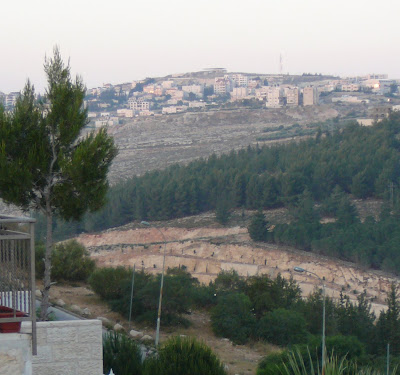
Palace of King Hussein, as seen from a suburb
of northern Jerusalem. It's the flat topped structure
on the crest of the hill in the distance.
Half of this city was captured by the army of the Jordanian king during Israel's desperate war of survival in 1948. Jordanian forces then set about destroying and desecrating anything Jewish on which they could lay their hands. The United Nations and other international agencies (to their eternal shame) did nothing to prevent or condemn this or the fact that the Jordanians prohibited access by Jews to all of the holy sites under their control. 

Then, in an unconscionable act of self-tribute, the Jordanian king built himself a large mansion on a Jerusalem hill-top that we can see as we type these words. 

Ostensibly a tribute to his dominion over a city holy to three religions, it serves as an indictment of his hypocrisy and that of the nations of the world who were evidently content with what was done by and in the name of the Hashemite regime to eastern Jerusalem and its historical and religious uniqueness during those nineteen miserable years.

The war of 1967 that was explicitly intended to drive the Israeli Jews into the sea (a euphemism for mass killing) resulted in the east and west parts of Jerusalem being reunited under Israeli rule. The city began to flourish in ways that it had not for two thousand years. Its splendour today is greater than at any time in the past. The freedoms it offers its residents and visitors in 2012 are the polar opposite of how things were when the Jordanians ruled. 

The same palace from a closer vantage point.
Construction was interrupted (permanently)
by the astonishing events of June 1967
The palace that King Hussein ordered built in his own honour on one of the highest points in Jerusalem still stands today. But it was never completed and remains an empty, dilapidated shell. Empty shell also happens to be an accurate way to characterize the undertakings Jordan gave in the framework of the 1949 Armistice Agreement to allow "free access to the holy sites and cultural institutions and use of the cemeteries on the Mount of Olives." 

Throughout those dark years of Jordanian control, tourists entering East Jerusalem had to present baptismal certificates or other proof they were not Jewish [source]. Under the Jordanians, the ancient Jewish Quarter and its ancient synagogues were systematically destroyed, and gravestones from the Jewish Cemetery on the Mount of Olives were used to build latrines for Jordanian army barracks. These were among the blackest years of one of the world's oldest and most important cities.

The Jordanians eventually abandoned their territorial claims to Jerusalem in a formal act on July 31, 1988, ceding their claims to the West Bank to the Palestine Liberation Organization

Mahmoud Abbas stands at the head of the PLO today. Carefully ignoring the infamy of those 19 years of Arab rule in half of Jerusalem - the only Arab rule the city has ever known - he has propounded an invented heritage and a bill of complaints, both of them fashioned from ideological claims, both of them bearing only the slightest connection to the reality of then or now.

This brings us to a conference being held in Doha, the Qatari capital, this weekend. It's called the "International Conference on Jerusalem" but Commander J. E. Dyer of The Optimistic Conservative Blog reminds us that its full and official name is “International Conference for the Defense of Occupied Jerusalem” with the implication of "a sense of momentum behind, and mainstreaming of, anti-Zionist themes".

We want to defer to the excellent Elder of Ziyon blog which has some sharp observations to make about this major event. Elder quotes from the conference keynote speech delivered this morning Mahmoud Abbas which is notable for its distortions, inaccuracies and air of incitement

Elder quotes Abbas saying this:
"The Israeli occupation authorities, using the ugliest and most dangerous methods, are accelerating in an unprecedented way the implementation of plans ...to erase and remove the Arab-Islamic and the Christian character of East Jerusalem. The occupying power is attempting to change the parameters and the structure of the Maqdisi scene the smallest details, believing they can wipe from the memory of the world and consciousness that are immediately evoked by the name of Jerusalem the image of the shimmering golden Dome of the Rock, the remarkable image of the juxtaposition of the brotherhood of the minarets of mosques and the domes of the churches, in the shadow of the city walls that are witness to the history and memories and facts, and the illusion that they are able to replace them, and bring a different scene serving illusions of superstition and arrogance of power, and they are by virtue of brute force that are able to invent history and install their allegations, and the abolition of facts, religious and historical."
Elder notes that:
"Abbas here is not claiming that the Jews are trying to destroy the Dome of the Rock. He is referring to the building of synagogues in the Old City, specifically the Hurva. When the Hurva was rebuilt and dedicated, on the exact spot that it had been destroyed by Jordanian troops along with some fifty other Jerusalem synagogues in 1948, the major objection by Palestinian Arabs was that - given that the Jewish Quarter is on a hill - the Hurva's dome is taller than that of the Dome of the Rock. (Islamic law says that the tallest structure in a city must be a mosque.) So now photos of the skyline of the Old City prominently show a synagogue, just as they did before 1948. This is what Abbas is objecting to, as he hypocritically is claiming that Israel is fabricating history of the city. And he himself is now claiming that Jerusalem historically only had churches and mosques - but no synagogues. In other words, the liar Abbas is trying to destroy the Jewish character of Jerusalem, today, while he falsely claims that Israel is destroying its Christian and Muslim character... Israel demolished the area in front of the Kotel in 1967 in order for Jews to be able to worship there, as the Arab homes there would have made that impossible..."
Elder continues:
"Abbas is stating as fact that Israel plans to destroy the Al Aqsa Mosque, a lie designed to incite Muslims to rise up against Jews. He is also lying in saying that Israeli archaeological work has not found any evidence of Jewish history in Jerusalem. In fact, the most important findings in recent years came not from Israeli digs - but from sifting the discarded remains of the disgusting wanton destruction of priceless artifacts by the Waqf on the Temple Mount, in the news again today. Beyond that there have been exciting findings nearly every week that prove beyond all doubt the ancient Jewish character of the city - as if that is even in dispute by anyone... Of course, Jews have formed the majority of Jerusalem's population since the mid-1800s. And there is no "ethnic cleansing" - there are more Arabs in Jerusalem now than at any time in history."
Elder quotes Abbas telling a disgraceful whopper:  
"The occupation authorities [he means the Government of the State of Israel] work through the impoverishment of the holy city and the destruction of its infrastructure and hit its economy, which has always been in all ages the booming center and head of economic activity and tourism, medical, educational, and an incubator for cultural, intellectual and artistic endeavors in Palestine."
The reality, as Elder says correctly, includes the fact that in 1967, the part of Jerusalem controlled by Jordan was a slum. An UNRWA refugee camp, called Mascar, located in what had been (and is again) the Jewish Quarter of Jerusalem's Old City, was shut down by UNRWA itself in 1965 because conditions there were so horrendous and unsanitary

Elder reminds us that
"Between 1948 and 1967, Jerusalem was a neglected backwater of the Arab world. There were essentially no Muslim pilgrims going there. And while thousands of Christians would indeed visit Jerusalem every Easter, that number increased dramatically after Israel regained possession of the holy city." 
Yesterday
But pause now and note that throughout those nineteen years, not a single rock-throwing protest or suicide bombing was directed against the Jordanian occupation regime

This cannot be because international law supported the Jordanians. The opposite is true: Jordan’s annexation of Jerusalem - the so-called Greater Syria Plan - was treated as illegal and void by almost everyone including the Arab states. Great Britain, Iraq and Pakistan formally recognized it, but no one else did. 

More importantly, Jerusalem's Arab residents who are so careful to term themselves Palestinians today accepted it, if their actions are a guide. The total number of emergency sessions of the UN Security Council called to deal with the Jordanian Arab occupation of the Holy City throughout all the years of its occupation was of course zero

The spinning of a myth about a glorious Jerusalem under Arab (and even Palestinian Arab) control and its endangerment and diminution under the Israelis has become the malicious basis for an increasingly intense and deliberate campaign of dangerous incitement. 

The people behind the campaign saw some early results yesterday when rioting young Arabs took to the streets with rocks (see image above). As we know from the sad history of this noble, troubled, sacred city, rocks become grenades become bombs, and wanton killing of innocents is too often the outcome. Jerusalem's future, and especially the future of its Arab and Islamic heritage, deserves far better custodians than those people gathered today in Qatar.