Showing posts with label Electricity. Show all posts

Sunday, September 10, 2017

10-Sep-17: Someone turned on the lights in Gaza. Will news editors see?

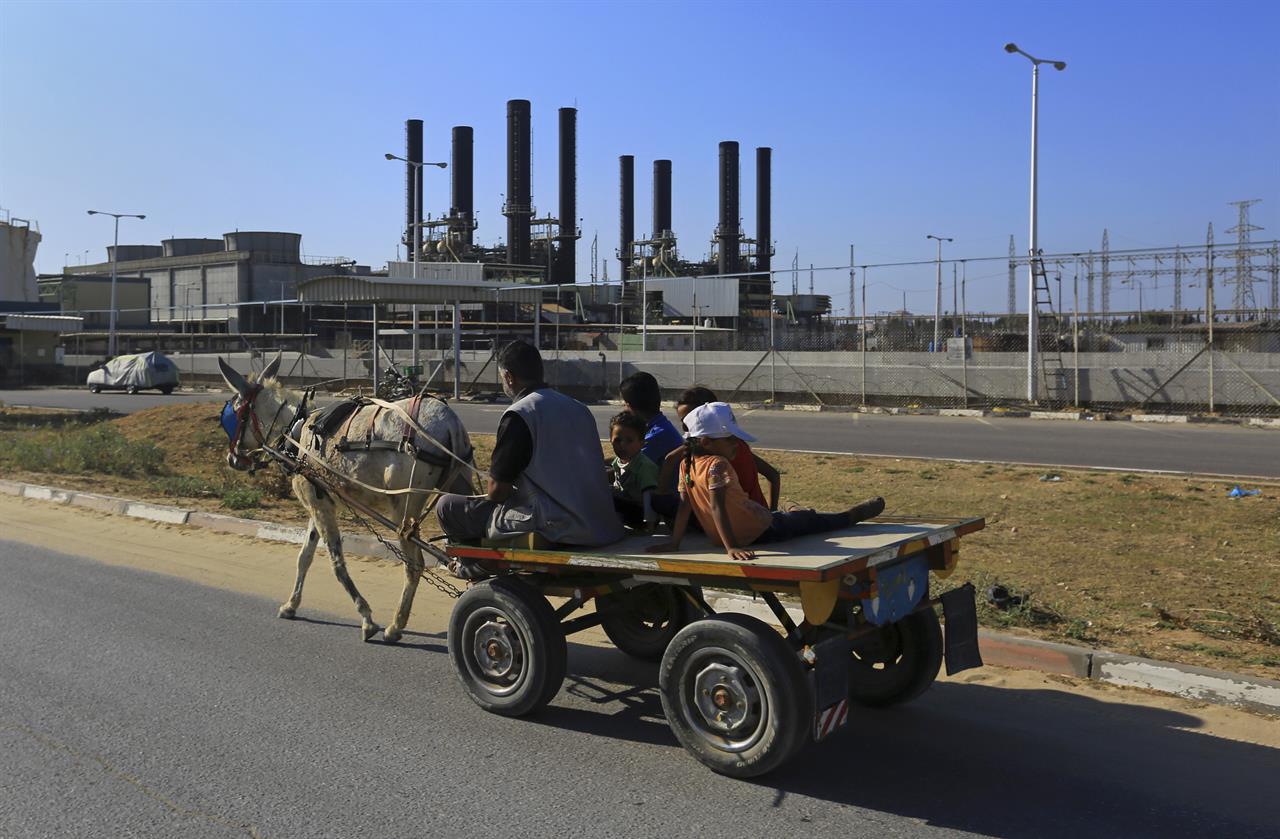
Gaza's Nusseirat power station, June 2017 [Image Source: AP]
If the news reporting industry had more integrity, there would be blaring headlines this morning focused on a simple decision taken by the thuggish Hamas terrorist regime who rule the Gaza Strip.
Hamas ponies up for fuel from Egypt, seeking to boost power in GazaSources says terror group has recently purchased $25 million worth of diesel, giving enclave six hours of electricity between blackouts and possibly staving off protests
By AVI ISSACHAROFF
September 10, 2017, 9:43 am | Times of Israel 
Hamas has recently bought large volumes of diesel fuel from Egypt in an effort to increase the output of the Gaza Strip’s only power station, after months of refusing to shell out money to provide electricity to the Strip’s residents. 
Already limited power supplies in the Palestinian coastal enclave have been further squeezed amid a spat between Hamas and the Palestinian Authority led by Mahmoud Abbas over who should pay for the fuel. The purchase of some 30 million liters of diesel from Egypt, at a cost of NIS 90 million ($25 million), indicates a change in attitude on the part of Gaza’s rulers, likely indicating a bid to stave off a repeat of street protests that roiled the enclave last winter. 
Most Gazans — aside from some areas in the north of the Strip — now get six hours of electricity instead of the previous four, but still must wait through the periodic 12 hour blackouts. 
Hamas, a terror group that is the de facto ruler of the Strip, has refused to pay for the Israeli electricity, claiming the PA is responsible for the funding. Earlier this year the PA reduced the amount of electricity it was pay for and as a result electricity supplies in Gaza were reduced from six hours to four hours followed by a 12-hour blackout. 
In June, former Fatah strongman Mohammed Dahlan struck a deal between Egypt and Hamas by which Cairo would begin trucking in fuel, paid for by the UAE. In a shift, Hamas will now begin paying the fuel and bring more of it in, sources told the Times of Israel...
Until now, Hamas had refused to pay for the fuel, insisting it was the responsibility of the PA, while spending millions of dollars of military infrastructure...
The cynicism of the two rival Palestinian Arab regimes - the one ruled by president-for-life Mahmoud Abbas and the one run by Hamas - is almost unfathomable.

The lives of the Gazan population - since 2006 following the savage blood-letting between fighters of the two that enabled Hamas to expel the Palestinian Authority and take control - have been held hostage to their aggressive ambitions and couldn't-care-less approach to the consequent suffering.

Indispensable to the whole unconscionable process has been the willingness of reporters, photographers and editors from almost all parts of the global news media to play along. There's nothing new in that. See for instance two of our posts from 2008, replete with photographs: "26-Jan-08: Humanitarian crises and dark manipulation" and "10-Feb-08: The lies that pictures can tell" and especially the photos embedded in each of them.

In the latter, we noted how
AFP photographer Mahmoud Hams and the Agence France Press newsagency concocted this piece of nonsense on January 22, 2008. His evidently-staged picture, published throughout the world the following day, shows Gaza "law-makers" meeting to do their vital legislative business in the Israeli-created dark... while bright daylight is blocked out by the drawn curtains. Hams obviously knew he was taking a snapshot in the full light of day. It's evident to anyone with eyes that he is a willing participant in a dangerous charade, a deliberate distortion of reality, a lie. And so are are his AFP masters.
And much more recently this from AFP 11 days ago: "When electricity comes on, life in Gaza begins" in which Hamas is mentioned but in effect exonerated of substantive responsibility. Today's developments make clear how materially misleading that view is.

Now let's sit back and wait as the news sites and blogs that have systematically concealed the manipulative cruelty of the Hamas jihadists against their own people own up to how Hamas could have solved Gaza's problems a decade ago and at every moment since then by making the decision to do what normal governments are expected to do for their people. They have the cash, they have the ability, they could have bought diesel fuel, they could have repaired the power station, they could have provided electricity at any and every point along the way.

But it made more sense for them to showcase a population suffering for the lack of enough electrical power. And to feed those news outlets that are predisposed to present a twisted reality, no questions asked. Literally.

Of course, reporting this would be to throw into the garbage the bogus convention by which the rocket-infested Gaza Strip is depicted as Israel's victim. That's not going to happen soon.

Tuesday, April 18, 2017

18-Apr-17: In Gaza, a decade of darkness and a never-ending blame-game

Image Source
Times must be getting really tough down there in the Gaza Strip now that one of the most highly publicized of the plagues traditionally blamed on the "Zionist entity" has become (not for the first time) the subject of bitter mutual accusations between the two rival Palestinian Arab statelets - the PLO-controlled PA, and the Islamist thugocracy of Hamas.

Below is an extract from an Albawaba news report ["Gaza thrown into darkness as Hamas-Fatah spat worsens"] datelined April 16, 2017. (Albawaba is based in Jordan, with offices in Dubai, and calls itself "the largest independent producer and distributor of content in the Middle East... providing first-rate coverage of the Middle East from a local perspective.")
Gaza was plunged into darkness late Friday as the territory's Hamas-run power authority cut electricity across the besieged enclave in protest against the Palestinian Authority. Hamas, who control Gaza, and the Fatah-dominated Palestinian Authority, have for years blamed each other for an electricity crisis in the besieged coastal enclave.
Gaza's power alternates on eight-hour cycles, with those who can afford it using generators in the down times.
On Friday, Gaza's power authority cut electricity in the coastal territory from 7 pm until 11 pm in protest against the PA's recent decision to cut public sector salaries for Gaza employees and tax disputes over the import of fuel. The PA responded by saying Hamas was attempting to create a "new crisis" in Gaza, according to Ma’an News Agency.
Earlier in April, a decision by the West Bank-based Palestinian Authority to impose pay cuts on its civil servants in Gaza sparked widespread anger. Tens of thousands took to the streets in Gaza to protest the 30-percent pay cut, with demonstrators calling on PA president Mahmoud Abbas to sack his government. The PA says it was forced into the move because its budget has been hit by falling foreign aid. PA salaries in the West Bank, however, remained untouched.
Gaza's sole power plant is on the verge of shutting down as Qatari and Turkish fuel supplies run out. Gazan authorities have no other choice than to buy additional fuel from the PA, but say recent tax hikes make it unaffordable.
In January, thousands of Gazans took the streets to protest chronic power shortages in one of the largest unauthorised protests in Gaza since Hamas took power in 2007. Hamas security forces quickly suppressed the demonstration and blocked journalists from filming. A day earlier, a local comedian was arrested for making a satirical video criticising power cuts. "There is no work, no (border) crossing points, no food, no water and also no electricity," Adel al-Mashwakhi said in the video clip, which amassed over 250,000 views.
But with that explanation, be assured dear readers that there is no Palestinian Arab that cannot - by hook, crook or outright fabrication - be blamed on the Zionists. Here's how the Albawaba piece ends:
In 2015, the United Nations warned that Gaza could become uninhabitable by 2020 if current political and economic trends caused by Israeli policies continue.
From our 2008 post: We wondered then whether the Reuters
photographer, depicting Gazan legislators working
by candle-light as clearly-visible daylight is shut out
by curtains, had a moron for an editor. [Image Source] 
To put that last claim into some perspective, please take a look at some relevant earlier posts of ours: "05-Mar-17: What Gaza's Pal Arabs think about the electricity problems in Gaza"; "30-Apr-15: What Gaza's oppressed know that reporters don't, and why it matters"; "28-Oct-12: What lies behind ongoing efforts to paint Gaza as a region under Israeli siege?"; and from nearly a decade ago when Hamas' silly games were not so different from today's: "10-Feb-08: The lies that pictures can tell".

That 2008 post, replete with some very revealing news photographs that tried to pin serious malfeasance on Israelis for "cheating" the Gazans of electric power, is worth going back to review.

Whatever has changed in the world of the Palestinian Arabs, one aspect has not: they continue to live in the dark, shutting out the light by whatever means and relying on the great news factories of the world to magnify and spread their baseless fury at Israel.

UPDATE Thursday April 20, 2017: The capacity of the two Palestinian Arab statelets - PLO/Fatah/PA and Hamas - to ride roughshod over the welfare of the people whose lives they dominate is a reality that gets almost no serious media attention. A report today by Avi Issacharoff, Times of Israel's Middle East analyst, updating the dire situation in Gaza ["Gaza hospitals on verge of blackout amid energy crisis"] says:
Hospitals in the Gaza Strip could face blackouts within days as an energy crisis continues to throttle power supplies in the Palestinian enclave. Israel and Palestinian officials estimated Thursday that hospitals would finish their reserve fuel for generators within 48-72 hours. On Sunday Gaza’s only functioning power station stopped working after running out of fuel. The crisis was compounded by a technical fault shutting down a power line between Egypt and Gaza that had provided over six hours of electricity a day. Gazans now have just four hours of electricity, followed by 12-hour blackouts, down from two eight-hour periods of electricity a day when the plant is operating normally and supplies are coming in from outside the enclave... On Wednesday, UN Special Coordinator for the Middle East Peace Process Nickolay Mladenov called on Palestinian leaders to put aside their internal squabbles and solve the energy crisis.
And who cares? Certainly not the people who control the people.

Sunday, March 05, 2017

05-Mar-17: What Gaza's Pal Arabs think about the electricity problems in Gaza

Seeking an energy solution in chilly, dark Gaza, January 2017
[Image Source: Aljazeera]
Buried deep inside an opinion poll report just published by the Jerusalem Media and Communications Centre is a real nugget.

JMCC's website says [here] the Ramallah-based organization was
established in 1988 by a group of Palestinian journalists and researchers seeking to provide information on what was happening in the occupied Palestinian territories.
Every few months, it publishes public opinion polls. The one we are discussing in this post was released for publication four days ago, on March 1, 2017. The next most recent one came out on October 9, 2016 - five months earlier.

To understand the context of what we're about to say, consider these recent news reports:
  • Gaza Strip - Anger is growing among Palestinians in the besieged Gaza Strip as the narrow coastal enclave's electricity crisis deepens. An estimated 10,000 Palestinians flooded the streets in Jabaliya refugee camp in northern Gaza last week, after more than a week of lengthy power cuts. In many parts of Gaza, residents received only three hours of electricity at a time, punctuated by 12-hour blackouts. Protesters expressed anger at Israel's blockade, and at the West Bank-based Palestinian Authority and Hamas authorities in Gaza. Demanding a solution to the power cuts, some demonstrators clashed with security forces. Speaking to local media on Monday, Gaza's Interior Ministry spokesman Iyad al-Buzm said that protesters arrested for "creating chaos" had been released after an agreement between various political factions. Nearly two million Palestinians in Gaza have endured electricity shortages since Israel, with the help of Egypt, imposed a suffocating blockade on the territory a decade ago. The electricity crisis has been exacerbated since Israel's 51-day war on Gaza in 2014, during which the main power plant was targeted and damaged by Israeli forces... ["Protests erupt in Gaza as electricity crisis deepens", Aljazeera, January 21, 2017]
  • Gaza requires 450-500 MegaWatts of power a day but is receiving barely a third of that. About 30 MW produced by its own ageing power plant, 30 MW imported from Egypt and 120 MW supplied from Israel... For weeks, Gazans have been making do with less than half their usual electricity supply - barely a few hours a day - with no sign of the shortages alleviating anytime soon, fuelling distress and frustration among the population... [S]ince late last year, there have been only three or four hours of electricity a day in total. The costs of running generators have spiralled. People are trying to light and heat their homes with candles or by burning scrap wood. Families wake in the middle of the night, when the power sometimes comes on, to take showers or wash clothes. "We live like rats," said Mazen Abu Reyala, an unemployed fisherman and father of five, sitting around a primitive stove that he uses to warm his house... ["Energy crisis leaves Gaza with barely four hours of power a day", Reuters, January 12, 2017]
  • ["Gaza electricity crisis: Hamas breaks up protest", BBC. January 13, 2017]
  • ["Israel cannot shirk its responsibility for Gaza’s electricity crisis", B'Tselem (far-left Israeli protest group), January 16, 2017]
Now consider the results of JMCC's rather inadequately named "Poll No. 89 - February 2017 - Gender, Equality and Politics" In the full text version of its analysis, it touches on Gazan anger at those responsible for the electric power power fiasco that is making hard lives even more stressful. And it gives numbers:

Source: JMCC Poll Number 89 (published March 1, 2017) [Online here]
Interesting. Look at the "Gaza" column, which reflects the opinions of the direct victims of the Hamas regime, those closest to the problem and suffering the most. Half of them lay the blame not at the feet of the Israelis but at the doorstep of their lords, masters and oppressors, the Islamist ideologues of Hamas.

When did you ever read or hear that via conventional news channels?

Notice also that Palestinian Arabs living far from Gaza (the column headed "West Bank") and who have essentially no first-hand knowledge or experience of living under the Hamas regime are twice as sure as their Gazan brethren (who do) that Israel is to blame.

Also interesting: if you read JMCC's poll summary (as distinct from the detailed report), there's not a word in it about the electricity crisis. Check for yourself; the summary report is online here. We're certain most reporters and their editors didn't bother to delve into the details. The summary met their needs. And so they missed a serious insight. And so did the consumers of their news.

Our friends over at the excellent Israellycool noticed something else funny/outrageous about social media coverage of the Gazan electricity screw-up. In "B’Tselem Caught In Malicious (And Dumb) Lie" (February 28, 2017), Israellycool's moving spirit, Aussie Dave, published a heart-tugging photo of an attractive young "medical student in Gaza [who] studies by the light of a battery-powered lamp... How does life without electricity, 90 minutes from Tel-Aviv, look like?" The photo and the accompanying text had been published by the ever-enthusiastic campaigners at B'Tselem.

Leaving aside the clumsy English (they have higher priorities at B'Tselem), if you take a close look at the "battery-powered" lamp, you quickly notice - unless you're as obsessed with simplistic anti-Israel narratives as B'Tselem's lot are - that it's not. The lamp is plugged into a wall power socket.

(And remember this earlier Gazan attempt [here] from 2008 at pulling the shades over people's eyes? Reuters played a central role in that scam too.)

Truth is often boring and shaded in grey. But that doesn't exonerate any of us from seeking it - even in the dark and the gloom. And that's especially true of the ladies and gentlemen of the news-reporting industry.

Saturday, January 14, 2017

14-Jan-17: Shock, horror: Press freedom under Hamas isn't what it ought to be

Reporting from the Israeli side of the border with Hamas-controlled Gaza
[Image Source]
It's the coldest part of winter in our part of the world, and there have been serious interruptions to the electricity supply in the Gaza Strip. The Islamist thugs who rule the enclave have responded in traditional fashion. And yes, personal violence is of course central to the story.
“Hamas forces blocked journalists from filming the gathering, and an Associated Press journalist was briefly detained at gunpoint until he handed over his mobile phones to plainclothes security men...” [Associated Press item reported last Friday]
Our attention was drawn to this via a piece that appeared Thursday on the website of TheTower.org [here] which says operatives of Hamas
blocked journalists from filming a major protest against power cuts in the northern Gaza Strip on Thursday, detaining an Associated Press journalist at gunpoint and badly beating an Agence France-Presse photographer who refused to relinquish his camera. The journalists sought to cover a demonstration against chronic electricity shortages in Gaza, which the AP described as “one of the largest unauthorized protests in the territory since the Islamic militant group took power a decade ago.” According to the Foreign Press Association, the Hamas men “stuck a pistol in his chest and verbally threatened the reporter until he agreed to give them the phones.” ["Hamas Holds AP Journalist at Gunpoint, Beats AFP Photographer for Covering Major Protest", The Tower, January 12, 2017]
It quotes a statement of the Tel-Aviv-based Foreign Press Association, a not-for-profit that represents the interests and views of correspondents working in our part of the world, saying that
In addition an AFP photographer was badly beaten to the head by uniformed policemen required medical care after he had refused to give up his camera. The memory card of his camera was confiscated and he was placed under arrest. He was subsequently released and the memory card was returned. The Foreign Press Association condemns this violent behavior in the strongest terms, and finds it especially shocking in light of verbal promises we have received from Hamas officials to respect the freedom of the press. We hope that Hamas will properly investigate this incident and provide an explanation and apology for this unacceptable behavior by their forces.
The Board of the Foreign Press Association. January 12, 2017
Especially shocking? We're shocked that the hard-boiled and experienced reporters of the FPA are shocked that verbal promises of the thuggish murderers who make up the leadership and rank and file of the Islamist Hamas terror group turn out to have not been respected. Almost as if Hamas tells lies.

The people at The Tower provide a valuable service in their article - evidently ignored by the FPA - by quoting a 2009 report for the Gatestone Institute authored by veteran Palestinian affairs journalist Khaled Abu Toameh:
Foreign journalists who manage to cross into the Gaza Strip face many restrictions imposed by the Hamas government. Local facilitators hired by foreign journalists are also under scrutiny by the Hamas government. That is why they are careful not to bring the dirty laundry out by telling the foreign media about things that could reflect negatively on Hamas.
Arabic-language news coverage of massive anti-Hamas protests in the
Gaza Strip this past week: Israel can't be blameed, so don't expect much Western
news coverage [Video Source]
They go on to quote egregious examples of the bare-knuckles Hamas management of media coverage of the Gaza Strip. including this from former AP correspondent Mark Lavie who wrote in August 2014:
Journalists, of course, won’t tell you what you’re missing in the coverage. Their anchors or editors won’t tell you why large parts of the story are colored a certain way or taken from a certain angle. They don’t want to put their reporters’ lives at risk. This is the main reason that video and pictures seem to flow freely out of Gaza. But critical elements of the story itself can’t, and neither can all the pictures and video. It gives the impression that the story is being covered, when only part of it—sometimes a small part—is being covered.
To see the report that Associated Press eventually put out after the events of January 12, 2017, see "In Rare Demonstration, Thousands Protest Power Cuts in Gaza". And for startling video clips - some of them emanating from fed-up (and courageous) Gazans - posted to YouTube in the last couple of days showing massive Gazan street rioting against Hamas, go here, here, here and here.

Heavily spun reporting of Gazan suffering under the boot of the Hamas Islamist regime - invariably with Israel being blamed - has been a news-reporting industry constant since Hamas violently seized control in 2007. Here's a sampling of posts we wrote after previous Gazan electricity crises:

Friday, March 27, 2015

27-Mar-15: What a person can do with water is both less and more than most people think

They know most people will never bother to check the facts behind
the allegations [Image Source: A March 23, 2015 RT article]
We live in a country where water is a key enabler, and limiter, of habitation and success. Israel's approach to storing, treating, transporting, recycling and desalinating water is admired throughout the civilized world. It's a heroic aspect of Israel's unique history, and one of the most significant reasons why resource-poor postage-stamp-sized Israel does so well in so many different ways.

A Reuters syndicated report ["Fighters target vital water plants across Middle East: Red Cross"] published this past Wednesday seemed to be dealing with the way terrorists, who by definition, respect no red lines, are targeting water supply resources. "Militants", it says, using a common euphemism for terrorists, "in Syria, Iraq and Gaza have also used access to water and electricity supplies as "tactical weapons or as bargaining chips," the ICRC said in a report."

Reuters then seizes on an instance to prove the point:
Gaza's only power plant was damaged during the 2014 war between Israel and Palestinian militants. The Gaza Company for Generating Electricity said an Israeli tank shell hit the main fuel tanks, taking out almost all capacity.
Electricity is vital to the effective management of water. So if "an Israeli tank" eliminated the capacity of the regime now ruling Gaza, Israel stands behind Gaza's water crisis. Right? No, not at all right, and understanding the real reasons why Gaza is chronically out of electric power is essential to making sense of allegations like the one we just saw. (We will come back to it here another time.)

Published to coincide with World Water Day 2015 this past Sunday (March 22), a report by NGO Monitor (online here) looks closely at the exploitation of water-centric issues as part of the multidimensional political warfare campaign that target Israel. Entitled "Water Myths and Facts: NGOs and the Destructive Water Campaign Against Israel", the report illustrates a fundamental truth about anti-Israel activism, expressed by its head, Prof Gerald Steinberg:
"Water is a regional issue, and one that, with close cooperation between all parties, can ensure equitable, maximal access to clean and safe water and help create a more peaceful environment... Unfortunately, NGOs would rather politicize this issue and demonize Israel than improve Palestinian access to clean water."
Some examples of how:
  • A coalition of NGOs  and UN organizations called EWASH (the lengthy membership list is here) opposed an EU-funded desalination project in Gaza that would improve water supply to the suffering inhabitants of the teeming, Hamas-dominated region. Why? Because the project would "accommodate the occupation" and "legitimize Israeli actions." Let the Gazans stay thirsty.
  • Constant and widespread repetition of one core claim - that Israel's hostility to Hamas "prevents Gaza's children from having normal opportunities...to drink clean water". In reality, Gaza's water problems stem from poor maintenance of water and sewage facilities by the ruling power, Hamas. As an unabashedly terrorist organization, Hamas' terrorist infrastructure and warfare requirements chronically take precedence over investing in their people. The neglect of vital civilian infrastructures is the inescapable result. But it's actually much worse than that. Since the signing of the Oslo Accords in 1992, the management of Gaza's water sector has been entirely in Palestinian hands, while Israel provides millions of cubic meters of water annually as those signed agreements require. The incessant Hamas rocket attacks against Israeli civilians have (astonishingly) not changed the reality that Israel continues to live up to the obligations agreed in the Oslo Accords. Even while under rocket from the people at the far end of the pipeline, Israeli water authority personnel repair and maintain the water supply to Gaza under the most stressful conditions.
  • Water gets lost in badly run systems no matter where in the world the bad management happens. This is mostly caused by leakage, spoilage, evaporation and inadequate delivery mechanisms (normally underground pipes). In the Gaza, those losses run at more than 40% of available supply. In the towns and villages under PA control, losses are around 33%. In Israel, it's less than a tenth of that.
  • Allegations are made that Mekorot, Israel's national water authority, gains from "Israeli control over a Palestinian captive market under occupation." So the claim is made that "Mekorot applies discriminatory water prices, charging Palestinians higher rates than Israelis”. (Click here to see this truthfulness-challenged assertion on the Who Profits website where it has been doing damage since 2013.) It's back-to-front wrong. The NGO-Monitor report shows how Mekorot sold water to the PA and Gaza in 2013 at a loss by honoring a set price contract to the Arabs. In reality, the price they pay is not more but in fact less than a third of what Israelis pay their own supplier. If Israel's aim is to make unjustified profits, it's an odd way to do it.
  • Another constant refrain: the Palestinian Arabs are prevented from creating a better water system because the Israelis make this hard for them. The reality, which depends on understanding treaties, agreements and opaque Palestinian Arab conduct (which most anti-Israel activists and a large part of their audience don't bother to do), is that water projects that have gotten all the necessary authorizations, including those needed from the Israeli side, and for which funding is available, routinely fail to deliver the goods because of conflict within the Palestinian Arab world, and the heavy lobbying of Palestinian sectoral interests, notably their agricultural sector.
  • And sometimes the attacks on Israel focus not on inadequate supplies of water but on too much of it. We took a close look at the beginning of March at how irresponsible, unprofessional and agenda-driven reporting from some of the world's largest creators of it can produce outrageous lies like the one claiming Israel uses an aggressive open-the-flood-gates strategy to drown the children of Gaza. It's here ["01-Mar-15: Facts, dam facts, and non-factual inventions aimed at the gullible"]
Foreign aid to the Palestinian Arabs is a notorious black hole. Somehow, the fact that they receive more money per capita than any other segment of mankind has in history keeps bumping up against their reality: photos of bedraggled mothers and children dragging gerry-cans among the rubble of bombed homes. Where did all that foreign cash go? Why do they still not have water or sewerage or reliable supplies of electric power?

Sadly, the process of painting Israel as the boogey-man of the Arab world pays dividends for the advocates of boycotts and sticking a finger in Israel's eye. The Dutch water company Vitens, the largest in its home market, canceled an agreement in December 2013 to collaborate with Mekorot. The Dutch Foreign Affairs Ministry played an anti-Israel role in the affair. ACEA, an Italian water corporation, signed a co-operation agreement with Mekorot in December 2013 [source] which included provisions where Mekorot would play a role in under-resourced regions of Italy; ACEA came under heavy pressure to break it almost immediately. 

At the same time, cooperation agreements exist among, and deliver benefits to, Israelis, Palestinians, and Jordanians. as they should. 

But in the hands of single-minded politically-motivated NGOs, water is a weapon of mass destruction. In many respects, those anti-Israel campaigns, involving high-profile non-governmental organizations, parrot the Palestinian Authority's political agenda, and that of Hamas. In addition to EWASH, they include Al Haq, Palestinian Center for Human Rights (PCHR), BADIL, Coalition of Women for Peace/Who Profits, Human Rights Watch, Amnesty International, United Civilians for Peace (an umbrella group comprising Dutch NGOs ICCO, Oxfam Novib, IKV Pax Christi), Cordaid) and others.

The blame game is played in creative ways by the political activists who purport to be standing up for Palestinian Arab water rights. It's effective, as we noted, until people start looking close at the facts. Israel provides significant amounts of its own water, for instance, to supply the Palestinian Arabs and not the reverse as claimed by the hostile activist NGOs. Unfortunately, the facts - as the Reuters report at the top of this post shows - are inadequate to the task of defeating fact-free or fact-light political agitation.

As with so many other aspects of the disdain and demonization that Israel experiences in international relations, what bothers the hostile side has very little to do with Palestinian suffering. What they cannot abide is Israel's success. There's a name for the sort of activism.

UPDATE April 5, 2015: We are pleased that readers in Poland now have access to a Polish version of this post, kindly translated by the noted Polish author Malgorzata Koraszewska (not for the first time - many thanks!) and posted at http://www.listyznaszegosadu.pl/notatki/problem-z-woda-w-kranach-i-w-propagandzie. Dziękuję bardzo za życzliwość!

Monday, October 27, 2014

27-Oct-14: In Gaza, the electricity is flowing again no it's not yes it is

A Gulf State newspaper published this picture in March 2014 with
a caption saying it show a Gaza City power station
shut down "due to a lack of fuel from Israel", without explaining
that "lack of fuel" in Gazan real-politik is almost invariably
self-inflicted by the Hamas regime for political advantage [Image Source]
Remember how Gaza's only power station was "destroyed" by you-know-who in July 2014? (Here's The Guardian's report from then.)

Reuters ["Gaza power plant resumes operations, director says"] this afternoon reports on something that borders on a miracle (but is not):
Gaza's only power plant has resumed operation far sooner than expected after being damaged during last summer's war between Israel and Palestinian militants. Rafiq Maliha, general director of the facility, told Reuters its generators went back online on Sunday, producing 90 megawatts out of a total potential capacity of 140 MW. The plant provides power to around half of Gaza's 1.8 million people. The Gaza Company for Generating Electricity, which operates the plant, said an Israeli tank shell hit the main fuel tanks during the war, taking out almost all capacity. It originally estimated that repairs could take as long a year.
So we can say bye-bye to reports (and photos) of Palestinian Arab Gazans struggling to live lives devoid of electric power, right? Not so much.
Maliha said the plant could be switched off again on Tuesday unless more fuel is supplied by the Palestinian Energy Authority. At peak demand, the Gaza Strip needs around 280 MW of power. Beyond what is produced locally, Israel supplies around 120 MW by electricity lines and Egypt around 17 MW, meaning there is always a shortage. Most Gaza residents have had to adapt to six hours of electricity a day since the plant stopped. Sources at the company said they expected rolling blackouts to continue, with power going on and off every eight hours.
We took a look at this more than two years ago ["2-Apr-12: More darkness in and from Hamas-controlled Gaza, and this time the price is paid in the silent, unnoticed deaths of children"]. We said then news reports from Gaza falsely depicted Israel cold-heartedly cutting off power to Gaza's teeming masses. The claims were not new; we referred to several earlier posts along similar lines:
We added numerous more posts after that, including these
These posts from the past reflect an absurd situation where Hamas, true masters of darkness, inflict power shortages on their own people through calculated manipulation of energy supplies including deliberately firing on the Israeli power station in Ashkelon that used to deliver some 70% of their electricity. 

The truth of the bizarre situation was that even as the terrorist gunmen and rocket-firers of Gaza, under Hamas inspiration and control, were trying to bring the Ashkelon plant to its knees, Israeli power workers inside the Ashkelon plant continued to work round the clock supplying electricity to the Gazans even while they were under constant Qassam fire.  At the simple human level, this is a non-trivial point. The head of the Israel Electric Corporation workers' committee chairman, Miko Zarfati, said it as plainly as you would want back at the time (here, in 2008, and in our post , but (and this can be checked) his words were barely quoted anywhere.

This is shocking. Instead of facing up to the blatant manipulation of Hamas, news-agencies throughout the civilized world swallowed the bait and published self-evidently-dishonest news photos like the one below showing politicians sitting in the dark in Gaza:

It is indeed deeply dark inside Gaza's political quarters, but only when you first close
the curtains in the middle of the day [Image Source: Reuters]
Hamas, let's say it clearly, has the capacity to produce enough electric power to ensure Gazans do not lack. But it's not a priority for them - quite the contrary. In 2012 [source], Gaza's power outages were
due to a deliberate policy of Hamas, which opposes import of fuel from Israel. As a result, the Gaza power station is operating at 20% capacity
Today's Reuters report (above) says they are generating "90 megawatts out of a total potential capacity of 140 MW". Why? And why are they not challenged on this by the expert reporters who cover the Gaza beat? Could it be that keeping people in the dark is more popular than we might have thought?

One final thought: the creation of electric generation, transmission and distribution capabilities is one of the core functions that every population needs and that government is supposed to provide either directly or by empowering an independent supplier. That's part of the ABC of running a country. Since the Hamas regime has the financial backing of Qatar, and it's known that in the Arab world in general, oil (to fuel those generators) is a commodity not exactly in short supply, we can understand why they want to blame Israel with whom they see themselves as being in a perpetual war. 

But is there a government anywhere that slips out from under public scrutiny of its own failures more often and more successfully than Hamas? Who is really in the dark? Perhaps some enterprising MSM reporters might want to theorize.

Sunday, July 13, 2014

13-Jul-14: Even more darkness in Gaza

Times of Israel says one of the many rockets fired by the terrorist thugs of Gaza today struck infrastructure on the Israeli side that normally delivers electricity to the Hamas-controlled entity. The result is that some 70,000 Palestinian Arabs are now without power.

Quoting Israel's Channel 2, the Israel Electric Corporation has decided not to put its service personnel in a position of personal danger. So the damage will go unrepaired until further notice. 


Gaza's very peculiar approach to its dependence on Israeli power has been the subject of comment here in the past:

Monday, November 18, 2013

18-Nov-13: Behind the celebration of terror, a pervasive darkness

Children in Palestinian Arab society are in the dark in more
ways than one. Why? [Image Sources]
Today's nauseating news reports ("Palestinians shower freed prisoners with handsome cash payments, perks" in the Jerusalem Post; "Palestinian Authority gives freed prisoners $50,000 each" in Times of Israel) reiterate how the Abbas regime competes with Hamas to put the lowliest of thugs on a well-spotlighted pedestal.

What does this do to Palestinian Arab society?

Measurably, it ties up a huge proportion of their budget. They are already chronically unable to pay their own bills as a government. They make themselves basket cases who cannot function without huge handouts from obliging outsiders, mainly from the West. They mortgage the future of their children (excluding the children of the innermost circle who do just fine) by failing to invest in their own infrastructure and facilities. That aspect is even more striking in the case of Hamas who leave much of their budget expenditure to the PA to provide, while investing in military tunnels and in offensive weaponry. They demand little or no income taxes from their citizens, hundreds of whom are wealthy, and even millionaires.

And when the UN declares a day for honoring toilets, they quickly point to the sewage that flows through their shacks and village squares because of a failure to invest in water and waste infrastructure and - most of all - electricity generation, transmission and distribution, and say: We're the real victims, over here, look, look.

They are a self-parody.

But even more than their scandalous money and infrastructure practices, the embrace of small-time killers as national figures of emulation impoverishes the Palestinian Arabs educationally, spiritually, culturally, ethically. They are in a self-inflicted race to the bottom of the evolutionary pile while parts of the civilized world look on and applaud.

Is there a historical precedent for such large-scale, lethal buffoonery?

Sunday, October 28, 2012

28-Oct-12: What lies behind ongoing efforts to paint Gaza as a region under Israeli siege?

We snapped this during a September 2012 visit to the Kerem Shalom crossing. A truck laden with
steel reinforcing rods for construction purposes leaves Israel and enters the Gaza Strip. Reports that Israel
prevents the entry of construction materials continue, despite the abundant evidence that disproves it.
We have commented here time and again about the persistence of the quiet inaccurate notion that Gaza is a region under siege. Over the past several years, we have seen campaigns that blame Israel for the shortage or absence or unreliability of electricity in the Hamas-controlled mini-state ["21-Jan-08: Electric wars - a sad tale of two realities"]. We have seen Gaza described as a huge open-air concentration camp ["30-Jul-10: Once again, from the world's largest 'prison camp'"]. Gaza's children have been portrayed as starving, uneducated, deprived of medical care and oppressed ["30-Aug-12: How close to hell is Gaza? Depends whom you want to believe"] and the blame for all of it is laid at the feet of Israel.

Perhaps things will get a little better now, in the wake of the flying visit to Gaza this past week by one of the world's wealthiest individuals, the Emir of Qatar.

Haniyeh: Qatar visit breaks Gaza siege
Published in Maan News Tuesday 23/10/2012 (updated) 25/10/2012 11:12    GAZA CITY (Ma'an) -- Hamas Prime Minister Ismail Haniyeh on Tuesday said the visit of Qatar's emir to the Gaza Strip had helped lift Israel's blockade of the enclave. Sheikh Hamad bin Khalifa al-Thani on Tuesday was the first head of state to enter Gaza since 1999 in a visit that broke the isolation of its rulers Hamas.  "You are today, by this visit, declaring the breaking of the unjust blockade," Haniyeh told the Qatari leader in a speech at the site of a new town to be built with Gulf money. "Today we declare victory against the blockade through this historic visit," he said. "We say thank you, Emir, thank you Qatar for this noble Arab stance ... Hail to the blood of martyrs which brought us to this moment." [More]
That visit, and the huge financial gift that Qatar says it is going to hand over, represents a potentially important turning point in the way Gaza is perceived. Two of the more influential writers at Haaretz, Amos Harel and Avi Issacharoff, offered an analysis in the newspaper's Friday edition that has not gotten the exposure we think it deserves.

Myth of a siege
Haaretz - Oct.26, 2012 | 2:05 PM
Amos Harel and Avi Issacharoff
For a moment last weekend, a small ship called Estelle shook up the international media. Once more a handful of peace activists demonstrated the brutality of the Israeli occupation, which is denying food to the starving residents of Gaza. And if that were not enough, after the forcible interception at sea, the hard-hearted Israeli government threw the pursuers of justice, among them a few Israelis, into jail.
The trouble with this story is that the activity to remove the supposed siege is not compatible with the facts on the ground − to put it mildly. The siege of Gaza has long since become a myth, promoted by the Hamas government with the aid of a few left-wing international organizations. In practice, the festive declaration on Tuesday by the Hamas prime minister that the siege has ended − during the visit by the Emir of Qatar − let the cat out of the bag.
Still, the activists’ spin made its way successfully into the international media. After the interception of the Estelle, CNN reported this week that the Israeli siege of Gaza has been going on for the past five years. The simple truth is that there is no longer an Israeli siege of Gaza.
Restrictions remain on exports from Gaza and on the free movement of people from Gaza to the West Bank (20,000 people a year move from the Strip to the West Bank). Gaza does not have an active airport or maritime port, and Israel blocks ships from docking there. Gaza has only a land crossing to Egypt and a limited crossing to Israeli territory. But a siege, in the plain sense of the term, does not exist.
Under pressure of the Mavi Marmara affair in May 2010 (when nine Turkish activists died after the Israeli navy boarded the ship), the Israeli government revised its policy and greatly eased the entry of goods from the West Bank into Gaza. There is currently no shortage in Gaza of food or construction materials. Gazans can enter Egypt through the Rafah crossing, and from there proceed to any destination in the world.
In fact, an average of 1,200 people a day are doing just that, according to statistics released by the Hamas government itself. Those who are prevented from crossing officially by the Egyptians (for security and other reasons) cross through the tunnels. This is no longer a tough trek between Palestinian Rafah and Egyptian Rafah through a dark, narrow tunnel. A taxi service, effectively a form of public transportation, now plies the Gaza-Egypt route via the tunnels.
The markets are overflowing with fruits, vegetables, the latest iPhones and much more. A major real-estate boom is underway in Gaza, and the projected growth rate for 2012 is 9 percent, according to the World Bank. (By comparison, the probable growth rate in the West Bank will be 5 percent.) For the first time in years, West Bank residents who are asked about this in opinion polls claim that they are economically less well-off than the Gazans (though they are wrong).
Israel allows almost free entry of goods through the Kerem Shalom crossing, apart from those which Hamas itself doesn’t want as it hopes to keep the tunnels flourishing and because the price of some goods from Egypt is cheaper.
This week’s visit by the Emir of Qatar, Sheikh Hamad bin Khalifa, was a historic occasion. A Hamas honor guard awaited him on the Palestinian side as he arrived via Rafah. He dedicated a huge rehabilitation project worth $400 million − a donation the likes of which the Palestinian Authority in the West Bank can only dream about. If even Haniyeh is talking about the end of the siege, maybe it’s time for left-wing activists from Israel and abroad to stop engaging in cheap PR stunts.
Given its usefulness to those who propagate it, we're not expecting the powerful 'Poor Gaza is a victim of Israeli cruelty' meme to go away anytime soon. But we do expect that more people will become sensitive to the cold-blooded manipulation by ideologically motivated media and political figures that keeps it alive.

Monday, February 11, 2008

11-Feb-08: Electricity and appropriate assurances

Finally - a powerful, uncompromising statement that's long overdue, given the deadly chaos that characterizes the jihadist Gaza Strip and its appalling regime:
We are ready to resume our support to the Gaza power plant within hours once we receive the appropriate assurances...
Only it's not the government of Israel speaking.

First, the context. (Thanks, David.) This past summer, at the very peak of the unbearable heat that bakes the houses and inhabitants of the Gaza Strip, the European Union caused a shut-down of electric power to the area. Meaning: no coolers, no air conditioners, no bottling plants. As the International Herald-Tribune wrote at the time:
"Power outages are nothing new in Gaza, where electricity reserves have long been unreliable. But the current one is particularly long... Gaza's latest electricity woes began last week, when Israel closed a fuel crossing into the coastal territory because of security concerns, leading to power shortages. Israel reopened the passage Sunday, but the plant's Israeli fuel supplier didn't deliver fuel after the European Union said it would not foot the bill. Although private generators and sporadic supplies from the Israeli and Egyptian companies that power the rest of the strip have eased the blackout, affected neighborhoods and cities have had only a few hours of electricity a day."
This was August 2007 - six months ago. The European Commission said it had information that Hamas was diverting electricity revenues. (And we know how very sensitive the European bureaucracy is about its money being wasted.) As a result, as IHT's article at the time describes, hundreds of thousands of Gaza residents were forced to make do without electricity as they
"became the latest victim of feuding between Gaza's Hamas rulers and their rivals from Fatah. European donors stopped paying key electricity aid over the weekend, concerned that Hamas is siphoning off revenues. As Fatah and Hamas traded charges of corruption, at least half of Gaza's 1.4 million people were plunged into darkness. "We are ready to resume our support to the Gaza power plant within hours once we receive the appropriate assurances that all the funds will be exclusively used for the benefit of the Gaza population," the European Commission - the EU's executive branch - said in a statement."
We looked long and hard for the words "humanitarian crisis" in the IHT report. Somehow couldn't find them. Most likely our search engine was temporarily broken. (Incidentally, yesterday, under the heading "Timeline of Gaza's Electricity Crisis", Associated Press put out a useful summary so people can put matters in perspective, starting from 2006. Unfortunately, politically-inspired perspective and agenda-driven reportage being what they are, the summer 2007 European blackout of Gaza is somehow overlooked in AP's narrative.)

Now back to today's reality.

On Friday, after the matter had been taken up and down Israel's government and administrative checks-and-balances system, including a prolonged visit at the High Court of Justice (which ruled that it's OK to do this), Israel cut back for the first time on its supply of electric power to Gaza. The reduction at this stage is ONE per cent, as we noted earlier, and it's explicitly a carrot-and-stick tactic. As one Israeli military official said last week:
"Israel will continue gradually scaling back electricity until the territory's Hamas rulers end the rocket fire... It's their choice. They need to choose if they want to keep investing in rockets and in attacking Israel or if they want electricity from Israel".
When you're living next door to jihadist barbarians with an open agenda (see Friday's Haaretz article "Hamas: Expect terror wave in Israel") of increasing their murderous attacks on you and on the very power stations where you create electricity for them, cutting their electricity seems a wise and humane alternative to bombing their cars and homes.

But not necessarily to the arbiters of civilized behaviour sitting safely with their children far from the scene. Like the Brits for instance.
Britain criticizes Gaza power cutsBritain yesterday criticized Israel's cut of 1 percent of the power it supplies to the Gaza Strip, and urged Israel to reverse the decision, which was made in the wake of rocket fire from Gaza on southern Israeli communities. British Foreign Secretary David Miliband said in a statement that he was extremely concerned by the cut. "We believe that such action risks a further deterioration in the humanitarian situation in Gaza without improving the security situation. Without a steady supply of electricity, hospitals cannot function, pumping stations and sewage systems fail and access to clean water is denied," Miliband said. He urged Israel to immediately reverse its decision, "to avoid any further planned cuts and to fulfill its obligations under international law." [Haaretz]
This isn't a swipe at the British, necessarily. We have our share of prize boobs here in this country too, like an especially clever former minister in the Israeli government quoted yesterday saying Israel ought to consider "reaching a cease-fire with Hamas, instead of stupid acts" as he called the power cut.

Yes, a cease-fire would surely be better, far better, than bombing them and cutting one per cent of their power supply. A pity the Islamicists of Gaza City and the West Bank don't see it that way.

Sunday, February 10, 2008

10-Feb-08: The lies that pictures can tell

We're indebted to Solomonia who first brought to light the shabby role played by mainstream news-agency photographers and their editors in perpetrating the massive ongoing hoax of the Gaza electricity cuts, along with the no-less-fraudulent "humanitarian disaster" nonsense being peddled by mainstream news channels.

Now with Israel finally reducing power supplies to Gaza step by tiny step, it's a good time to review some of the lies and the identity of those peddling them over the past three weeks. Here's a selection.
1

AFP photographer Mahmoud Hams and the Agence France Press newsagency concocted this piece of nonsense on January 22, 2008. His evidently-staged picture, published throughout the world the following day, shows Gaza "law-makers" meeting to do their vital legislative business in the Israeli-created dark... while bright daylight is blocked out by the drawn curtains. Hams obviously knew he was taking a snapshot in the full light of day. It's evident to anyone with eyes that he is a willing participant in a dangerous charade, a deliberate distortion of reality, a lie. And so are are his AFP masters.
2

Mohammed Salem of Reuters was there the same day, taking the same snapshot, playing along in the very same charade. Perhaps Mohammed prepared the curtains for Mahmoud... or did Mahmoud switch off the lights for Mohammed? No matter - the pay-masters at Reuters lapped it up, and sent this pic off to their paying newspaper customers throughout the world. With bright daylight barely concealed by the semi-transparent curtains, they must have a considerable degree of contempt for the intelligence of their customers and their news-consumers.

3

Another newsagency snap - the Pal-Arab legislators of Gaza, forced to do their critical democratic duty by candle-light. Someone forgot to tell the editor in London to crop out the windows whose curtains barely manage to keep the bright daylight out.

4

Mohammed Salem again - same candles, same daylight streaming through the curtains. Does he have a complete moron for an editor at Reuters?

5

Hard to imagine a more tragic proof of Israeli heartlessness. Clear evidence the Zionists have cut off power indiscriminately. Collective punishment of the weakest in society, forcing even the preemie ward at this Gaza maternity hospital to pay an unbearable price. But wait a moment, could that be...? (See next pic.)

6

Yep. Same ward, same babe, different angle. Suddenly it's not a power-deprived hospital because (take a closer look) the electrically-powered monitor off to the side is working just fine. 

So who exactly was in the dark here? Certainly not the photographer. He knew the game he was playing. Did his editors?

7

Desperate Gazans, demonstrating in the pitch dark with nothing but their candles to light the way. Somehow the editors at head office forgot to crop those pesky electrically-powered street lights in the background out of the frame; they're clearly operating here in full force.

8

Abu Haykel must have forgotten to point out to his Reuters editors that those street lights and shop signs in the background needed to be edited out of the pictures he sent them to illustrate their "Gaza plunged into darkness" stories. There's plenty of darkness here... but it's not on Gaza's streets.

9


Same Abu Haykel, same idiot editor at Reuters who must have been transfixed by the subtle effect of the candles in the hands of the street protestors. And just forgot that the lights in the background - street lights, commercial signs - are powered by the electricity that isn't supposed to be there.

There's a serious message here. Some of the biggest brand-names in the news-manufacturing world - and certainly including AFP and Reuters - have no problem at all fabricating a story if it fits the agenda of the editors.

The Snapped Shot ("exposing photojournalism one frame at a time") website, among others, does a fine job of tracking the liberties these people are taking with our credulity.

Agenda-driven photographers, photo editors and news packagers are a menace because in a world existentially threatened by jihadists and other terrorists, if you get these stories wrong, you are liable to make the most catastrophic mistakes.

That's exactly what the terrorists want to happen, and their friends in the huge news factories (AP, Reuters, AFP et al) are either their willing accomplices or prize fools.

Saturday, January 26, 2008

26-Jan-08: Humanitarian crises and dark manipulation

Far from the headlines of the mainstream media, there are things going on with the jihadist Hamas regime in Gaza that are being ignored by journalists, their editors and political analysts. The terrorist-generated narrative is being swallowed wholesale even while the clear evidence of manipulation is there for anyone (who cares to see it) to see.

Palestinian reporters told an alert journalist on Wednesday that, in the midst of the many tear-soaked international headlines of a threatening humanitarian crisis in Gaza, Hamas staged a phony 'photo op' meeting in Gaza City while they were seated in front of burning candles. The picture at right comes from Reuters. Somehow the Pal-Arab journalists - but not the editors at the major international news agencies - noticed that the need for candles was completely artificial. Both meetings were being held in daylight.

The ever-quotable Khaled Abu Toameh writes: "They had closed the curtains in the rooms to create the impression that Hamas leaders were also suffering as a result of the power stoppage," one journalist told The Jerusalem Post. "It was obvious that the whole thing was staged. Another journalist said he and his colleagues were told to wait for a few minutes before entering the chamber of the Palestinian Legislative Council so that each legislator would have time to light his candle. He said that when he saw that the curtains had been closed to prevent the light from entering, he realized that Hamas was trying to manipulate the media for political gain."

Nothing especially profound here... except that not a single mainstream media channel reports it. But the pictures of a phony blackout are everywhere. And accurate reporting of the facts is practically invisible.

What sort of darkness really descended onto Gaza this week? Consider this analysis from Joel Leyden and Amir Mizroch:

"As the clock struck 8 p.m. this past Sunday night, prime time in the Middle East, Israel and Europe for TV news broadcasts, the Al Jazeera satellite TV network opened its top-of-the-hour news bulletin with a live scene from Gaza City. The footage was powerful and unforgettable: thousands of people gathered to light candles in a Gaza City plunged into darkness. The possibility that the Hamas PR machine itself had switched off the lights in the densely populated city to create the impression of an urgent humanitarian crisis was likely not considered by many watching the broadcast... How could Al Jazeera broadcast if there was no electricity? Where did those candles come from? Who organized this demonstration and how much were they being paid? Why wasn't this information getting out? The Israel decision over the weekend to reduce shipments of industrial diesel fuel to the Gaza power station, still fresh in the minds of worldwide viewers, was presumably seen overwhelmingly as the cause of the outage. Never mind the fact that Israel's Ruttenberg power station in Ashkelon was still streaming electricity into Gaza and that there had been no Israel action that shut the city's lights off."


Noah Pollak points out that less than a third of Gaza’s electricity comes from within Gaza. A tiny amount is supplied by Egypt, and by far the largest share is generated in and supplied by Israel. "It was the power station inside of Gaza that was shut down, and not shut down by Israel, but by Hamas, in order to lend credibility to its effort to generate international pressure against Israel’s blockade of the Strip. For the media, it staged candle-lit scenes and trumpeted the fiction that Israel had plunged Gaza into darkness."

To which we add that the Israeli power station that supplied, supplies and will continue supply electric power to the huddled masses of Gaza living under jihadist rule has been under constant fire (via Qassams) by the armed representatives of those same huddled masses since Israel removed its soldiers and its thriving communities from Gush Katif and the other Jewish enclaves in Gaza two years ago.

Seems the people kept in the dark are not limited to the areas under jihadist control. No sign that anyone's about to turn on the real lights.