Showing posts with label Beit Ummar. Show all posts

Sunday, October 30, 2016

30-Oct-16: Another vehicle ramming attack, another shooting attack, another "martyr"

This evening's attack vehicle after IDF forces stopped it and its
driver [Image Source]
Haaretz reports ["Three wounded troops hurt in West Bank car-ramming", October 30, 2016] on an Arab-on-Israeli vehicle-ramming attack late this afternoon in Beit Ummar, a town that has earned itself [click here] a reputation for wanton violence in recent years.
A Palestinian driver was shot dead after running over three Border Policemen north of the West Bank city of Hebron. The three troops were lightly wounded. The incident occurred in Beit Omar, north of Hebron. The victims were evacuated to a hospital in Jerusalem by the Magen David Adom ambulance service... [In addition, a] Palestinian teen was killed in Beit Omar last Thursday after he pelted an army patrol jeep with stones. Military Police have since opened an investigation into the incident.
Times of Israel, quoting Arab sources, names the driver of the ramming car as Khaled Ahmad Aylan, 23 years old, of Beit Ummar. The Arab news source Ma'an News Agency calls him aKhalid Ahmad Elayyan Ikhlayyil, and in its Arabic version [here] gives prominence to a smiling portrait of the would-be killer, calling him (who's surprised by this?) shahid, Arabic for "martyr"

As we noted last night ["29-Oct-16: Knives, cars, guns: Israeli security thwarts weekend attacks"], another vehicle-ramming attack was launched against Israelis this past Friday near Ofra.

The same Haaretz article also reports about a shooting attack last night that brought with it echoes of the intense violence of the early 2000s:
On Saturday evening, gunmen opened fire toward Israelis driving near the Karmei Tzur settlement. No casualties or damage were reported and a manhunt is underway for the assailants.
The editors at Haaretz don't name last night's victim who, thankfully, escaped uninjured. She is Ruthie Gillis whose vehicle came under fire as she was driving from her home in Karmei Tzur towards Jerusalem. Her husband, Dr. Shmuel Gillis, a respected haematologist at Hadassah hospital in Ein Karem, was murdered by gun-firing Arabs on the same road fifteen years earlier in 2001 as he was driving home from the hospital to his wife and five young children.
He treated patients suffering from leukemia and lymphoma, not only from Israel but also from Gaza, Ramallah, Nablus, and even from Jordan and Egypt. One of his patients, an Arab woman, described him as "better than an angel"... [Source]
The savagery that holds much of Palestinian Arab society and its leadership in its fierce grip pays scant attention to whether Israeli victims are life-saving doctors or angels. As we wrote here ["18-Oct-16: What do the Palestinian Arabs think and feel now?"] less than two weeks ago
Palestinian Arab support for... "an armed intifada" is currently high, as it has been for a long time. Three months ago, it stood at 54%. In this latest poll, it's down all the way to 48% - which still means every second Palestinian Arab favours the continuation of a shooting/stabbing/ramming campaign against Israeli civilians. Think about that for a moment, and consider what it means for those of us who come into contact with them every day. 

Friday, October 09, 2015

09-Oct-15: The wave of terror attacks goes on

In the aftermath of this morning's murderous attack on an Israeli in the
Kiryat Arba community, the assailant's knife and blood are left behind
after the victim is taken to hospital and the attacker is shot dead [Image Source]
The coordinated eruption of rock-hurlings, stabbings, shootings and assaults by Arabs on Israelis continues in full force today, Friday.

We heard a commentator on BBC's Outside Source, reporting from the Mount of Olives an hour ago, call them lone-wolf attacks (she may also have slipped the word "alleged" into the sentence to flesh out the effect of her political korrectness) but they are nothing of the sort - unless wolves take their orders via shrill voices broadcasting messages of hate-based incitement via the social media and in mosques and prayer rooms.

The direction of the reporting, at a time when Arab-on-Jew attacks are happening at a furious pace throughout the country, is reflected in the precisely-worded lede of a major BBC report at this hour:
Israelis and Palestinians have been injured in a fresh spate of stabbings, including what Israeli police say was an apparent revenge attack on Arabs... The attacks come amid soaring tensions between Israelis and Palestinians...  ["Israelis and Palestinians injured in new stabbing attacks", uploaded to BBC's website around 3:00 pm Friday]
Here's an incomplete summary as of 2:30 pm Friday:
  • An Arab woman attacked a security guard with her knife in Afula's bus station around 2:00 pm this afternoon. (Another knifing attack was launched on one of Afula's main streets just last night.) The guard was unarmed according to this report, though he was part of the team responsible for safeguarding passengers moving through this northern city's main transit hub. Friday early afternoon is one of the week's two major public transport rush-hours throughout Israel. Friday is the start of the weekend in Israel, and many travelers want to be at their destination before the sun sets signifying the start of the Sabbath, The attacker, evidently a resident of the predominantly Arab Israeli city of Nazareth, whose name is reported as Asraa Zidan Tawfik Abed, was stopped with a bullet fired by one of two IDF soldiers (says Jerusalem Post), one male, one female, who fired at her legs and brought her down but did not kill her (this is not Syria or Jordan). The knife-woman is now in Afula's Ha'emek Hospital getting the best treatment that Israeli medicine can offer. We wish her a speedy recovery and a very long prison sentence. The guard's selfless actions almost certainly saved lives today.
  • In the southern city of Dimona, a Jewish youth of 17 stabbed four Arabs this morning. BBC calls them "two Israeli Bedouins and two Palestinians". The attacks occurred at a shopping center and nearby. A security guard tackled the knife-wielding Israeli and held him till police arrived to arrest him. This Jew-on-Arab attack has caused an uncommon amount of consternation. News reporters often search high and low to spin terrorism and related events in this country as if they were part of some mythical cycle-of-violence, which they are not. The violence in this current wave is like that of previous waves - calculated to deliver a message of hatred-driven terror into the hearts of Israelis. Unfortunately an Israeli engaging in similar-looking tactics, even given the vast gulf that separates Israeli public opinion about terror from Palestinian Arab views on the same subject, makes it that little bit easier for those superficial reports to be made and to sound credible. All four of the Arab victims are out of danger. Two have moderate injuries and the other two are said to have light injuries. Three of them were taken to Beer Sheba's Soroka Medical Center for treatment. According to Associated Press, "Dimona mayor Beni Bitton said the stabber is a "mentally ill man." He told Channel 10 TV that two of the victims worked for City Hall, and that passers-by quickly rushed to help the wounded Arabs and provided first aid."
  • On the narrow route that passes the notoriously violent Arab village, Beit Ummar (about which we have written frequently), hails of rocks yesterday and today (and many times in the past) continue to make life dangerous for Israeli traffic traveling on the Gush Etzion, Kiryat Arba and Karmei Tzur roads. Numerous vehicles have been damaged during today's violence.
  • In Jerusalem around noon today in the haredi Shmuel Hanavi neighbourhood, a Jewish teenager of 16 (according to Jerusalem Post) was stabbed and moderately injured by a Palestinian Arab from Hebron. Israel National News reports that the assailant was tracked down by security personnel and apprehended soon after, The wounded boy is getting treated at Hadassah hospital.
  • Also around noon, in Kiryat Arba - close to the spot where a serious very similar attack took place yesterday - a policeman was stabbed and injured by a Palestinian Arab male. The assailant was shot by other officers and died of his wounds.
  • We are hearing reports from the coastal city of Ashdod about Arab construction workers hurling rocks and cinder blocks at passing cars in the early afternoon.
  • And perhaps feeling out-activisted by the Fatah-controlled crowds of lone-wolves in Judea and Samara, the Hamas overlords of the Gaza Strip appear to be flexing their muscles this afternoon. A Times of Israel report, uploaded around 3:00 pm Friday, says "Hamas’s chief in Gaza on Friday called for additional violence against Israel. "Gaza will fulfill its role in the Jerusalem intifada and it is more than ready for confrontation,” Ismail Haniyeh said during a sermon for weekly Muslim prayers at a mosque in Gaza City. “We are calling for the strengthening and increasing of the intifada… It is the only path that will lead to liberation,” he said." The results were not long in coming: "Some 200 Palestinians approached the fence closest to the Nahal Oz Kibbutz in the northern Gaza Strip. “They began throwing stones and rolling burning tires at Israeli forces,” an army spokesperson said. IDF troops, who remained on the Israeli side of the border, opened fire at the protesters, who were approximately 150 feet (50 meters) away, in order to break up the protest and push them from the fence, the spokesman said."
More when we can manage to write and edit. The Sabbath is approaching fast.

Monday, August 05, 2013

5-Aug-13: Boys and their hobbies: the New York Times uncovers another little village

Morality-free NYTimes homage to would-be killers. How to explain
the role played by those who write the disgraceful paeans
to violence and hatred? 
How sentimental - or acceptable in terms of journalistic integrity - is it that a Jodi Rudoren article in the New York Times on Sunday ["In a West Bank Culture of Conflict, Boys Wield the Weapon at Hand"] describes the deaths of "a man and his 1-year-old son who died" (in fact Asher Palmer and his son Yonatan) without saying the ring leader of the gang hurling the "stones" was convicted of murder? And that others from the same gang are on trial on similar charges?
Menuha Shvat, who has lived in a settlement near here since 1984, long ago lost count of the stones that have hit her car’s reinforced windows. “It’s crazy: I’m going to get pizza, and I’m driving through a war zone,” said Ms. Shvat, who knew a man and his 1-year-old son who died when their car flipped in 2011 after being pelted with stones on Road 60. “It’s a game that can kill.” [Sunday's NYTimes]
The killer is Wa'al Al-Araja. Understanding his story, which involves months of training, cement blocks, large rocks and fast-moving cars, is key to putting the morality tale of the "Abu Hashem boys" and their "hobby" into a grown-up context. Their little village of Beit Ummar, among other "little villages" so beloved of the NYT's editors, features regularly in the news in these parts [see this for instance]. The context is rarely bucolic.

It's a revealing article that says more about the cognitive warfare driving this sort of reporting than about the passions and dynamics of this ongoing war. When you think about how it must feel to have to drive regularly in the vicinity of such places (located just a few kilometers south of Jerusalem) and then take note of the sympathetic newspaper coverage (the music track of the embedded video clip is particularly evocative), it throws some sharp light on how lethal journalism works.

Here below is a scene from the real Beit Ummar, as distinct from the disingenuous confection served up yesterday by the editors of the NYTimes. Look closely and you can see the journalists are fully in the picture too, in both senses. Are they cause, effect, neither or both?


Woman and her baby driving through Beit Ummar experience first-hand encounter
with boys, their hobbies and the photojournalists of the world's major newspapers
We tweeted the NYT's writer this morning, saying: 
" Homage like this one to proud, would-be killers, vengeance-seeking "boys" of 17, raises issues of journalistic ethics, basic decency

Tuesday, April 02, 2013

2-Apr-13: Justice and rocks

The murder victims: real people, real lives, real loss

In September 2011, we wrote here:
What seemed on Friday to be a routine car accident now turns out to have been an attack by terrorists in the vicinity of the Jewish community of Kiryat Arba. [Source]. The Jerusalem Post reports this evening that police now believe that rock throwing was the cause of the car accident that killed Asher Hillel Palmer, 25, and his one-year-old son Yonatan on FridayAt a court hearing today, counsel for the police said that it now appears the car veered off the road after a rock shattered its windshield. "The police said that the front window was shattered, and a large rock was found inside the car with Palmer's blood on it. People close to the victims claimed that the police quickly determined it as a car accident in order not to inflame the region." A young man and his baby son are dead and a family is forever shattered.
Some time afterwards, we got to know Michael Palmer. A man of great dignity, carefully spoken, determined, he is Asher's bereaved father and the murdered one year-old Yonatan's saba (grandfather). A cultured person who keeps his opinions mostly to himself, he faced (we are assuming) a question with which we ourselves have had to grapple and to answer: They killed my loved ones. What is there for me to do now? 

Michael set out to do whatever is humanly possible to bring the killers to justice. This, for the benefit of readers living in comfortable places far from here, is not always so easy to do and never to be taken for granted. 

We know only some of what he managed to do. We know he retained a lawyer who knows the military court system inside out - not an obvious thing to do, but one that helps to level the playing field. He pressured the authorities to treat the deaths of the young father and his baby son as murder by terrorism: the signs were there for anyone who wanted to see them, but at first the authorities did not see them. 

He pressed for the law to to be applied in the manner appropriate to cold-blooded perpetrators who set out to develop killing skills, and who eventually succeed in killing. 

He resisted with incredible firmness some of the more idiotic aspects of the military justice and prison system, some of which we were there to witness ourselves. 

He patiently endured postponements and adjournments, one after another: the defence lawyer fails to arrive in time, the prisoner has to prepare for exams, another reason, another excuse, another nerve-wracking delay. 

He encouraged well-intentioned strangers and friends to come and be there in the small court room at Machane Ofer on Jerusalem's northern edge - not only to be there but to be there with photographs in our hands. Photos of Asher and of Yonatan. By this, he succeeded in creating something unusual in a terrorism trial: an awareness of the victims. When our daughter Malki's murderers were tried in a different military court eleven years ago, we were told nothing before, during or after. The first intimations we had of their arrests and convictions came when we read about them in the news.

Today, Michael Palmer together with the mutual friends who introduced us - Melody and Yosef Hartuv (Yosef writes the Love of the Land blog) - left their community south of Jerusalem and headed north by car to hear the judicial panel in the court room pronounce the verdict in the murder trial of Wa'al Al-Araja. 

The road they traveled runs north through a notorious Palestinian Arab village called Beit Ummar. We have written about it here in the past: "23-Feb-12: The power of the camera". Please go and read it if the title does not ring a bell for you. It features some graphic photographs detailing what happens when a deliberately hurled rock, cement block or boulder shatters the windshield of a young Israeli mother's fast-moving car. The Hartuvs and Michael Palmer followed the highway through the same town today. They encountered, as hundreds of other local Israeli residents do daily, the same malevolent intent, the same indifferent onlookers, as we depicted in that blog post a year ago. 

Yosef told us:
While we were passing through Beit Ummar early this afternoon, a Arab youth - I would say between 16 and 18 and wearing a ski cap to conceal his identity - stepped out from behind a building with rock in hand, targeting our car. Veering away, we managed things so that the rock struck 'only' the body of our car. Once before, when we were heading back home from Machane Ofer and a previous hearing, another budding terrorist - or was it the same one? -  shattered the windshield of our car a few hundred meters away from where today's attack happened. It's all just part of the seemingly regular challenge of attending a trial where the accused make use of stones directed at Jewish motorists as murder weapons.
It's possible someone was arrested in Beit Ummar today, but if so it did not happen when the Hartuvs and Michael Palmer were hit. (Perhaps a little later; we can hope.) Shaken but uninjured, they kept on going, and were in court when the decision was given:
The Ofer Base Military Court convicted Tuesday Waal al-Araja, a member of the Palestinian security forces from Halhoul, of the murder of Asher Palmer and his infant son, Yonatan, in September 2011. Al-Araja, who was throwing stones from a moving vehicle toward Palmer's car on Route 60, causing the father and son's death, was also convicted in connection with a series of attempted murders of a similar nature. The verdict is considered unusual in relation to stone hurling incidents where the Military Prosecution seldom files indictments for murder. The judges, Justice Amir Dahan, Justice Zeev Afiq and Justice Steve Berman noted in their decision that there has been no precedent in a similar case since the 1980s. Al-Araja admitted to the crimes ascribed to him in both the interrogation and during the trial but claimed that he did not mean to kill the victims. In their verdict the judges noted that al-Araja was convicted of murder because it was proven that he intended to kill Jews and that he understood that throwing rocks could cause their deaths. The verdict also revealed that at the time that the Palestinian terrorist committed his crimes, he was becoming an expert at hitting his targets and noticed the serious damages that were a result of stone hurling. The judges further noted that al-Araja's associates boasted of their actions, called it Jihad and later claimed that they carried out the acts because "the settlers cursed the prophet Mohammad and burned mosques." [Source: Ynet]
The report goes on to describe Michael weeping and embracing those friends who had kept on turning up to present the court with those unwelcome reminders of what Palestinian Arab terrorism is really about: innocent victims, shattered lives.

We emailed Michael this evening to express our feelings of admiration and relief at the effort and the outcome. He responded with this:
Thanks for your email. Adrian Agassi, the attorney representing Asher's and Yonatan's interests, refused (and continues to refuse - there are five defendants left and appeals) to let the prosecution walk away from the expectations we agreed to with them 18 months ago and he deserves a big share of the credit. 
The pursuit of the men and women who practice terrorism rarely has happy moments, and this was not one of them. Asher is not coming back to his wife and to the baby daughter born five months after his death. And baby Yonatan's smile has ended forever. What's left, and it is something small but precious, is the pursuit of justice. Not vengeance; justice. The lives already stolen will not be restored, but other lives, not yet damaged, can be protected and saved. 

With his own two hands and a fierce sense of what must be done, Michael Palmer saved lives today: no one can know how many. May he and his family be blessed with the joy of knowing this, and from their decent lives and achievements and those of their children and grandchildren. 

Tuesday, December 25, 2012

25-Dec-12: Scenes from the front lines, courtesy of the Tayar Report

Rock-hurling, vehicle-seeking
Palestinian Arab 'activist' 'militants' [Image Source]
The chronology below is a continuation of the reports we have published in recent months based on information received via the Tayar Security Report, with some editing and annotating by us. Yehudit Tayar produces her invaluable bulletins on the basis of first-responder, police and army reports.

Monday December 17, 2012
  • Gush Etzion-Hevron highway, near the Karmei Zur community: Several Israeli vehicles came under rock attack by Arabs; damage is caused to one of the cars
Tuesday December 18, 2012
  • Multiple rock attacks by Palestinian Arabs against Israeli vehicles:
Wednesday December 19, 2012
  • Gush Etzion-Hevron road near Beit Ummar: An Israeli bus comes under rock  attack by Arabs
  • Samaria – west of Ma'aleh Shomron: Several Israeli vehicles come under rock attack by Arabs – several vehicles are damaged
  • Route 443 – the Modi'in/Jerusalem highway near the IDF post at Maccabim:  Several Israeli vehicles come under rock attack by Arabs – several vehicles are damaged
  • Jerusalem: In the vicinity of the Shu’afat “refugee” “camp”, three fire bombs (Molotov cocktails) are hurled by Palestinian Arabs
Thursday December 20, 2012
  • Yehudit is authorized to disclose that units of the IDF and the security services arrested several Arabs during November, in the course of Operation Pillar of Defense. Those arrested include Bedouin Arabs from the Negev region, and Palestinian Arabs from the Hevron region. They are charged with being involved in a terrorist stabbing attack in Be'er Sheva on November 19, 2012.
Friday December 21, 2012
  • At the Rama military base, adjacent to A-Ram in east Jerusalem: Two Palestinian Arabs attacked an IDF soldier at the checkpost of the base, using tear gas, stole his weapon and fled. The soldier was injured in the attack and received medical treatment from IDF ambulance staff.
Saturday December 22, 2012
  • At the IDF checkpoint on the Gush Etzion-Hevron highway at Beit Ummar: Service personnel manning the post come under violent attack by rock-hurling Palestinian Arabs. An officer is struck in the head and suffers injuries requiring hospital treatment. Two of the Arab attackers are injured; one from gunfire to a leg. The Arabs are treated by Red Crescent ambulance crew.
Sunday December 23, 2012
  • In the Binyamin region, on the Abud bi-pass road north-west of Ramallah: Three fire-bombs (Molotov cocktails) are thrown from a passing Arab vehicle at an Israeli vehicle.
  • Near Ma'aleh Michmas: Arabs obstruct the highway with rocks and nails.  Two IDF vehicles are damaged.
  • North-west of Ramallah near Luban A-Sharqiya  Several Israeli vehicles come under rock attack by Arabs – several vehicles are damaged
  • Near Ofra in the Mateh Binyamin region: An Israeli bus come under rock attack by Palestinian Arabs
Monday December 24, 2012
  • The IDF Spokesman says a Palestinian Arab armed with a 17 cm-long knife is stopped at the IDF post south-west of Bethlehem and taken into custody for interrogation
  • On the Gush Etzion-Hevron road near El Arub, an Israeli bus comes under rock attack by Arabs, causing damage to the vehicle
  • In the vicinity of Omer-Meitar in Israel's Southern District: Bedouin Arabs from the Abukaf tribe attack an Israeli bus filled with IDF service personnel; two soldiers are injured
  • Gush Etzion-Hevron road near Beit Ummar:  Several massive and violent attacks by rock-throwing Arabs; a traveler suffers head injuries from flying glass. It is important to note the increasing levels of violence on the roads, directed at Israelis traveling in cars and buses
  • Luban A-Sharqiya:  An Israeli bus comes under rock attack by Arabs; there is damage to the bus
  • Southern Hevron Hills region near El Fu’ar: Rock-throwing Palestinian Arabs attack Israeli vehicles traveling on the roads 
  • Adjacent to the Moshav Shekef community: A fire-bomb (Molotov cocktail) is hurled at the security fence
Tuesday December 25, 2012 (today)
  • Yehudit is authorized to disclose that units of the IDF and the security services arrested terrorists today in the Ramallah region; they are alleged to have been planning the execution of multiple terror attacks including the attempted abduction of Israelis in order to secure the release of Ahmad Sa’adat, the head of the terrorist Popular Front for the Liberation of Palestine (PFLP), who is jailed in Israel.
  • Near the Oranit checkpoint in the direction of Rosh HaAyin: Rock throwing attacks by Palestinian Arabs were directed against Israeli vehicles. There is property damage
  • Near the T-Junction in Gush Etzion: Rock throwing attacks by Palestinian Arabs are directed against Israeli vehicles. There is property damage
  • Vicinity of Turmos Aya, north-east of Ramallah, close to the community of Shilo: an Israeli bus comes under rock attack by Arabs
Postscript from Yehudit Tayar: "These reports are translated and publicized by Hatzalah Yehudah and Shomron with the clearance and confirmation of the IDF. Hatzalah Yehudah and Shomron is a voluntary emergency medical organization with over 500 volunteer doctors, paramedics, medics who are on call 24/7 and work along with the IDF, 669 IAF Airborn Rescue, the security officers and personal throughout Yesha and the Jordan Valley, and with MDA. We, the volunteers of Hatzalah Yehudah and Shomron go out to rescue anyone who needs our emergency medical assistance; including civilians, military and Arabs also those within the PA territories. (with IDF presence) To us a life is precious and we go out at risk leaving home and family or stopping on the road to rescue anyone in need."

Wednesday, December 12, 2012

12-Dec-12: Scenes from the front lines, courtesy of the Tayar Report

Palestinian Arab attackers, equipped with rocks and Molotov cocktails
The chronology below is a continuation of the reports we have published in recent months based on information received via the Tayar Security Report, with some editing and annotating by us. Yehudit Tayar produces her invaluable bulletins on the basis of first-responder, police and army reports.

Friday November 30, 2012
Sunday December 2, 2012
  • Near Anbata, east of Tul Karem: Several Israeli vehicles come under rock attack by Arabs; damage is limited this time to property loss.
  • The Benjamin region close to Hizma: Several Israeli vehicles come under rock attack by Arabs.
  • Between Hawara Checkpoint and Tapuah Junction: Several Israeli vehicles come under rock and Molotov cocktail attack by Arabs. There is resultant property damage.
  • Between the community of Adam and the Hizma Crossing in the Benjamin region near the northern entrance to Jerusalem: Ongoing heavy rock attacks on Israeli vehicles result in a traffic accident
  • South of Nablus/Shechem near Hawara: Several Israeli vehicles come under rock attack by Arabs.
  • Route 443 in the Benjamin region, a major intercity highway running between the coastal plane and Jerusalem: In the vicinity of Bet Horon and the village of A-Tira: Several Israeli vehicles come under rock attack by Arabs.
  • Between the Arab village of Azun and the Israeli community of Ma'aleh Shomron: Several Israeli vehicles come under rock attack by Arabs.
Monday December 3, 2012
Tuesday December 4, 2012
  • Near El Arub on the Gush Etzion-Hevron highway: Two Molotov cocktails are hurled at Israeli vehicles. No serious injuries or damage.
Wednesday December 5, 2012
Thursday December 6, 2012
  • At Shavei Shomron Junction: An IDF jeep comes under attack by Arabs armed with Molotov cocktails.
  • Near Hawara, an Israel bus carrying school students comes under rock attack by Arabs, causing property damage.
  • At the Hizma Crossing in the Benjamin region: the driver of an Israeli bus reports his vehicle came under rock attack the communities of Rachelim and Eli.
  • On the Gush Etzion-Hevron highway near Beit Ummar: Arabs subject Israeli vehicles, including buses, to sustained rock and boulder attacks. Though there are no injuries,there is significant property damage, including damage to vehicles.
  • Hevron: In Kikar Hashoter ("Policeman's Square") IDF soldiers come under attack by a mob of some 150 Arabs armed with rocks and Molotov cocktails. The soldiers disperse the attackers.
  • Hevron: An IDF patrol is attacked by police officers of the Palestinian Authority using their fists, while non-uniformed Arabs throw rocks. The IDF force retreats under a hail of rocks.
Friday December 7, 2012
  • West of Nablus/Shechem: Violence directed at Israelis by Arabs. Two IDF soldiers are injured by rocks hurled at them; one suffers a suspected fracture of the arm. Another suffers facial injuries and lacerations. A third soldier suffers burn injuries from an exploding grenade thrown at him. IDF soldiers from the 76 Brigade of the Engineering Corps are evacuated to Beilinson Hospital in Petach Tikvah for treatment.
  • On the Gush Etzion-Hevron highway at Beit Ummar: Ongoing violent attacks by Arabs directed against Israeli vehicles result in one driver suffering head injury from rocks hurled at her vehicle; she manages to continue driving until she reaches Karmei Zur where she is treated by an IDF ambulance crew and taken to hospital by Magen David Adom. Damage is caused to Israeli vehicles including buses. IDF forces disperse the agitators into the village.
Saturday December 8, 2012
  • North-west of Ramallah near El Moiyer: Explosive devices are found on the road and inside a pipe on the road. IDF bomb squad sappers are called in and they safely dispose of the threats. 
  • On the Gush Etzion-Hevron highway at Beit Ummar: Several Israeli vehicles come under rock attack by Arabs.
Sunday December 9, 2012
  • Azun Junction: A Molotov cocktail is thrown by Arabs. No injuries or damage.
  • The road running between Har Homa and Tekoa in Jerusalem's southern suburbs: An Israeli bus comes under rock attack by Arabs near Herodian Square, causing damage but no injuries.
  • Near Azun: Israeli vehicles and buses are attacked by Arabs armed with rocks and Molotov cocktails.
  • Near HawaraMolotov cocktails is hurled at an Israeli vehicle.
  • The tunnel road running south from Jerusalem and under Bethlehem: Several Israeli vehicles come under rock attack by Arabs; no injuries but there is property damage.
Tuesday December 11, 2012
Wednesday December 12, 2012 (today)
  • North of Ofra in the Mateh Binyamin region: Several Israeli vehicles come under rock attack by Arabs; no injuries but there is property damage.
  • On the Gush Etzion-Hevron highway near Beit Ummar: Arabs subject an Israeli passenger bus to rock and boulder attack.
Postscript from Yehudit Tayar: "These reports are translated and publicized by Hatzalah Yehudah and Shomron with the clearance and confirmation of the IDF. Hatzalah Yehudah and Shomron is a voluntary emergency medical organization with over 500 volunteer doctors, paramedics, medics who are on call 24/7 and work along with the IDF, 669 IAF Airborn Rescue, the security officers and personal throughout Yesha and the Jordan Valley, and with MDA. We, the volunteers of Hatzalah Yehudah and Shomron go out to rescue anyone who needs our emergency medical assistance; including civilians, military and Arabs also those within the PA territories. (with IDF presence) To us a life is precious and we go out at risk leaving home and family or stopping on the road to rescue anyone in need."

Thursday, February 23, 2012

23-Feb-12: The power of the camera


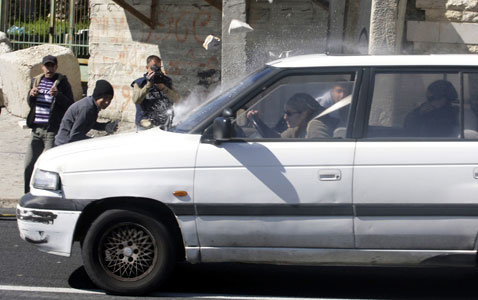
We don't know much about the man in the picture above. Clearly he's a photographer, wearing a vest with the name of his occupation in large letters. (This is meant to keep him safe in dangerous neighborhoods like the one in which he's standing.) 

He's just doing his job, standing by the side of the road, in a town a few kilometers south of Jerusalem. A moment before this shot was snapped by Nasser Ishtayeh (who takes excellent pictures for several international syndication agencies), this photographer was standing and waiting, camera at the ready, while young men around him gathered cement blocks and rocks and prepared to hurl them at people inside cars with yellow license plates. Around here, yellow license plates mean Israeli vehicles. The people inside are statistically quite likely to be Jewish.


We know a few things, but not much, about the woman in the picture above. 

Her name is Zahava Weiss. She is Jewish, a school-teacher. She is driving a family wagon on her way home to Karmei Zur. She wrote a Hebrew-language note that was translated into English earlier today and we published it here a few hours ago

She's not alone in the car. There's a female hitch-hiker sitting in the seat behind her. This is because in the front seat, there is a special seat/harness which under normal circumstances would be holding the woman's young child as securely as possible. The infant is not in the car which, as it turns out, may have saved the child's life, and the hitch-hiker whom we don't see also escaped injury because of that safety device. 

The woman is hunched up and looks frightened. The larger context tells us why.


Same picture as the two above (Image sourcebut cropped differently. And also cropped differently from the similar one we published this morning (see here). Unlike that one, here we see the photographer standing on the far side of the road. And here we see the young Palestinian Arabs who have been waiting, rocks at the ready, to attack a car and its passengers, once they are able to ascertain that the license plate is yellow and the people inside Jewish. This picture tells us more than the earlier version. 

How about the caption given to it by the Associated Press editors?
Palestinians hurl stones at a car driven by an Israeli woman on the main road between Jerusalem and Hebron after a demonstration in solidarity with Islamic Jihad member Khader Adnan, who has been on hunger strike for two months, in the West Bank village of Beit Omar, Feb. 21, 2012.(Nasser Shiyoukhi/AP Photo)
While these particular rocks thrown on this particular day at that particular vehicle with its particular driver were connected to a demonstration for this or that Palestinian Arab grievance, people living around Jerusalem and especially in Gush Etzion south of the capital know that rock-throwing or cement-block throwing by Palestinian Arabs don't always have a clear connection to a hunger striker or any other cause. 

Violence directed at Jews and Israelis by Arabs in the area has been a constant for much more than a century. It predates 'occupation' and Hamas and Fatah. It predates the State of Israel. And this particular spot, in the town called Beit Ummar, is very frequently the scene of dangerous hurling of rocks at cars [like this and this and this.]

The most disturbing dimension of all this, for us, is the role of the photographers. At a certain point, their presence is not just the fulfillment of their professional obligation. They become collaborators and co-conspirators. The event they are covering is happening not just when they are there but because they are there. There's a variation of this, fauxtography, in which their work product is deliberately manipulated to illustrate a story that never happened like the one below.


The man on the ground writhing in agony is a Palestinian Arab construction worker. "An Israeli army driver drove a trailer hooked to a tractor over his legs", according to the caption writers at AP, but as the analysis by CAMERA shows, he is uninjured. It's a kind of pantomime, but the public that saw this image in newspapers and websites all over the world didn't know that and certainly were not told it by the news organizations that published it. The photographer may or may not have known the truth, but that hardly matters once the picture is published. Once it's out there, retractions and corrections have very little effect - the message has been delivered and absorbed and is as real - even more real - than the reality which the photo presents.

There are other pictures where context changes everything. If the audience knows the context, the message changes form completely. But often the context is simply hidden from the audience's view, as with these famous snaps.


The power of the image of Palestinian Arab rock throwers and flag wavers is considerably less heroic once you comprehend that it's all happening for the cameras.

The misery of the crying Jerusalem woman, again a Palestinian Arab, in the well-known image below captured beside the still-under-construction security barrier in East Jerusalem... 


takes on a different meaning when you understand, from the context, that it's a performance; crying on demand in order to create a visual image for the photographers whose work demands one.


We don't say that photographers who capture news pictures are always complicit when bad things happen to innocent people in front of their lenses. Or that it's their responsibility when the image they create is then marketed, along with a misleading or fabricated caption, to tell a story that serves someone's agenda but that never happened. 

What we do say is that understanding what is happening around us in general and in this ongoing war in particular calls for all of us to exercise judgement, to not take matters at face value, and above all to demand appropriate context whenever important conclusions have to be reached.

23-Feb-12: Wishing for life (No one was killed so why give it even a moment's thought, right?)

This striking image of the moment of impact appears on the
Ynet website today. In a matter of hours, some of the photos
captured by the cameramen described in Zehava's short testimony
(men who stood by, as they customarily do in this part of the world,
waiting for a picture with some blood and/or drama) begin to appear.
This is written (translated from the original Hebrew - hat tip to Yisrael) by the terrified woman in the photo at right.
This past Tuesday, 28 Shvat, February 21, I was returning home to Karmei Tzur from Efrat where I work. At Gush Etzion Junction, I collect a female hitchhiker who got into a back seat since the front passenger seat was where our infant seat was affixed. What luck. While traveling between El-Aroub and Bet-Omar on the ascent, I noticed a car approaching from the opposite direction with a damaged front window from a rock that must have previously landed.  I naively presumed that that was the result of an old incident that hadn't yet been fixed.
When I came close to the gas station at Bet-Omar (a location that usually requires a driver's attention due to wrongly parked taxis, bypassing and pulling out into the highway in a careless manner), I observed a man running across the road from right to left.  At first, I thought that this was a soldier with a rifle and I slowed down to take in what was happening. Then I noticed dozens of people, old, young and teenagers, congregating on my right. It became apparent that the "soldier with a rifle" was actually a photographer with a camera.  He was seeking a better picture angle to snap away at what was about to happen. On my left were at least two other photographers, waiting for the action.
I should emphasize that I was not the first victim and other cars had already been stoned. So these press photographers were well aware what was happening and was about to happen to me. None of them, it seems, thought to call for assistance from the police or IDF, none of whom were present.
Knowing I had no choice but to continue and surely not stop - for otherwise, if I had slowed down, I would have been trapped and blocked off - the only thing in my mind was to get home and not be caught at that crossing.
It was difficult to pass since the rocks were flying from a distance of just a few feet from my car... 'zero-range' as we say.  The rioters clearly could see that the car contained two young females, and that we were completely defenseless.
We were hit by a large number of rocks. My view was blocked by the cracked windshield glass. All I could so was concentrate on getting out of there as fast as possible. At the time, as well as at this moment of writing, I did not fully grasp the danger of the situation we were in.
Only when I got home did I realize that the entire front end of the car was covered with shattered glass, including me, the infant seat, the back seat, everything. There was plenty of damage to the sides of our car.  At least eight large rocks and cement blocks had hit my vehicle. I learned that the rock-throwing continued for a good few minutes afterwards with the damage to other vehicles and psychological damage to the drivers and passengers.
I had to tell my children what happened in a normal, non-hysterical fashion so as to prepare them for further conversations that they would likely hear from grown-ups talking about this.
I have never before experienced such a serious and difficult incident as this. I pray it is my last. We have been living in Karmei Tzur for the past eight years. Now I know first-hand experience and with certainty that rock-throwings happen all the time, especially on Highway 60 between Gush Etzion junction and Halhoul.  My first-grade son's school bus has also been stoned.
Another point: these terrorists had no qualms about leaving their faces uncovered during this attempt to murder.
We try to overcome the fear and to live our everyday life.  We are believing people, a people with faith.  After an event like this, we will pronounce the customary Gomel benediction: "Blessed is He who Who bestows good things on those unworthy, and has bestowed on me every goodness". We believe in goodness, and that it will overcome evil.
We only pray and hope that people in Israel and around the world will finally recognize the truth, that our enemies, the Arabs who fight us, wish for evil. They want destruction while we wish for good and want peace, even with our neighbors. We wish for life.
Zehava Weiss
Karmei Tzur
You might also want to consider the comments of Elder of Ziyon ("A popular resistance brick harmlessly hurled at evil Zionist woman") here.

Here at This Ongoing War, we have tried in the past to capture the madness of giving the rock-and-cement-block-throwing thugs the benefit of a relaxed liberality. Please look at "5-Dec-11: Attempted murder by rock", "6-Oct-11: Those rock throwing "youths" are proliferating", and "25-Sep-11: "Only" rock throwers - but now a father and his infant son are dead".

How does the law deal with stone-age attempted murderers in your community? How would it treat photographers who stand on the side, watching the assault take shape and then recording the death and injuries that follow?