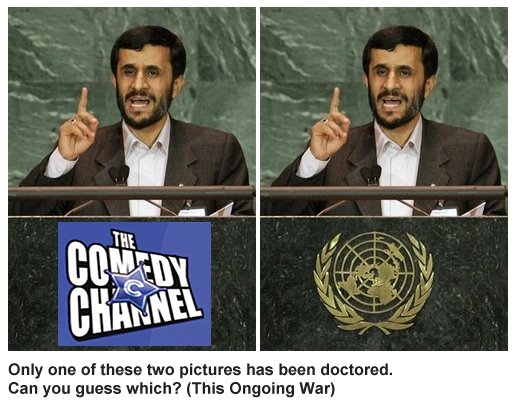
Showing posts with label Ahmadinejad. Show all posts

Wednesday, December 18, 2013

18-Dec-13: Head of Iran's nuclear energy agency: "Iran's centrifuges are working at full capacity. You talk, we act."

    Memories of a simpler, more optimistic epoch...
    three weeks ago [Washington Post article]
    An opinion piece entitled "Iran Nuke Deal Quietly Collapses" by Amir Taheri in the New York Post, December 16, 2013, presents a devastatingly different view of how the West's delicate dance with the ayatollahs is perceived over in Iran:
    Less than a month after it was hailed as "a great diplomatic coup," the Geneva accord to halt Iran's nuclear ambitions seems to have come unstuck. The official narrative in Tehran is that Iran signed nothing. "There is no treaty and no pact," says Foreign Ministry spokeswoman Marzieh Afkham, "only a statement of intent." Originally, Iran's official media had presented the accord as a treaty (qarardad), but it now refers to a "letter of agreement" (tavafoq nameh). On Sunday, an editorial in the daily Kayhan, published by the office of Supreme Guide Ali Khameini, claimed that the six-month period of the accord was meaningless and that a final agreement might "even take 20 years to negotiate"... Translated into plain language, the new Iranian narrative is that talks about implementing an accord that is not legally binding have collapsed and that, in the words of the head of the Iranian Atomic Energy Agency, Ali-Akbar Salehi, there is no change in the rhythm and tempo of Iran’s nuclear project. “Our centrifuges are working full capacity,” Salehi said last Thursday... If unable to impose its will on others, the Iranian regime will try to buy time through endless negotiations... Here is how Khamenei’s daily mouthpiece put it Sunday: “If our centrifuges do not continue to turn, no other wheel shall turn for our dignity, independence, power and security.” The message from Tehran to Washington is clear: You talk, we act.
    What's worse? That the P5+1 leadership thought they had a deal?
    Or that they knew they did not, but pretended
    otherwise? [BBC page]
    As ominous as this sounds (and it certainly should), there's an additional dimension that gets too little attention outside Iran:
    The mullahs also use the prospect of normalization, especially with the United States, to divert attention from their increasingly repressive rule. While Iranians are bombarded with talk of President Hassan Rouhani’s “diplomatic miracle,” an average of 10 people are executed in Iran every day. [Taheri]
    Translating that into body count terms, under "Smiling" Hassan Rouhani, its new, mild-and-moderate post-Mahmoud Ahmadinejad president, the number of state-instituted deaths by execution so far this year has soared to 529 as of the end of November [source], making it the world's new leader, on a per capita basis. 

    Further proof that while the word talks, in Iran they act.

    Monday, June 17, 2013

    17-Jun-13: In Iran, who is moderate, why, and what does it mean?

    Naharnet: Moderate not once, but twice. At least.
    There are some mighty optimistic messages going out this weekend about political changes in Iran. See Reuters for instance: "Analysis: Iran moderate's poll triumph is mandate for change", and "Hasan Rowhani, moderate cleric, pulls off Iranian election win" from CBS News.

    From a considerably more sober place, the Wall Street Journal carried an op ed yesterday called "Behind Iran's 'Moderate' New Leader | Hassan Rohani unleashed attacks on pro-democracy student protesters in 1999", written by Sohrab Ahmari, an Iranian-American who is the paper's assistant books editor. Key excerpt:
    So this is what democracy looks like in a theocratic dictatorship. Iran's presidential campaign season kicked off last month when an unelected body of 12 Islamic jurists disqualified more than 600 candidates. Women were automatically out; so were Iranian Christians, Jews and even Sunni Muslims. The rest were purged for possessing insufficient revolutionary zeal. Regime loyalist Hassan Rowhani, 64, a former nuclear negotiator and security apparatchik, served for 16 years as secretary of Iran's Supreme National Security Council. During his tenure, Rowhani led the crackdown on a 1999 student uprising and helped the regime evade Western scrutiny of its nuclear-weapons program. During the campaign, he boasted of how during his tenure as negotiator Iran didn't suspend enrichment - on the contrary, "we completed the program." 
    Some moderate. Some reformer.

    As to how much power we ought to credit to the new man, it's worth bearing in mind how the mainstream media worked hard these past few years telling us that the previous president (that would be Ahmadinejad) really had very little substantive power, and that control was actually with "supreme leader" Ayatollah Ali Khamenei. See for instance "Ahmadinejad is noisy, but look behind him to find real power in Iran" from the NY Times in 2007. Note to editors: Khamenei continues to wield today no less power than he and his predecessors had then.

    And here's a conundrum. A month ago, the only news outlet calling Rowhani moderate was Iran's own notorious state-controlled PressTV (here, for instance). What did they know that no one else does? And why is everyone now lined up behind their view? Stay tuned.

    Tuesday, May 17, 2011

    17-May-11: Did you imagine things were getting better?

    Venezuela's President Hugo Chavez (left) with Iran's President Mahmoud Ahmadinejad
    during an agreement-signing ceremony, Tehran September 6, 2009 
    Iran, deeply involved in funding and encouraging jihadism in the Middle East already, is establishing itself as a shooting power in the Western hemisphere, according to one of German's leading newspapers. Die Welt said on Thursday [source] the Iranians are building rocket launch bases in Venezuela.
    Iran is building intermediate- range missile launch pads on the Paraguaná Peninsula, and engineers from a construction firm – Khatam al-Anbia – owned by the Revolutionary Guards visited Paraguaná in February. Amir al-Hadschisadeh, the head of the Guard’s Air Force, participated in the visit, according to the report. Die Welt cited information from “Western security insiders.” The rocket bases are to include measures to prevent air attacks on Venezuela as well as commando and control stations. The Iranian military involvement in the project extends to bunker, barracks and watch tower construction. Twenty-meter deep rocket silos are planned. The cost of the Venezuelan military project is being paid for with Iranian oil revenue. The Iranians paid in cash for the preliminary phase of the project and, the total cost is expected to amount to “dozens of millions” of dollars, Die Welt wrote. The Paraguaná Peninsula is on the coast of Venezuela and is roughly 120 kilometers from America’s main South American partner, Columbia. According to Die Welt, the clandestine agreement between Venezuela and Iran would mean the Chavez government would fire rockets at Iran’s enemies should the Islamic Republic face military strikes.
    As it happens, the Iranian news website Tehran Times ran an article under the headline "Venezuela calls for closer cooperation with Iran" just two months ago:
    "Venezuela’s Foreign Minister Nicolas Maduro has said that Caracas is keen to have closer cooperation with Iran in the international arena. Maduro made the remarks during a meeting with Iranian Deputy Foreign Minister Behrouz Kamalvandi who is currently on a tour of Latin America. The Venezuelan foreign minister also said that his country is ready to cooperate with Iran to push ahead the two countries’ common goals. Kamalvandi highlighted the role of Venezuela in the campaign against the major powers’ imperialistic policies."
    Putting those outlandish assertions into context, here's what the same newspaper wrote today about where Iran stands in the community of nations:
    "Iranian President Mahmoud Ahmadinejad has said that the Islamic Republic of Iran, which is ruled by a supreme jurisprudent, is the most progressive and democratic country in the world. The Islamic Republic of Iran faces no insurmountable problem thanks to the presence of the Supreme Leader, Ahmadinejad stated during a televised interview broadcast live on Iranian television on Sunday night."
    It's wrong to laugh. These are serious people, with very serious resources at their disposal, including vast stocks of weapons. They're not smiling; neither should we.

    Last year, a Washington Post article entitled "Is there a Chavez terror network on America’s doorstep?" reported on an August 2010 summit meeting of jihadists hosted by Venezuelan president Hugo Chavez at the Fuerte Tiuna compound in southern Caracas. Participants included Palestinian Islamic Jihad Secretary General Ramadan Abdullah Mohammad Shallah (on the FBI’s list of most-wanted terrorists); Hamas’s supreme leader Khaled Mashal; and Hezbollah’s chief of operations whose identity is a closely guarded secret.

    Is the picture getting clearer?

    Sunday, May 01, 2011

    1-May-11: Eye on the terrorism masters: so where is Ahmedinejad ?

    Ahmedinejad delivers his infamous
    "Wipe Israel from the map" speech at Tehran's
    “The World without Zionism” Conference,
    October 26, 2005
    According to the BBC, there are signs of an internal power struggle among the ruling terrorists in Teheran. It says powerful Iranian MPs
    "have called for a closed debate on President Mahmoud Ahmadinejad's apparent boycott of his official duties. The president has not been seen at his office for eight days, missing two cabinet meetings and cancelling a visit to the holy city of Qom. Iran's supreme leader, Ayatollah Khamenei, recently re-instated a cabinet minister he had pushed out. Analysts believe an internal power struggle may be under way."
    The timing is interesting. Ahmedinejad's Iran is closely identified with the currently-embattled Bashar Assad regime in Iranian-client Syria. The secretive Syrians are in the news because of the ruthless and increasingly bloody attempts by government forces to put down a popular rebellion. Al Arabiya says that this past Friday, Syrian troops armed with tanks and helicopters killed at least four people (BBC says 6) in and near the famous Omari mosque, located in the Roman-era old town of Deraa. (The LA Times carries a report today quoting a Syrian military source who says Assad's security forces have been ordered to quell the uprising in Deraa "even if this means that the city is to be burned down.") Ynet quotes Syrian sources saying 62 Syrians were killed in protests on Friday alone. The UK-based Syrian Observatory for Human Rights says 539 people have been killed since protests against the repressive Assad dynasty began on 15 March.

    We all know the killing of worshippers in a mosque would normally make major headlines. But for reasons only a close observation of Middle East media coverage would begin to explain, the grotesqueries of the Syrians have long benefited from benign neglect by the world's media and politicians.

    Also little noted, but in reality of huge significance, is that Yukiya Amano, the head of the International Atomic Energy Agency, said Thursday for the first time (quoted in an AP report) that a target in the Syrian desert the Syrians complained was attacked and destroyed by Israeli forces in 2007 was indeed the covert site of a future Syrian nuclear reactor
    "countering assertions by Syria that it had no atomic secrets. Previous reports by the International Atomic Energy Agency have suggested that the structure could have been a nuclear reactor. Thursday's comments by IAEA chief were the first time the agency has said so unequivocally..."
    AP also notes that
    "Syria denies allegations of any covert nuclear activity or interest in developing nuclear arms. Its refusal to allow IAEA inspectors new access to the bombed Al Kibar desert site past a visit three years ago has heightened suspicions that it had something to hide, along with its decision to level the destroyed structure and later build over it... The IAEA is also trying to probe several other sites for possible undeclared nuclear activities linked to the bombed target but Damascus has been uncooperative on most counts, saying that most of the sites are restricted because of their military nature... Israel has never publicly commented on the strike or even acknowledged carrying it out. The U.S. has shared intelligence with the agency that identifies the structure as a nearly completed nuclear reactor that, if finished, would have been able to produce plutonium for the fissile core of nuclear warheads."
    The Ahmedinejad regime's own nuclear program is also under IAEA investigation after a long history of Iranian denials, semi-admissions and outright falsehoods. The BBC says:
    "Iran hid an enrichment programme for 18 years, so the Security Council says that until Iran's peaceful intentions can be fully established, it should stop enrichment and other nuclear activities... Iran's nuclear facilities remain under IAEA monitoring and the IAEA produces regular reports. However it has reported that Iran is refusing to answers questions about allegations that it has in the past studied how to make a nuclear warhead."
    The Undersecretary for Media Affairs at Iran's  Supreme National Security Council (Abolfazl Zohrehvand to his friends) captures Iran's attitude well when quoted by an Iranian source a few days ago saying "the world has accepted Iran as a nuclear state" and that Iran's approach "is based on nuclear transparency".

    With so much partial and wrong information out there, there may be individuals somewhere who believe him.

    Friday, April 18, 2008

    18-Apr-08: Removing the leaven

    Passover is upon us. Saturday night, Jewish families throughout the world will sit down to a formal dinner laden with ceremonial elements that have been part of Jewish life for nearly three thousand years. That meal is preceded by the reading of the Haggadah, the narrative that traces the emergence of a Jewish nation out of Egyptian slavery, and by days - sometimes weeks - of clearing the leaven from our homes.

    Leaven. It's a word that few people use if they're not getting ready for this Jewish festival. In Hebrew, Chametz, the word conveys not only a sense of the difference between bread (that rises in the course of being baked) and matza (the perfectly flat bread we eat for the next week). It's also the symbolic expression of arrogance, hubris - like yeast, something that causes a puffing up in dough.

    An excellent time therefore to review the visit to this part of the world of James E. Carter, a former president of the United States and the noted author of a book entitled Palestine: Peace Not Apartheid. Michael Kinsley's review in Slate ("Jimmy Carter's moronic new book about Israel") provides a good overview.

    Carter's visit was marked by his laying a wreath on the tomb of an arch-terrorist and master Palestinian-Arab embezzler and physically embracing and conferring with several leading active Hamas terrorists (quite possibly breaching several US Federal laws in the process). He also visited beleagured Sderot (looking strikingly bored according to eyewitnesses) and pronounced the endless missile and rocket attacks on southern Israel "criminal". The word must have slipped past Carter's pursed lips because the last thing he meant, it appears, was that Israelis need to respond as one responds to a criminal attack by degenerate thugs on your home, family and future.

    Sadly, the man gets considerably more mileage in the circles in which he moves by pronouncing Israelis as practitioners of apartheid than as victims of an ongoing mugging and conspiracy to murder.

    Here are a couple of the more cogent published observations stimulated by the former peanut farmer's visit to one of the world's most complex war-zones.
    • Jimmy Carter and Hamas - Washington Times Editorial
      Jimmy Carter's decision to meet with the terrorist organization Hamas is turning the former president into something of a political pariah. During a visit to the West Bank town of Ramallah Tuesday, Carter hugged and kissed a leading Hamas official at a reception. He is scheduled to meet later this week with Hamas' Damascus-based leader, Khaled Meshaal. After Iranian President Ahmadinejad called the Holocaust a "myth" and said Israel should be "wiped off the map," Meshaal congratulated Iranian leaders. Hamas has been behind scores of suicide attacks against Israel, and following that nation's August 2005 withdrawal from Gaza, Hamas has stepped up its firing of rockets and missiles at Israel.
    • Carter's Confusion - Clifford D. May National Review
      When Neville Chamberlain met with Hitler in Munich, he no doubt believed he could reason with him because he also no doubt believed that the Fuhrer was a reasonable man like himself. Offer Hitler a good deal - land, power, prestige - and surely he'd take it rather than plunge his nation into a terrible war. What this leaves out is ideology. Hitler's ideas inspired millions to fight and die for the glory of the Third Reich. And Marxist/ Leninist/ Stalinist/ Maoist ideology inspired millions to fight and die for the illusion of a Communist utopia.
      Hamas proudly proclaims that "the Koran is our constitution, Jihad is our way, and death for the sake of God is our highest aspiration." Hamas leaders promise their followers not just rewards here on Earth but in the next world as well - a selling point neither Nazism nor Communism could offer. As a matter of religious conviction, Hamas leader Khaled Meshaal cannot accept Israel's existence. Hamas believes every inch of Israel and, indeed, of any land ever ruled by Muslims is "an Islamic Waqf consecrated for future Muslim generations until Judgment Day." A Muslim can fight to reclaim this endowment or he can fail to fulfill the obligations his faith imposes. To Hamas, there is no third way.
    Removing a little of the hubris and the self-serving political narcissism from our midst at this time of year means not only ceremonially burning the bread with the crumbs but also recognizing puffed-up spent political leaders and placing their well-dressed hypocrisy on the garbage pile for immediate disposal.

    Saturday, September 16, 2006

    16-Sep-06: Peace: What Will It Take?

    Don't be misled by the title. The subject of what it will take to create a state of peace between the Arabs and Israel is too large, too complicated for this blog.

    To be clear: this is not because we don't want peace, but because peace is a complicated thing, built on a myriad of changed relationships and conditions.

    No, this blog is to briefly showcase a bleak, very black-and-white viewpoint. Not ours, but that of a noted veteran expert on Islam, Prof. Moshe Sharon of the Hebrew University of Jerusalem. Speaking at last week's conference on countering terrorism at the Institute for Counter-Terrorism of the Herzliya Interdisciplinary Center, Sharon said: "There is no possibility of peace between Israel and the Palestinians whatsoever - ever." He's especially troubled by the role of Mahmoud Ahmadinijad ... and throws some light on what the role of a religious lunatic at the head of a major country can mean for everyone else.

    Very briefly, some other points made in Prof. Sharon's analysis:
    • "The root of the problem between us and the Arab world is Islam. Islam is not only a religion. It is a culture, politics, a state. Islam is everything. It has been like this, and it will be like this for the foreseeable future. Islam is a messianic religion. From the very beginning, it talked about the end of the world."
    • From his study of Iranian culture, literature, newspapers and broadcasts and from interviews with major players in the Islamic regime, Sharon concludes that a deep belief in a Shiite messiah is at the root of Iran’s nuclear project.
    • “What today moves the Iranian government, its prime minister Ahmedinijad, is first and foremost the wish to bring about the Twelfth Imam, also known as the Mahdi. They truly believe that the Shiite messiah, the Twelfth Imam is here, and that he will reveal himself… What moves the Iranian government and leadership today is first and foremost the wish to bring about the Twelfth Imam."
    • Western officials fail to grasp that the Arab and Islamic world truly see Israel’s establishment as a “reversal of history” and are therefore unable to ever accept peaceful relations with it.
    • From Moslems’ perspective, “Islamic territory was taken away from Islam by Jews. You know by now that this can never be accepted, not even one meter. So everyone who thinks Tel Aviv is safe is making a grave mistake. Territory which at one time was dominated by Islamic rule, now has become non-Moslem. Non-Moslems are independent of Islamic rule and Jews have created their own independent state. It is anathema. Worse, Israel, a non-Moslem state, is ruling over Moslems. It is unthinkable that non-Moslems should rule over Moslems.
    • The power of the ayatollahs in Iran comes from the grassroots and popular belief that they can contact the Mahdi. Everybody believes. How will they bring him? By an apocalypse. He (the Mahdi) needs a war. He cannot come into this world without an Armageddon. He wants an Armageddon. The earlier we understand, the better. Ahmadinejad wants nuclear weapons for this.
    • Israel is a side issue for Iran. Iran is using Israel as a means to enter the Islamic world, to dominate it. "But they cannot bluff the Saudis, the Wahabbis. The Shi'ites (Iran) are hated by the Sunnis. The Saudis are far more apprehensive of nuclear weapons in the hands of Iran than Israel."
    • What is the difference between Judaism, Christianity and Islam? Judaism speaks about national salvation: at the end of the story, when the world becomes a better place, Israel will be in its own land, ruled by its own king and serving G-d. Christianity speaks about the idea that every single person in the world can be saved from his sins, while Islam speaks about ruling the world. I can quote here in Arabic, but there is no point in quoting Arabic, so let me quote a verse in English: ‘Allah sent Mohammed with the true religion so that it should rule over all the religions.’"
    • "The idea, then, is not that the whole world would necessarily become Moslem at this time, but that the whole world would be subdued under the rule of Islam... This is why [Iranian President Mahmoud] Ahmadinejad seeks nuclear weapons,” Prof. Sharon is quoted as saying. “The faster we realize this, the better.
    • The Iranian government is seeking nuclear weapons in order to bring about an apocalypse.
    We're not in favor of simplistic analysis or of paying attention to pooled ignorance. Political life in most places is filled to overflowing with both.

    On the other hand, ignoring, ostrich-like, what's happening in the Islamic and Arab worlds, and in Iran, and shutting out the shrieks of hatred - the calls to wipe Israel off the map, the rising mass-hysteria for war and global domination - that emanate from those places are among the most foolish and irresponsible things that politicians can do.

    Some politicians do, however, get it.
    President Mahmoud Ahmadinejad is a rising Adolf Hitler with his stand on Iran's nuclear programme, German Chancellor Angela Merkel said [in April 2006]. Merkel said the threat of Iran's nuclear ambitions is similar to Germany's Nazi regime, adding that the world must act now to prevent it building an atomic bomb. "In the early 1930s when National Socialism (Nazism) was on the rise, there were many who said 'It's only rhetoric - don't get excited'," she told a forum of world leaders. Iran "has blatantly crossed the red line", she said. "We must prevent Iran from developing its nuclear programme... A president who questions Israel's right to exist, a president who denies the Holocaust cannot expect to receive any tolerance from Germany."
    It's far from clear that the German leader's plain-spoken words stand a chance of being heeded. And just as doubtful that the real significance of the hateful, deadly malevolence emanating from Teheran is being understood in all the places it needs to be understood.

    POSTSCRIPT:
    An additional morsel of food for thought - a quotation of Adolf Hitler from 1922: "Once the hatred and the battle against the Jews have been really stirred up, their resistance will necessarily crumble in the shortest possible time. They are totally defenseless, and no one will stand up to protect them."

    Thursday, August 03, 2006

    3-Aug-06: Scarier Than Fiction

    Item 1: Iranian president: Israel's destruction is only solution to Mideast crisis
    Iranian President Mahmoud Ahmadinejad said Thursday that the only solution to the Middle East problem is the destruction of Israel. "The primary medicine for the problems of the region and the world is the annihilation of the Zionist regime," Ahmadinejad said.
    Item 2: French FM Hails Iran's 'Stabilizing' Role in ME
    TEHRAN (Fars News Agency)- Iran is a key player in the Middle East and "plays an important stabilizing role" in the region, French Foreign Minister Philippe Douste-Blazy said. "It is clear that we cannot accept a destabilization of Lebanon that could lead to a destabilization of the region. In the region there is a great country like Iran which is respected and which plays an important stabilizing role in the region," he said during a visit to Beirut.
    Item 3: How dangerous are Items 1 and 2?

    As slightly-amusing as these two pieces of imbecilic logic might be under normal circumstances, they're neither funny nor trivial here and now. The challenge is to keep in mind that:
    • Item 1 reports today's speech by a head of state who recently addressed the United Nations, and whose country is developing nuclear weapons.
    • Item 2 reports last week's speech by a top-level politician from Europe's largest country - a country which has veto power over the UN Security Council and which has a track record of self-aggrandizing, irresponsible meddling in other people's affairs.