Showing posts with label Safed. Show all posts

Sunday, November 22, 2015

22-Nov-15: The young Israeli woman stabbed this afternoon in Gush Etzion has died of her injuries

Hadar Buchris - murdered this afternoon
Tragic news: the 21-year-old Israeli woman who was the victim of a stabbing attack at Gush Etzion Junction, near Efrat, this afternoon [here], has died of her injuries.

Emergency treatment was given at the scene before she was rushed to Shaarei Zedek Medical Center in Jerusalem. She died there. Her name is Hadar Buchris. She lived in Safed, in the Galilee. At this stage, that's all we know about her life. We want to know more and will share what we learn.

Her family are entering one of the most difficult and challenging chapters that any of us ever know. May their family and friends have the wisdom to know what to say and not to say, what to do and not to do, and to provide them with the love and support of which they will now have great need.

The murderer was shot and killed by security forces at the scene. He is Wissam Tawabte (or عصام ثوابتة - Issa Thawabta, Essam ThawabtehIsam Ahmed Salman Thawabteh), a man in his early thirties from Beit Fajjar, a Palestinian Arab town of about 11,000 people, close to Efrat. In Ma'an's version of reality:
Thawabta was the third Palestinian to be killed on Sunday, after another two Palestinians were shot dead by Israeli settlers after allegedly attempting to attack Israelis.
Sickeningly, every Arabic-language site and/or Twitter account we have looked at tonight declares the killer of this luminous young woman a "martyr".

Monday, November 25, 2013

25-Nov-13: Out of the deep darkness of Syrian Arab-on-Arab savagery, pin-pricks of light in northern Israel

Ziv Medical Center, Tzefat [Image Source]
A small, almost inconsequential, BBC report from Tzefat, an ancient city of some 32,000 and a renowned center of Jewish scholarship and mysticism, focuses a little welcome attention today on the Ziv Medical Center for the work its good people do in the face of the Arab-on-Arab savagery being done just a short distance away in Syria. 

ZMC was established as a small clinic in 1910, later re-named in honour of Lady Rebecca Sieff, which is pronounced Ziv in Hebrew, and eventually expanded greatly as Tzefat itself grew. It is a government-owned and -operated medical center with 316 hospital beds, incorporating clinics, units and institutes, research laboratories and a nursing school. It now hosts the new Faculty of Medicine of the University of Bar-Ilan in Zefat, engaged in the education and training of future physicians.
The victims of Syria's war finding care in Israel 
By Kevin Connolly | BBC Middle East correspondent, Tzfat | 25 November 2013 
In the maternity unit at the Sieff Hospital in the Israeli city of Tzfat, the safe arrival of every baby feels like a minor miracle. But on the day we visited, there was one little boy among the row of newborns who will one day have quite a story to tell. That is, if his parents ever decide to tell him. 
The child's name has to be withheld: publishing any kind of information which could identify him might put him in danger when he goes back to his home village - which is in Syria. His mother's name or any personal information that might identify her can't be published either. She looked tired but happy when we met her, quick to praise the kindness of the Israeli medical staff who had treated her. She was already in labour when she went to her local clinic in her home village in Syria - but they told her that they could not treat her. Her worried husband knew that it was possible to get her treated in Israel - and so the couple began a dangerous race to the frontier in a country at war and a desperate race against time. She had to be taken to a point inside Syria from where she could be seen by Israeli soldiers patrolling the fence that marks the old ceasefire line between the two countries that dates back decades. A military ambulance then took her to hospital - she made it time. 
The humanitarian chain that got the woman from her home village under heavy shellfire to the boundary fence and then to hospital links guides in Syria to Israeli Army paramedics on the frontier, to the doctors and nurses in Tzfat. For the woman, every step in the process worked perfectly, perhaps because it has become a well-trodden path. She was the 177th person to make to the journey to the emergency room in what has become one of the most extraordinary subplots of Syria's agonising civil war. 
Syria and Israel regard each other as enemies. A state of war has existed between them for decades. And yet, since the first patients arrived around nine months ago, the informal system of patient transfer has become so well-established that some patients have even arrived with letters of referral written by doctors in Syria for their Israeli counterparts. Dr Oscar Embon, the director of the Sieff Hospital, says simply: "Some beautiful relationships have started between the staff at the hospital and the people that we treat. Most of them express their gratitude and their wish for peace between the two countries." 
The Israelis say they are treating everyone who needs treatment. That often means women and children but it is possible that among the young men who have been patched up, there may well be fighters loyal to Syrian President Bashar al-Assad, or jihadist rebels who in other circumstances would attack Israeli targets if they could. Dr Embon says that policy of not discriminating between the sick and the hurt is entirely consistent with what he sees as the values of his country and the ethics of his profession. He told me: "I don't expect them to become lovers of Israel and ambassadors for what we do here, but in the interim I expect they will reflect on what was their experience here and that they will reflect differently on what the regime tells them about Israelis and Syrians being enemies." 
Israel's help for the Syrian patients is politically interesting, of course - this is the Middle East, after all. But even if you only spend a few hours in the hospital at Tzfat, you get a sense that there are powerful human dramas being played out in the treatment room. Most of the patients, though, won't talk about what they have been through - they are too frightened about what would happen to them back in Syria if it emerged they had been to Israel. 
At the centre of the system is an Israeli Arab social worker who asked us to refer to him only by his first name, Faris. He calms the fears of disoriented patients who are shocked to find themselves suddenly being treated in an enemy state. He organises charity collections to provide them with toiletries and toothbrushes. And he listens to their stories.
Today's BBC report
The hospital treats any Syrian case - from pregnant women to injured rebel or government fighters The job Faris does is tough at the best of times - imagine having to explain to a young boy blinded in an explosion that he will never see again - but with the Syrian patients, it feels even more difficult because they go home as soon as they have been treated. And once they cross back onto the Syrian side of the boundary fence, all contact with them will be lost between the old enmities of the Middle East and the dangerous chaos of civil war. 
Faris acknowledges that the regular partings from men, women and children he has helped through dark moments are tough for him as well as for them. He looks tired when we meet but says he sleeps well knowing that he has been given a chance to do some good. "When people come here for two months," he told me, "a relationship starts between you and them and becomes stronger. Then they go home and the sad thing is you can't be in contact with them because their villages are 'enemy' villages." 
Such is the grinding misery of Syria's civil war, though - and the growing problems in the healthcare system there - that it seems every week will bring Faris and the medical staff at the hospital new patients and new problems. The Syrians who go home cannot be too open about the help they have received in Israel - merely admitting having been here could put them in danger. But somehow word is spreading and it seems likely that as long as the civil war goes on, the tide of injured seeking help will continue to rise.
The people of Tzefat might have been expected to take a different view of the opportunity handed to them by the ongoing horror of the Syrian fighting. The city has been the target of bombardment from the Arab side, most recently from the Iranian-proxy jihadists of Hezbollah ["2 More Israelis Are Killed as Rain of Rockets From Lebanon Pushes Thousands South", NY Times, July 15, 2006]

In Iran, naturally, they have their own interpretation
In 1974, gunmen of the DFLP Palestinian Arab terror gang infiltrated from Lebanon, murdered several Israeli Arab women and then a Jewish couple and their four year old child before lucking upon a school excursion group from a Tzefat school called Netiv Meir Elementary, spending the night in a small Israeli town, Maalot. The terrorists held them for two days, eventually killing 22 children and three adults by grenades and automatic weapons fire, and injuring 68 more. [See "Maalot massacre"]. It's highly likely that many of the staff personnel at Ziv hospital are personally connected to the victims of that horrifying terrorism.

Iran's state-controlled media, illustrating how some of the world's darkest, terror-infested corners try to make sense of news about people helping other people for humanitarian reasons, reported earlier this year on the lives being saved in Tzefat. Predictably such reports (example here) are spun to suggest this is done to support the anti Assad "militants", thereby serving as a hook on which claims of a "Zionist conspiracy" against the Iranian-backed Syrian regime are hung.

Saturday, August 31, 2013

31-Aug-13: Syria and Israel: Reminder of the human dimension

The entrance to Ziv hospital [Image Source]
Having just watched the White House speech of President Obama in which he explained that his administration's policy decisions in relation to the ongoing slaughter in Syria have now been re-calibrated so that the UK Parliament's vote can be more clearly taken into account before the US war machine goes into action, we feel the need for a reminder of the human side behind the catastrophic mess across our northern border.

The op ed below from Times of Israel is written by Australia's ambassador to Israel. Sadly, what he sees in northern Israel is bound to be relegated to the margins of the discourse about the conflict in which we Israelis find ourselves. Given what it reveals about people, and the simple decency that can be found if you want to see it, his short article ought to be out there, front and center.

Israeli compassion amidst the atrocities
Dave Sharma |  Times of Israel | August 28, 2013, 3:36 PM

As the world’s capitals and leaders discuss how to respond to last week’s chemical weapons attack in Damascus – the most repugnant in a series of atrocities committed in the war that is raging in Syria – it can be easy to lose sight of the daily human toll this conflict is extracting. Though Damascus is only some two hundred kilometres from Jerusalem (or shorter than the distance between Canberra and Sydney, as I tell my Australian friends), the conflict in Syria can feel like a world away.

But in the town of Safed in the north of Israel, better known as one of Judaism’s Four Holy Cities, the front-line of the conflict in Syria feels very close. At Ziv Medical Centre, without fanfare or publicity, they are treating a steady and growing stream of wounded Syrians from the conflict. Some 72 Syrian patients have been admitted to Ziv Medical Centre since February.

When I visited earlier this week, 15 hospital beds were being used to treat such victims, the youngest a girl of only eight. They have harrowing stories and horrific injuries. Suffering from shrapnel and bullet wounds, burns and crush injuries, they have somehow managed to limp to the border with Israel, from where they are then transferred to Ziv Medical Centre. On admission they are malnourished, fatigued and traumatised. Many have lost family members. But they are immensely relieved. If they had remained in Syria, the extent of their injuries means most would have died or been left permanently incapacitated.

At Ziv Hospital they get the best medical care on offer to any Israeli, from surgeons and physicians who are quite literally the best in their field, having authored textbooks on the treatment of injuries from armed conflict. On the day I visited I saw how doctors had managed to save the leg of an 8-year old girl from amputation by use of some of the most advanced surgical techniques and injury treatment protocols. A 15-year old girl whose leg was amputated in Syria had been fitted with a prosthetic limb. Against the odds, the doctors at Ziv had managed to save her other leg. This girl was now learning to walk again, taking her first steps.

Arabic-speaking doctors, nurses and social workers are all available to communicate with the Syrian patients and help ease their anxieties. They are provided time and space to recover and rehabilitate and supplied with basic provisions, including clothes and toiletries donated by generous residents from Safed. The multi-ethnic staff at Ziv Hospital – drawn from the Jewish, Arab and Druze communities – reflect the diversity of Israel. They are dedicated and compassionate professionals driven by a profound sense of humanitarianism. They do not stop to ask the patient’s nationality or religion as she is wheeled into the emergency theatre in a critical condition. They simply do their utmost to save life and treat injury.

Ziv Hospital is a profound example of humanity and decency at its most compelling. It is Israel at its very best, and a side of Israel that the world too rarely sees or acknowledges. With all the tales of human woe and misery that continue to emerge from Syria, such small stories of hope should be cherished.

Dave Sharma is Australia's ambassador to Israel.

Sunday, August 13, 2006

12-Aug-06: The peace toll

The toll from yesterday's missile attacks on Israel:
  • 68 missile landings
  • Injured by shrapnel: 8 people
  • Treated for shock: 17 people
  • The damage toll since 12th July: Missiles striking Israel: 3,650; Missiles landing in an urban area of Israel: 835
Missile strikes in the area of:
  • Kiryat Shmona: 930
  • Nahariya: 730
  • Maalot: 584
  • Safed: 448
  • Tiberias: 181
And of course many deaths and many injuries.

The civilian toll so far today (Sunday):

  • Heavy missile barrages all morning in the general direction of Israel's northern communities, with several landings in the Haifa suburbs. (UPDATE: Yediot says there have been 153 missile landings so far today, Sunday.) (5.45pm UPDATE: The tally of missiles has risen to more than 210 for the day. The havoc and hatred that every one of them delivers is incalculable.) (8.15pm UPDATE: 250 missile so far; 6 hits on Haifa at 7pm, and some sixteen separate rounds fired at Haifa throughout the day)
  • One person, a man of about 70, killed following a direct missile hit on a house in Shlomi (the town itself is pictured above)
  • Nine injured - most of them treated in Safed and Nahariya public hospitals, both of which have been struck several times themselves by Hizbollah's missiles.
  • Street demonstrations in the United States and Europe yesterday, supporting the people who launch these missiles at Israel, are extensively photographed in Sunday's media. What puzzles us most about these images and reports is that AP and Reuters consistently refer to the people holding Hizbollah posters and pictures of the fanatical Shi'ite leader Nasrallah in these often-violent demonstrations, as 'peace' protesters.
We check routinely, and have yet to see a single caption referring to Israeli efforts at stopping Nasrullah's monumentally large missile arsenal as being related to peace. But the fact is, for anyone close enough to the action to not be misled by distorted reportage, that when Nasrullah's arsenal is destroyed, there will be peace. We Israelis expect little more than the peace of the graveyard until that time.

Sunday, August 06, 2006

6-Aug-06: Disproportionality argument starts to fade

To the evident satisfaction of the Vatican and leaders of most European countries, the disproportionality of losses between Lebanese and Israelis has undergone a significant re-alignment in the past 48 hours.

The tragic deaths of a mother and her two daughters in their own home in the Israeli village of Arab Daramshe on Saturday, almost entirely un-noticed and un-reported by news media outside Israel, pushed the death toll up, as did developments this morning. 

A fifteen minute-long barrage of Katyusha missile attacks on Sunday struck Kfar Giladi, Ma'alot, Safed, Acre, the Golan Heights and numerous open areas in the north. Initial reports say ten Israelis were killed in this morning's attacks, and many others injured. Additional missiles are landing as we write these lines.

Hezbollah's missile firings are always essentially pot-shots

This is by no means a strategic problem for the Lebanese Shi'ites since they have never pretended to be engaged in a strategic battle. Every loss of human life - and certainly including Israeli Arab lives, which happen to be over-represented among the Israeli casualties - on the Israeli side of the border is a victory for Nasrallah's barbarians. Any act of violence qualifies as "resistance", and there is a ready supply of media dupes ready to buy and repackage their spun stories.

Part of the freedom that comes from being designated a terror organization under United States, UK, Canadian and Australian law, but not under the laws of most European countries or of the EU, is that Hezbullah can shoot anywhere it likes. Anything that dies or is destroyed can then be treated as an achievement.

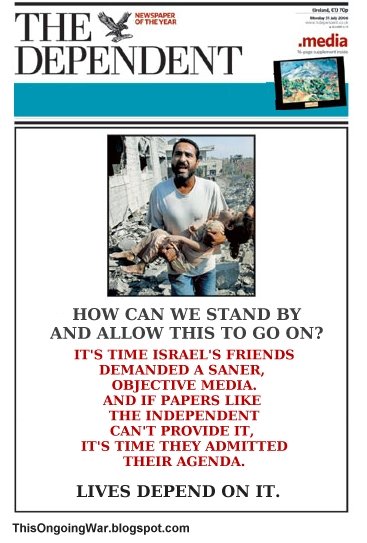
So long as Hizbollah can spin the news as effectively as it has done so far, even the deaths of Lebanese advance their cause. While this will sound odd to many ordinary people unversed in the finer points of press coverage, the editors of such sober and object publications as The Independent (UK) understand this well.

Tuesday, August 01, 2006

1-Aug-06: Using Dead Lebanese Children for Ammunition


Those of us living in Israel or concerned for Israel's welfare have a pretty good idea what's happening in Haifa, Nahariya, Safed, Afula. This is in large measure because of the real-time, mainly-unfiltered reportage and live television coverage from there and from every other part of this robustly democratic and open country.
But do you know what really happened in Qana? In Tyre? In Beirut? No, neither do I. What we think we know is what the news media – papers, TV, blogs, radio – feed us, generally after the fact, sometimes days afterwards. How safe is a diet like that? Well, as with most diets it's a matter of how carefully you want to check. Here's a look at who's doing the feeding and at the additives, preservatives and other foreign materials that are mixed into what reaches us.
Qana question
As painful as what happened in Qana is to most of us, there are some very disturbing aspects about the tragedy which go to the root of what happened. Some of them:
  • Did Hezbullah stage-manage the Qana incident? A Lebanese source (translated from French to English here) says yes. It suggests disabled children were brought to a building which served as a base for a Katyusha battery because the inevitable destruction of such a building by the IDF and the deaths of children would have such a powerful effect on world opinion.
  • As revolting as this sounds, the cynical parading of dead children's bodies tells you we're dealing with people whose culture and humanity are unrecognizable to most of us.
  • We're also dealing with newsagencies (Reuters, AFP, Associated Press) whose photographers are active collaborators in this disgraceful pornography. The evidence is in the bullet below.
  • A small handful of Hezbollah low-lifes appear in one staged photo after another, posing with a dead child's body, hamming up a range of facial responses. If you can stomach it, see The Parade of Dead Children - Euphoric Reality; What Really Happened in Qana? - Wizbang; Qana: The photographic evidence (Update: Bodies from Tyre?) from Hot Air; and especially EU Referendum.
  • It may be that the dead bodies from fighting some days earlier in Tyre were trucked in to Qana. Ridiculous? Maybe. But you may want to read this before dismissing the idea entirely.
  • In its briefing for journalists at the end of the long day on which the Qana incident happened, the IDF raised several more serious questions. Customarily careful to avoid saying what might not be fully confirmed, the spokespeople presented whatever they were confident to show. This included video footage of missiles being fired from immediately next to the destroyed house several hours before the IDF attacked Qana. CNN's Brent Sadler has just been on our screens this afternoon (Tuesday), reporting live from Qana, pooh-poohing Israeli claims that the town was a launching pad for Hezbollah war ("Nope, no Hezbollah people here"), and asserting that Israel has failed to bring any evidence to the contrary. If you have Sadler's email address, we'd be glad to know he gets this link to the film footage.
  • Sadler or his CNN producers might also be interested to hear - since they evidently have no clue - that Qana was the source for no fewer than 150 rockets fired into Israeli civilian settlements in the past three weeks, as documented here. Hezbollah salvos from Qana have crashed (among others) into Haifa, Nahariya, Ma'alot and Kiryat Shmona. They caused the documented, proven and undisputed deaths of 18 Israeli civilians and hundreds more wounded. Brent, our email address is on this page for when you get a free moment to send the people of Israel your apology.
  • Reuven Koret over at Israel Insider has some additional, cogent and bothersome questions. Please visit his excellent site to read them.
  • We know how hard it can be for some people to accept that Hezbullah would ever treat their Lebanese brethren poorly. But there is some evidence that this is not entirely beyond them. Try looking here and here and here.
  • As for the general credibility of Hezbullah, its record as one of the bloodiest of the bloodthirsty speaks for itself... though evidently not loudly enough.
But the western media would surely blow the whistle on stage-managed news fakery, right?
Reporting from southern Lebanon (and quoted in the Columbia Journalism Review), freelance journalist and Time magazine contributor Christopher Allbritton drops this little gem:
To the south, along the curve of the coast, Hezbollah is launching Katyushas, but I'm loathe to say too much about them. The Party of God has a copy of every journalist's passport, and they've already hassled a number of us and threatened one.
To be clear, he doesn't say that Hezbollah fakes the news events. Or that they manipulate the journalists. But he doesn't need to. And we're left wondering: on what other aspects of this complex story are he and his colleagues loathe to report? And what have they reported as fact that perhaps ought not to have been reported as fact? Fair questions, no?
CNN's Nic Robertson can supply a helpful answer to that. Last week, Howard Kurtz – on his Reliable Sources show on CNN - interviewed Robertson about reporting from Lebanon. Here's Columbia Journalism Review's analysis of their exchange:
Just a few days before, Hezbollah minders had taken Robertson on a tour of a neighborhood in southern Beirut that had been hit by Israeli missiles. Robertson told Kurtz, "Hezbollah has a very, very sophisticated and slick media operation," and in southern Beirut, "they deny journalists access into those areas. They can turn on and off access to hospitals in those areas." He also said that Hezbollah "designated the places that we went to, and we certainly didn't have time to go into the houses or lift up the rubble to see what was underneath ... Hezbollah is now running a number of [press tours] every day, taking journalists into this area. They realize that this is a good way for them to get their message out, taking journalists on a regular basis. Robertson [said]: "We went in to those southern suburbs of Beirut with that media representative from Hezbollah. They haven't let western reporters into some parts of that very, very, very carefully controlled southern suburbs ... they took us in because they wanted to show us what was being damaged." He then ended by again reminding viewers that it was a "very, very brief and swift tour escorted by Hezbollah." The disclosure that Hezbollah acted as tour guide does put the report into perspective, but still, Robertson could have dwelled a bit more on the calculated photo op CNN's cameras were provided by an obviously interested party.
(Source: Paul McLeary, Lifting the Cover of the Hezbollah PR Effort). McLeary also quotes CNN's Anderson Cooper from a week ago (transcript here):
We found ourselves with other foreign reporters taken on a guided tour by Hezbollah ... They only allowed us to videotape certain streets, certain buildings... This is a heavily orchestrated Hezbollah media event. When we got here, all the ambulances were lined up. We were allowed a few minutes to talk to the ambulance drivers. Then one by one, they've been told to turn on their sirens and zoom off so that all the photographers here can get shots of ambulances rushing off to treat civilians ... These ambulances aren't responding to any new bombings. The sirens are strictly for effect.
So whom can you believe?
In our opinion, no one deserves our uncritical support. Questions need to be asked, and no one is beyond criticism. Politicians will do what politicians always do, and terrorists will do whatever they can get away with. Our question is why are so few journalists doing what journalists do -- dig, question, investigate. Thus, the one action point we would urge on everyone visiting this blog is: never assume that reporters, editors, photographers are more credible or more objective than anyone else. It's perfectly plain that they're not and never have been. More than this, they are as capable of being jackasses and dupes as anyone else.
And working for a brand-name media channel is no defence.

Tuesday, July 18, 2006

18-Jul-06: Quotation for the Day


It is hard to know if the fire was intentionally directed at us. We know from the movies that hospitals are not attacked (in war), but when it comes to Katyushas the rules must be different.
Deputy director of Safed's Rebecca Sief Hospital Dr. Klein Shapira, speaking after the hospital was hit by a Hezbollah missile on Monday night. The attack damaged the hospital's air conditioning system and injured 5 patients, two doctors and two other hospital employees. All were treated in the hospital's emergency room.

Friday, July 14, 2006

14-Jul-06: This Ongoing, Ongoing War

In the past several hours (it's now mid-afernoon, Friday), Hezbollah forces in southern Lebanon have fired off barrage after barrage of Katyusha missiles into any Israeli target they can reach - civilian, military, agricultural; it's all the same to them. Rockets have hit
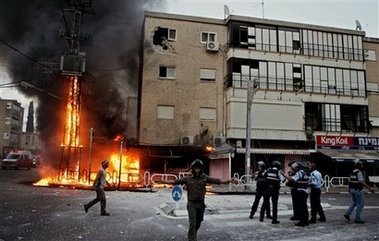
  • Tsfat (some know it as Safed) - reports in the last few minutes of another direct hit on a residence. The Old City was extensively damaged there yesterday and there are several people critically injured.
  • Nahariya - center of town is hit. Local leaders and government politicians happen to have been meeting very nearby to discuss the crisis situation. Among politicians present was Vice Premier Shimon Peres.
  • Hatzor Haglilit near Rosh Pina - several people suffered from shock after a missile landed near a bomb shelter. A vehicle parked nearby exploded.
  • Beit Jan
  • Kiryat Shmona - two separate barrages. One near a factory in the city's northern industrial zone; a second near the village of Beit Hillel.
  • Biranit
  • Matat
  • Sasa right on the northern border.
  • Karmiel - where we have friends who spent last night very uncomfortably accommodated in a bomb shelter. All the residents of the city have now been told to enter bomb shelters and protected structures this afternoon after today's Katyusha missile landings in the vicinity. So far no reports of injuries or serious damage, but we're told (and we believe) it's terrifying.
  • Maalot - initial reports of a direct hit on an apartment building with injuries and damage.
  • And Haifa's residents are being told right now (4.40pm) to find shelter and stay there.
If you're not familiar with Galilee and northern Israel, the places listed above are not military bases or desert reserves. These are towns and cities filled with people; places that have not been under direct Arab attack in decades, and which ought to be in the midst of their tourist season. The area suffered 120 long-range missile attacks yesterday. And today's no quieter.

For those of us mindful of what a terror organization is, it's self-evident that the only thing that will stop their active enmity (translation: shooting) will be when their physical ability to do this is neutralized.

Of course, it would be awfully nice if that could be done in a proportionate way. And we're happy to discuss with anyone interested (perhaps the political leaders of the European Union, Norway, Russia, France, Italy, the United Kingdom) how a proportionate response to deliberate, willful and enthusiastic mass murder ought to be conducted.

One last word: we named our blog "This Ongoing War" when we started it because we're appalled at the way observers and reporters keep presenting events out of context. Our daughter was murdered almost five years ago in a terrorist massacre. That attack on a restaurant filled with women and children, conducted by agents of the people who now sit in the Palestinian parliament and funded and supported by them, was one in a long series of acts of war. We can wish it weren't so. We can hope that there are people on the other side who really, truly want peaceful relations. But we can't make it happen by wishing and hoping. And we can't ignore the straight line that connects today's missile attacks on Israel, yesterday's Qassams and Katyushot, last week's stabbings, last month's drive-by shootings, and the restaurant bombings, grenade throwings and all the other acts of intended and actual murder carried out day after day for the past 6 years since the Arafat War began.

That straight line is described in our chronicle below, and wishing and hoping won't change its reality.

14-Jul-06: A word about the BBC

BBC's Kim Ghattas
It's Friday afternoon. The television here in the living room is tuned in to BBC World whose noon bulletin from London kicks off with main headlines that are all about "Israel has again attacked", "Intensified Israeli raids", "Israel seems determined to send a message to Syria", "Here's the latest from our correspondent in Beirut" and "Let's hear from an academic expert".

And familiar old feelings are being aroused.

In choosing to present both sides of the frightening events of the past 36 hours, BBC's voice from Beirut happens to be that of Kim Ghattas (pictured), a born-in-Lebanon Lebanese who speaks English smoothly and is never identified as partisan or even (in our experience) Lebanese. The BBC's choice of academic expert is a Lebanese man based in Washington DC with a very Lebanese viewpoint. And the message from both (paraphrased by us) is: it's those belligerent Israelis all over again, and until civilized and cultured forces from outside step in, the bloodshed will continue. 

We're now into the second half-hour of this hour-long bulletin, and while there's not a single word - not one word, not one image - so far about what's being done to Israeli towns all over the Galilee, there is a diplomatic analysis, courtesy of Syria's ambassador to the UN. (Yes, Syria.)

The bulletin's now over. They're into the economic news. Not one word on how tiny Israel, smaller than the state of New Jersey, surrounded by the sea on one side, by a Hamas state on two sides and a Hezbollah state on the fourth, is under unprovoked intense fire today from three out of four directions, with the fire landing right in the heart of major centers of population.

Not one word about how Israeli forces, more powerful by orders of magnitude, could turn its enemies and their towns and cities to rubble in a 24-hour concerted effort - but don't. Or to put it another way: if all the weaponry in this region were in the hands of the Islamists and Jihadists, the result would be genocide; while if all the weaponry were in the hands of Israel, the result would be serenity.

Not one word or picture from Tsfat where a house - adjacent to Ziv Hospital - took a direct hit this morning, causing serious injuries and damage.

Not one word from Nahariya where another barrage of Katyushas crashed into the center of the city around noon, causing significant damage close to where a woman was killed a day earlier in previous barrages.

Not one word about Katyushas landing in the past two hours in a number of western Galilee locations. Not one word about missiles striking Kibbutz Kabri, Kibbutz Gesher Haziv, Kibbutz Saar and the community of Bat-Ami.

The reason we created this blog was our conviction, based on personal knowledge and the experience we have of living here close to events, that the people who work in the news media are causing real harm to the lives of innocent Israelis. Their reporting, their editorial decisions, the choice of which images and video footage are put to air and which not - all of these are fundamental to the process of how opinions are formed. We don't need the news media to think like we do, or believe what we do. It would be enough if they were able to present both sides of an argument without advocating one of them at the expense of the other in a subtle and unprofessional manner.

Experience shows that the editors of the BBC in London are not currently, and not going to be, held to any objective test of how fair, honest and accurate their work-product. (And yes, we are very familiar with the efforts made in the last year to bring them to account, with little meaningful or respectable result.) Given how pervasive their influence is, in the United States no less than in the UK, Asia, Europe and elsewhere, Israel's friends everywhere need to take an even more active role - and especially now - in challenging the way the BBC spins the narrative. 


There are people hard at work inside the BBC fashioning a message that is hostile to Israel and Israeli interests. It's important for us to recognize this, and to do the things that individuals can do.

Thursday, July 13, 2006

13-Jul-06: A matter of proportion

Let's talk proportionate. The word is getting an inordinate amount of use today and this week.

During the past few hours, on a national fast-day recalling past destruction, the entire northern region of this small country has come under rocket and missile attack. The pictures are deeply upsetting - we're seeing them now on the evening news. Ordinary people, ordinary homes, ordinary towns - under fire, on fire, wounded, killed, being buried. Towns that ought to be filled with local and visiting holiday-makers - now deserted. The locals are in the air-raid shelters; the visitors have rushed away. No place is out of range.

Israel often feels like a very small place to those of us living here. We relate to the hourly radio news bulletins and the evening television news in the way families in other places relate to long-distance phone calls from members of the immediate family: Ssh, ssh, let me hear, what's she saying?

So what's on our news right now in these minutes? The fiancee of one of the IDF soldiers blown up in a tank yesterday, sobbing as she speaks of her lost future. Live video interviews from corners of towns that all of us know - Nahariya (in the picture above), Tsfat, Carmiel, Hatzor, Rosh Pina, Haifa - all in flames; suddenly they've become the war front. A military funeral in a Druze village. Coverage of Bnei Akiva youth group teens praying for the welfare of one of the kidnapped soldiers. (Unlike some of the naive and ill-informed reporters, we're familiar with what a Hezbollah kidnapping means. Two decades of fruitless efforts on behalf of Ron Arad have made their mark on Israeli consciousness.) And almost as an after-thought, scenes from the south - another war front - where missiles keep being fired, and a kidnapped Israeli teenager keeps being sought by those who love him.

There's a good deal of anger here. Israelis know better than anyone else how little we want to be at war with our neighbours, but we're not being offered the choice. We're barely out of the trauma of last summer: the lead up to prime minister Sharon's "Disengagement", then the very troubling scenes of uniformed Israelis forcibly removing dedicated families from homesteads and farms and businesses they had cultivated for decades - but the message was: this is for peace. We'll do this and then a major obstacle to better relations with the difficult people on the other side of the fence goes away. But the obstacle has of course not gone away. The ruins of those Jewish towns in Gaza are today Palestinian military camps and launching sites for missiles that now need to travel a slightly shorter distance to hit and hurt communities in undisputed Israel.

No one, unfortunately, is holding the Palestinian leadership to account for their massive historic failure to build something - anything - constructive for themselves. The image of Gaza farmers growing and selling hydroponic tomatos in the greenhouses left behind by Israeli agriculturalists is a sad joke. They never even came close.

A sense of how far our neighbours are from sharing values with us can be gotten from the news pictures this week of jubliant Arab men dancing and prancing in celebration of two more kidnapped IDF soldiers. As the frequency and intensity of lethal missiles fired anywhere in the general direction of Israeli centers grows, this is what they want - more than they want educated and safe and happy children. They are beyond our comprehension.

There there's the matter of Europe.
The European Union is greatly concerned about the disproportionate use of force by Israel in Lebanon in response to attacks by Hezbollah on Israel. The presidency [of the European Union] deplores the loss of civilian lives and the destruction of civilian infrastructure. The imposition of an air and sea blockade on Lebanon cannot be justified... Actions, which are contrary to international humanitarian law, can only aggravate the vicious circle of violence and retribution, and cannot serve anyone's legitimate security interests.
This, an official statement made this afternoon in Brussels, is self-serving nonsense. Actions which lead to the defeat of a leadership more interested in dancing with joy at having kidnapped the enemy's children than with improving their own lives do serve legitimate security interests. Europe understands this perfectly well, but only to the extent it concerns their enemies. Are we to learn about proportionality from the Russian treatment of the Chechens? Does the study of British or French or Belgian history help?

Proportionate
is a code word. Remember when France's ambassador to the Court of St James, who never troubled himself to deny it, was quoted calling Israel "that shitty little country..."? Most people who took notice were miffed by his reference to excrement. But the real problem with Monsieur Bernard's snide candor was in his use of the word "little". What he was really saying is: How dare that little entity, that non-entity, presume to take self-defence measures that upset so many interests? So many French interests. That's in effect what European governments and the EU are saying tonight.

We've personally met with many European public figures and politicians since our daughter's murder by Hamas terrorists. Some are decent empathetic people. But many - including several European foreign ministers with whom we have had closed-door conversations - are transparent, crocodile-tear-shedding hypocrites. Proportionate when it comes from mouths like theirs means nothing more and nothing less than this: Keep killing one another's children because you're doomed to do it forever. But don't you dare presume to prevail, because that would cause enormous waves and even deeper humiliation and resentment on the part of the People-with-the-Largest-Chip-on-Their Shoulder in history. And we know what that means for Europe's cities.

We Israelis, with our hatred and fear of war, understand that unless we defeat the terrorists, we - and they - are going to keep paying a heavy price for their barbarism for years to come. We do still have a choice, and that is to ignore the double-talk of the foreign populists and the superficial, ignorant reporting of the media analysts - and to act decisively, to do what it takes. That's what Israelis from every part of the political spectrum are saying tonight. Hezbollah and Hamas are not our rivals in some sort of argument about the shape of future borders. They are terrorist thugs, committed to nothing constructive for their own people and massively obsessed with hurting us.

Perhaps you need to be sitting in front of an Israeli television tonight to understand that. The proportions look very different from here, tonight.