|
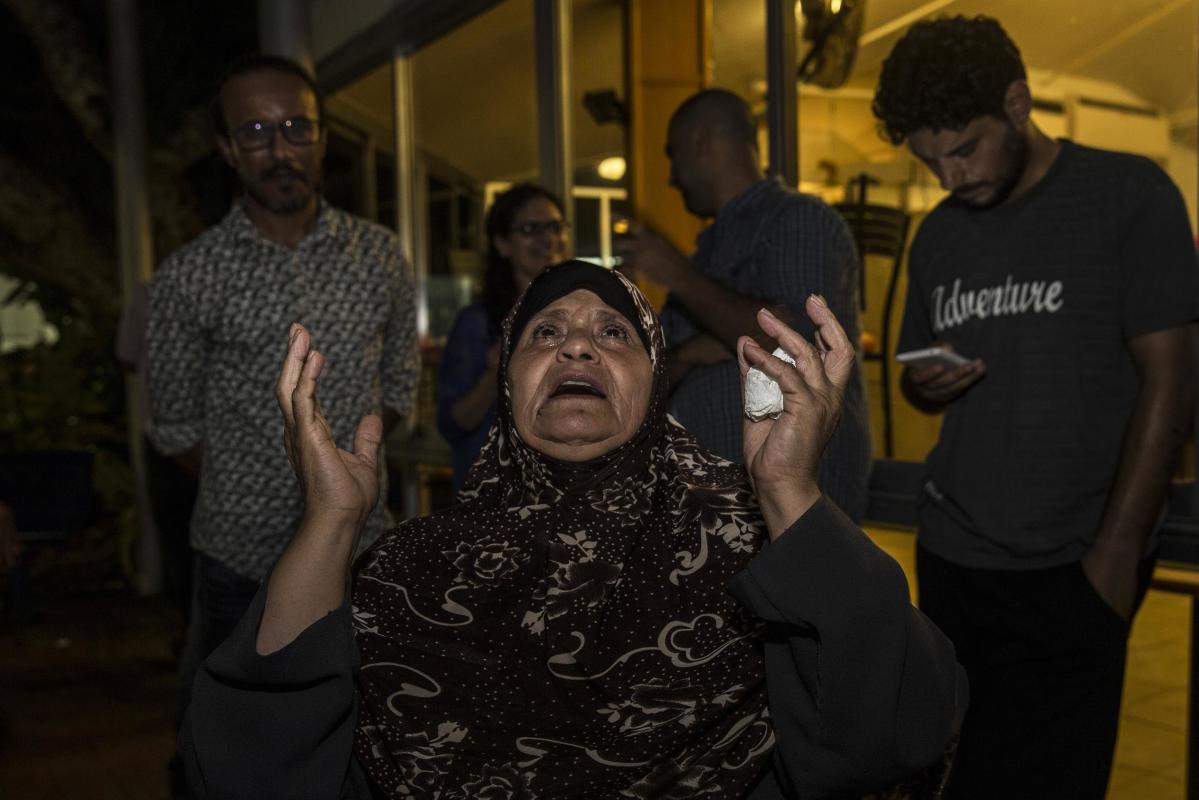
| This photo of the notorious PA insider, Issa Karake, appears in a Jordan Times article [here] under the headline "Palestinians call for release of hunger-striking prisoners". The face at the top of his poster belongs to Abdullah Barghouti. Calling him "hunger striker" somewhat misses the point. A confessed mass murderer, he wants to add to his current tally of 66 innocent victims. Naturally, they want him free. |
Muhammed Alaan (about whom we wrote on Friday: see "21-Aug-15: Hungering, thirsting, just dying for fresh victims")
told a Hamas journal: “I am free at the moment. If the Israeli occupation arrests me again, I will return to the hunger strike until they put an end to the travesty I am suffering, as are hundreds of administrative prisoners.” He added that the practice of detaining suspects without trial while refusing them the right to a lawyer and denying them visits from their family must be stopped “immediately.” Allaan was speaking from his hospital bed at Ashkelon’s Barzilai hospital. The High Court of Justice on Wednesday suspended Allaan’s administrative detention — a special anti-terror measure that allows imprisonment without trial on terrorism charges — after tests showed that he had sustained brain damage as a result of his two-month fast. There were conflicting reports as to whether the damage was reversible... Security officials believe Allaan, 31, is tied to the Islamic Jihad terrorist organization. Right-wing lawmakers and ministers reacted furiously to the High Court decision, with some accusing the court of setting a dangerous precedent that would lead to the release of other security prisoners being held in Israel. On Friday Allaan said in a video that his strike had been successful, and thanked his Israeli Arab “brothers” for their support. ["Terror suspect says he’ll renew hunger strike if rearrested" | Times of Israel, August 21, 2015]It's unlikely to get much media coverage outside Israel (which is a pity), but some observations by an Israeli expert on how to treat prisoners, Orit Adato, emerged in an interview shown on Israel's Channel 1 on Saturday night. They were triggered by the ongoing Alaan case and the absurd and dangerous results it seems to be producing.
Odato, a specialist consultant whose privately-held business focuses on effective ways to manage the imprisoned terrorist population, is Israel's only female three-star army general, and a past commissioner of the Israeli Prison Service.
She said last night that the Israeli authorities have made two serious mistakes that have brought on the current fiasco.
- Israel freed hunger strikers several years ago. This conveyed a clear message to the prisoners and their advocates that in Israeli eyes they hold a very effective tool in their hands. If Israel had wanted to release some administrative detention prisoners - and Israel was holding many at the time - it ought to have released several who were not on hunger strike, along with perhaps one or two who were. The point would be to make clear that the hunger strike was not the reason for the releases. Instead, Israel released only the hunger strikers.
- The doctors who have refused to force-feed the hunger striking prisoners are utterly wrong. They have an obligation to save lives. They already save the lives of other terrorists who have no interest in living - for instance, human bombs (erroneously called "suicide bombers" - see "30-Jun-15: We need to be calling them what they are: human bombs") who survive. They save prisoners who are found hanged and are freed from the rope before death. The case of a hunger striker is no different from those other cases.
Here, below, is an essay published in 2006 in which she features. It's one of those now-forgotten (and always ignored) pleas we made to the Israeli authorities to re-think their plans to free terrorists from Israeli prisons in order to secure the freedom of Gilad Shalit, a hostage illegally held by Hamas for years.
This particular article was published in Front Page Magazine just before we started blogging here, and fully five years before the catastrophic Shalit Deal was executed. We're still sure it made sense then and feel it's helpful to repost it here, now.
"Reasonable" Suicide | Frimet Roth | FrontPageMagazine.com | September 12, 2006
Prepare for another Israeli retreat. The prison gates are about to be flung open again and Hamas handed a victory greater than any territorial concession. Sources say that the release of kidnapped Israeli soldier Cpl. Gilad Shalit is imminent. The ransom demanded by Hamas reportedly now stands at 800 Palestinians imprisoned in Israel. The absurdly skewed numbers make plain that this will be no exchange. While the first Palestinian to walk through those prison gates will be swapped, the seven hundred and ninety nine who follow him will be handed over gratis.Nine years later and in the wake of the deplorable events of October 2011, we have the tragic answer. And along with millions of other Israelis, we are left to live with its consequences.
A mass release of this kind, if it takes place, will be catastrophic for Israelis. In its wake, terrorists would be insane not to carry out more such abductions in order to reap such bonanzas. And past experience shows that released prisoners rejoin the ranks of their terror gangs with redoubled fervor.
Orit Adato, former Commissioner of the Israeli Prison Service, observed, in her 2005 article, "The Issue of Prisoner Release", that some security prisoners "left jail more extreme and better equipped ideologically and professionally." But these sacrifices have long been accepted as the unavoidable price of "bringing our boys home." Israeli soldiers and their families, facing the harsh realities of life here, know that no stone is ever left unturned in our government's pursuit of that goal.
Amnon Zichroni, a veteran negotiator for the release of Israeli soldiers, reflecting on this, said in a recent interview: "Perhaps the other side doesn't have the same attitude as we do to our people." Based on his past involvement in trying to free European hostages held in Iran and Lebanon, he is convinced that even "the Europeans placed less value on their citizens' lives than we [Israelis] do."
This noble attitude should not be tampered with. However, it is essential that candidate prisoners be carefully selected and their release wisely negotiated. Zichroni, a lawyer, has come by this wisdom over several decades. His experience in the field began in 1978 when PM Menachem Begin appointed him to handle the release of Israeli prisoners and hostages in Arab hands. He was also involved intensively with the cases of Ron Arad and the 1982 Sultan Yaakub MIA's.
Successful negotiation, he maintains, demands that government lay the groundwork immediately after the kidnapping. Interviewed by the Bitter Lemons forum shortly after Cpl. Shalit was taken hostage, Zichroni advised the Israeli government to "desist from targeted assassinations and deal instead with targeted kidnappings… of people who are close to the organizations holding Shalit, who could be bargaining cards... Without leverage, we fail."
His advice was not heeded. Prime Minister Olmert's initial public stance was to refuse to negotiate at all. Zichroni says this increased the danger to Shalit's life.
Having since flip-flopped and with no ground-work, Olmert is negotiating from a position of weakness. Consequently, the deal being weighed threatens to be more loathsome than all those preceding it. If closed, it will cross a critical red line that has been observed in all of Israel's earlier prisoner exchanges.
To obtain Shalit's freedom, Israel has reportedly agreed for the first time to hand over prisoners "with blood on their hands." But the deal's brokers and Israel's political leaders are attempting to conceal this with the lulling words "women and children."
The fact is that several of the women and sub-eighteen-year-olds who are candidates for release are no less lethal and murderous than the stereotypical twenty-something male terrorist.
Those who grieve – like me – for loved ones murdered at Jerusalem's Sbarro Restaurant are well aware of the dangers posed by female terrorists. One hot August afternoon five years ago, Ahlam Tamimi, then a twenty-year-old university co-ed, played a central role in the terror attack that took the life of my daughter and 14 other innocents, most of them children.
Tamimi selected the target and escorted the suicide bomber to the restaurant's door. 130 people were injured and maimed in that massacre.
Interviewed in her prison cell four months ago, she told reporters: "I'm not sorry for what I did. I will get out of prison and I refuse to recognize Israel's existence."
Tamimi has served less than five years of her 16 consecutive life sentences. Yet already in March 2006, she proclaimed, "I know that we will become free from Israeli occupation and then I will also be free from the prison."
I appeal to Prime Minister Olmert to resist the pressure of Palestinian and Western diplomats to succumb to the above terms. They are undoubtedly invoking populist comparisons between the IRA and the Palestinian prisoners and pointing to the success of the Good Friday Agreement, signed by the IRA and Britain in 1998. But our situation is fundamentally different.
The Good Friday document took into account several factors absent from the Palestinian case. First, there was no mass exodus of hundreds of Irish convicted terrorists. They were released gradually, in order of the severity of their crimes and the time remaining in their sentences.
In addition, only prisoners belonging to organizations that had signed the ceasefire accord were freed. The others were to be reassessed at a later stage in the peace process. And both sides, the Irish and British governments, were entrusted with re-integrating the prisoners both before and after release.
Clearly, none of those conditions apply in our region. No Palestinian terror organization has signed anything remotely like a cease-fire with Israel. On the contrary, they have reiterated, both in word and deed, their commitment to the destruction of Israel. There is no peace process to speak of.
Consequently, once the freed Palestinians have rejoined the ranks of their terror organizations, the only "re-integration program" they will attend is target practice and advanced Islamist indoctrination.
There is another significant distinction between the Irish and Palestinian experiences. InIreland, the victim families were involved in the process from the start. They were notified of pending IRA prisoner releases and invited to respond. The pain of the Israeli victims has never been a factor in the prisoner release equation.
With Gilad Shalit, Ehud Goldwasser and Eldad Regev still held for ransom by terrorists, prisoner release is a hotly debated issue. Now is the time for the government to reassess this tactic. Once fine-tuned, it can become the key to "bringing our boys home" without being suicidal: without strengthening our enemies, endangering Israel, making a mockery of justice or infuriating the victims.
The question is: Are our leaders up to the challenge?