Showing posts with label Alaan. Show all posts

Wednesday, August 26, 2015

26-Aug-15: Defiance, activism, jihad and New York Times journalism

Click for the background to this 2013 CAMERA campaign.
The girl in the poster is our murdered daughter, Malk
An article by Diaa Hadid in yesterday's New York Times, a classic exemplification of lethal journalism, reminds us of the extraordinary amorality the paper's editors have demonstrated when dealing with the ideology-driven murderers of Jews and Israelis.

It's a piece about a Palestinian Islamic Jihad terrorist (rooted in a defiant past, she writes) who is at the center of an article we posted here on Friday ["21-Aug-15: Hungering, thirsting, just dying for fresh victims"] and another two days later ["23-Aug-15: Do they understand the price of freeing the hunger-striking terrorists?"].


Hadid repeatedly invokes his quiet, his defiance, his activism. But never his blood-lust or doctrinal hatred of Jews.


She devotes precisely zero words to an explanation of Palestinian Islamic Jihad and its goals ("destruction of Israel through violent means", according to the Council on Foreign Relations) and its status as a client of the Islamist regime in Iran. These are at the very heart of understanding how a man ends up being and doing what he is and does. But it goes unmentioned, unanalyzed.


What she and her editors have created can only be called a hagiography, beatifying a quiet-spoken hero who... thirsts, hungers, to kill people.


But let's start with her words: what did he do before becoming a hunger striker?

Mr. Allan joined Islamic Jihad when he was studying law... in Jenin, said his father... He said his son was energized by the fight against Israel during the second Palestinian intifada. Mr. Allan was first jailed by Israel in 2006 for trying to recruit a suicide bomber to carry out an attack in Israel, and was held for three years. He was briefly detained a second time by Israel in 2011...
We expect some readers will wonder why "trying to recruit a suicide bomber" causes this much angst.

Not for the first time, we want to say here clearly and unambiguously that we hate the expression "suicide bomber". We tried to explain why here: "30-Jun-15: We need to be calling them what they are: human bombs". Here is part of what we wrote then:

Whatever the intentions of those who do them, who engineer them, who plan them and who encourage them, lethal attacks in the nature of 9/11, 7/7, 11-M, the massacre by a Saudi inside a Kuwaiti mosque this past Friday, are never about suicide, and never were. Acts of murder is what they are about, and what they are. The intention of those acts and of the people who do them is to kill. Often, the person doing the killing is completely indifferent to the personal outcome for himself or herself, for reasons that are worth understanding but come down to this: the killing is the reason; the death of the killer is an incidental outcome about which the perpetrators (and those who facilitated the killing by sending the killer on his or her way) have no particular concern.
This has significance. The term "suicide bomber" is used frequently in the mainstream media - almost always inaccurately and usually misleadingly - when what they are in reality describing is a human bomb, and a human bomb attack.
Hadid is of course not the problem. Like anyone else, she holds views. At the New York Times, a huge commercial entity, they have people whose jobs including filtering out tendentiousness, subjectivity, hate-filled polemicism masquerading as journalism, and bad, agenda-driven writing. 

And in the case of Ms Hadid's work product about which there is some background here ["The NY Times' Israel-hating Reporter", FrontPageMag, April 28, 2015], it's not really that difficult to know what to watch for if watching is part of what a NY Times person is supposed to do. 


Things like this tirade from 2007:

"I can't look at Israelis anymore. I can't separate your average Israeli citizen from the occupation, I don't want to be friends with them, I don't want to talk to them," says Hadid... ["Diaa Hadid: AP's Propagandist"] 
There's nothing wrong with any of this as long as we agree that people are free, in democratic societies where the human rights of all are respected, to express the most intolerant of viewpoints, and under certain conditions even hatred. But then why would the New York Times decide to give a person with that kind of mindset a job reporting on Israel-hating, murder-minded Islamist terrorists? And, to judge from the by-line of yesterday's piece, to give them the privilege of writing it from the NYT Middle East bureau in the heart of beautiful Jerusalem... where Ms Hadid can't avoid looking at more Israelis than she plainly wants to. Doesn't seem right or fair or smart.

As for the editors at the New York Times, we wish they had reconsidered that extraordinary paragraph we quoted above. Here's how, in our view, it should have been phrased:

Mr. Allan joined Islamic Jihad when he was studying law... in Jenin, said his father... He said his son's Islamist passions, and especially the lust for murdering Jews wholesale was ignited during the terrorist war declared by Arafat in September 2000. Mr. Allan was first jailed by Israel in 2006 for trying to plant a human bomb in a location where many Jewish Israelis would have been blown to pieces (as had happened five years earlier at Jerusalem's Sbarro pizzeria, the credit for the blowing up of which was first claimed by Islamic Jihad before Hamas made a more convincing case to show it was their work.) He was held for three years, an astonishingly light sentence given the effort he had made and the intended carnage that was so narrowly avoided. He was briefly detained a second time by Israel in 2011 on the basis of well-founded fears that he was making another effort to achieve the barbarous aims of the outlawed terror organization to which he had pledged alliegance... 
So do we expect to get any serious attention for this from the New York Times? 

If you are familiar with some of our previous posts about its work ["28-Jun-07: About sweet-faced young women", "5-Jul-07: A Balance of Views?", "17-Mar-13: A little village in the hills, and the monsters it spawns", "30-Mar-13: "To see the NY Times gloss over this travesty of justice is journalism of the most amoral sort", "9-Aug-13: Protesting journalism of the amoral sort", "14-Nov-13: To really understand about terrorism's victims, can't beat the New York Times"], you probably know the answer already.

Sunday, August 23, 2015

23-Aug-15: Do they understand the price of freeing the hunger-striking terrorists?

This photo of the notorious PA insider, Issa Karake, appears in a Jordan Times
article [here] under the headline "Palestinians call for release of 
hunger-striking prisoners". The face at the top of his poster
belongs to Abdullah Barghouti. Calling him "hunger striker"
somewhat misses the point. A confessed mass murderer, he wants to add to 
his current tally of 66 innocent victims. Naturally, they want him free.
Flush with the thrill of achievement, the imprisoned Islamic Jihad terrorist who has been waging a campaign against the Israeli authorities is back to making some improbable fresh threats from his Israeli hospital bed.

Muhammed Alaan (about whom we wrote on Friday: see "21-Aug-15: Hungering, thirsting, just dying for fresh victims")
told a Hamas journal: “I am free at the moment. If the Israeli occupation arrests me again, I will return to the hunger strike until they put an end to the travesty I am suffering, as are hundreds of administrative prisoners.” He added that the practice of detaining suspects without trial while refusing them the right to a lawyer and denying them visits from their family must be stopped “immediately.” Allaan was speaking from his hospital bed at Ashkelon’s Barzilai hospital. The High Court of Justice on Wednesday suspended Allaan’s administrative detention — a special anti-terror measure that allows imprisonment without trial on terrorism charges — after tests showed that he had sustained brain damage as a result of his two-month fast. There were conflicting reports as to whether the damage was reversible... Security officials believe Allaan, 31, is tied to the Islamic Jihad terrorist organization. Right-wing lawmakers and ministers reacted furiously to the High Court decision, with some accusing the court of setting a dangerous precedent that would lead to the release of other security prisoners being held in Israel. On Friday Allaan said in a video that his strike had been successful, and thanked his Israeli Arab “brothers” for their support. ["Terror suspect says he’ll renew hunger strike if rearrested" | Times of Israel, August 21, 2015]
It's unlikely to get much media coverage outside Israel (which is a pity), but some observations by an Israeli expert on how to treat prisoners, Orit Adato, emerged in an interview shown on Israel's Channel 1 on Saturday night. They were triggered by the ongoing Alaan case and the absurd and dangerous results it seems to be producing.

Odato, a specialist consultant whose privately-held business focuses on effective ways to manage the imprisoned terrorist population, is Israel's only female three-star army general, and a past commissioner of the Israeli Prison Service.

She said last night that the Israeli authorities have made two serious mistakes that have brought on the current fiasco.
  1. Israel freed hunger strikers several years ago. This conveyed a clear message to the prisoners and their advocates that in Israeli eyes they hold a very effective tool in their hands. If Israel had wanted to release some administrative detention prisoners - and Israel was holding many at the time - it ought to have released several who were not on hunger strike, along with perhaps one or two who were. The point would be to make clear that the hunger strike was not the reason for the releases. Instead, Israel released only the hunger strikers.
  2. The doctors who have refused to force-feed the hunger striking prisoners are utterly wrong. They have an obligation to save lives. They already save the lives of other terrorists who have no interest in living - for instance, human bombs (erroneously called "suicide bombers" - see "30-Jun-15: We need to be calling them what they are: human bombs") who survive. They save prisoners who are found hanged and are freed from the rope before death. The case of a hunger striker is no different from those other cases. 
We have quoted Odato several times in the past (in 2008, for instance). She has expressed some consistently smart views that, in retrospect, pointed in the right direction.

Here, below, is an essay published in 2006 in which she features. It's one of those now-forgotten (and always ignored) pleas we made to the Israeli authorities to re-think their plans to free terrorists from Israeli prisons in order to secure the freedom of Gilad Shalit, a hostage illegally held by Hamas for years.

This particular article was published in Front Page Magazine just before we started blogging here, and fully five years before the catastrophic Shalit Deal was executed. We're still sure it made sense then and feel it's helpful to repost it here, now.
"Reasonable" Suicide | Frimet Roth | FrontPageMagazine.com | September 12, 2006 
Prepare for another Israeli retreat. The prison gates are about to be flung open again and Hamas handed a victory greater than any territorial concession. Sources say that the release of kidnapped Israeli soldier Cpl. Gilad Shalit is imminent. The ransom demanded by Hamas reportedly now stands at 800 Palestinians imprisoned in Israel. The absurdly skewed numbers make plain that this will be no exchange. While the first Palestinian to walk through those prison gates will be swapped, the seven hundred and ninety nine who follow him will be handed over gratis.

A mass release of this kind, if it takes place, will be catastrophic for Israelis. In its wake, terrorists would be insane not to carry out more such abductions in order to reap such bonanzas. And past experience shows that released prisoners rejoin the ranks of their terror gangs with redoubled fervor.

Orit Adato, former Commissioner of the Israeli Prison Service, observed, in her 2005 article, "The Issue of Prisoner Release", that some security prisoners "left jail more extreme and better equipped ideologically and professionally." But these sacrifices have long been accepted as the unavoidable price of "bringing our boys home." Israeli soldiers and their families, facing the harsh realities of life here, know that no stone is ever left unturned in our government's pursuit of that goal.

Amnon Zichroni, a veteran negotiator for the release of Israeli soldiers, reflecting on this, said in a recent interview: "Perhaps the other side doesn't have the same attitude as we do to our people." Based on his past involvement in trying to free European hostages held in Iran and Lebanon, he is convinced that even "the Europeans placed less value on their citizens' lives than we [Israelis] do."

This noble attitude should not be tampered with. However, it is essential that candidate prisoners be carefully selected and their release wisely negotiated. Zichroni, a lawyer, has come by this wisdom over several decades. His experience in the field began in 1978 when PM Menachem Begin appointed him to handle the release of Israeli prisoners and hostages in Arab hands. He was also involved intensively with the cases of Ron Arad and the 1982 Sultan Yaakub MIA's.

Successful negotiation, he maintains, demands that government lay the groundwork immediately after the kidnapping. Interviewed by the Bitter Lemons forum shortly after Cpl. Shalit was taken hostage, Zichroni advised the Israeli government to "desist from targeted assassinations and deal instead with targeted kidnappings… of people who are close to the organizations holding Shalit, who could be bargaining cards... Without leverage, we fail."

His advice was not heeded. Prime Minister Olmert's initial public stance was to refuse to negotiate at all. Zichroni says this increased the danger to Shalit's life.

Having since flip-flopped and with no ground-work, Olmert is negotiating from a position of weakness. Consequently, the deal being weighed threatens to be more loathsome than all those preceding it. If closed, it will cross a critical red line that has been observed in all of Israel's earlier prisoner exchanges.

To obtain Shalit's freedom, Israel has reportedly agreed for the first time to hand over prisoners "with blood on their hands." But the deal's brokers and Israel's political leaders are attempting to conceal this with the lulling words "women and children."

The fact is that several of the women and sub-eighteen-year-olds who are candidates for release are no less lethal and murderous than the stereotypical twenty-something male terrorist.

Those who grieve – like me – for loved ones murdered at Jerusalem's Sbarro Restaurant are well aware of the dangers posed by female terrorists. One hot August afternoon five years ago, Ahlam Tamimi, then a twenty-year-old university co-ed, played a central role in the terror attack that took the life of my daughter and 14 other innocents, most of them children.

Tamimi selected the target and escorted the suicide bomber to the restaurant's door. 130 people were injured and maimed in that massacre.

Interviewed in her prison cell four months ago, she told reporters: "I'm not sorry for what I did. I will get out of prison and I refuse to recognize Israel's existence."

Tamimi has served less than five years of her 16 consecutive life sentences. Yet already in March 2006, she proclaimed, "I know that we will become free from Israeli occupation and then I will also be free from the prison."

I appeal to Prime Minister Olmert to resist the pressure of Palestinian and Western diplomats to succumb to the above terms. They are undoubtedly invoking populist comparisons between the IRA and the Palestinian prisoners and pointing to the success of the Good Friday Agreement, signed by the IRA and Britain in 1998. But our situation is fundamentally different.

The Good Friday document took into account several factors absent from the Palestinian case. First, there was no mass exodus of hundreds of Irish convicted terrorists. They were released gradually, in order of the severity of their crimes and the time remaining in their sentences.

In addition, only prisoners belonging to organizations that had signed the ceasefire accord were freed. The others were to be reassessed at a later stage in the peace process. And both sides, the Irish and British governments, were entrusted with re-integrating the prisoners both before and after release.

Clearly, none of those conditions apply in our region. No Palestinian terror organization has signed anything remotely like a cease-fire with Israel. On the contrary, they have reiterated, both in word and deed, their commitment to the destruction of Israel. There is no peace process to speak of.

Consequently, once the freed Palestinians have rejoined the ranks of their terror organizations, the only "re-integration program" they will attend is target practice and advanced Islamist indoctrination.

There is another significant distinction between the Irish and Palestinian experiences. InIreland, the victim families were involved in the process from the start. They were notified of pending IRA prisoner releases and invited to respond. The pain of the Israeli victims has never been a factor in the prisoner release equation.

With Gilad Shalit, Ehud Goldwasser and Eldad Regev still held for ransom by terrorists, prisoner release is a hotly debated issue. Now is the time for the government to reassess this tactic. Once fine-tuned, it can become the key to "bringing our boys home" without being suicidal: without strengthening our enemies, endangering Israel, making a mockery of justice or infuriating the victims.

The question is: Are our leaders up to the challenge?
Nine years later and in the wake of the deplorable events of October 2011, we have the tragic answer. And along with millions of other Israelis, we are left to live with its consequences.

Friday, August 21, 2015

21-Aug-15: Hungering, thirsting, just dying for fresh victims

Image Source
Muhammad Allan, a Palestinian Arab, is widely depicted in parts of the social media right now as a hunger-striker unjustly detained, a veritable "freedom fighter", "courageously resisting tyranny". And of course "gentle, conscientious and well-respected". 

Multi-media campaigns like the one in which he now features usually come with gentle backgrounders ("loved kittens, spoke nicely to his sisters") plus lawyers, mothers and protesters. This one is from that same template, along with media distortions, half-truths and inaccuracies.

A 31-year-old Arab lawyer, the man is indeed a hunger striker and has been since June. He became comatose earlier this week and then regained consciousness in Barzilai Medical Center, Ashkelon, on Tuesday where he has been getting Israeli medical care. The following day, Wednesday, Israel's High Court ordered that he be freed from administrative detention "due to his deteriorating medical condition, including the revelation Wednesday afternoon that his brain had been damaged." More than this, 
Deputy High Court President Elyakim Rubinstein and justices Hanan Melcer and Neal Hendel held that due to his health situation, Allan’s family members could visit him on an unrestricted basis, as if he were not a detainee. [Jerusalem Post]
Once the court had ruled, one of his lawyers told Reuters that the 65-day hunger strike was done: 
"The story is over, administrative detention is canceled, and therefore there is no strike," said lawyer Jameel Khatib. But a hospital spokeswoman said it would not have been possible for Allan to make such a decision, since he was not conscious or aware of his surroundings... [Jerusalem Post]
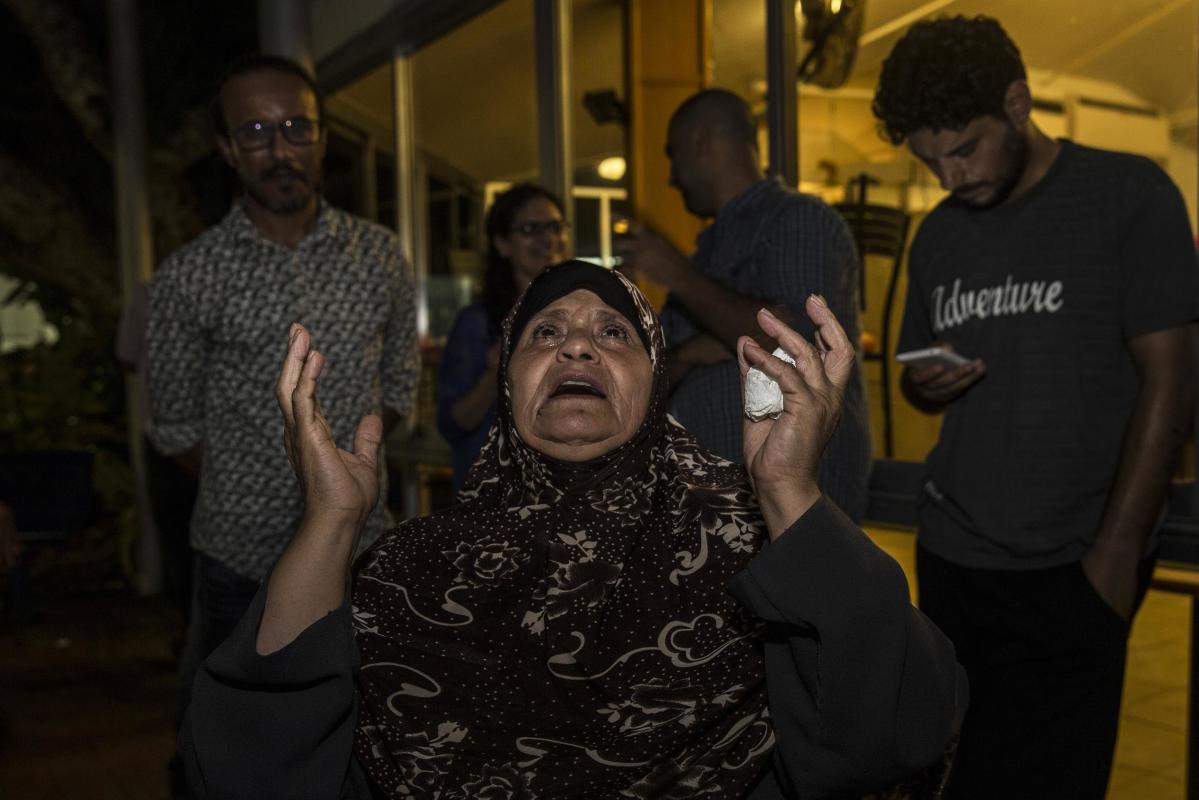
Hunger striker's mother in the Ashkelon hospital where his life
is being saved by Israeli medicine, despite his best efforts [Image Source]
Internal contradictions happen. No one seems too concerned for factual accuracy when Palestinian Arab figures are being elevated to mythic/heroic status against all the evidence. For us news consumers, we're left to distinguish among the available menu items of fantasy, exaggeration, political spin and ordinary empirical facts.

Naturally, Allan (or Alaan or Alan or محمد علان) is not just a lawyer. And his problems are not the kind that traditionally come from legal practice. 

Quite the opposite: from reliable sources, we understand he's deeply invested in terrorism as both active player and facilitator. Allaan was first arrested by Israeli authorities in 2006 due to his involvement in recruiting a human bomb in advance of a murderous attack. These charges earned him a trial, a conviction, and a sentence of which he served three years in jail. He was arrested again in 2014 on the basis of reliable intelligence regarding his contacts with Palestinian Islamic Jihad in the context of preparing of fresh terror attacks. The evidence was brought before the same High Court that eventually released him on Wednesday, Based on their judicial review at that time, his incarceration under Israel's administrative detention laws got the court's approval - not a foregone conclusion in Israel's strict legal frameworks. At a guess, we think this may have been a "ticking time bomb" case, though no one has said so in the media.

Same mother, same hospital [Image Source]
Alaan's hunger strike is naturally self-imposed, and the physical damage he may have caused to himself is too. 

But setting that aside for a moment, concerned people reading the heart-rending descriptions in the media of what he and his organs went through up until Wednesday might find it hard to avoid feelings of sympathy. It was good to note that one of the judges in Wednesday's hearing, presented with a passionate argument on Alaan's behalf by another of his lawyers that detention was at the root of the problem, pointed out what ought to be obvious:
"This is not a result of his detention, sir. There is damage as a result of his hunger strike that he undertook." - Supreme Court Judge Hanan Melcer, quoted in Jerusalem Post, August 19, 2015
They might even come away with the impression that Israel applies administrative detention widely and indiscriminately. Or that Israel is somehow unique or unusual among civilized states in resorting to it. 

Again, the mother, the hospital, the arms [Image Source]
Reuters, in reporting on Alaan on Monday, framed its version of the narrative in a way that might easily lead a reader to those wrong conclusions:
Israel sees his hunger strike, which began more than 60 days ago, as a powerful challenge against "administrative detention", a practice that has drawn criticism from Palestinians and human rights groups but which Israel calls a security necessity... [Reuters, August 17, 2015]
Human rights people say this, but Israel says that. He says, she says, the human rights people say. It's a common news industry approach with which friends of Israel are familiar, but it's also cheap, unfair and misleading. 

The reality (very rarely mentioned in Alaan-related news reports) is that many states, some of them respectable - including Australia, Brazil, Ireland, Jordan, United Kingdom and the United States - all have laws providing for administrative detention. Those laws are in active use when there's a need and the circumstances are appropriate. Considering the intense but little reported acts of terrorism to which Israeli civilians are routinely subjected by their Palestinian Arab neighbours, you could make a strong case that Israel has the need. And the circumstances, according to the widely respected High Court of Justice, are appropriate.

Hunger striking terrorist's mother again. She's in an Israeli hospital
- probably Barzilai - but we can't be sure [Image Source]
To illustrate: we wrote about a rocket barrage that struck northern Israel yesterday ["20-Aug-15: Rockets from Syria slam into Israel's north"]. The IDF says those rockets came from Syrian terrorists acting in the name of Palestinian Islamic Jihad (the PIJs deny it, but the IDF makes a pretty strong case). They're Alaan's colleagues, the people in whose company he hangs when he's not on hunger strike in an Israeli hospital room.

As for how widely administrative detention is used by Israel, the numbers given in this Palestinian Arab news report suggest it's currently applied to about 7% of the Arabs in Israeli prisons.

A word about Barzilai before we end. 

The medical center where the hunger-striking Islamic Jihadist is having his life saved is in Ashkelon, the closest Israeli city to the Islamist-ruled terror-addicted Gaza Strip. Despite the unstinting care it provides to all-comers on a non-discriminatory basis, Barzilai gets routinely attacked by Qassam and Grad rockets ("as many as 140 over one weekend" and here's a fine photo collection to drive the message home) fired at them by Hamas and PIJ. Scarce funds have had to be diverted from the hospital's budget into the construction of underground wards and emergency facilities - an effort that saves lives. 

We understand the profound cultural and ethical chasm separating us, and don't expect the Alaan clan to give thanks. But it's striking that no mainstream media channel has seen fit to at least mention that the facility which has saved this Islamic Jihad terrorist's life has frequently come under rocket-attack by his fellow savages-in-arms, and almost certainly will again when they can do it.