Showing posts with label Haniyeh. Show all posts

Wednesday, June 16, 2021

16-Jun-21: What do the Palestinian Arabs think now?

Image Source: Red Cross
There's unique value to Palestinian Arab polls of Palestinian Arab public opinion. 

They often come with internal contradictions and unanswered ambiguities. But at least they don't suffer from, or impose on their readers, the wishful thinking and projection that make some outside analyses, especially from far-away reporters and columnists with axes to grind, misleading and worse.

We have reported here for years about the results of periodic polling done by the Palestinian Center for Policy and Survey Research (PSR), headed by a respected professional, Dr. Khalil Shikaki. We know Shikaki only by his work and reputation; there is no personal connection between us.

Before getting into the details and the data, it's worth repeating what we wrote in one of our previous posts about Palestinian Arab opinion polls ["04-Apr-18: Here's (one view of) what the Palestinian Arabs want"]:
Palestinian Arab polls of Palestinian Arab opinion can be valuable tools for understanding what they think at any given time. And no less importantly, how accurate the assessments of what they want for the future are. And to be blunt about this, they're invariably more valuable by far than media guesses about what the Palestinian Arabs think and want. Claims are made freely and often about Palestinian Arab aspirations. Very often, though, the data tell a story that's at total variance from what's being claimed about them. That's why we have chosen from time to time to publicize here the results of opinion polls conducted by relatively respected organizations within Palestinian Arab society.
PSR Public Opinion Poll Number 80 was released yesterday. It reports on polling conducted on a sample of 1,200 adults interviewed face to face in 120 randomly selected locations in the West Bank and the Gaza Strip between June 9 and 12, 2021. The margin of error is plus/minus 3%.

The press release summarizing its findings starts with uncommonly strong language, speaking of "a paradigm shift in public attitudes against the PA and its leadership and in favor of Hamas and armed struggle". 

In these current fraught times, you would think this would get significant headline treatment. But the PSR polls almost never do. Here are some of the key findings.

Political leadership

  • PSR found widespread public discontent with how President Mahmoud Abbas, now 85 years old, leads them. Abbas was elected on January 9, 2005 to serve as President of the Palestinian National Authority (usually called the PA) until January 15, 2009. More than sixteen years after taking charge, he gives no indication that he's ready to relinquish control. Quite the opposite.
  • Abbas announced on January 15, 2021 that elections would take place for the no-longer-functional Palestinian Legislative Council on May 22, 2021. These were going to be followed by presidential elections on July 31, 2021. Based on reports we saw, there were few observers who believed they were actually going to happen.
  • And on April 30, 2021 ["Palestinian leader delays parliamentary and presidential elections, blaming Israel" via Reuters] the skeptics were proven right. It was all Israel's fault, naturally - because everything bad in their world is the fault of the Jews..
  • Now notice that, as the poll shows, two-thirds of Palestinian Arabs reject Abbas’ decision to postpone the elections. To us, this is a big deal. While the Western media are busy swallowing Abbas' chronic blame-all-problems-on-the Zionists, Abbas' subjects understand the games that are being played and don't like them. 
  • The same proportion, two-thirds, say the reason the elections were postponed is not because of Zionist dirty doings but rather (which is obviously the case) that Abbas "was afraid of their outcome, not because Israel has prevented the holding of elections in East Jerusalem." His placing the blame on Israel is the subject of an April 27, 2021 Associated Press report ["Egyptian officials: Palestinians plan to call off elections"] in which the obvious is pointed out: that the Israeli role is nothing more than "a pretext for Abbas to cancel a parliamentary election that his Fatah movement is expected to lose badly. Fatah has split into three rival lists, paving the way for Hamas to emerge as the biggest party in parliament."
  • The latest PSR data bear this out. A clear majority prefer Hamas leadership over Fatah under Abbas. More concretely, if presidential elections were held today on a head-to-head basis between two candidates, Mahmoud Abbas would get 27% and lose massively to Hamas leader Ismail Haniyeh who gets 59%. Three months ago, a PSR poll predicted Haniyeh at 46% and Abbas at 47%. This is not what Abbas wants to hear.
  • Nor is this: In a hypothetical two-horse race between Haniyeh and convicted and imprisoned-for-life terrorist Marwan Barghouti who personally paid for the guitar bomb that murdered our daughter (among a long list of additional crimes for which he is in prison), Barghouti would win 51% to 42%. But note, which PSR does not, that in a previous poll three years ago, the malodorous Mr Barghouti did considerably better than this month. 
  • Abbas does worse in the West Bank than he does in Gaza. In Gaza, Abbas would get 30% of votes (44% three months ago); Haniyeh gets 60% (56% three months ago). In the West Bank which Fatah/PA/Abbas nominally control, Abbas gets just 25% (52% three months ago) and Haniyeh gets 59% (38% three months ago).
  • What's more, there is "widespread public discontent with the performance of the PA government and leadership as well as Fatah during the [recentconfrontations and the war."
  • Overall, support for Hamas electorally and in general has increased dramatically at the expense of Fatah: "A majority of the Palestinians think that Hamas is more deserving of representing and leading the Palestinian people" than Fatah under Abbas’ leadership.
  • Asked about the ability of the current PA government headed by Prime Minister (since April 2019) Mohammad Shtayyeh, to improve economic conditions, 62% expect failure.

Palestinian Arab Gazans with no work - 2017 [Image Source]
Peace

  • What are Palestinian Arab society's preferred courses for getting out of what their report calls the current status quo. 27% of them say “reaching a peace agreement with Israel” (down from 36% three months ago) - not much of an answer without some explanation of how this gets done but it's the answer the pollsters chose to offer. But then a major larger group amounting to 39% say waging “an armed struggle against the Israeli occupation” (sharply up from 26% three months ago). 11% prefer waging "non-violent resistance”. 18% say the status quo isn't actually that bad and prefer to keep it.
  • Asked about the desirability of re-engaging with the United States now that Trump has gone and the Democrats under Biden are in charge, 54% don't want it to happen. 
  • The US and Europe speak often and enthusiastically about a two-state solution. But support for the concept (which was not defined in the poll for reasons not explained in the PSR report) was a mere 39%., almost identical to what it was three months ago. A whopping 58% of Palestinian Arabs say they oppose it.
War
  • Support for a return to armed confrontation and intifada rose sharply to 60%. Support for a resumption of negotiations with Israel and the belief that negotiation are the best way to end "occupation" fell.
  • Which side "won" the May 2021 battle between Hamas forces in Gaza and the IDF? The Palestinian Arab public has a breathtakingly clear view on this: "An overwhelming majority... (77%) believes that Hamas has come out a winner in its last war with Israel while only 1% think Israel came out a winner."
  • 72% think those 4,300+ Hamas rockets were launched at Israeli towns and homes "in defense of Jerusalem and al Aqsa Mosque". 
  • Of the various groups "most willing to defend Jerusalem and its holy places", Hamas gets a 29%, rating and Mahmoud Abbas' Fatah/PA a dismissive 3%.
  • 60% of those polled believe the participation (presumably the civil disobedience, riots, armed and unarmed attacks on Israelis) of "the Palestinian citizens of Israel in the recent confrontation was driven, first and foremost, by their desire to defend the holy sites." 
  • 94% "are proud of the performance of the Gaza Strip during the May confrontation with Israel while 6% say they are not."
  • Asked whether they have a positive view of life ("positive evaluation of conditions"), only 8% of people in the Gaza Strip say yes. In the West Bank, it's a whopping 24%.
  • 26% of all Palestinian Arabs "want to emigrate due to political, security, and economic conditions". Breakdown: in the Gaza Strip it's 42% (slightly up on three months ago when it was 40%). In the West Bank, it's 15% (sharply down on 23% of three months ago). 
  • Based on viewing habits of the past three months, by far the most watched TV channel for Palestinian Arabs is Aljazeera TV (Arabic of course) with 36% of respondents. Next came Al-Aqsa TV with a mere 13% and six others with far smaller audiences.
Corruption in Palestinian Arab institutions
  • Is there corruption in PA institutions? 84% say yes.
  • Is there corruption in Hamas institutions? 57% say yes.
  • Can you criticize PA institutions without fear? 46% of West Bankers say yes. 
  • Can you criticize Hamas institutions without fear? 50% of Gazans say yes.
Rewards for Terror
  • This being a Palestinian Arab survey of Palestinian Arab views, no one should be surprised that the poll avoids asking whether the Palestinian Authority's notorious incentive payments program for imprisoned or dead terrorists ("Pay to Slay" or less colorfully Rewards for Terror) ought to continue. Of course (we say) they want it to continue. 
  • Instead, based on the responses, the PSR poll question is apparently this: Should those payments "to the families of martyrs and prisoners [be] based on need assessment and number of family members rather than on the act committed by the martyr or the number of years in jail"
  • Payments according to how sickening the act of terror was and how long the prison sentence, assuming the terrorists were caught, tried and convicted, is how it works today. Adjusting it to take account of the terrorist family's actual needs is the far-fetched proposal offered by the poll question. 
  • The result is absolutely (and disturbingly) clear: 70% are opposed to the suggested change. They're happy with how things are today - more dead and injured Israelis means more cash from the chronically insolvent PA budget and they see nothing wrong with that.  Abbas and his cronies, unable to build or run their own education system, their own decent health-care system, their own industrial infrastructure to create employment and entrepreneurship opportunities for a society with a staggering unemployment rate of 38% among the crucial youth cohort aged between 18 and 29 (2019 data) - instead simply spend the foreign cash the PA gets from foolish government officials in Europe and elsewhere. It's an easy decision.
  • A significant footnote: The 2019 unemployment rate (official Palestinian Authority figures) among that same youth cohort in Gaza stood at an unbelievable 63%. It's a piece of information to keep in mind when we see coverage of masses of Gazans being herded to protest rallies and wildly violent "protests" in the vicinity of the border with Israel.  
There's much to ponder in these findings, perhaps the most significant part of it being that Palestinian Arab leadership is neither building a credible alternative to peace with Israel nor doing anything to moderate their society's passion for war, confrontation and self-delusion.

It's a depressing picture for anyone who gives a damn.

Click here for the full list.

[For Polish-speaking readers, a version translated into the Polish language is online at the Listy z naszego sadu site - dziękuję ci bardzo, Małgorzata.]

Thursday, September 13, 2018

13-Sep-18: What do the Palestinian Arabs think?

The Oslo Accords are signed at the White House exactly 25 years ago today, on September 13, 1993 | Shimon Peres, Israel's foreign minister, signs  as Israel's prime minister Yitzhak Rabin; President Bill Clinton and the PLO's Yasser Arafat and Mahmoud Abbas look on. [Image Credit: J David AKE/AFP]
One of the most interesting things we do here is look at what the Palestinian Arabs think. As we explained in our most recent attempt to do this ["16-Jul-18: What do the Palestinian Arabs want? What do they believe? What do they think?"], looking at accurate, well-collected and intelligently analyzed opinion poll data is
invariably more valuable by far than media guesses about what the Palestinian Arabs think and want. Claims are made freely and often about Palestinian Arab aspirations. Very often, though, the data tell a story that's at total variance from what's being claimed about them... [source
Bluntly, much of what the mainstream media claim about Palestinian Arab public opinion is just plain wrong. We make that statement on the basis of carefully reviewing the work of a Palestinian Arab organization called The Palestinian Center for Policy and Survey Research (PSR). It's headed by a respected professional, Dr. Khalil Shikaki. We have no personal connection with him or his work. His reputation for objectivity is why we pay attention. Here are some of our previous analyses:
Here are some insights we found PSR Public Opinion Poll Number 69, published yesterday (Wednesday September 12, 2018). It's based on survey data collected face-to-face in the previous week from a total sample size of 1,270 Palestinian Arab adults.

Political leaders?

From our perspective and with Arab-on-Israeli terrorism very much on our minds, the most clear-cut insights have to do with Mahmoud Abbas, the fading president-for-life of the Palestinian Authority:
  • More than six out of ten Palestinian Arabs want him to resign. This is very slightly higher than the last poll showed. Broken down, the rejection stands at 52% in the West Bank; 78% in the Gaza Strip.
  • An overwhelming majority disagree with his most important domestic policies. Overall about half of the Palestinian Arabs now see Abbas' PA as a burden rather than an asset.
  • So where do they want power to reside? Well, fully two-thirds are against his decision (incapable at this stage of being implemented) to disarm the terrorist groups in the Gaza Strip.
  • Furthermore, most reject his demand that Hamas hand control over the Gaza Strip to the so-called reconciliation government controlled by his PA. 
  • Related to this, most Palestinian Arabs say they support Hamas’ efforts to reach a long-term Tahdia agreement with Israel even if the reconciliation government cannot be created. (Tahdia or Tahdiya is an Arabic word that is usually translated cease-fire or calming-down. It does not mean truce or peace.)
  • These data points show that Hamas gets more overall trust and backing now than Abbas and his Fatah/PA/PLO factions. But both get less support than they had when the last survey was published three months ago.
  • In party-political terms, if elections (which were last held since 2006) took place for the Palestinian Legislative Council and its 132 seats, 27% say they would support Hamas (down on the summer poll results); 36% would vote for Fatah (also down on the summer results); all the other parties combined would get 10%. The 28% who say they are undecided would be more numerous than Hamas' voters. By comparison, Hamas defeated the long-dominant Fatah in those 2006 elections, ending up with 76 seats out of the 132. Chaos ensued, followed, in June 2007, by the eruption of open fighting between the armed forces of Fatah and Hamas in the Gaza Strip. The winners of the blood-bath (the physical one, not the electoral one) were Hamas who have held on tightly to control until today. No parliamentary elections have happened in the ensuing 12 years, and none are realistically in prospect.
  • But leaving aside the factions and focusing on the personalities, the picture gets confusing. If a two-horse election race had been held last week: 
    • If it were Mahmoud Abbas up against Ismail Haniyeh (of Hamas), Abbas wins 47% to 45%. 
    • If instead of Abbas, the Fatah candidate were the imprisoned murderer Marwan Barghouti, he would steamroller Haniyeh by the substantial margin of 58% against 37%.
The role of the United States?

It's no secret that the Palestinian Arab leadership is having a hard time with the Trump Administration. How have such moves by the US as ending most of its cash aid to the PA, cancelling its contributions to UNRWA, moving its Tel Aviv embassy to Jerusalem affected Palestinian Arab opinion?
  • An overwhelming 90% now view the US as biased towards Israel.
  • Half want their leaders to absolutely reject what the pollsters call the US “Deal of the Century” - the terms of which no one has actually seen yet - because "it will certainly be bad for Palestinians"
  • Moreover, most oppose the resumption of any dialogue with the US.
  • Most also are against going back to negotiations with Israel. 
How bad are things?

The poll looks at how ordinary people feell about the overall condition of where they live. The results are bleak. What proportion think their conditions are "positive"?
  • In the Gaza Strip, a whopping 5%
  • In the West Bank, just 19%.
  • Overall, 77% worry that reductions in foreign aid from the US and others will generate more unemployment growth, more poverty and still further deterioration in daily living conditions.
  • Who's to blame for all this awfulness? 43% say it's the PA and its head, Mahmoud Abbas - and note that Gazans are twice as likely to say this as West Bankers. 24% blame Hamas. 8% say it's Egypt that caused the problems. 17% say it's "others". 
  • Presumably making matters even worse, 59% of Palestinian Arabs - not surprisingly, given the nature of the two regimes in question - say they cannot criticize the Palestinian Authority (except to the pollsters) without fear. And 77% say there is corruption in the PA's organs 
  • A third of all Palestinian Arabs say they want to emigrate if they can. This trend is much stronger in Gaza (about 50%) than in the West Bank (22%). 
Violence?
  • Two-thirds - and this holds equally true in Gaza and in the West Bank - favour allowing the "armed battalions", meaning terrorist factions and their weapons, where they currently are.
  • 68% support (and 25% oppose) the PA decision to cease security coordination with Israel. At the same time, 69% think the Palestinian Arab leadership will never actually implement that decision.
Peace?

Has life gotten better or worse since the Oslo Accords were signed between Arafat's PA and the government of Israel in 1993? And how will peace look when it arrives?
  • 73% say "conditions today are worse" than before Oslo.
  • 36% blame this on Israel for "refusing to end its occupation"
  • 35% say its the failure of the "international community" to press Israel harder
  • 65% believe the Oslo Accords "damaged the national interest".
  • Support for the two-state solution has risen slightly compared with three months ago: 47%.
  • When asked to choose among (a) the two-state solution, (b) the one-state solution and (c) any other third solution, the two-state solution wins with 53%.
  • At the same time, 56% say the two-state solution is no longer practical because of Israeli settlement. 
  • Do they agree that the chances for the creation of a Palestinian Arab state side-by-side with the State of Israel in the next five years are slim or nonexistent? Yes, say 72% of Palestinian Arabs.
  • And for 30%, the preferred next stage entails waging armed struggle against "the Israeli occupation”. 39% say "negotiation is the most effective means of establishing a Palestinian state next to the state of Israel".
  • Don't expect or look for coherence or consistency.
  • 80% think the Arab world doesn't see Palestine as "its primary cause", which sounds right to us.
  • Depressingly, 57% "believe that Israel’s long-term aspiration is to expand the state of Israel to stretch from the Jordan River to the Mediterranean Sea and to expel the Palestinian population". 
The biggest challenge?

What do Palestinian Arabs see as the most serious problem facing their society today? They're facing in numerous different directions.
  • 27% say poverty and unemployment 
  • 25% say the "occupation" and "settlement" activities (they mean by Israel)
  • 22% say corruption in Palestinian Arab public institutions
  • 20% say the "siege" (they mean by Israel) of the Gaza Strip
  • 3% say the absence of national unity.
All in all, it's hard not to feel a sense of despair when confronted with views like those on which the PSR reports each 90 days. So much effort, so much news-reporting, so much foreign aid, so much waste... so little of anything constructive to show for it - except that a plurality of them now agrees that it's poverty that tops their list of challenges. 

But they're hopelessly divided on that too. 

And catastrophically ill-served by venal political operatives and self-serving insiders who have never shown the smallest interest or ability in addressing that vital issue among the many on their people's agenda.

This post, like a number of others before it, has been translated to Polish ("Co myślą palestyńscy Arabowie?") by courtesy of Malgorzata Koraszewska over on the Listy z naszego sadu website. Our sincere thanks to her, and great appreciation to readers of this blog in Poland.

Monday, July 16, 2018

16-Jul-18: What do the Palestinian Arabs want? What do they believe? What do they think?

The last time we addressed the important matter of Palestinian Arab opinion polls ["04-Apr-18: Here's (one view of) what the Palestinian Arabs want"] we started this way:
Palestinian Arab polls of Palestinian Arab opinion can be valuable tools for understanding what they think at any given time. And no less importantly, how accurate the assessments of what they want for the future are. And to be blunt about this, they're invariably more valuable by far than media guesses about what the Palestinian Arabs think and want. Claims are made freely and often about Palestinian Arab aspirations. Very often, though, the data tell a story that's at total variance from what's being claimed about them. That's why we have chosen from time to time to publicize here the results of opinion polls conducted by relatively respected organizations within Palestinian Arab society.
We stand by every word of that.

The Palestinian Center for Policy and Survey Research (PSR) has just posted the findings of its latest opinion poll conducted in "the West Bank and the Gaza Strip between 25 June and 1 July 2018". PSR is headed by a respected professional, Dr. Khalil Shikaki. We know him only by his work and reputation; we have no personal connection. We have reported on his organization's past findings at intervals over the past four years - here are some of the posts we wrote:

The latest PSR Public Opinion Poll is Number 68 and was released yesterday. It's based on a survey sample of 2,150 adults interviewed face to face in 127 randomly selected locations. Margin of error is 2.5%. Some of the findings that caught our attention:

How rotten are their lives? Palestinian Arab society is highly dysfunctional on multiple plains, and strongly marked by very wide citizen fear of its own institutions. How strongly? 60% of them (maybe read that again - sixty percent!) say people cannot criticize the PA "without fear". This may be connected to the next finding - that "perception of corruption" is 80%. We interpret this to mean that eight out ten of them believe the people with whom they are forced to deal in the PA and Hamas regime offices are on the take or applying wrong and subjective criteria and will put personal benefit or other irrelevant interests ahead of doing an honest job. That's a nightmare world.

The downward spiraling of Gaza: The pollsters asked what they call an open-ended question: which party or which side is causing the worsening of conditions in the Gaza Strip? 34% say it's Israel - no great surprise given the full-blast hate messaging emanating from Hamas. But what of the other two thirds? So 26% blame Mahmoud Abbas and his Palestinian Authority; and despite the thuggish grip they and their Islamist insiders have over Gaza, no fewer than 20% believe it's Hamas' fault. Conclusion: most of the anger about Gaza that Palestinian Arabs are willing to express is directed at two of the Palestinian Arab regimes. (They were not given the option of blaming the third Palestinian Arab entity, Jordan.)

Leadership: If Palestinian Arab elections were held now, and they took the form of a two-horse race, Fatah/PA/PLO president-for-life Mahmoud Abbas and Hamas terrorist-in-chief Ismail Haniyeh would produce a near-dead-heat: 47% versus 46%. If the convicted, imprisoned and unrepentant ex-leader of the Fatah/Tanzim terrorist gunmen Marwan Barghouti were to run against the Hamas guy, Barghouti would walk it in: 58% versus 37%. This is not the only indication that Palestinian Arab public opinion respects men who know how to kill (meaning they know how to tell their underlings how to kill).

Abbas go home: From his standpoint, it's good that president-for-life Mahmoud Abbas doesn't have to actually face up to elections, but there is a tiny silver lining to the cloud of rejection that his leadership evokes among ordinary Palestinian Arabs. The latest measure of "satisfaction" with Abbas' leadership is a pathetic 37%; active dissatisfaction stands at 59%. Sounds bad, right? (According to the Gallup Polls website, satisfaction with how President Trump is doing his job is just a bit higher: 41% as of a week ago.) The silver part of this for Abbas is he was doing worse three months ago. Back then, PSR found a dismal 33% were satisfied with his leadership and 68% wanted him out of office immediately. Today 61% of all Palestinian Arabs want to see him leave office immediately. Which isn't entirely bad since 90 days ago it was 62%. (He's doing great by his own standards.)

Jerusalem: The recent relocation of part of the US embassy's functions from its beachside Tel Aviv location to the long-established US consulate in Jerusalem is seen as weakening the Palestinian Arab "position" (we're frankly not certain what that word means in this context - probably the "position" that Jerusalem which has never been the capital city of any Arab entity in history should become "Palestine"'s capital) by most Palestinian Arabs: 55% of them. We're frankly puzzled at the strength of this concern which, in practical terms, has not changed anything on the ground. But being a Palestinian Arab is nothing if not a matter of perceptions and watching over your own shoulder.

Israeli municipal elections: When eligible voters vote on October 30, 2018, most East Jerusalem Arab residents who can vote (holders of so-called Blue Israeli IDs - the vast bulk of the Arabs we see everyday commuting into downtown Jerusalem by car, bus or light rail) say they won't. A mere 22% say they will. We guess going to the election centers comes at a certain price in a community where most people see most officials as dishonest and dangerous. A pity for all of us. But especially for them - especially since other data show they demonstrate a solid, practical and growing connection to living under Israeli sovereignty compared with the past ["Jerusalem Palestinians still seek Israeli citizenship despite Trump declaration", USAtoday, December 18, 2017]

The "peace" process: Here's where it gets especially painful - if you believe the widespread and irresponsible media narrative of a desperate Palestinian Arab search for more and better peace with their Israeli neighbors. The most effective means of establishing a Palestinian state next to the state of Israel is, according to respondents to the poll:
Negotiation: 39% (West Bankers 41%; Gazans 35%)
Armed "resistance": 34%
"Non-violent resistance": 22%. We could write an essay about the gulf that separates that simple-seeming term and what the highly immoderate "moderate" Abbas and his cohort mean when they use it. In fact, we have written several - click for some. We especially recommend "18-Aug-17: On vehicle rammings, Mahmoud Abbas, moderate advocate for terror, is open-minded, sees both sides".
What do the Israelis want? A large majority of Palestinian Arabs, 58% of them, say Israel’s "long-term aspiration" (undefined) is to expand Israel to stretch from the Jordan River to the Mediterranean Sea and to expel the Palestinian Arabs. A more moderate view, held by 21% of Palestinian Arabs, is that Israel plans to annexe "the occupied territories" (undefined) and then "deny the Palestinian citizens their rights" (undefined). Fewer than one in five Palestinian Arabs think Israel’s intention is to withdraw from all or parts of those occupied territories after ensuring its security.
AP Photo/Majdi Mohammed
If there's a single take-away that we wish the Western media would absorb from this and all the previous poll results we have posted here, it's that among Palestinian Arabs there's far less belief in their own leaders than a difficult process like making peace needs. This trumps all the better-publicized problems like the endless rivalry between the Fatah people and the overtly-Islamist people, and the sense among the Arabs that the Israelis want to kill them all, expel them all or absorb them all while stealing their rights. 
There is literally no possibility of a deeply split society (which is what the Palestinian Arabs surely have) even starting the process of adjusting their expectations towards the compromise that peace necessarily demands. That will remain true so long as the leadership is steeped in personal and institutional corruption, a total unwilling to surrender power or even submit to elections and obsessively focused on the need for outsiders - the UN agencies in general and UNRWA in particular - to solve Palestinian Arabs' economic and development problems.

Though they never seem to be asked about this by pollsters, what will it take for ordinary Palestinian Arabs to see that their collective destiny depends on them and their own initiatives?

This post, like a number of others before it, has been translated to Polish ("Czego chcą Arabowie? W co wierzą? Co myślą?") by courtesy of Malgorzata Koraszewska over on the Listy z naszego sadu website. Our sincere thanks to her, and great appreciation to readers of this blog in Poland.

Saturday, December 09, 2017

09-Dec-17: Friday night rocket-reminder of Gazan rage

Sderot [Image Source]
We're just getting to the developments of the Shabbat just ended, with Tzeva Adom incoming-rocket warnings being sounded three times on Friday evening, after the onset of the Sabbath, in a broad swathe of southern Israel communities. Ynet reports that residents of those cities, towns and homes within shooting distance of Gaza vicinity "who were forced to flee Friday to shelters and protected areas due to rockets being fired from Gaza said Saturday they knew it was coming, but knowing never makes it any easier."

Israel National News:
A rocket fired from Gaza exploded on Friday evening in the city of Sderot in southern Israel. The rocket caused damage to several vehicles but there were no physical injuries. The attack on Sderot was the third rocket attack on southern Israel within several hours. Earlier on Friday evening, Gaza-based terrorists fired two rockets towards southern Israel. One of the rockets was intercepted by the Iron Dome anti-missile system. A second may have exploded in an open area. There were no physical injuries or damages in either attack.
Providing some background, Times of Israel adds that
Hamas, an Islamist terror group which seeks to destroy Israel, has called for a new intifada in response to US President Donald Trump’s recognition on Wednesday of Jerusalem as Israel’s capital. Hamas’s leader Ismail Haniyeh on Friday evening praised as a “blessed intifada” the violent protests held by thousands of Palestinians across the West Bank and in Gaza throughout the afternoon. Two Gazans were reported killed in what Israel said were violent protests at the Gaza border fence and a third was badly injured. Israel holds Hamas responsible for all rocket fire and other attacks emanating from the Strip, which the terror group still overwhelmingly controls despite handing over some power back to the Palestinian Authority.
And over at JewishPress.com, this:
Studied and deliberate editorial disinterest about Israeli victimhood ensures
most people have no idea what the terror directed at Israelis does
[Image Source]
Southern Israeli residents were warned to remain near their shelters and safe spaces after the first Red Alert incoming rocket warning siren shattered the calm of a Sabbath evening at around 6:11 pm, sending families racing to safety in Sha’ar HaNegev, Sdot Negev, Eshkol and the Ashkelon Coastal Regional Council districts. That was followed up shortly after by another at around 7:07 pm, sending families back to the shelters in Sdot Negev and the Bnei Shimon Regional Council districts. A third warning siren activated at around 10 pm, again in the Sdot Negev and Bnei Shimon Regional Council districts. “Due to alarms activating recently in the communities in our area, we are asking residents as a precaution to remain near shelters or protected spaces,” said the announcement from the Sdot Negev Regional Council... ["Sabbath Quiet Shattered Friday Night by Rocket Fire on Southern Israel", December 8, 2017]
Other than by parts of the Israeli news media, Friday night's multiple rocket attacks on southern Israel are ignored by most of the global news-reporting industry. Most people in most places have no idea they happened. (Israeli counterattacks, if and when, are bound to get far wider coverage.)

Tuesday, September 26, 2017

26-Sep-17: What do the Palestinian Arabs think now?

[Image Source: PCR]
It's been about nine months since we last addressed the core question of what Palestinian Arab opinion polls tell us about their hopes, fears, ambitions and values. That last review is here: "15-Dec-16: What do the Palestinian Arabs think now?"

As it happens, this morning has gotten off to a really rotten start with another Arab-on-Israeli terror attack at the entrance to the bucolic northern Jerusalem suburb of Har Adar. As we write this, reports say three Israelis were shot to death and a fourth is fighting for his life in a Jerusalem hospital. The gunman is dead. We will report on what we know about this later.

With the fresh extreme violence in mind, what do the data tell us? What do Palestinian Arab polls of Palestinian Arab opinion, reveal about support for murder of this kind and about the other issues that are on the minds of the people who play such an influential/complicated role on the lives lived by us Israelis?

As we have said here before, what the Palestinian Arabs think is something we're very interested in knowing. Relying on newspapers or electronic media coverage of their views, a person is likely to get someone's wishful projections or politically-skewed understandings rather than data-based analysis. The difference between the two is vast and unbridgeable.

There are some serious polling organizations that are themselves Palestinian Arab. We tend to focus on the findings of the Palestinian Center for Policy and Survey Research or PSR [website] headed by the respected Prof. Khalil Shikaki. We're doing that again now.

In PSR's Poll Number 65 (there have been three on which we did not manage to report since our last related post), which was published on September 19, 2017, we think these are the key findings (italicized texts are taken verbatim from the source)
A syndicated AFP photo shows the supporters of Fatah and of Abbas in the
Gaza Strip last week. There may be more out of camera range. [Image Source]
  • Violence: 35% of those polled "think that the most effective means of creating a Palestinian state alongside the state of Israel is armed action". Negotiation gets 33% and "popular non-violent resistance" 26%. In the December  2016 poll, armed action got slightly more: 37%. A year ago, it got 34%. Those slight rises and falls are less significant than the reality that a third of the Arabs living closest to us see the best solution to the differences between as being achieved by murder and terror. A third. But it gets worse...
  • Non-violence? Now bear in mind that "popular non-violent resistance" is an expression that means something quite different for the Palestinian Arabs and their advocates - including their president - than for most other people. Abbas and people around him use it to refer to lethal measures like hurling rocks at Israelis and their vehicles: non-violent resistance in  their lexicon includes rock hurling, knifings and vehicle-rammings. That's plainly terrorist violence, whatever advocates for the Palestinian Arabs claim, and it means that nearly two-thirds of the Palestinian Arabs are for it. 
  • An "overwhelming majority" are "worried about the future of liberties in Palestine". Contributing factors, over and above the decades of heavy-handed, thuggish rule by a self-preserving clique of aging Abbas/Arafat regime kleptocrats (our observation, not PSR's) include a marked rise in PA arrests of reporters and "activists"; a new presidential decree enacting an oppressive piece of regulation that they call a "cybercrime law"; and upcoming changes to the PA's Law of the Judiciary. 
  • Related to the first point: A large majority of Palestinian Arabs (85% of West Bank Arabs) now say they are afraid to criticize their PA masters. Fully half of them believe Abbas' PA has become "a burden on the Palestinian people". 
  • This is evidently affecting their political outlooks. If presidential elections were held today, the Hamas candidate "Haniyeh would win against Abbas. Findings also indicate a decline in support for Fatah, particularly in the Gaza Strip where Hamas is more popular. In the West Bank however, Fatah remains more popular than Hamas." Just 3 months ago, PSR found that each candidate had the same level of support if this were a two-horse race. No longer. 
  • But even before they get to elections, there's no doubting the appetite for immediate political change: "67% of the public want president Abbas to resign... Three months ago, 62% said [this]... Demand for Abbas’ resignation stands at 60% in the West Bank and 80% in the Gaza Strip."
  • Gaza is one big set of problems for Fatah and its leader: "It is certain that [Mahmoud Abbas, president-for-life of the PA] would lose any presidential elections in the Gaza Strip to Hamas’ Ismael Haniyeh". 
  • Worth recalling that the last time Palestinian Arabs were given the chance to vote for a president was in January 2005 when Abbas won; he has held tenaciously on to power ever since. The only previous presidential election, dominated by Yasser Arafat, was in 1996.
  • For the rather touchy Abbas and his hangers-on, there's more bad news and it involves Abbas' fiercest rival: "Fatah is fast losing its popularity in the Gaza Strip, standing at 28% today compared to 40% only nine months ago. Those who still support Fatah in the Gaza Strip are shifting loyalty to Mohammad Dahlan whose popularity among Gazans has more than doubled during the past nine months, from 9% to 23% today, while his popularity among West Bankers did not change, remaining hardly at 1%."
  • In a three-way race, the convicted murderer Marwan Barghouti who lives in an Israeli prison cell, would easily beat both Abbas and Haniyah.
  • Support for violence against Israelis has risen over the previous poll, "despite the fact that a majority remains opposed to it", partly because of "the lack of trust in diplomacy. Findings show that about three quarters believe that the Trump Administration is not serious about Palestinian-Israeli peace making and an even higher percentage believes that the Administration is not an honest broker and that it is biased in favor of Israel".
  • When they watch television, here's where they tune in: Al Jazeera (Qatar-owned, Qatar-based) 20%; Ma'an TV 14%; Hamas' Al Aqsa TV 13%; Palestine TV (controlled by the PA) 12%; Filasteen al Youm/Palestine Today 11%; Al Arabiya (Saudi-owned, Dubai-based) 6; Hamas' Al Quds TV 4%; al Mayadeen (satellite-news station based in Beirut) 3%.
  • The popular perception of corruption in the PA and its institutions is now at 77%. This is actually something of an improvement; in a 2014 PCR poll, it stood at 81%.
  • On the list of "Most vital Palestinian goals and problems", the top item with 40% support is the need "to end Israeli occupation". A mere 12% think the "first and most vital goal should be to establish a democratic political system that respects freedoms and rights". The most serious problem confronting their society today is poverty and unemployment (26%) with "the spread of corruption in public institutions" second at 25%.
  • The violent confrontations that took place on Jerusalem's Temple Mount in July 2017 in the wake of the brazen and cold-blooded killing of two Israeli Druze security men [see our post] occupied much of the thinking of the Palestinian Arab public. In PSR's words and despite those other concerns we just listed, the "the installment of metal detectors at the entrance to al Haram al Sharif gates were the most important event during the period in question". 
  • As for Israel's decision to quickly remove them, a minuscule 7% of Palestinian Arabs attribute this to King Abdullah II of Jordan despite Jordan's not-so-subtle PR efforts to grab the limelight, as in this Arab media quote: “Without the Hashemite custodi­anship and the steadfastness of the Jerusalemites, the holy sites would have been lost many years ago.” (Those of us old enough to remember life in Jerusalem pre-1967 recall how the Old City of Jerusalem was under illegal Jordanian military occupation from 1949 until freed in the Six Day War.)
There's not much here to feel good about. As their own societies - both Fatah and Hamas - explore new kinds of tyranny, between one-third and two-thirds of them hold tight to a vision of more violence as a solution to their problems. The future of their children, meanwhile, along with their health, their schools, their environment and their economy remain mired in self-inflicted gloom, failure and inertia.

PSR 65 was based on a sample size of 1,270 adults interviewed face-to-face (not by phone) in 127 locations selected randomly. The statistical margin of error is 3%. 

Saturday, July 22, 2017

22-Jul-17: Friday night carnage in Neve Tzuf

Elad Salomon Z"L, pictured with his wife Michal, was murdered at his parents'
Sabbath table on Friday night [Image Source]
The Friday night news from Neve Tzuf (often called Halamish which is the Hebrew word for flint) is devastating.
A man, Omar al-Abed, 19, from a Palestinian Arab settlement called Kobar - the home village of the notorious convicted Palestinian Arab terrorist Marwan Barghoutijumped the fence in the dark and made his way to one of the nearby, brightly-lit houses. He burst into the home around 9:30 pm brandishing a kitchen knife he had purchased earlier in the day for what he admitted to be an intended knife attack on Jews.

Finding a family seated at their Shabbat dinner, he launched a frenzied attack and managed to stab four family members. We know now that they are Yosef Zvi Salomon, 70: his wife Tova, 68; their daughter Haya Esther Salomon, 46; and their son El'ad Menachem Salomon, 36 and the father of five young children.

Tova is seriously injured and underwent emergency surgery in Jerusalem's Shaarei Zedek Medical Center last night. After surgery, she was told that her husband and two of their children had succumbed to their injuries. The older Salomons have three other children.

Times of Israel says the Salomons were celebrating the birth of a baby boy in the family. Also that El'ad's wife, Michal, managed to flee from the carnage and protect their five children behind a locked door in the house from where she called police.

That same report quotes the 19 year-old murderer saying he was driven to carry out the killings by the incitement of "the imams on the Temple Mount". This statement ought to be getting much media amplification but almost certainly will not.

And from another source, it appears he had been under recent suspicion of terrorist plans and was arrested three months ago by PA security forces, spending the next two weeks in PA detention where he was "violently interrogated about alleged plans to attack Israelis before he was released." His father described the son's motivation - that he:
was upset over the loss of Palestinian lives following violent clashes over escalating tensions at the Temple Mount and wanted to protect the “honor” of the Jerusalem holy site. “The honor of Muslims is only the Haram,” Mohammed al-Abed said. “If it’s gone, the Muslims’ honor is gone. This was the motive for my son.”
Honor. It's a value that underlies a colossal amount of bloodshed in their culture.

In a Facebook post prior to the attack, the knifer said
he expected to be killed in the attack. He wrote that he wanted his body to be covered by a banner of the Hamas terror group and a photo of Abbas’s predecessor, Yasser Arafat... [Times of Israel]
The Islamist terror movement in Gaza wasted no time aligning itself with the murderer:
Hamas issued a statement this evening welcoming the attack, which they called "heroic." According to Hamas, the attack followed "Israel's violation of the rights of our people in Jerusalem and the Al-Aqsa Mosque." [Ynet]
It's been a big weekend for the stabber's family. Ismail Haniyeh, who became the head of the Hamas terrorists in May 2017, phoned the father and, quoted here, said "Your son brought pride to the nation."

Fatah, desperate not to fall too far behind in the terrorism stakes, issued its own statement [here] praising the Arab-on-Israeli killings. Mahmoud Abbas who heads Fatah in addition to being the PA's President-for-Life may yet condemn the stabbing-killings because... well, because he can. And doing that, in a cruel, superficial and hypocritical world, has its uses. But also because the mainstream news media routinely avoid pointing out the brazen, chronic contradictions in the man's stance on terror: advocates for it in his Arabic messaging, while claiming to be against it when talking to the non-Arabic media. This works.

It's a hard neighbourhood in which to live: all of Neve Tzuf's residents had to briefly abandon their community eight months ago ["27-Nov-16: What lies behind the conflagration"] when wild fires destroyed a depressingly large number of the community's homes.

Neve Tzuf is located across the highway and an easy stroll from Nabi Saleh, the Tamimi clan's base of operations about which we wrote "17-Mar-13: A little village in the hills, and the monsters it spawns"; "29-Aug-15: Revisiting a Palestinian Arab village and its monsters"; and "01-Sep-15: A tale of two villages: one devoted to non-violence, another that actually exists".

Thursday, February 16, 2017

16-Feb-17: When they talk to Arabic-speaking audiences, a different message about terror and a two-state solution

A Nov. 2012 Gaza City rally honoring an Arab military victory over Israel
Shaath, and to his left, Hamas chief Haniyeh, Islamic Jihad arch-terrorist
Mohammed Al-Hindi and Ahmed Bahar of the Palestinian Arab
parliament, Gaza City [Image Source: Reuters]
While impassioned speeches about a "two state solution" to the Arab/Israel conflict remain in the air, we think it's useful to publicize the views of one of the most central figures in the Palestinian Arab political firmament.

We're speaking about Nabil Ali Muhammad Shaath, also known as Abu Rashid, who has been the foreign minister of Palestinian Authority (between April 2003 and February 2005, the first person to occupy that office), a cabinet minister in the Palestinian Authority regime, the Acting Prime Minister of the Palestinian National Authority, a member of Fatah's Central Committee and currently the Commissioner of the Fatah Department of International Relations (whose website, we see today, has been hacked, evidently by pro-Israel vandals).
Shaath has established himself as an important Palestinian leader with close ties to European and other governments. He maintains a strong relationship with President Abbas but is viewed by a large part of the Palestinian public as corrupt. Still, he has never having spent time in prison, unlike most Fatah Central Committee members. He has developed a substantial fortune and owns an excellent collection of Palestine stamps. [Fatah Central Committee Profiles, Washington Institute for Near East Policy, 2015
Shaath is a figure of top-level seniority. He's also well-educated, having gotten both a masters degree and a doctorate from the University of Pennsylvania. The consulting firm he established in the mid-seventies, TEAM International, is well-known and successful. What he says has significance.

So we're indebted to the good people at Palestinian Media Watch for translating into English the hateful and dangerous Shaath bombast reproduced below. They were recorded when Shaath was interviewed on Awdah TV, which PMW calls a Fatah channel, on January 23, 2017.


Watch it (above) and you will see Shaath manage three times in the course of a very brief interview to justify a claimed Palestinian Arab right to use what he terms "armed struggle", a well-established euphemism for terror.

"Our cause is just. Our right to the armed struggle is an indisputable right. The Israelis didn't come here through negotiations. They did not come at our request. They are usurpers who came with weapons to murder and tried to expel [us]. They succeeded in expelling a large part of our people by force. Therefore, our right to the armed struggle is indisputable... We are humane people. We want to liberate our homeland. After we liberate our homeland, we will have no problem with living in a democratic state in which Jews, Muslims and Christians live - in a Palestinian Arab democratic state... [As a Palestinian] - your cause is just. You are occupied. Your land was stolen. Your rights were taken. Therefore, I've never seen any problem with carrying out the armed struggle while diplomatic and political activity supporting your cause is being carried out." [Awdah TV, January 23, 2017]
Reaching for lethal violence - stabbings, shootings, bombings, truck-rammings - is an "indisputable" right, he asserts. Resorting to it is justified because it enables Arabs to "liberate our homeland". And once that liberation process runs its course, in Shaath's way of looking at things, a "Palestinian Arab democratic state" will then exist within whose borders Muslims, Christians and Jews will party together or something similar.

This is the kind of blather that Arab political figures reserve for their Arabic-speaking audiences. It used to have little traction or credibility outside those circles. But that has changed.

It's worthy of note that Shaath's speech puts the lie to numerous public undertakings given by Fatah and the PLO to stop doing terror at various points in the past three decades. Those commitments were a quid pro quo for things the Palestinian Arabs wanted to achieve in their political campaigning.

PMW refers to several key Palestinian Arab commitments to stop terror:
  • "The PLO renounces the use of terrorism and other acts of violence and will assume responsibility over all PLO elements and personnel in order to assure their compliance, prevent violations and discipline violators." [Source: Arafat to Rabin, Letters of Mutual Recognition, Sept. 9, 1993, attached to the Oslo Accords] 
  • "1. Both sides shall take all measures necessary in order to prevent acts of terrorism, crime and hostilities directed against each other, against individuals falling under the other's authority and against their property and shall take legal measures against offenders." [Oslo Accords ARTICLE XV]  
  • "2. Both sides will, in accordance with this Agreement, act to ensure the immediate, efficient and effective handling of any incident involving a threat or act of terrorism, violence or incitement, whether committed by Palestinians or Israelis... Each side shall immediately and effectively respond to the occurrence or anticipated occurrence of an act of terrorism, violence or incitement and shall take all necessary measures to prevent such an occurrence." [Oslo Accords Annex I, ARTICLE II]
Just how solidly does Shaath support the idea of a two-state solution? You can judge for yourself from this subtly-titled video:
"We Will Never Accept the "Two-States for Two Peoples" Solution to the Palestinian-Israeli Conflict". [ANB TV, Lebanon/London via MEMRI, July 13, 2011
Shaath's exhortations to violence over the years have had little impact on the public relations people at University of Pennsylvania, Shaath's alma mater, who wrote of Shaath that he "has devoted decades his life working toward peace between the Israelis and Palestinians" ["A Palestinian Voice for Peace", Wharton School, 2007].

We're guessing they don't speak Arabic.

Monday, February 13, 2017

13-Feb-17: Another Shalit Deal milestone: Four terms of life imprisonment but this murdering jihadist now heads Hamas in Gaza

Sinwar, the day Israel let him walk free [Image Source]
Associated Press is reporting this afternoon that Hamas has a new leader in Gaza, and calls him "one of the Islamic militant group's most hard-line figures".
The appointment of Yehiya Sinwar, who was freed by Israel in a 2011 prisoner swap, solidifies the takeover of Gaza operations by the armed wing of the group. The military wing, which controls thousands of fighters and a vast arsenal of rockets, has battled Israel in three wars since Hamas seized Gaza a decade ago...  Sinwar replaces Ismail Haniyeh, who served as the prime minister of Hamas' government following the 2007 takeover of Gaza. Haniyeh is now expected to take over as Hamas' supreme leader, replacing Khaled Mashaal, who lives in exile. Khalil al-Haya, another political hard-liner, was elected as Sinwar's deputy. ["Hamas Names Top Militant as New Leader in Gaza", Associated Press via Bloomberg, February 13, 2017]
We're pleased to note that AP's story skips the customary nonsense about the Islamists wanting desperately to create a Palestinian Arab homeland and itching to build more kindergartens, nicer maternity wards and child-friendly museums. Instead:
Hamas is sworn to Israel's destruction and has killed hundreds of Israelis in suicide bombings, shootings and other attacks... Gaza is mired in poverty and widespread destruction. International organizations estimate the unemployment rate at over 40 percent, and the movement of people and goods in and out of the war-battered territory remains restricted. [Associated Press]
Sinwar was released from Israeli prison in the catastrophic Shalit Deal of 2011, having been arrested on January 21, 1988 and sentenced a year later after being tried in an Israeli court to four life terms for multiple offenses including (according to AP) masterminding the abduction and murder of two Israeli soldiers.

But a Haaretz profile two days ago reveals that Sinwar (sometimes written Sanwar) was sentenced by Israel
to life in prison in 1989 for the murder of Palestinian [Arabs] suspected of collaboration. His younger brother Mohammed was a commander in the Khan Yunis sector and was involved in the operations in which Shalit was abducted in June 2006, which five years later led to Sanwar’s release. ["Palestinians Freed in Shalit Deal Running the Show for Next Prisoner Swap", Haaretz, February 12, 2017]
It goes on to paint a portrait of an unusually vicious personality, even by Hamas' satanic standards:
Palestinians who have met with Sanwar describe him as an extremist, even in the context of his organization, and as someone who speaks in apocalyptic terms about perpetual war with Israel... [For example] the case of Mahmoud Ishtiwi, a Hamas battalion commander in the Gaza neighborhood of Zeitoun who was executed about a year ago. In the past, claims circulated in Gaza about the reasons for his execution, ranging from collaboration with Israel to suspected homosexuality... Ishtiwi’s sister [said] in April 2015, three months after Ishtiwi’s arrest, Sanwar visited the Ishtiwi family at home with Ishtiwi in tow – and Sanwar threatened them with a gun. In February 2016, Ishtiwi was executed... The Hamas leadership said the decision was based on “security and moral reasons.” [An Israeli source however] cites a power struggle within the Hamas military wing. The young battalion commander had accumulated influence and dared to try to undermine Sanwar. So in a highly unusual move, Sanwar decided to get rid of him... [Haaretz]
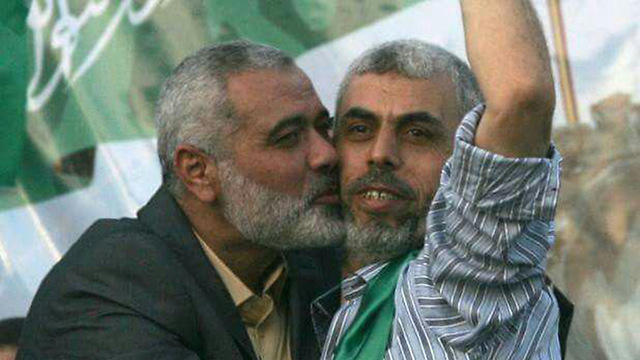
Sinwar is kissed in 2011 by the man (Haniyeh) he has replaced in 2017
[Image Source]
A Ynet profile today ["Hamas elects new radical leader in Gaza"] says Sinwar
is considered to be ascetic, strong, tough and the possessor of extreme discipline. He distances himself from the media, which accounts for one of the reasons why he is less well known in Israel, despite his key role in Hamas.
It's especially galling (to us at least) how this sociopath was released from behind Israeli bars five years ago with barely a mention of the risks his unwarranted freedom represented.

For instance: Israel Prison Service records, issued at the time the 1,027 Shalit Deal terrorists walked free and which we have filed away, indicate merely that Sinwar - named there as Yihia Ibrahim Hasan Al-Sinwar, יחיא סנואר אברהים חסן, prisoner ID 955266978 - was serving time for
הריגה ; אימונים בנשק ; פעילות חבלנית עוינת ; הסתה
Manslaughter; weapons training; hostile terrorist activity; incitement 
Mild language in the context. No hint, in other words, of the man's distinctive malevolence or leadership role. But today, with Sinwar free, unconstrained and ascendant, the expert assessments start to appear.

This one for example from the Associated Press piece we cited above:
Kobi Michael, a former head of the Palestinian Desk at Israel's Ministry for Strategic Affairs, said Sinwar represents "one of the most radical and extreme lines of Hamas." He described Sinwar as a "bitter enemy" of Egypt who is focused on building Hamas' military capabilities. "The idea that he was elected is a very dangerous and concerning indication of the destabilization of the region," Michael said.
New York Times backgrounder ["Hamas Appoints Hard-Line Militant as Gaza Leader"] quotes Israeli security experts saying Sinwar "had the status of prisoner No. 1" and that he was the "most senior prisoner released, and clearly destined for leadership".

A great pity Israelis weren't told any of this before the Shalit Deal went through and this man was set loose despite the four uncompleted life-terms to which he had been duly sentenced. The prison system surely had some assessments of this thug on its files. They knew him and what the price of letting him loose might entail.

Sinwar comes accompanied with a pair of loyal deputies who likewise are Shalit Deal graduates:
At Israel’s Nafha Prison, Sanwar created a circle of activists who were loyal to him. Two of them, who were released along with Sanwar, are now in key posts in the Hamas security apparatus. Ruhi Mushtaha is in charge of the prisoner portfolio and Tawfik Abu Naim heads the internal security apparatus in Gaza. [Haaretz]
As parents of a child whose murderers - several of them - walked free in the catastrophic Shalit transaction, we wonder when its tragic harvest will be more widely acknowledged. It represents a moment of massive misjudgment which, we fear, will haunt Israel and the Jewish people for years to come.

Some background reading: 
23-Jan-17: Another Shalit Deal outcome, another life sentence, another bereaved family13-Sep-16: Could Israel be about to release convicted terrorists in another deal? • 24-Dec-15: Another terror outrage narrowly averted - and Shalit Deal releasees are again at the heart of the darkness • 11-Dec-15: The price of the Shalit Deal and the countries that help it keep rising  • 27-Nov-15: Our daughter won't be with us today as we remember her birthday23-Aug-15: Do they understand the price of freeing the hunger-striking terrorists?Palestinians freed in Shalit deal killed 6 Israelis since 2014" [Times of Israel, July 20, 2015] • 20-Jul-15: Pausing for a moment to reflect on when we lost our collective senses19-Jul-15: Another catastrophic outcome of the 2011 Shalit Deal27-Nov-14: Hamas terrorist ring is busted; Israel says the handlers operate from Turkey; Qatar is involved • “Ten lessons the Shalit deal taught us”, Frimet Roth, Times of Israel, October 15, 201430-Sep-14: Martyrs and monsters11-Sep-14: Freeing terrorists: The price in human lives lost and in justice perverted keeps getting clearer11-Aug-14: Shalit Transaction revisited: At what point does facing up to the cost of a disastrous decision become unavoidable?23-Jun-14: Quietly, inexorably, almost entirely unreported, the lethal consequences of the Shalit Transaction grow4-May-14: Who cares about justice? About the victims? About truth?16-Apr-14: Capitulating to terrorism and lessons for a people in search of leaders18-Mar-14: Most don't understand what's so terribly wrong about freeing convicted terrorists before they complete their lawful prison sentences27-Jan-14: Finally, they're starting to quantify the outcomes of the Shalit Transaction22-Dec-13: Delving into how those prisoner releases worked out18-Oct-13: Two years after the mass release of killers and other terrorists, a cry of pain22-Sep-13: Quote of the week: A growing understanding of what the Shalit deal has actually cost us27-Aug-13: Justice devalued, lives demeaned, principles cheapened: the high price of freeing murderers25-Aug-13: Wake up call for those who thought the terrorists are walking free for peace27-Jul-13: To defeat the terrorists, what one thing must a government never do?21-Jul-13: In the debate over whether Israel should free convicted terrorists, one key argument is mostly ignored13-Jun-13: Little-known sides to the post-Shalit careers of unjustly released killers10-Dec-12: The Gilad Shalit transaction continues to haunt and endanger us18-Oct-12: The Shalit deal a year later - a personal reflection17-Oct-12: Yediot: "Dozens of terrorists released in Shalit deal arrested by Shin Bet during past year"10-Jun-12: "Prime Minister Netanyahu: Honor the principles of justice and decency on which our nation is based17-Apr-12: Turns out the terrorists freed for Shalit are still doing terrorism. Who would have thought it?19-Oct-11: Haaretz: Shalit prisoner swap marks 'colossal failure' for mother of Israeli bombing victim18-Oct-11: "The statistical likelihood of more murders in the wake of a mass release of terrorists... is a certainty"  • 18-Oct-11: Frimet Roth speaks about our daughter's murderer going free (audio)17-Oct-11: "The public has been given a false sense that there were no other options"17-Oct-11: Releasing terrorists: "The calculation is based on extortion"16-Oct-11: "Do not free my daughter's murderer" (Haaretz today)15-Oct-11: From today's NY Times: "This deal is a disaster"15-Oct-11: Video: The murderer of our child says: "I don't regret anything"20-Jul-11: How the media hijacked the campaign to free Gilad Shalit23-Nov-09: On freeing a monster22-Jul-08: The once and future child murderer