Showing posts with label Grief. Show all posts

Wednesday, September 11, 2019

11-Sep-19: Looking back into the dark

The oldest of our daughters holds the youngest. Malki ז"ל adored
Haya, her brain-damaged and blind little sister.
The Malki Foundation, which was created under the worst of all conceivable situations exactly eighteen years ago to the day, is more than just a charity for those of us who started it.

It's a living memorial to the life of a greatly-loved child who was murdered when, being Jewish and living in the capital city of the Jewish state, she was in a pizzeria with her best friend precisely when a human bomb planted by a deeply-bigoted agent of the Hamas terrorist organization - a woman of 21 called Ahlam Tamimi - walked in with an undetected explosives-and-nails-filled guitar case and pressed a detonator.

The precious lives lost in the carnage that followed are gone forever. Their memories remain among those who loved them.

Malki's memory is honored by work that goes on every day in a modest Jerusalem office from where meaningful, constructive, supportive activities enable families from every part of Israeli society to do things for their child with special needs that otherwise would very likely not happen.

It's a cause we're very, very proud to be connected with.

Unlike this blog and some of the things we do, the Malki Foundation's work has absolutely no political dimension. It's one hundred per cent about helping people based on their need; nothing else.

A letter received by Arnold Roth last week makes the point in a charming way:
You probably won't remember me - that's okay :). But we traded a couple emails a couple years ago when Ahed Tamimi was arrested. I got offended by something you posted online etc. It was a cordial exchange - we even hoped to tag up in Jerusalem but I haven't made it back there yet - but we strongly disagreed with each other. And we probably still do.
However, I have often thought of this incident and honestly, I think my reaction was wrong. I was never a big donor to the Malki Foundation (I'm not wealthy, just a working stiff) but I realize I should have never stopped giving because of that reason. You do good work with those in need of that type of care. So, I want to apologize to you. We can disagree on politics but a good work is a good work.
I actually tried to make a small donation a couple weeks ago but I guess your site is being revamped. I'll give it another go next month. Still not wealthy so donations will be small but hey, it all counts, right? I hope you will accept my apology. Keep up the good work.
When we conceived of the Malki Foundation, sitting on the floor of our home in Jerusalem late at night after all the friends and strangers who had filled our apartment had left on one of the seven days of mourning, our heads were filled with the horror of what hatred can do to people.

It seemed to us that the world had reached one of its lowest points.

Then, on the morning that the registration papers for the new charity - Keren Malki, Hebrew for Malki Foundation - were issued by Israel's registrar of not-for-profits, a more optimistic sense emerged: with this new creation, a legal entity with a mission, we're going to do some good things for people who need more good in their lives.

Then a few hours later the sky fell again. The date was September 11, 2001, nine-eleven.

In very large measure, our conviction is the world, its leaders, many of its most thoughtful people, haven't come close to grasping what terrorism is, what it does to lives, to society, to the values that enable us to live together. What we ought to be doing is, at best, imperfectly understood and perhaps a lot worse than that.

One thing though is clear to us from our experience: that responding to the chaos and deep pain by helping others has value, not just in what it does for others but for how it helps to heal and improve us.

Monday, August 12, 2019

12-Aug-19: The pain of a child's murder: A burden of grief and injustice

Malki Z"L was deeply devoted to her blind and profoundly
disabled youngest sister
It appears that the pain of a child's murder is so inconceivable in our society that it is down-played. Swept under the carpet.

Frimet Roth | This op ed was originally published on the Israel National News website, August 8, 2019

I don't mention my murdered child, Malki, often.

Over the eighteen years since the terror bombing at Jerusalem's Sbarro pizzeria, I have learned that most people are bored, disconcerted or annoyed by my dredging up that "ancient incident".

Closure, moving on, forgiving are the trendiest notions circulating in the world of grief.

A few years back, my husband, who had just delivered a talk about terrorism in his hometown, Melbourne, overheard an old acquaintance gripe about him. "Hasn’t he gotten over that yet?"

I recall a CNN journalist reporting about a tragic mass shooting in the US involving children, commenting "The families of the victims certainly have several tough weeks ahead of them."

Weeks? Make that lives.

It appears that the pain of a child's murder is so inconceivable in our society that it is down-played. Swept under the carpet.

I vividly recall the silky feel of my Malki's hair, the way we swam the crawl together holding hands, the way we always walked up the ramp to our car arm in arm, the tears of pride I would shed whenever I heard her play the flute in a concert.

Her smile as she walked through our front door was infectious.

Her concern for anyone with disabilities was incomparable and unique for a teen. It was expressed not by vacuous words of compassion but rather active involvement with them.

Malki sought out places to volunteer as a caregiver even to the most profoundly affected children.

That included her youngest sibling Chaya who suffers from a rare genetic illness that includes severe epilepsy and blindness. Malki’s tenderness and devotion to her were incomparable.

And I remember the last time I heard her voice; she phoned me an hour before her life ended and we closed always, with the words “I love you.”

For the past eight years, our grief has been exacerbated by anger over injustice. The mastermind of that terror bombing, a Jordanian terrorist called Ahlam Tamimi, sentenced to 16 life terms in an Israeli court, was freed in the 2001 Shalit Deal.

She was “exiled” to her home – Amman – where she was reunited with her family. Some exile.

On March 14, 2017, the US Department of Justice unsealed charges against Tamimi and said it was requiring the Jordanian regime to extradite her to Washington. This was due to Malki and two other victims of that attack being US citizens.
But Jordan’s King Abdullah II has provided Tamimi with refuge, refusing to abide by his kingdom’s 1995 extradition treaty with the US.

My husband and I have asked that US officials pressure the king to hand over the monster he is protecting. Instead, the current US administration fetes him and his family, receives him in the White House as an honored guest, lavishes his shaky kingdom with massive cash gifts and other support.

The terror attack on Sbarro was unique in several ways.

One family was nearly decimated: a mother, father and three of their eight children perished.
Another couple lost their one and only child along with the baby she was carrying who would have been their first grandchild. I visit that bereft mother regularly as she now faces myriad health crises, confined to a wheelchair.

Sbarro is also unique in that Tamimi boasts to this day of “her operation". She has described in televised interviews how she scoured Jerusalem's city center for the perfect target - one that would be filled with women and children.

For years she hosted a weekly program beamed from Amman to viewers throughout the Arab world on Hamas' Al Quds TV station.

She smiled joyfully when she learned that her 15 victims included 8 children, not the mere three she claimed to believe.

She has been a constant presence on Facebook, Instagram and Twitter where she incites her fans to follow her example. She is undeniably the incarnation of evil.

And yet she is safe, free and raising a family. Every day of this reality is another stab in our hearts.

This week, grieving Americans were assured by Federal authorities that the El Paso shooter who murdered 22 innocent victims would be deemed a terrorist. He would receive “swift and certain justice.”

The victims of terrorist Tamimi are still waiting for that.

Frimet Roth's daughter, Malki, was murdered in the Sbarro terrorist attack at the age of fifteen. She had gone to enjoy a summer vacation pizza with her friend Michal Raziel, who was killed with her. Frimet is a freelance writer. She and her husband live in Jerusalem with their family. More from the author ►

Thursday, September 01, 2016

01-Sep-16: Getting back to blogging

From a few months ago [Twitter]. The Auschwitz survivor, a beloved
member of our family, passed away ten days ago
This blog tends not be very revealing of our private lives, other than in relation to the matter of terrorism as it has impacted us and how it stole the precious life of our daughter.

But since a few readers have been concerned enough to ask why no update for the past few days, we will mention the death of a parent of one of us and the seven day shiva period that Jewish tradition grants to the mourners, followed shortly after by the birth of a grandchild.

Life's like that, right?

We're now getting back to blogging, and look forward to hearing your comments and responses.

Thursday, November 23, 2006

23-Nov-06: Israel Under Fire - Only You'd Never Figure That Out From The Reports

For far, far too long, the media have reported the daily bombardments of southern Israel - if they have reported on them at all - as being attacks on Sderot.

Since most Israelis have never visited Sderot, and most non-Israelis don't have a clue where Sderot is or what it looks like, this has serious implications.

It amounts to a total delegitimization of the suffering of ordinary Israelis in the face of the extraordinary ongoing war waged by the Palestinian government against Israel and Israelis.

Even within Israel, there's a reluctance to face up to the true implications. After all, it's only Sderot under attack. We can tolerate that, but just don't let those Arabs dare to attack our centre, our cities, our whatever.

The fact is - it's Israel under attack, not (only) Sderot. It's Israelis under attack, and the intention is to cause civilian deaths and injury. There is no strategic plan beyond this, because civilian deaths and injury are enough when you're a terrorist. In fact, they are the whole purpose.

An analogy that comes to mind is an American administration saying to its people: "Never mind, the enemy have only attacked far-off Pearl Harbour. We don't really need to let this ruin our parade."

The Palestinian Arabs don't hide what they're doing. They don't deny it. They do however rely on the in-built apathy of people living far from where the rockets fall to allow them to get on with their barbarism. That apathy costs lives.

The headline-writers, and the policy makers as well, are playing into the hands of the terrorists.

The unusually sensitive article below comes from today's Haaretz.

As officials stay away from funeral of eighth Qassam victim, relatives ask: 'Why doesn't anyone visit us?'
By Mijal Grinberg

The only public figure from City Hall, the Knesset or the government who attended the funeral of Sderot Qassam victim Yaakov Yaakobov yesterday was Yisrael Beiteinu MK Robert Ilatov. Municipal officials say they didn't attend because intermediaries asked them not to. Yaakobov's sister-in-law, Zilpa, denies such a request was made, saying the pain is too great for anyone to have asked.

All day Tuesday, the family, immigrants from the Caucasus, maintained a vigil by Yaakobov's bedside in Soroka's intensive care unit. Throughout the day, relatives repeated the question "Why doesn't anyone come to us? From City Hall? The government?"

"If he were Moroccan, they would be here," Yaakobov's son said through his tears, summarizing the sense that no one cares.

8:20 A.M.. School buses pick kids up all over town, a rocket lands in the parking lot of Sderot's Gil elementary school, slightly damaging the building. A few shock victims are evacuated a little later. Teachers union chair David Manzur was on a previously scheduled visit to the site. "I don't think the state knows what's going on here," he says.

10:30 A.M.. Two people are standing at the entrance to the Off Kor meat-packing plant, looking at the site of yesterday's rocket strike. "Poor things," one mumbles. "Lost friend," another sighs. Few of Yaakobov's friends speak Hebrew. They sweep the floor quietly, everything around them is burnt. They try to wash down the area with a hose. Shift boss Meir Kakoun mumbles, "Everything is from God, from the heavens."

11:00 A.M.. On the quad at Sapir College, the students organize a protest. It is difficult for them to explain what they are protesting. Many are wearing red shirts, a reference to the "Color Red" alert sounded when a Qassam is fired. The shirts say, "The South is Israel too." They want someone to recognize their distress, as well as reinforce buildings at the college and provide counseling.

Sapir has students from a variety of ethnic and religious backgrounds. Among the organizers of the demonstration are Ethiopians and Russians, united under the color red. Bedouin student Hanni takes the stage to speak. "We hear the cries and pain of women and children on both sides every day. We want a solution of peace and hope." His words are greeted by applause. Every once in a while, people look toward the sky. This many people together is a little scary. The demonstration ends with a reading from Psalms and singing of the national anthem, as well as a promise to continue to organize and take action.

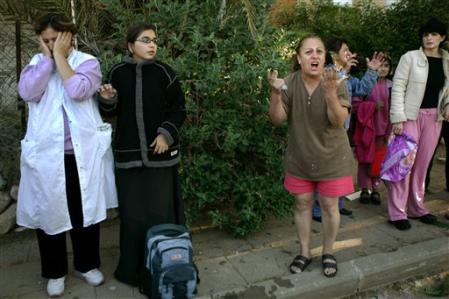
1 P.M. The Sderot cemetery is crowded already, mostly with immigrants from the Caucasus. Almost no one speaks Hebrew and the only words that are understandable are "Olmert" and "Peretz," which are accompanied by angry faces and sharp hand gestures. The women congregate on one side and the men on the other. The women's cries shatter the air; someone pours water on them to calm them.

The unassuming Ilatov is the only official in attendance. The rabbi addresses the crowd in Hebrew. "We are the fourth-largest arms dealer in the world," he tells them. "And what good does that do us?" The body is taken away and the heart-wrenching cries grow louder. Yaakobov's wife Purim falls on the ground and is taken away in an ambulance. She's not the first.

Downtown, between the big candy store and Itzik's falafel stand, there are huge black puddles on the sidewalk, the remnants of yesterday's burning tires. Yesterday, local business owners were furious. "[Arcadi] Gaydamak ruined our livelihoods," they yelled, about all the people who left town and lowered their turnover. When the police arrested two of them for the tire burning, the demonstration came to a quick end. The evening bar mitzvah, which had received a great deal of media coverage, calmed matters down. "Arcadi called," celebrant Itzik recounted. "He said he would take all the kids to Eilat, the saint."

The Yaakobov family had already begun the mourning preparations specific to their ethnicity. Long white tables are spread out and set up. Everyone comes to provide support to the mourners.

"It is important to hold those who suffer and not let go," they explain. "This is why the community is strong." They don't hide the pain of their feeling of abandonment, however. "Why could all the Knesset members come here yesterday for the bar mitzvah, but they can't come for us?" they ask.