Showing posts with label COGAT. Show all posts

Thursday, April 30, 2015

30-Apr-15: What Gaza's oppressed know that reporters don't, and why it matters

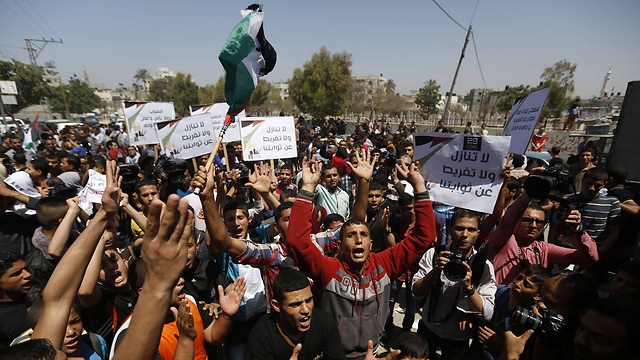
Anti-Hamas protest in Gaza yesterday [Image Source]
Little reported news from Gaza today via Agence France Presse
Hamas police beat, arrest protesters at Gaza rally | GAZA CITY (PALESTINIAN TERRITORIES) (AFP) - Police in the Hamas-run Gaza Strip beat and arrested protesters on Wednesday at a youth rally in the north of the besieged Palestinian territory, an AFP correspondent said. More than 400 demonstrators gathered in Shejaiya, a neighbourhood in eastern Gaza City that was razed during a July-August war between Hamas and Israel, urging reconstruction and calling for an end to intra-Palestinian division. Plainclothes police officers entered the crowd, beating a number of protesters without causing serious injury, the AFP correspondent said. They then arrested at least seven people, according to witnesses. The Hamas-run interior ministry said in a statement that the crowd had grown violent, forcing police to intervene "to protect the lives of those participating, after which calm prevailed"... With Hamas continuing to control Gaza, Israel has left in place its eight-year blockade, which has largely banned the import of building materials, fearing they could be used by militants to make weapons... Reconstruction of homes has barely begun...
There's a similar report in the New York Times today [here], with a similar degree of superficiality and spin.

We don't claim to have any direct sources in Gaza where a miserable population struggles to keep families together under the Islamist jackboot of the Hamas regime. But it does appear we know more than the AFP editors and their reporters. Or maybe we are just more honest. For instance:
  • Not a word in this AFP piece about the colossal investment of construction materials, in particular cement, that went into the construction of Gaza's city-beneath-the-city of attack tunnels, largely but not completely neutralized by Israeli military action this past summer, and by Egypt more recently. 
  • Hamas bleated for years to gullible foreign reporters about Israel preventing imports and exports. In reality they were diverting vast resources away from their people's needs and into the bottomless pit of their war-mongering capability. COGAT, an arm of Israel's Ministry of Defense, routinely reports on truck loads (by the hundreds daily) of goods entering and leaving Gaza, including construction materials. That information gets routinely ignored in news stories covering life in Hamas-controlled Gaza.
  • We learned, when visiting Kerem Shalom two and a half years ago ["2-Oct-12: Gaza and the perils of Arab solidarity"], that on a daily basis, many truck-loads - sometimes hundreds of them at a time - get approved by Israel after being requested by the Gazan side and then simply fail to show up. The entire import/export enterprise affecting Gaza is routinely manipulated by its Hamas masters.
  • Hamas has a proven history, starting with the intra-Palestinian blood-letting that brought it to power in 2007, of dumping its own people at the very bottom of its strategic priorities. For all practical purposes, that means 1.8 million men, women and especially children held hostage to a grand Islamist/Moslem Brotherhood plan. That plan seeks to overcome Israel's material advantages by (appallingly) creating a pool of strategic misery - self-inflicted and exceptionally cruel - with the goal of achieving victory in actual war by sacrificing its own people, with a cold-blooded focus on children. That history is well-known, of course, to the Gazans. It's why they knowingly took to the streets to protest this week. A pity the reporters failed to mention it. Is this self-censorship or ignorance? It hardly matters. The result is the same.
  • While new housing gets shoved aside by the Gazan leadership despite the desperate need, tunnel construction - involving steel, cement, electricity infrastructure - is proceeding at full speed [see some of the evidence here] with virtually unlimited access to the very resources that Gaza's ordinary people don't get to see. 
Egyptian soldiers seize control of a Gazan tunnel in this
November 2014 news photo [Image Source]
In case there's any doubt about that last point, here is what has been happening in Gaza's underground empire just this week, from Palestinian Arab news sources Albawaba and Maan:
  • "A Palestinian worker died on Monday when a tunnel collapsed in the southern Gaza city of Rafah, a health official said. A Ministry of Health spokesperson Ashraf al-Qidra told Ma'an that Muhammad Khalid al-Najjar, 27, was killed in the incident. His body has been taken to the Abu Youssef al-Najjar hospital..."
  • "Last week, Ahmad Majed Salim al-Saqqa, 19, from Khan Younis died after he was electrocuted in a tunnel beneath Rafah,.. "
  • "[A]nother Palestinian from Khan Younis, Ibrahim Fathi Isleih, 21, died a week before in similar circumstances."
But Gaza is impoverished, right? And lacking basic construction items, correct? How can Hamas possibly get its hands on what's needed and fund the huge investment required by those tunnels and the supporting infrastructure? The Telegraph UK knows:
Iran 'is intensifying efforts to support Hamas in Gaza' | Iran has transferred tens of millions of dollars to Hamas's military wing in Gaza to help it rebuild after last summer's conflict with Israel, intelligence sources state | April 4, 2015 | Iran has sent Hamas’s military wing tens of millions of dollars to help it rebuild the network of tunnels in Gaza destroyed by Israel’s invasion last summer, intelligence sources have told The Sunday Telegraph. It is also funding new missile supplies to replenish stocks used to bombard residential neighbourhoods in Israel during the war... Iran has sponsored Hamas’s military operations for years, despite the contradiction that Hamas is part of the worldwide, Sunni-supremacist Muslim Brotherhood, while Iran is Shia... [The Telegraph UK, April 4, 2015]
Oddly, none of this background found its way into the AFP/France24 report. Might this be connected to the way Gaza's misery is a function of what Gaza's powerful insiders (most of whom live far from Gaza) decide to approve and to refuse? Gazans know (and are prepared to get beaten in the streets for it), even if the news people don't.

Sunday, November 23, 2014

23-Nov-14: Who cares about rebuilding Gazan lives?

Kerem Shalom crossing seen from the Israeli side, August 2014
More than an ordinary stream of trucks; a lifeline [Image Source]
If you have not already seen our post from earlier today (including video) of Hamas trumpeting the tunnels they are busy digging and/or repairing in order to murder more Jews ["23-Nov-14: Gaza's wealth and where it is - and is not - going"], please do that before reading on. It's at the top of the list of messages Hamas is delivering to its captive population and the larger Arabic-speaking world.

Back? OK, so if it's not the thugs of Hamas (and it is surely not), who is taking seriously the need of the Palestinian Arab Gazans for repaired houses and a better life? From the Jerusalem Post:
Under an arrangement reached last month to ensure that building materials needed to rebuild the thousands of homes destroyed in the seven-week Operation Protective Edge are not diverted to build terror tunnels or manufacture rockets, the UN is to present Israeli engineers with construction plans, and the engineers will determine how much cement is needed. That cement then will be allowed into Gaza in stages, to enable inspection to ensure that it is being used for the designated purpose. If it is determined that the cement is being stolen and used for other purposes, the supply will stop. A recent assessment conducted by the UN found that more than 100,000 homes in Gaza remained damaged or destroyed. The first batch of construction materials since the Gaza military operation in the summer entered the Strip from Israel in September... ["25,000 Gazans to get access to construction materials to rebuild homes", jpost.com, November 22, 2014]
Keep in mind the mentality of the parties concerned.
  • Israel fights the Hamas regime because of the jihadists' rockets, terror tunnels and single-minded desire to kill as many of us as possible. The fight that it fights can, given the circumstances, be devastating. (It's hard for us to see the logic of Israel doing less than that.) But at the same time, and with essentially the same goal in mind, Israel permits a steady flow of goods, services and electrical energy to traverse its roads and borders even while the Gazans are firing rockets into Israeli towns. Israeli repair crews, for instance (among many instances) risked their lives worked on fixing the high-voltage cables running into Gaza [see report] even while those Gazan rockets were being fired at them in August. Those cables had been put out of action by Hamas/Islamic Jihad Gazan rocket fire.
  • The Hamas inner circle systematically fails to provide anything close to a livable environment for the people they dominate. They consistently point to other parties (always other parties) who they say are responsible for almost everything, even including Gaza's own security. But - and this is mostly unknown to the Gazans themselves - when their own wives, children and close family members need the best possible, most conscientious and professional medical care, to which Zionist entity do they run (with not the slightest sign of embarrassment)?
Who cares about rebuilding Gazan houses and lives? Who cares about the Gazans?

According to the most recent daily report filed by the people at COGAT, Israel supervised the entry across its Gazan border of 1,014 people that day (last Monday), as well as the entry of 274 trucks carrying 7,335 tons of goods for the people of Gaza. An additional 94 semi-trailers that had been authorized and scheduled by the Israeli side (this has consistently happened over the years, as we know from visiting the crossings) simply did not show up. Requests for a entry/crossing permit from the Israelis is seen by the Hamas side as part of a war strategy, and dealt with accordingly, consequences be damned. Some 600 kg of Gazan fish were trucked through Israel to the towns of the Palestinian Authority the same day.

And there is some additional somewhat startling background, here: "Egypt tightens closure on Gaza as Israel eases it" [Ynet, yesterday].

A strange form of warfare, no? But it tells a reasonable person something about the relative values of the human societies on the two sides.

Sunday, November 02, 2014

02-Nov-14: In Gaza, puzzlement all over again

Essential goods cross over from Israel to the Gaza Strip
in August 2014 [Image Source]
In Gaza, they're evidently at a complete loss to explain some recent developments:
ISRAEL CLOSES TWO GAZA CROSSINGS WITHOUT MENTIONING ANY REASON | Israel will on Sunday close down Gaza's only functioning two crossings, namely Kerem Shalom and Erez. Israeli authorities had told the Palestinian side that they would close down Kerem Shalom, Gaza's only functioning commercial crossing, on Sunday, even without mentioning any reasons, Mounir al-Ghalban, the head of the Palestinian side of the crossing, told Anadolu Agency. He added that Israeli authorities did not mention a date for reopening the crossing, warning against the effect of the crossing closure on Gaza's foodstuff supplies. Israeli authorities will also close down Erez Crossing in northern Gaza, al-Ghalban said. He added that only Palestinians on emergency would be allowed to cross between the Gaza Strip and the occupied West Bank through the crossing. [Daily Sabah (a Turkish publication), yesterday]
No reasons? We can help. Here's a little fresh background via Ynet:
Gaza cut off from the world as Israel, Egypt close border crossings | Ynet - Saturday | The Gaza Strip will be completed isolated from the world starting Sunday after Israel decided to close both the Kerem Shalom and Erez border crossings and Egypt has accelerated its plans to create a buffer zone on the Sinai-Gaza border. According to the Arabic Sky News channel, the evacuation of the border area to create a buffer zone was sped up after satellite images showed hundreds of tunnels remaining in the area, even after an intense Egyptian campaign to eliminate them.
While the Egyptian army has managed to destroy 1,500 smuggling tunnels, satellite images exposed hundreds of additional tunnels - some in Rafah mosques, bedrooms and shops. The establishment of a buffer zone in Rafah - a strip of land 14km long and half a kilometer wide - started following a terrorist attack in Sinai that led to the death of 33 Egyptian soldiers. The army began its work on the buffer zone by quickly evacuating and destroying 800 homes, compensating the residents... The Qatari TV network affiliated with the Muslim Brotherhood quoted residents and activists who claimed this was the "Egyptian equivalent of the Nakba in '48." Egyptian state media, on the other hand, focused on the citizen's understanding of the operation. Al-Aharam newspaper wrote that evacuated residents were "standing by the state after the terrorists made their lives hell." The rocket fire from Gaza to Israel on Friday is viewed by Israel as the first blatant violation of the ceasefire by Hamas. It led to the decision to close both of the border crossings from Israel to Gaza - Kerem Shalom at the south of the Strip, used to transfer goods, and Erez in the north of the Strip, through which people pass - as a way of pressing Hamas and making it clear to Gazans what is the price of rocket fire.
Kerem Shalom a year ago: trucks laden with goods for
Gaza, lined up and waiting to be received [Image Source]
A pity Daily Sabah doesn't keep its readers more updated on the strategic value of Kerem Shalom to the long-suffering ordinary people of the Hamas-dominated Gaza Strip. They might for instance have shared this story with them: "First trucks with reconstruction supplies enter Gaza" [Times of Israel, October 14, 2014]. Or this, if they prefer a Palestinian media source: "Reconstruction material enters Gaza via Kerem Shalom" [Ma'an News Agency, October 30, 2014]. Then again, if they did give proper coverage of what outsiders like the Israelis wish they could do more of for the Gazans, they might have to include a line like this one:
"On the Gaza side of the Kerem Shalom crossing, PA and UN officials are overseeing the shipments to ensure they do not fall into the hands of Hamas, the IDF’s Coordination of Government Activities in the Territories said." [Times of Israel]
Or this explanation from Associated Press:
"The United Nations, in turn, devised a system under which Israel would gradually ease a ban on selling building materials to Gaza, with U.N. monitors keeping track of shipments in Gaza to make sure they are not diverted by Hamas for military use." [AP, October 22, 2014]
So Hamas is meant to get none of the incoming materials. They are intended for the Gazan people. Comprehending this might take the Daily Sabah people and their readers some way towards understanding why (a) the thugs of Hamas have no problem firing more rockets into Israel, and (b) Israel wants Gazans to understand that Israel-bound rockets fired by Hamas rocket-men from the alleys where they live come at a price.

Thursday, August 01, 2013

1-Aug-13: Escalating troubles in Sinai and Gaza: Is it still news if Israel can't be blamed?

Rafah, near Gaza's border with Egypt: Each of the tents and
canopies covers a tunnel mouth [Image Source: Majed Abusalama]
Linda Gradstein, writing for The Media Line (and Ynet) describes a steadily growing shortage of fuel in the Gaza Strip, with serious and visible consequences. A Gazan economist she quotes says only about 25 percent of the required level of fuel is now available, and cars are lining up for hours at gas stations. Sewage treatment plants have been shut down, with untreated effluent being dumped into the Mediterranean. Naturally, this - along with the ecological mess it causes - is going to be blamed on the Israelis.

But in reality the cause is Egypt and Hamas.

Gradstein says the Egyptians have shut down 80 percent of the tunnels, numbering in the hundreds, that run between Egypt and Gaza. An extensive security crackdown waged by the transitional Egyptian government is underway right now. It's directed at the Sinai-based gunmen and terrorists about whom we have written here frequently.

But, and this is new, it's also directed at Hamas, whom the new Egyptian rulers accuse of conspiring with the overthrown Morsi government to carry out attacks on Egyptian soldiers and police in Sinai.

The Egyptians say the weapons for those attacks come through the tunnels and the perpetrators can flee into the safety of Hamas-controlled Gaza. hence the crackdown. And Israel? Listen to this:
Israel is making every possible effort in order to enable the transfer of goods into the Gaza Strip given the current policy,” Guy Inbar, the spokesman for the Coordinator for Government Activities in the Territories (COGAT). "We emphasize that Israel does not limit the amount of goods transferred to Gaza and that the Kerem Shalom crossing has yet to reach its maximum capacity. As for today, it is possible to transfer 400 trucks every day, but the demand from Gaza is lower, and on an average day we receive requests for about 300 trucks.” Inbar said that in the last three weeks, 165 fuel tankers have passed via Kerem Shalom at the request of the Palestinians from Gaza.
We visited the crossings last summer and heard the same analysis.

Israeli sources quoted by Gradstein say Israeli fuel is three times more expensive than Egyptian, so sharp price increases are expected. Cement and other construction materials are also in short supply now, and the large and heavily publicized Qatar-funded building projects are currently on ice.

In an Al-Monitor piece on the Egypt/Hamas tensions ["The Silence on Gaza"], Shlomi Eldar looks closely at Gaza's problems and predicts worse ahead:
If, until recently, it seemed to the leaders of Hamas both in Gaza and on the outside that after seven years of a suffocating siege, all their troubles were about to disappear, they are now seeing their world turning against them... [Recently] the skies came crashing down on them. Egyptian President Mohammed Morsi, a member of the Muslim Brotherhood, was deposed, and Hamas was pilloried along with him. Egypt’s new regime considers Hamas an enemy. The Egyptian army has launched a far-reaching offensive in the Sinai, and is waging a war of annihilation against the subterranean network of smuggling tunnels in Rafah, which were the main source of food and raw materials for the Gaza Strip. The light they saw at the end of the tunnel just a few months ago went out in a flicker. The markets emptied of goods, gasoline for automobiles has just about run out, and emergency stockpiles of gasoline and diesel fuel are running very low as well. The electricity is turned off every few hours, hospitals report that there is a shortage of drugs, and even cigarettes have vanished from the shops. Right now Gaza is going backward six or seven years to a situation in which it is hermetically sealed off, almost as it was after the Hamas military coup of June 2007. [Eldar]
Eldar thinks it's astonishing that Gaza's growing problems are triggering so little responsiveness among the circle of Hamas-friendly parties in the area.
  • "Why isn’t the Al Jazeera network heard broadcasting from the Gaza Strip encouraging the local residents to take to the streets en masse, to tear down the wall around Rafah and burst into the Sinai?" asks Eldar.
  • And the recently installed emir of Qatar, Gaza's recent hero, has he gotten lost? From Qatar, there is not "a word of condemnation directed at the new military and civilian leadership in Egypt", says Eldar.
  • After all the reports in recent months that Turkey's prime minister Recep Tayyip Erdogan, "the self-appointed patron of Gaza" was going to be visiting Gaza, it's now off the agenda. Turkey is no longer threatening to send its warships to sail alongside "aid" flotillas as they try to break through Israel’s maritime siege.
  • The organizers of the bloody 2010 Turkish flotilla that included the Mavi Marmara, are silent. Nowhere to be seen. Eldar asks: "Isn’t this the perfect time to get the boat ready for another voyage? Isn’t this the right moment to recruit volunteers from Lebanon, Syria, Turkey and the Gulf States to load crates of food and medicine on deck, so that they can be delivered to the people of Gaza, who are under siege?" But they're not coming.
  • Nobel Peace Prize laureate Mairead Maguire, who sailed on board the yacht sponsored by the group “Free Gaza” is missing in action. Doing nothing. Saying nothing.
The answer, says Eldar, is obvious
This time there is no way to accuse Israel, because it is not involved in the injustice. These days, Israel barely imposes any restrictions whatsoever on the import of foodstuffs, clothing, and raw materials into the Gaza Strip. It is engaged in economic cooperation with Hamas, based on the transfer of goods through the Kerem Shalom border crossing. The real issue is that Hamas preferred to rely on the smuggling tunnels in Rafah, so as not to create a dependence on Israel.
Those smuggling tunnels, by the way, were not only Hamas' preferred option. They were central to the economic well-being of the fast-rising Gazan select nouveau riche, the favoured of Hamas society. And if they are being systematically shut down and destroyed by Egypt, this has implications. Khaled Abu Toameh, an Arab Israeli journalist whose writings we quote here often said something prescient a year ago:
If the Egyptian army succeeds in demolishing the underground smuggling tunnels that keep Hamas running, it could mark the end of the Islamists' rule over the Gaza Strip. But if Egypt's new president, Mohamed Morsi and the Muslim Brotherhood tie the hands of the Egyptian army's generals and keep them from completing the mission, Hamas will become even stronger and wealthier. [Khaled Abu Toameh, Gatestone Institute Website, August 30, 2012]
His article is entitled "How Many Millionaires Live in the "Impoverished" Gaza Strip?". Since he's referring to the place that parts of the media routinely call a concentration camp, how does he answer?:
According to an investigative report published in the pan-Arab newspaper Asharq Al-Awsat, there are at least 600 millionaires living in the Gaza Strip... The Palestinian millionaires, according to the report, have made their wealth thanks to the hundreds of underground tunnels along the border between the Gaza Strip and Egypt. Informed Palestinian sources revealed that every day, in addition to weapons, thousands of tons of fuel, medicine, various types of merchandise, vehicles, electrical appliances, drugs, medicine and cigarettes are smuggled into the Gaza Strip through more than 400 tunnels. A former Sudanese government official who visited the Gaza Strip lately was quoted as saying that he found basic goods that were not available in Sudan... Palestinians estimate that 25% of the Hamas government's budget comes from taxes imposed on the owners of the underground tunnels. For example, Hamas has imposed a 25% tax and a $2000 fee on every car that is smuggled into the Gaza Strip. Hamas also charges $15 dollars for each ton of cement, eight cents for a pack of cigarettes and 50 cents for each liter of fuel smuggled through the tunnels. [Khaled Abu Toameh]
The chaos in Sinai is exacting a rising toll in blood. A Turkish news agency says, in a story filed from El Arish today, that
At least 42 people, including civilians and security personnel, have been killed in a spate of militant attacks in Egypt's Sinai Peninsula since July 5, two days after the army ousted elected President Mohamed Morsi, according to a tally compiled by Anadolu Agency. One soldier was killed and another one wounded on Thursday (today) in an attack by gunmen on a security checkpoint in the North Sinai city of Arish.
Al-Masry Al-Youm, an Egyptian news source, today quotes an un-named "security source" saying that interrogations of those arrested in Sinai in the last few days
have proven that there are ties between the extremists in Sinai and foreign intelligence bodies. The same source told Al-Masry Al-Youm that the investigation carried out by the general and military intelligence bodies has shown that the extremists have ties to elements in Afghanistan and Pakistan, as well as in Gaza... Approximately half of the extremists in Sinai entered Egypt during the rule of ousted President Mohamed Morsy.
All in all, it's unlikely the violence in Sinai and the turmoil in Gaza are going to end quickly though we confess to wondering (despite the fingers pointed at Afghanistan, Pakistan and the Hamas regime) how long before it's all blamed on our side again.

Wednesday, March 06, 2013

6-Mar-13: The goods crossing on Israel's Gaza border: A postscript from a Palestinian Arab source

Steel for building construction makes its way from Israel to Gaza.
We snapped this picture at Kerem Shalom six months ago.
While we await a clearer view of what has been happening at the Kerem Shalom crossing on Israel's Gaza border, here is a Palestinian Arab update from a non-Hamas source:
Israel reopens Gaza crossing  | Maan News | Published March 5, 2013 at 22:22 | GAZA CITY (Ma'an) - Israeli forces reopened the Kerem Shalom commercial crossing with Gaza on Tuesday, after a week-long closure, a Palestinian official said. Palestinian Authority official Raed Fattouh told Ma'an that the crossing will operate regularly on Tuesday, with 390 truckloads of goods set to enter Gaza and one truck of flowers to leave. Israel closed the commercial crossing last Tuesday after a rocket was fired from Gaza toward Ashkelon in southern Israel, but agreed to reopen it Monday. A dispute between Hamas and the company operating the crossing further delayed its opening. Officials in Gaza told Ma'an that Hamas dismissed the company in charge of the terminal after a dispute over the collection of customs revenue. The officials told Ma'an that Hamas wants to keep the taxes, which are usually paid to the Fatah-led Palestinian Authority in the West Bank. Truck drivers at Kerem Shalom told Ma'an that rivalries over control of the crossing were impeding their work.
For background see our post from yesterday: "4-Mar-13: Trucks filled with food and essential goods are lined up outside Gaza. Would it surprise you to know the role that money plays in this?"

The terrorist leadership of Gaza's branch of the Moslem Brotherhood gains literally nothing from a situation in which its people have interrupted access to food, water and electricity. So the bottom line is that for now, hundreds more goods-laden trucks on a daily basis will continue to roll into Hamas-controlled Gaza, providing the residents there with the means to stay alive but only until the next Hamas-engineered interruption.

Monday, March 04, 2013

4-Mar-13: Trucks filled with food and essential goods are lined up outside Gaza. Would it surprise you to know the role that money plays in this?

Some months ago we snapped this shot of a small forest of state-of-the-art refrigerators at Kerem Shalom,
awaiting trans-shipment into the 'open concentration-camp' Gaza Strip
The Gaza Strip, tightly ruled by the terrorist Hamas organization for the past seven years, depends on the import of a wide range of goods for its existence. 

Hamas has invested close to zero in economic infrastructure and means of production for reasons that are obvious to people who understand what terrorist organizations exist to do. Thus, since Gaza no longer has an airport (see "Gaza airport destroyed by scavengers"), imported goods arrive via three land routes: (a) the border-crossing with Israel, (b) the border-crossing with Egypt and (c) a vast network of tunnels from Egyptian Sinai.

The sole crossing for the goods that pass in both directions between Gaza and Israel is Kerem Shalom, the 'Vineyard of Peace'. But it's not especially peaceful. 

This is where, in June 2006, infiltrators from Gaza tunneled under the border and attacked an IDF patrol, killing two soldiers, wounding three others, and kidnapping Gilad Shalit whom they then illegally and cruelly held hostage for five years. Last August (2012), armed terrorists ambushed an Egyptian military base in Sinai close to Kerem Shalom, killed 16 Egyptian soldiers there and commandeered two Egyptian armored cars with which they forced their way across the border into Israel via Kerem Shalom. In the ensuing firefight with an IDF contingent, six of those attackers were killed and, fortunately, all the Israelis were uninjured.

A measure of the important role Kerem Shalom plays in the life of Gaza is that, during 2012, an average of 250 filled truckloads of goods passed through en route to the Gaza Strip daily according to Wikipedia (though the IDF says 300). 

For the past six days, Kerem Shalom has been closed. This was Israel's non-violent response to last week's rocket attack on Ashkelon [see "3-Mar-13: The terrorists of Gaza keep trying to destroy the electric power station that feeds them"] as well as to a sniper attack on Friday in which the personal military vehicle of the Gaza Division's Northern Brigade was hit. Then yesterday (Sunday) the head of COGAT said Kerem Shalom, as well as the Rafah Crossing which is for people, not goods, would re-open on Monday morning i.e. today. COGAT is a key IDF unit that is responsible for responsible for implementing the Israeli government's policies in Judea, and Samaria and in relation to Hamas-controlled Gaza 

But Kerem Shalom did not open this morning and the reason throws some light on how Hamas operates. 

As Haaretz reports today (see "Israel accuses Hamas of keeping Gaza crossing shut"), 65 fully-laden trucks (but COGAT says 70) pulled up on the Israeli side of the border this morning but found that the Palestinian Arab contractor who holds the franchise for operating the Gazan side was AWOL and no one was there to open the crossing from the Palestinian side, according to IDF spokesperson Guy Inbar:
Hamas instructed the contractor that his services would no longer be needed that that it planned to "take over" management of the crossing.... [The] coordinator of government activities in the territories, on Monday spoke with high-ranking Palestinian Authority officials to brief them on what was happening at the Kerem Shalom crossing. Replacing the contractor on the Gaza side violates the security status quo that has allowed the Kerem Shalom border crossing to operate... The contractor’s failure to show up stems from Hamas' attempts to replace the Palestinian Authority's fanchisee with one of their own, in an attempt to gain control of operations at the crossing and increase its profits... The crossing remains closed and goods are not being transferred to the Palestinian side [Haaretz]
According to Ynet's reportNahed Shuhaiber is the franchisee who until yesterday operated the the Palestinian Arab side of the Kerem Shalom crossing in the name of the Palestinian Authority. Times of Israel says Shuhaiber had held this right for years and was "at odds with the Hamas leadership in Gaza". He was told by Hamas officials, according to Ynet  that his rights were being ended forthwith and that starting Monday morning, the new concessionaire would be Muhisan Sharafi. UPI names Sharafi as a Hamas official.

It's well known that Israel and its defense establishment, as a matter of policy, do not work opposite any Hamas-related entity.

For a non-Hamas, Palestinian Arab view, the Maan News Agency reports tonight ("Hamas closes Gaza crossing")
The Hamas government in Gaza closed the Kerem Shalom crossing on Monday, despite the fact Israel had agreed to reopen it after a one week closure.... The border remained closed on the Palestinian side. Officials in Gaza, who spoke on condition of anonymity because they are not authorized to discuss the issue, said the Hamas government in Gaza has fired the company that operates the terminal after a dispute over the collection of customs revenue. The officials told Ma'an that Hamas wants to keep the taxes, which are usually paid to the Fatah-led Palestinian Authority in the West Bank. Hamas has decided to appoint a new company to run the terminal, they said. Truck drivers at Kerem Shalom told Ma'an that rivalries over control of the crossing were impeding their work, adding that they hoped the terminal would reopen soon. [Maan]
We visited the facility five months ago. In a blog post "2-Oct-12: Gaza and the perils of Arab solidarity", we wrote:
If you get to see the Kerem Shalom and Erez crossings from up close as we did last week, you can hardly fail to be impressed by the massive (that's the correct word) humanitarian efforts Israel has made to open the gates of Gaza to an almost unlimited range of goods - in both directions. The capacity of Kerem Shalom (after a heavy Israeli investment funded by us ordinary Israeli taxpayers) to serve as a two-way gateway is vast - and greatly (and deliberately) under-utilized by the Gazan Palestinian Arab regime.
We also noted how the inner circle of Hamas fat cats are doing stunningly well from the restrictive importation policies over which they preside and the wealth it generates [see "How Many Millionaires Live in the "Impoverished" Gaza Strip?"]. The price for this is, of course, paid by the largely impoverished Gazans.

It turns out, when you look more closely than most journalists and analysts do, that much of the daily pain experienced by ordinary Gazan Arabs is a direct function of money-related decisions made by Hamas insiders. (We know how difficult it may be for lovers of simple black-and-white oppressor -v- oppressed narratives 'explaining' the Israel/Arab conflict to accept this, but life is messy and usually made up of shades of grey. What can you do?) 


For evidence of how well this pays off for some of them, take a peek at "Hamas chief flexes muscles – literally" and the related, and impressive, photo essay of one Hamas senior leader's rather indulgent lifestyle. Here's a taste.

Khaled Meshaal works out in a private gym in a fancy part of his new
hometown of Doha, Qatar. Photo: Kate Geraghty [Image Source]